
A guide to RoboCop: Rogue City’s best early-game skills

In RoboCop: Rogue City, cop-turned-cyborg Alex Murphy returns to Old Detroit with his trusty Auto 9 pistol and his partner Annie by his side. And this time, you’re in control.
Developer Teyon’s video game sequel to RoboCop 2 gets a ton of things right, including the feeling of walking around as a nigh-indestructible humanoid tank. But what do you do in a game where you begin as the most powerful thing in the world? More or less what you do in many other video games, it turns out: You make that cyborg tank better by learning new skills.

You’ll have to start picking skills early in the game when you know the least. The Skill Tree can feel a bit overwhelming when figuring out what you should pick first and why—but you don’t have to guess. You can learn from our experience.
In this RoboCop: Rogue City skills guide, I’ll explain how skills work, detail the advantages and disadvantages of every Skill Tree, and recommend the best early-game skills to unlock.
How skills work in RoboCop: Rogue City
RoboCop earns experience points for most everything he does, from completing missions to finding and collecting missing wallets and fake ID cards scattered randomly around Old Detroit.

When he earns 1,000 XP, he levels up and receives a Skill Point. You can then spend those Skill Points to become more efficient at things that RoboCop does (like how to ricochet bullets to hit enemies in cover), learn new tricks (like how to slow down time), and unlock more useful dialogue.
RoboCop: Rogue City skills
RoboCop: Rogue City’s skill tree has eight branches. One skill point goes into each node. Every so often—on your second, sixth and tenth node—you unlock a new ability or augment. For example, pour two skill points into the Armor skill tree, and you’ll get the Shield skill, which lets RoboCop reduce damage by 80% for a short time.
Here are all of the skills and what you’ll get by investing in them.

Combat
Combat skills are—as you might have guessed—all about RoboCop’s offensive capabilities. At the beginning of RoboCop: Rogue City, enemies are neither smart nor tough, so I don’t recommend making this a priority.
- Shockwave: Stuns nearby enemies for a short time.
- Reloading Strike: A successful punch connecting with an enemy reloads all carried weapons.
- Enhanced Shockwave: More powerful shockwave that instantly kills nearby enemies.
 Armor
Armor
Armor is about making the already-very-tough RoboCop even tougher. There’s really no reason to invest in the armor skill tree at the beginning of the game, unless you’re dying.
- Shield: Reduces received damage by 80% for a short time.
- High Damage Reduction: Explosives and high caliber weapons deal 25% less damage.
- Deflect: Small caliber rounds ricochet off your armor and damage nearby enemies.
 Vitality
RoboCop’s Vitality skill tree gives the man-machine hybrid more health. Early on, you’re a tank, and your enemies are mushy sacks of easily destroyed meat. You don’t really need a ton of health in your first few hours.
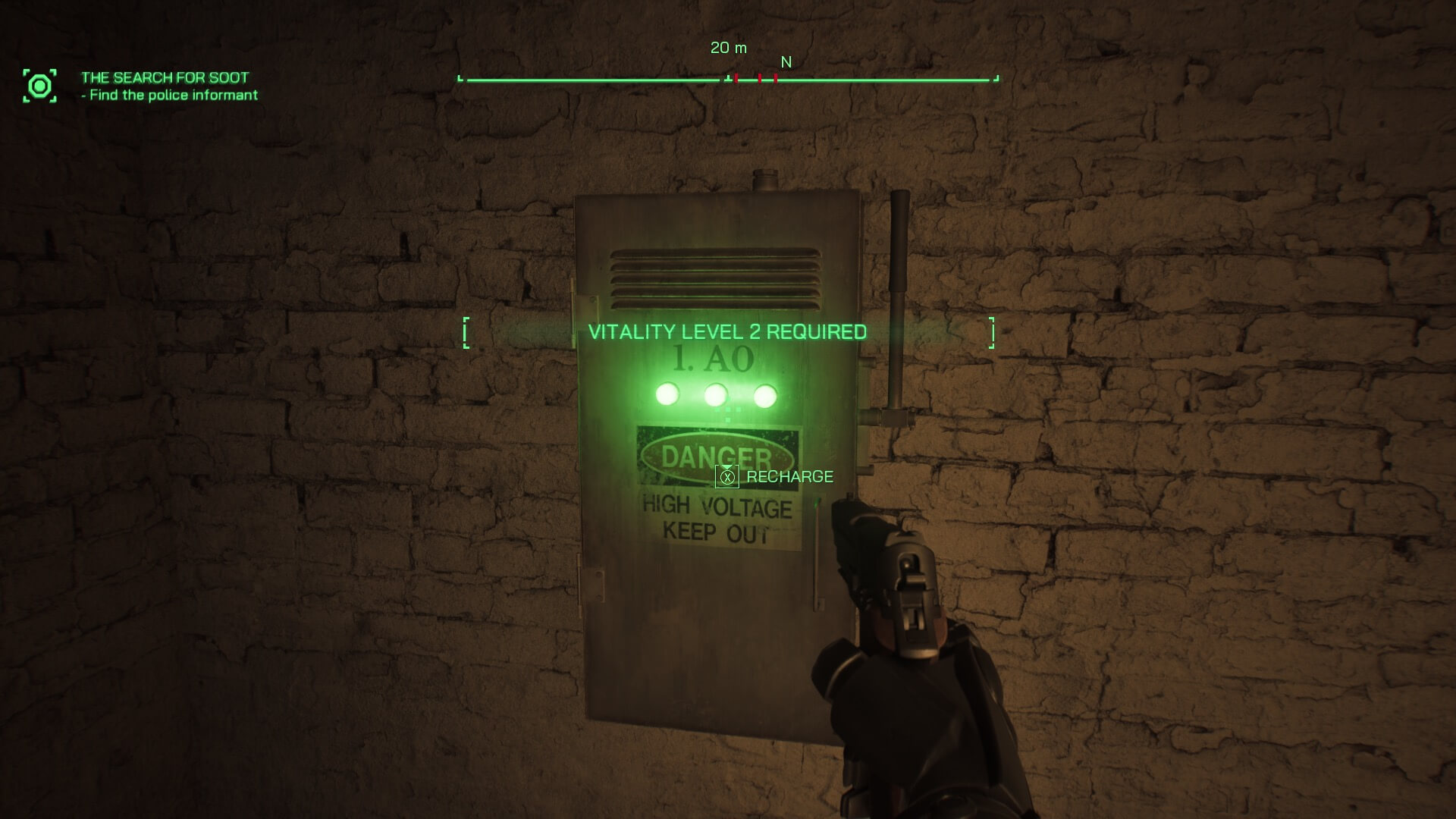
That said, spending two Skill Points to get Fuse Boxes Recovery allows you to refill RoboCop’s health at fuse boxes, and there are quite a few of them throughout the early game missions. I wouldn’t necessarily buy Fuse Boxes Recovery first, but it should be among the first few skills that you unlock.
- Fuse Boxes Recovery: You can use Fuse Boxes to recover up to 50% of your health. Increases the maximum number of OCP Recovery Charges to 4.
- Enhanced Fuse Boxes Recovery: Fuse Boxes recover your entire health. Increases the maximum number of OCP Recovery Charges to 5.
- Auto Regeneration: Slowly recovers up to 75% of your maximum health.
 Engineering
The Engineering Skill Tree is about dashing and cracking safes. The dash ability is nice to have a little later into the game, because you can use it to back away when you have low health. Cracking is great because there are lots of safes scattered around Old Detroit—but it’s expensive, so it’s not for the early game.
- Dash: Dash allows you to ram into enemies or quickly escape danger.
- Cracking: Allows you to open any safe without knowing the combination. You can also reprogram enemy turrets.
- Enhanced Dash: Reduced cooldown time after a dash.
From the very beginning of the game, you’ll also find safes that you can’t open, teasing you with the ability to open them at Engineering level 6. The Cracking skill is something to strive for, but it’s not the best choice in the early game, particularly because it’s so expensive.

Focus
Slow Motion is the first skill I bought, though I’d recommend you wait. I don’t entirely regret the decision, because it’s fun to slow down time and pick off enemies with headshots, but fun isn’t necessarily the smartest priority in the game.
- Slow Motion: Your reflexes allow you to see your environment in slow motion for a short time.
- Enhanced Critical Damage: Doubles your critical damage.
- Enhanced Slow Motion: Eliminating enemies in Slow Motion increases Slow Motion duration.
 Scanning
Like the Focus Skill Tree, this is a fun category but it’s not necessary. You can wait on it—unless you just want to shoot punks and bikers in interesting ways, and who am I to argue against that?
- Ricochet: Lets you hit enemies behind cover by bouncing bullets off certain spots. Activate RoboCop Vision to use.
- Instant Scanner: RoboCop Vision instantly marks every enemy in sight.
- Ricochet Split: Ricocheting bullets split and hit more enemies.
 Deduction
The Deduction Skill Tree has the best early-game skill in RoboCop: Rogue City. Spend your first two skill points to unlock Enhanced Scanning first. It lets you find hidden objects and rooms, and every one of those will get you a little bit more XP, and every bit of XP means you level up faster, and every level means more Skill Points. Start earning those early.
- Enhanced Scanning: Scanning lets you more often detect helpful information, such as a safe combination, or discover hidden objects or rooms
- Enhanced Map: Marks the locations of valuable items or data on your map.
- Enhanced Learning: Gain 30% more experience points.
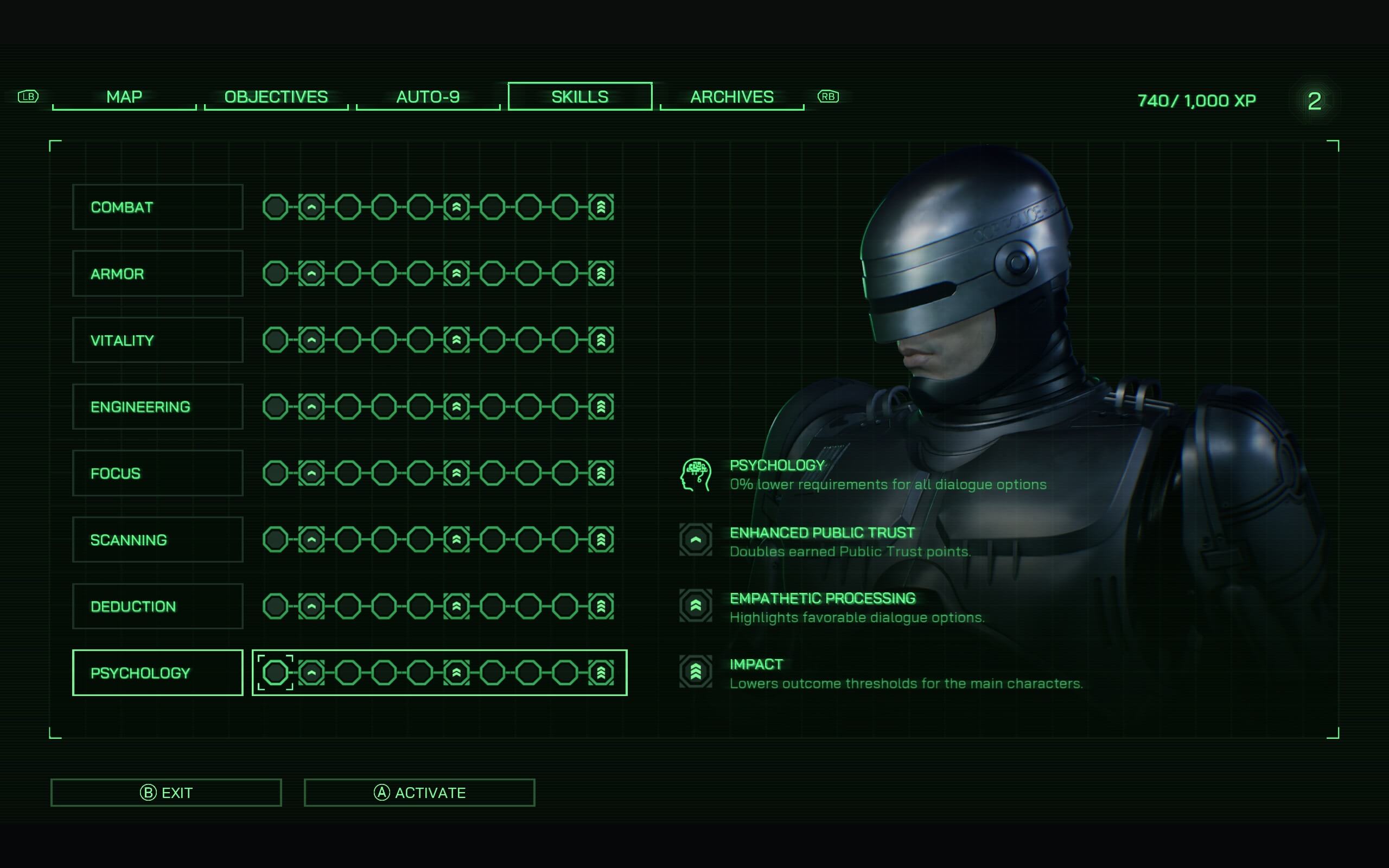 Psychology
The Psychology Skill Tree is worth an early investment. Enhanced Public Trust effectively means an easier road ahead of RoboCop in a city where people are unsure of him. It’ll also make certain parts of early missions…well, if not easier, then at least more likely to turn out in ways that a good guy would want them to.
- Enhanced Public Trust: Doubles earned Public Trust points.
- Empathetic Processing: Highlights favorable dialogue options.
- Impact: Lowers outcome thresholds for the main characters.
RoboCop: Rogue City skill recommendations
So what skills should you buy first? These are the ones I’d pick, in this order.
- Deduction > Enhanced Scanning: This lets you find things hidden throughout Old Detroit, and you’ll spend a lot of time exploring that dump. Basically everything that you find earns you a little more XP, and XP leads directly to Skill Points when you level up. You’re going to be there anyway. Might as well make some XP while you’re at it.
- Vitality > Fuse Boxes Recovery: This skill allows RoboCop to refill a portion of his health at fuse boxes, and there are a bunch of those scattered around early missions. You’ll use this. It’s not that we expect you to die a lot in the early hours of RoboCop: Rogue City, but it can’t hurt.
- Psychology > Enhanced Public Trust: You’ll spend some time early in the game walking the streets of Old Detroit and interacting with its residents. If they trust RoboCop, then your job is easier. Put differently, you’re more likely to get the outcome that you want if the people who talk to you believe you.
Those are the most practical skills to buy. But RoboCop: Rogue City is a game where enemies’ heads explode into fireworks of blood, so it’s perfectly OK to have some fun, too. If you want to mix in a little fun, then grab…
- Focus > Slow Motion: Popping your enemies’ heads off in glorious slow motion just doesn’t get old.
If becoming the best cop in Old Detroit sounds fun to you, check out RoboCop: Rogue City in the Epic Games Store.