Age of Wonders 4 delivers customization, legacy to its excellent 4X play
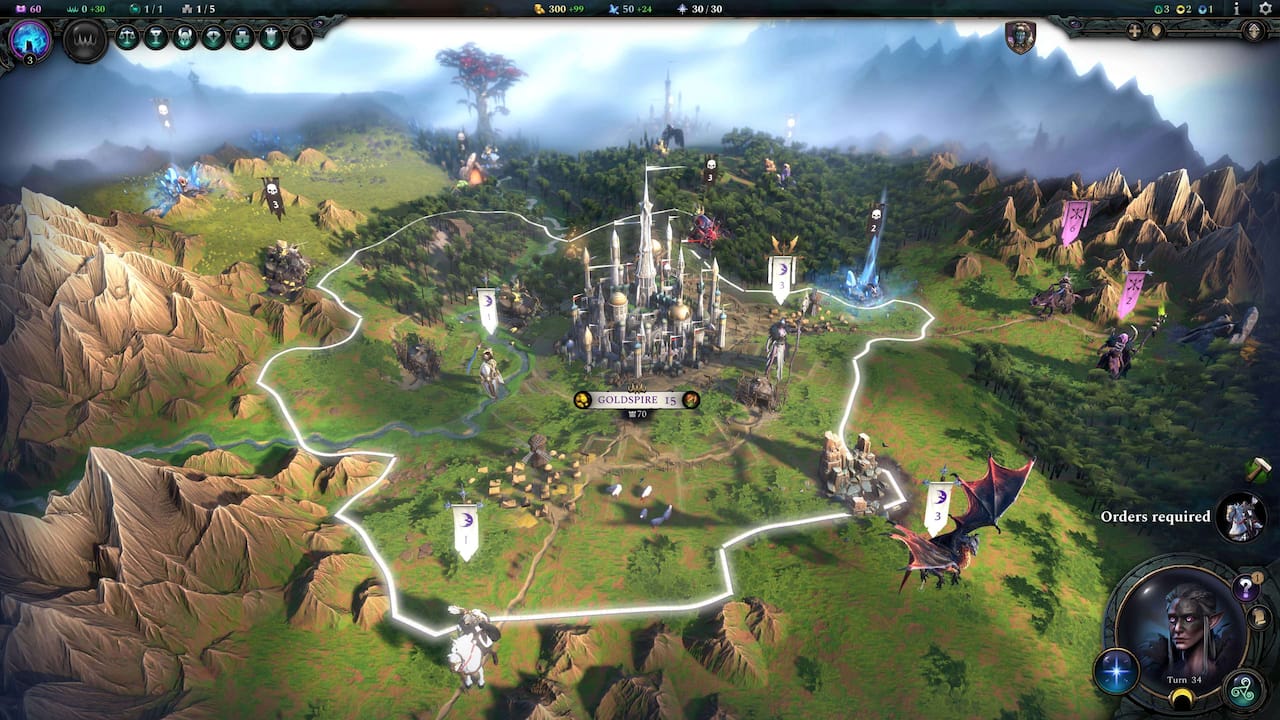
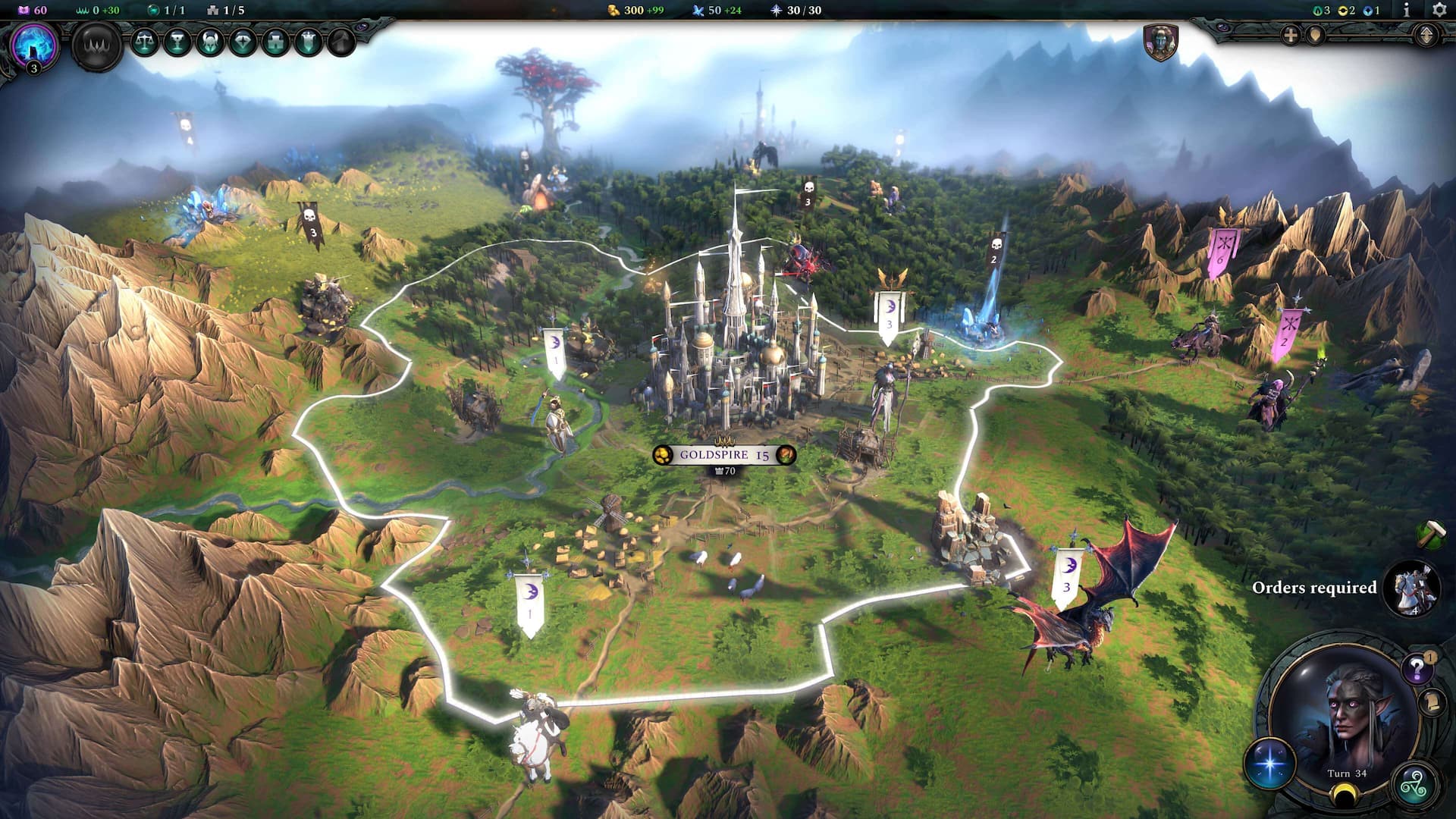
It doesn't look good for Empress Saffron Stareater.
Despite prospering early, building out three cities and an expansive empire, the Feline ruler made an enemy early in this run-through of Age of Wonders 4 and allowed a Human queen to survive an attack.
Now the Human queen and her Tigran ally had Saffron's capital surrounded.
Perhaps it's worth noting that Saffron is loosely modeled – both in physical traits and personality – after the young cat that often sleeps in my office and who occasionally sweeps by the monitor, her tail rubbing against the screen as if inspecting how her namesake is doing
The short answer: Not well. I probably tried too hard to recreate in-game – with the help of Age of Wonders' phenomenal customization options – her real-life aloofness or penchent for cuddling up to me for a few minutes only to suddenly screech and scratch me with her nails.
People, it turns out, will accept this from real cats, but fictional leaders aren’t OK with it from their in-game counterparts. Ultimately, no amount of big-eyed purring or soft-pawed posing could save Saffron from the Age of Wonders 4 encroaching hordes.
Originally launched in 1999, the Age of Wonders franchise has a dedicated following and a fascinating history in the world of turn-based strategy games.
The inaugural title started life co-developed by Triumph Studios and what was then called Epic MegaGames (now Epic Games) as World of Wonders in 1997. That was later scrapped and restarted as Age of Wonders.
Over the ensuing two decades, the franchise has managed to – if not thrive – that at least survive, never failing to deliver worthy successors to its name – each a turn-based strategy marvel that is played from an isometric view on hexagonal tiles and features units, leaders and warfare in a high fantasy setting.
The franchise would have likely died had it not been for the personal and financial support of Minecraft creator Markus "Notch" Persson. His investment helped revive the franchise after a nearly ten-year sabbatical with Age of Wonders III.
Age of Wonders 4, the sixth installment in the franchise, hits all of the high marks for a turn-based strategy game, embracing what makes the Age of Wonders titles so much fun while also injecting some intriguing tweaks to the successful formula.
 Some of that came from an unexpected diversion by developer Triumph Studios: Age of Wonders: Planetfall.
Released in 2019, Age of Wonders: Planetfall shifted the franchise from high fantasy to science fiction, a change in setting that allowed the team to experiment in ways they hadn't in the past.
"The Sci-Fi setting of Planetfall was a great opportunity to try out new directions," said Lennart Sas, the Director and Co-Founder of Triumph Studios. "Creating the setting with a post-apocalyptic galactic empire, new game mechanics like modular units, and the galactic empire meta-mode was an opportunity to experiment, and it was rewarding for the team. It was our intention to take these learnings and apply them to the main fantasy game."
One of the big takeaways, he said, was that players love agency in a 4X strategy game. "The unit modules and galactic empire mode were very well-received," Sas said. "We learned that players love to tinker with their experience, their faction, and how they play.
"We also learned that while some people loved the highly fleshed-out premade factions like Vanguard, Assembly, and Amazons, others felt 'trapped' inside them with limited ways to adapt them to their own strategies and role-playing fantasies."
Taking those learnings to heart, the team built out deep customization options for the game. Sas said that the idea started with the premise of creating your own fantasy race from a number of components: physical form, body and mind traits, and society and behavior traits. The team also decided that they didn't want to limit that customization to a simple creation mode at the beginning of the game. Instead, they wanted players to be able to evolve their custom races throughout a game.
 "We cut up the tech tree into 54 tomes of magic spread over five tiers, containing spells, unit unlocks, economy upgrades, and ways to evolve your people," he said. "At the start of the game, you only get to choose one Tome, and during the game, you get to add on many more at steady intervals, allowing you to steer the development of your empire. You can start off as barbarian wildlings and, through cryomancy and necromancy, turn them into undead ice demons that turn the world to icy death. Or you can uplift an orc tribe to be angelic beings spreading order and harmony.
"To give all the choices structure and to allow you to more easily identify rival players, we associated all choices with six magical affinities: Order, Chaos, Natural, Astral, Materium, and Shadow. Each affinity is associated with a particular gameplay style, and by looking at the points in each affinity, you get a sense of the overall capability of a faction."
 For me, that meant my first game was built around a chaotic race of anthropomorphic rats. For the second game, I dug a little deeper and created a cat race named after one of our cats, even using the game's body, mind, societal, and behavior traits to try to match Saffron's quirky real-world personality. The result made for a much more compelling (and eventually heartbreaking) game. And the likely mishmash of creations that will spring from this new system actually fits neatly into the game's lore, Sas said.
"The established lore contains Wizard King characters that created new races using their god-like powers," he said. "It also contained realms beyond the canon world of Athla. Now in Age of Wonders 4, players actually get to make new races themselves and travel to these magical realms beyond.
"For Age of Wonders 4, we expanded the game to be set in a multiverse rather than a single world. A Mount Olympus-style central hub in the Astral Sea called Magehaven allows the Wizard Kings to travel between realms. In this setting, anything goes. But ultimately, the player has control. If they want to have a world populated by just traditional fantasy races, they can make this happen. Or a swamp world populated by warring cannibal toads, that's possible too."
Another way the developers give players a greater sense of agency is what happens when a game ends.
"Age of Wonders 4 adds the Pantheon meta-system where progress is gained between games," Sas said. "In the Pantheon, you gather both your own (victorious) customized characters and unlocked story characters from campaigns. While playing, you gain Pantheon XP at the end of each game, which can be used to unlock new customization options and gameplay traits. You can even encounter characters from the Pantheon as heroes offering their aid or face them as rival wizards! As you gain levels, you also gain access to new Presence Realm Traits, which let you add challenging and unique opponents to future Realms to conquer!"
 That means, in my world, the rat race that eventually took over the land in my first game could have come to the aid or helped with the destruction of Saffron and her brood in my second.
"The Pantheon system is based on the positive reactions we got to the Galactic Empire mode from Planetfall," Sas said. "Which was added as a special game mode in a later game update. This time around, we integrated the meta-system into the core of the game. This means that it works in all game modes - whether you play custom maps, story missions, or multiplayer; all experience builds up your Pantheon."
While working to build out new ways to deliver player agency and a sense of permanence between sessions, the developers also had to ensure that a game built on a player base that stretches back more than 20 years would be both intriguing to those super fans and welcoming to new players.
 "Age of Wonders 4 is a great way to get started with the series," Sas said. "We invested in a top-notch tutorial and advice system that reacts to what the player is doing on screen. There are easy difficulties, and we suggest players start to tinker with faction customization right away—at first purely for role-playing and not worrying about potential synergies. In terms of the game's story, we are in a new cycle where you don't need any prior knowledge to enjoy the game."
Ultimately, the team at Triumph Studios saw this latest title as an opportunity to let players develop their own stories and challenges in a lush fantasy strategy sandbox. That means designing your own fantasy races, player avatars, and fantasy realms and then evolving them all during the game.
"Our goal was to make a sequel that would not only push the series forward but also add features that would bring the strategy genre forward," Sas said. "We aim to deliver a game experience that is highly personal to people and which they can play for a long time."
The game's availability on Epic Games Store marks the return of the franchise to the company that first helped get it off the ground.
"We signed with Epic in the '90s when the game was called World of Wonders and Epic operated as a shareware publisher," Sas said. "We owe a lot to folks like Tim, Mark, Jay, and Doug, our producer working with us at the time. I think very fondly of the times visiting the original Epic offices in Rockville, Maryland, and seeing Tim work day and night on the foundations of Unreal. Epic has grown a lot since then, and it's great to be back on the Epic Store."