The human horrors of Red Dead Redemption 2
There are people who claim they can divine the future from entrails. I knew what my future held when I came across a loop of intestine by the side of a road, in the Heartlands of Red Dead Redemption 2. Those intestines led me to a murder victim, and that sad death pointed me towards one of the game’s most remarkable moments: I was going to find a serial killer.
The “American Dreams” quest in Red Dead Redemption 2 is not really a mystery to be solved. Rockstar, in a brazen flex, simply hid three small crime scenes in its busy, bustling game world. Valentine’s Sheriff Malloy can put players on the killer’s trail in a more official capacity, though he provides no more than a slap on the ass and a “git going.” But most players risk uncovering the horrors simply by playing the game. Trotting across a vast wilderness, players develop a keen sense of their surroundings, spotting critters that could become lunch or a hat. Or in this case, three bodies torn, hung, and secreted off the beaten track.
Blink and you’ll miss them—or you’ll wish you had, at any rate.
I was tracking a deer when I spotted a red glint out of the corner of my eye. A human leg lay on the ground, discarded by the side of the track, surrounded by a few gristly and glimmering chunks of meat in the scrub. Carrion birds, plucking away at indistinct smears, scattered as I approached.
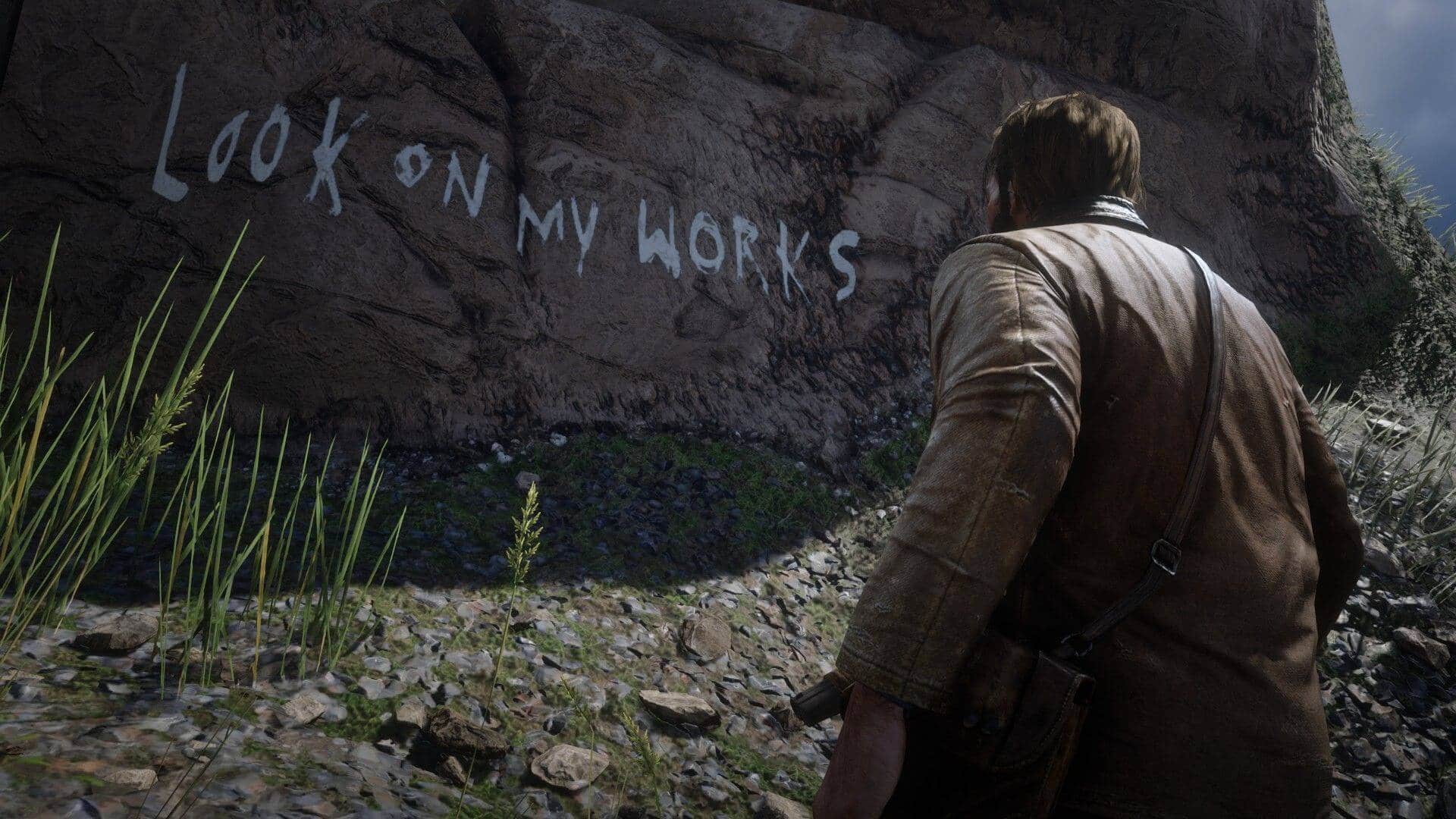
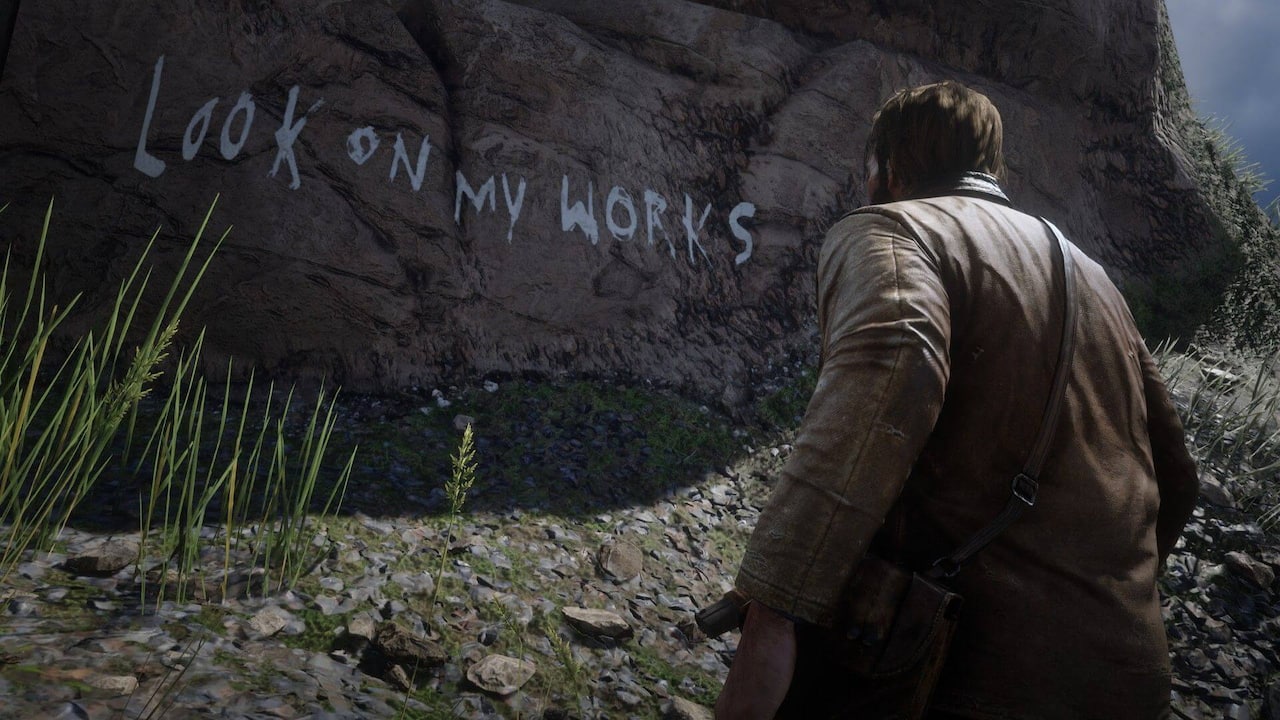
But there was nothing indistinct in what I found. Someone had scrawled “Look On My Works” in foot-high letters upon a rock. A few steps back, a head with a roll of paper in its mouth was nailed to a railway bridge. I gingerly plucked the paper from the mouth and unfurled it to reveal a section of a map. This flimsy, stained piece of paper was the only real clue I had to the killer.
It was the second body that really got to me. I can’t even remember what I was doing at the time, but I spotted another splash of red and some ugly chunks of matter on the side of the road. I hopped off my horse, Trotsky, and followed the spilled bowels like snakes in the grass.
The entrails stopped in a cluster of large boulders that seemed like a dead end—and I guess it was, for someone. “Do You See?” was scrawled across a boulder, and splayed across the rock face next to it was the remains of another victim. The lifeless arms were twisted and pulled by thin ropes, the torso barely recognizable as something that was once part of a human being.

I saw, alright. In broad daylight. It was one of those times when I wished Red Dead Redemption 2 wasn’t so darn detailed, and I spun the camera away from the hanging meat in disgust. It only shifted my focus, where I spotted a bloody splat on a smaller rock nearby. It was another head resting on a rock, another piece of the map sticking out of its mouth. Was there no end to this?
In a game where you can kill three people before your breakfast beans have started to digest, it can be hard to make the player care about death. But this was a different kind of death, and Rockstar played me like a fiddle. The killer violated his victims to an extreme extent, eviscerating them to traumatize the people who stumbled on his work. The victims were reduced to nothing more than bait and discarded offcuts. From the painted messages, it was clear the killer’s goal was to be remembered for his work. Not to be understood, nor to even deliver a message from a higher power. Just simple recognition. And he’d strip people to their bones to get it.
I was furious. Genuine anger flared inside me at the dim bulb that craved celebrity in this fashion.
I found body number three a few days later. By then, my anger had dimmed, but not quite extinguished. There was enough left to reignite the guttering flame when I spotted the pool of red in the deep south of the map, on a forked road near Rhodes.
A torso stretched between the branches of a gnarled old tree a scant few steps from the side of the road, with “Behold” scrawled on its bark. I found the final head—and the last piece of the map—on the other side of the trunk, and the location of the killer was revealed.

The completed map pointed to “Lucky’s Cabin,” a burnt-out hovel with a locked basement. The killer was revealed to be living just a short walk from Valentine, right under the crusty Sheriff’s nose. I unlocked the basement and entered.
My lantern, thankfully, struggled to cast enough light to depict the full scene—skulls on shelves, hanging body parts, handprints on the wall. More details on the killer were revealed in scrawled notes, and even a camera. The camera. The height of the technology at the time, as powerful as a gun in the wrong hands.
This was the work of Edmund Lowry Jr., a nervous shell of a man. A victim in his own right of an overbearing mother, who sent him screeds about remaining unmarried and how he needed a good woman. A man who craved being seen. He even wrote letters to the local newspaper, demanding coverage of the killings, in the guise of a concerned citizen.

Lowry was the type of monster that would eventually be profiled all across the 20th century—first by the FBI, and then in newspapers, reports, books, podcasts, and documentaries. But for now, all he had was a pissed off Arthur Morgan as an audience.
Nonetheless, Edmund got the jump, unpeeling from the shadows and knocking me out.
Edmund Lowry Jr. was also the type of man who would bore a victim to death, filling their final moments with his thoughts about pain and pleasure. Arthur, a man of practical means, manages to wake up and grab the nearest weapon—a severed head that was casually lying by the mangy mattress he’d collapsed on. That poor person at least had some measure of revenge, flooring Lowry with the ultimate headbutt.
I’ve done a lot of bad things as Arthur in Red Dead Redemption 2. I’ve answered stares with fists, drawn a gun when there was no threat, and killed dozens of people. Meeting Edmund Lowry Jr. changed my own perspective on how I played the game. Living as a thief, a bandit, someone who would turn in his own kind for coin, was the easy option when every other person I met seemed ready to draw and shoot. I’ve killed folk, shot them in the back after passing them on dirt roads. They meant no harm. Some even said hello.
But I stopped doing it after Edmund Lowry’s basement. I became less casual in how I viewed death in Red Dead Redemption 2.

There is a morality system baked into Arthur's adventures, but it went beyond bullets and body counts for me. There had to be a difference between me and the man in the basement. I had a choice in that. Killing random folk was off the table. I only drew a gun when I had to. I stopped to help people, even though it got me ambushed and beaten. I didn’t choose to play to the game’s Honor system, but even so things started to change. Dialogue options became more optimistic. Store items got cheaper. People liked me. I felt better about myself.
Edmund is one of three serial killers in Red Dead Redemption 2. Another is a killer prostitute who tries to gain your help. Her story is tragic and personal, but she’s eventually proven to be a remorseless killer. There’s also a vampire stalking the streets of Saint Denis. I’ve met them both, and ultimately been a part of their downfalls. It was the only way.
Red Dead Redemption 2 is available on the Epic Games Store.