ニュース
5 creepy pop culture references you might have missed in Thimbleweed Park
S
Sarah LeBoeuf
However, Winnick and Gilbert drew inspiration from many sources other than classic adventure games. This “whodunit” murder mystery leans heavily into pop culture references, particularly those that skew a little spooky. Some are more obvious than others, so you’d be forgiven for not catching them all. Here are five of the most prominent cultural references in Thimbleweed Park, and how they help create the vibes that make the game so atmospheric.
The truth is out there
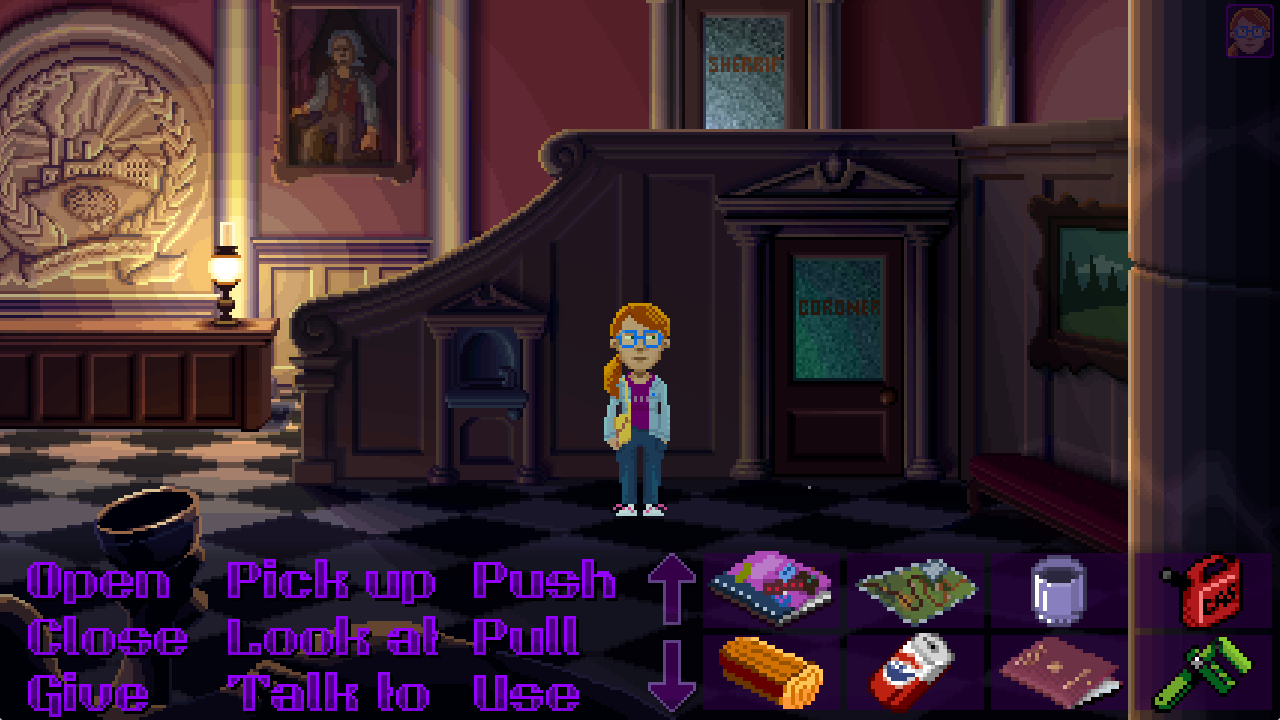
Thimbleweed Park begins with an investigative duo arriving at the titular town to look into a murder. Though they have similar names—Agent Ray and Agent Reyes—the two federal agents couldn’t be more different. Agent Ray’s fiery red hair reflects her spicy personality; she makes it clear right away that she’s there to solve the case and has no time for conspiracy theories. Reyes, a dark-haired man, is more willing to embrace the possibility of the supernatural as a result of his tragic past.

Sound familiar? It will if you were a fan of Fox’s prime-time TV lineup in the '90s and early 2000s. Reyes and Ray are a clear tribute to The X-Files’ Mulder and Scully, two fictional federal agents whose respective open-mindedness and skepticism made for witty banter and undeniable chemistry when investigating the unexplainable. Because they’re introduced in the first few minutes of Thimbleweed Park, the arrival of Mulder and—oh, sorry, Reyes and Ray—sets the tone with just a visual reference and a few lines of dialogue. From there, we know we’re in for an eerie mystery that defies the laws of man and nature.
Don’t plan it, don’t wait for it
The X-Files isn’t the only cult classic television series that inspired Thimbleweed Park. There are plenty of not-so-subtle references to the short-lived Twin Peaks, which also focuses on a federal agent investigating a murder in a small (and bizarre) town. And speaking of those towns, Twin Peaks and Thimbleweed Park share the same initials. Coincidence? Probably not.
The nods to David Lynch’s fever dream of a procedural don’t end with the game’s title. Aside from dialogue quips referencing the infamous Log Lady and a certain monologuing cherry pie enthusiast, the developers crafted the game’s playable characters with Twin Peaks-esque qualities in mind. “They’re all odd and you start to wonder if you can trust them,” Gilbert said in a 2017 interview. “Twin Peaks is very good at that.”
Don’t be a tuna head
From the very beginning, the team behind Thimbleweed Park described it as a spiritual successor to Maniac Mansion, the game that cemented Gilbert and Winnick’s reputations as masters of the point-and-click adventure. Originally released in 1987, Maniac Mansion was ahead of its time with its roster of playable characters—each with their own unique abilities—and multiple endings that unfolded based on the player’s actions. Maniac Mansion was also full of red herrings, like a chainsaw that’s perpetually out of gas, and therefore can never be used. A similar chainsaw can be found in the early chapters of Thimbleweed Park, only this time it has a more fitting name: the Chainsaw of Disappointment. And that’s just the beginning.
Several Maniac Mansion characters, including Dr. Fred and Nurse Edna, can be spotted in the audience of Ransome the Clown’s circus act. Ransome’s pet hamster appears to live in his microwave, a callback to one of gaming’s earliest controversies. But perhaps the scariest thing of all is seeing what became of Dave and Sandy, whose relationship was the driving force behind Maniac Mansion’s premise. Those kids are still together, even running their own diner in Thimbleweed Park, but they’re hardly the epitome of successful entrepreneurship. The diner is filthy, neither of them appears to be particularly happy, and Sandy constantly throws sly insults at Dave. This is the thanks he gets for rescuing his girlfriend from a brain-stealing meteor?
We all float down here
Let’s get back to Ransome for a moment. As clowns go, he’s not a particularly charming one; he’s bitter, curmudgeonly, and has a fouler mouth than a sailor with periodontitis. He once drew massive crowds to the Stupendous Brothers Traveling Circus, but those days are long over. By the time Reyes and Ray stumble over the first dead body in Thimbleweed Park, Ransome is living in a trailer in the abandoned circus grounds. Thanks to a decades-old curse, he can’t remove his clown makeup…ever.

Clowns are unsettling enough on their own, but the red balloon Ransome is constantly clutching in his fist kicks the creepy factor up several notches. It’s a clear reference to Pennywise, the terrifying, otherworldly, shapeshifting clown from Stephen King’s novel It (and its various screen adaptations). Winnick seemingly confirmed that inspiration when he described Thimbleweed Park as “a send-off of Twin Peaks and The X-Files, with some True Detective and a dash of Stephen King thrown in.” No wonder Ransome becomes an early suspect in the ongoing murder mystery.
I’m afraid I can’t let you do that
This is where things start to get spoiler-y, so proceed with caution if you haven’t played the game yet. Near the end of Thimbleweed Park, aspiring game designer Delores faces off against a digitized version of her Uncle Chuck. Chuck’s uploaded his consciousness to a computer in order to become an immortal, all-knowing human/AI hybrid. Unfortunately for him, Delores realizes she can shut the whole thing down by removing the computer’s vacuum tubes.
As Uncle Chuck shuts down, he pivots from mocking Delores to singing “Daisy Bell,” an 1892 bop about lovers on a bicycle built for two. Chuck’s pitiful warbling signifies that he’s being shut down, which is exactly what happens to the evil AI HAL 9000 in the seminal sci-fi flick 2001: A Space Odyssey. There’s a sadness to the song as both HAL and Chuck realize their time is coming to an end despite their apparent victories over technology and mortality. This is darkly ironic, considering that “Daisy Bell” was the first song ever sung by a computer way back at Bell Laboratories in 1961.
You can play Thimbleweed Park now on the Epic Games Store.