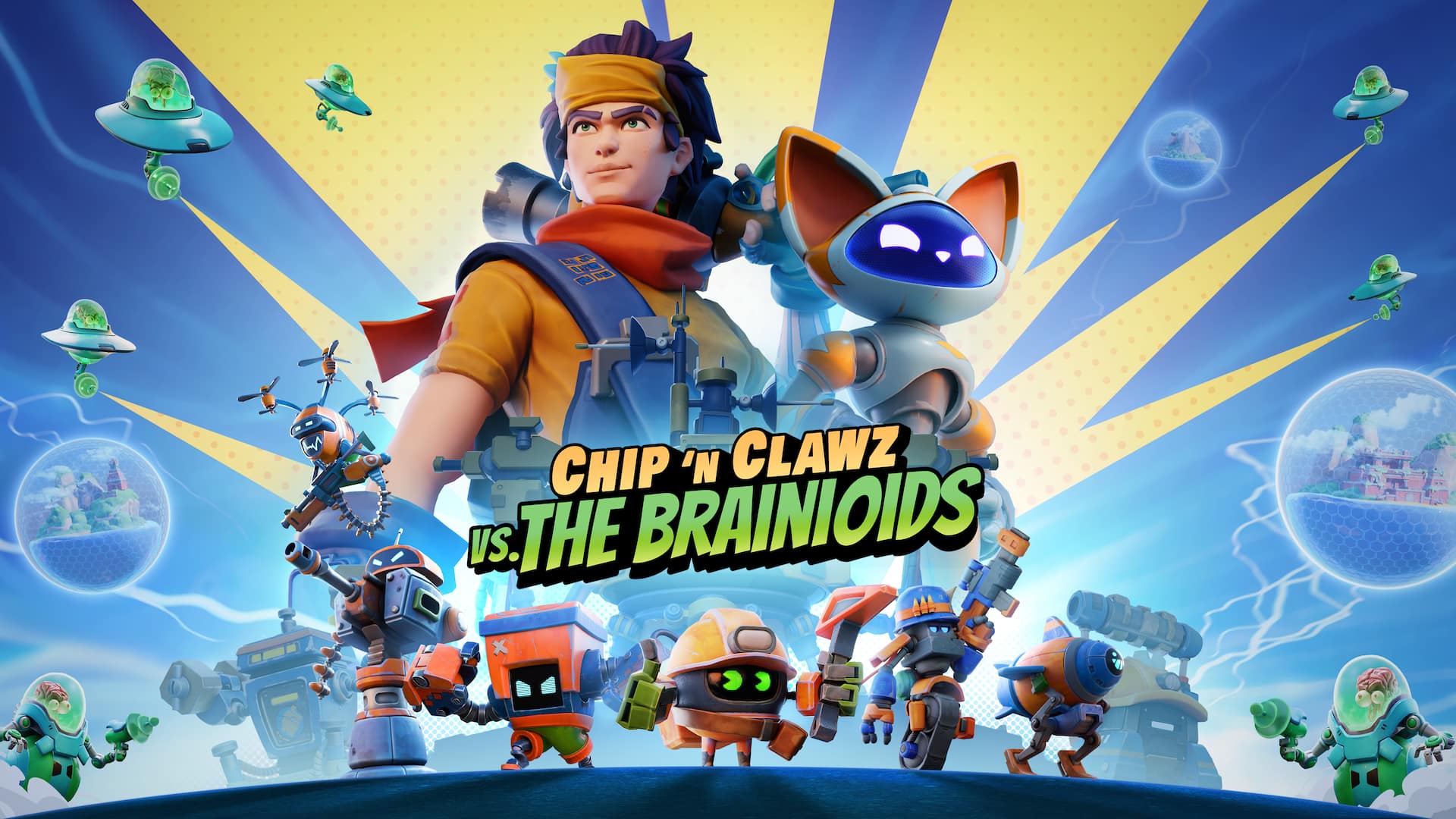
Chip 'n Clawz vs. The Brainioids: Squishy RTS action from the mastermind behind XCOM
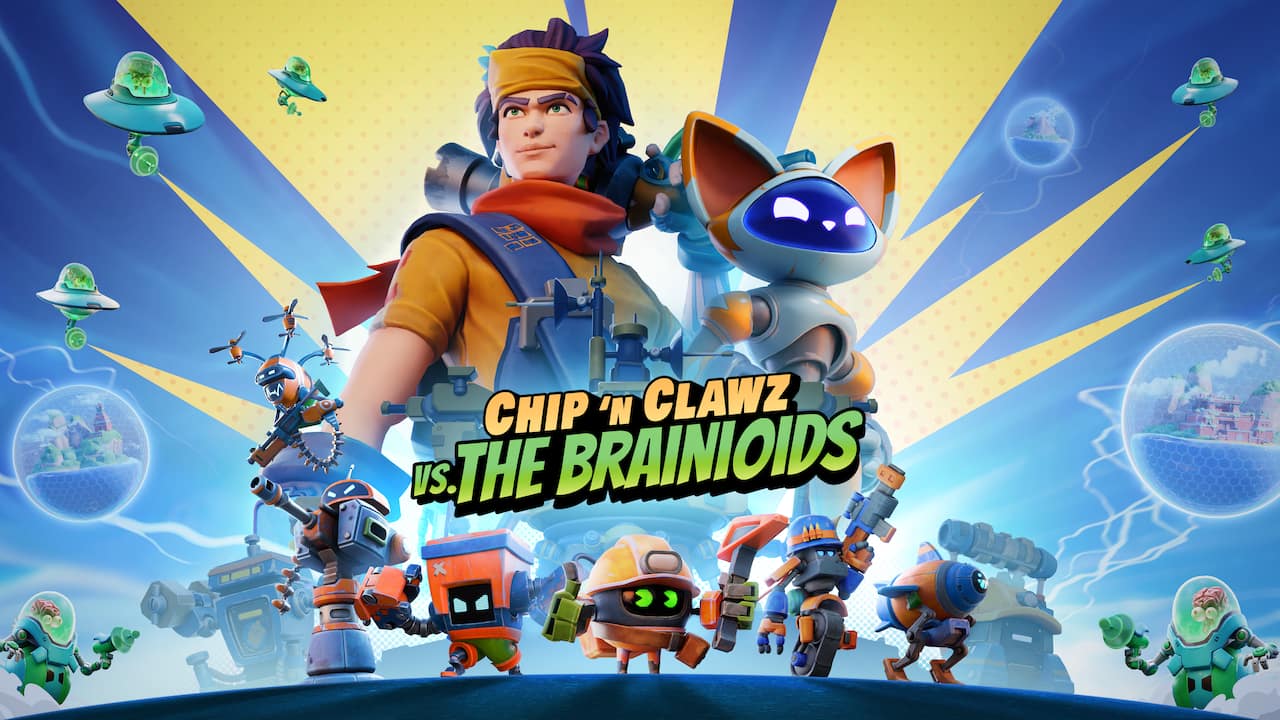
What Julian Gollop doesn’t know about strategy games would fit on the 48-kilobyte cassettes that stored his very first ZX Spectrum titles (a.k.a the Timex Sinclair 2068 in the US) in 1984. The original XCOM, Magic and Mayhem, and Chaos Reborn are just a few highlights from the 40-year career that has ensued since then, utterly devoted to the genre. Even when he directed Assassin's Creed III: Liberation, he couldn’t resist adding base-building to lend a more tactical edge to the series’ PvP multiplayer backstabbing.
In his latest RTS venture at the helm of Snapshot Games, Chip 'n Clawz vs. The Brainioids, we’re back battling aliens. Only this time, instead of XCOM’s desperate rebellion against enemies unknown, we’re exchanging laser blasts with a horde of heavily armed brains in jars—both easily shattered and easily squished to enjoyably squelchy effect.
“There's just way too many post-apocalyptic, zombie-pandemic, death-eating monster games around,” Gollop chuckles as he describes that tonal shift from depressing warmongering to gleeful action strategy. “It's time for something a little bit different.”
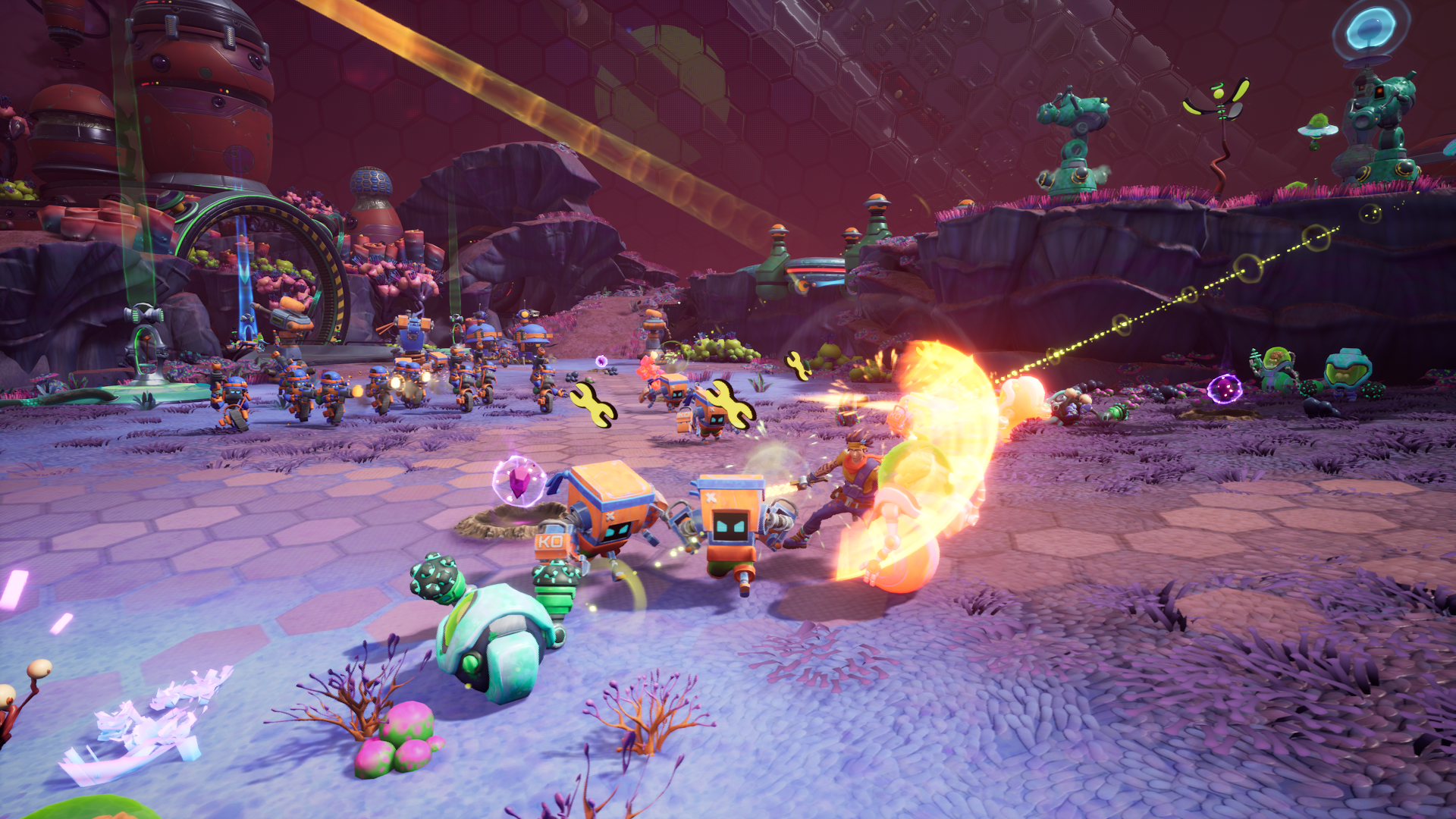
One of those differences is how you primarily play Chip ‘n Clawz in third-person, either as Chip, the laser-sword-wielding inventor, or his robot-cat sharpshooter creation Clawz. In a cross between Pikmin and platformers, you’re also an active participant in the frontline besides customary RTS base-building, unit management, and resource collecting.
When buildings come under attack, you can help clear them with Chip’s melee attacks, pepper them with projectiles from Clawz’s pistol from the safety of the sky with his jetpack, or, even better, scatter them like Skittles in a bowling alley from behind the wheel of Chip’s hoverbike.
Gollop calls his approach “immersive strategy.” You get third-person action and shooting, exciting traversal options, and vibrant overworlds that wouldn’t look out of place in Astro Bot. But alongside that, you have the usual RTS concerns like map control, unit placement, resource allocation, and defense of strategic chokepoints. Maps are compact. There’s no fog of war to obscure enemy activity, and battle commences quickly. “It's all about countering, counteracting what the other player can do, and quick responses,” explains Gollop.
None of this high-level strategizing could happen without Command View. The press of a button takes you to the kind of top-down view more traditionally associated with the RTS genre. Here you survey the full battleground, enemy unit movement, and building positions before placing beacons to direct your specialized units into optimal placements.
Now that your orders are in place, with another press of a button, you’re back in third-person mode, watching artillery rockets fire upon well-guarded enemy buildings and troops of your boxer units marching forward to intercept advancing enemies. Flying robot-copters, ranged gunbots, and turrets are all available too, with numerous upgrade blueprints available to improve their raw output (like increasing the number of units that one building generates) or to make them stronger, tougher, or better suited for their individual roles across the campaign.
It’s a minimalist unit range by design. For Gollop, the time economy is crucial, especially when your building placement is dictated by third-person traversal rather than the gliding sweep of a mouse cursor. “The player has to be able to make these decisions quickly without fiddling around with trying to learn too much complex interface stuff,” he says. “Because of the slightly more frenetic nature of the game, you have to be able to make decisions and implement them quickly.”
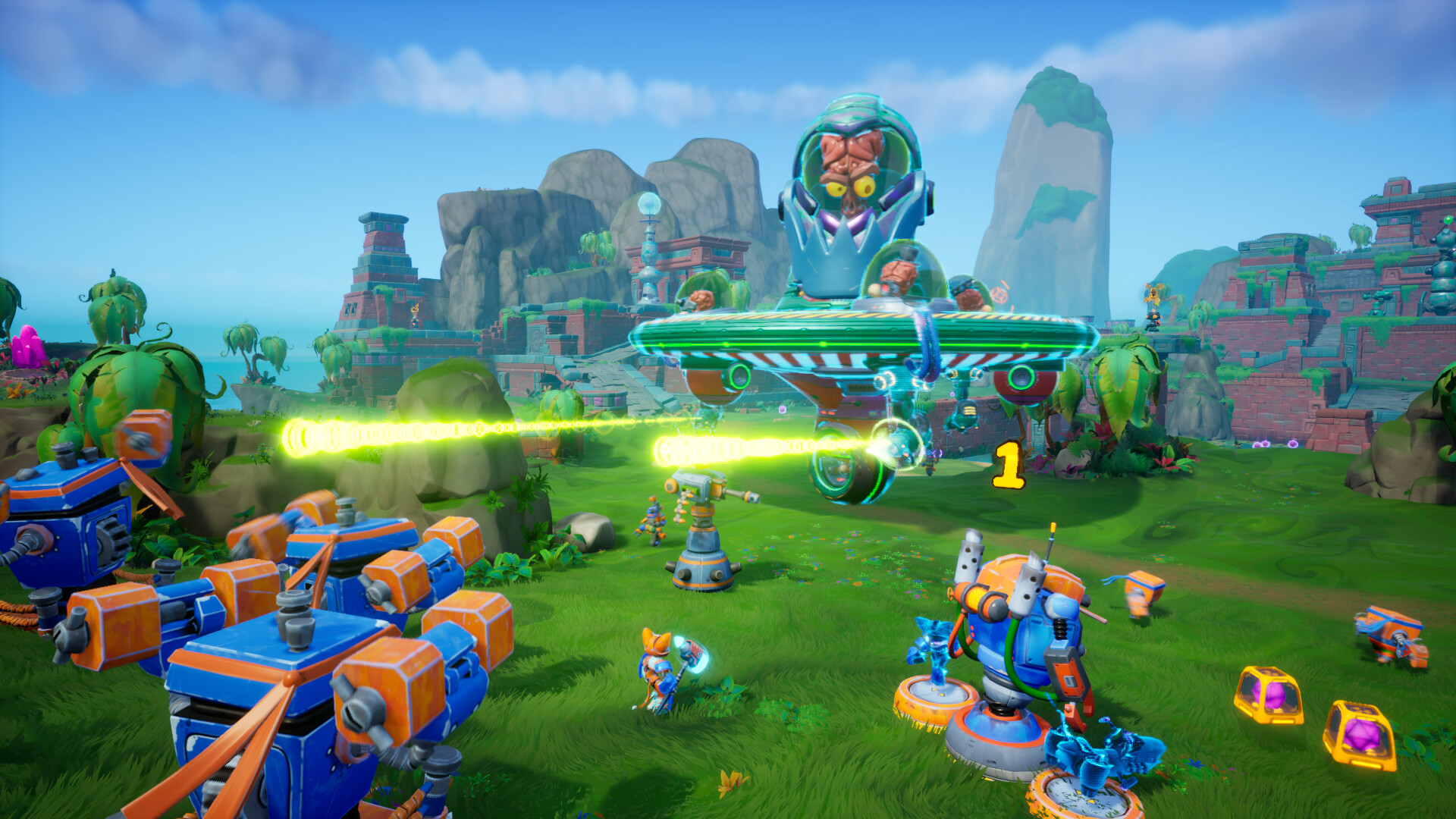
Your units will need active management. Your flying robots can roam anywhere on the map, but are easily gunned down by ranged artillery. And your artillery, adorable rocket launchers on tottering legs, will raze buildings to ruins but are defenseless against opposing units without an escort of either yourself or melee-specialist boxer troops.
A sizeable campaign boasts strong puzzle elements that make the most of the traversal options, puzzles, tower defense, challenge levels, and collectible upgrades—plus boss battles against a memorable cast of threatening yet blundering alien generals, including one who believes he’s a military genius when, in actuality, he’s a mere middle manager whose self-delusion has a hint of Futurama’s Zapp Brannigan, possessing a confidence as unshakeable as it is entirely unjustified.
In PvP mode, where you play as either Chip and Clawz or the Brainioids, maps prioritize fairness with symmetrical layouts for 1v1 or 2v2 battles. Gollop hints at some devious special ingredients, like how certain areas are only accessible with mobility upgrades or how one map modeled after Quake introduces a dangerous risk of falling off the edge of the map.
Alongside the faster pace of enemy engagements (battles last between five to 10 minutes), the biggest shake-up comes in the form of the Panic Button comeback mechanic. In an emergency, you can hit it to repel invaders, gain resources, and speed up building production. But there’s one hitch: Your HQ is now a ticking time bomb. Secure a victory before the timer runs out or you lose. Gollop is pleased by how the mechanic intensifies Chip ‘n Clawz’s already hectic battles into a dramatic finale, one to match the most depraved endgame scheme by a Bond supervillain. “It works really well, and helps stop the game resulting in stalemates or long drawn out battles,” he says.
Gollop felt strongly motivated to add co-op features for the campaign as well as PvP, something he felt was missing from the RTS landscape. Co-op RTS campaigns have traditionally been isolated affairs, played online from separate locations or over a LAN where players share the same room but stare at different screens. After greatly enjoying playing the Lego games, It Takes Two, and Minecraft co-op with his kids, he insisted on couch co-op being an option for Chip ‘n Clawz, hence the introduction of the game’s titular double act and their highly distinct abilities.
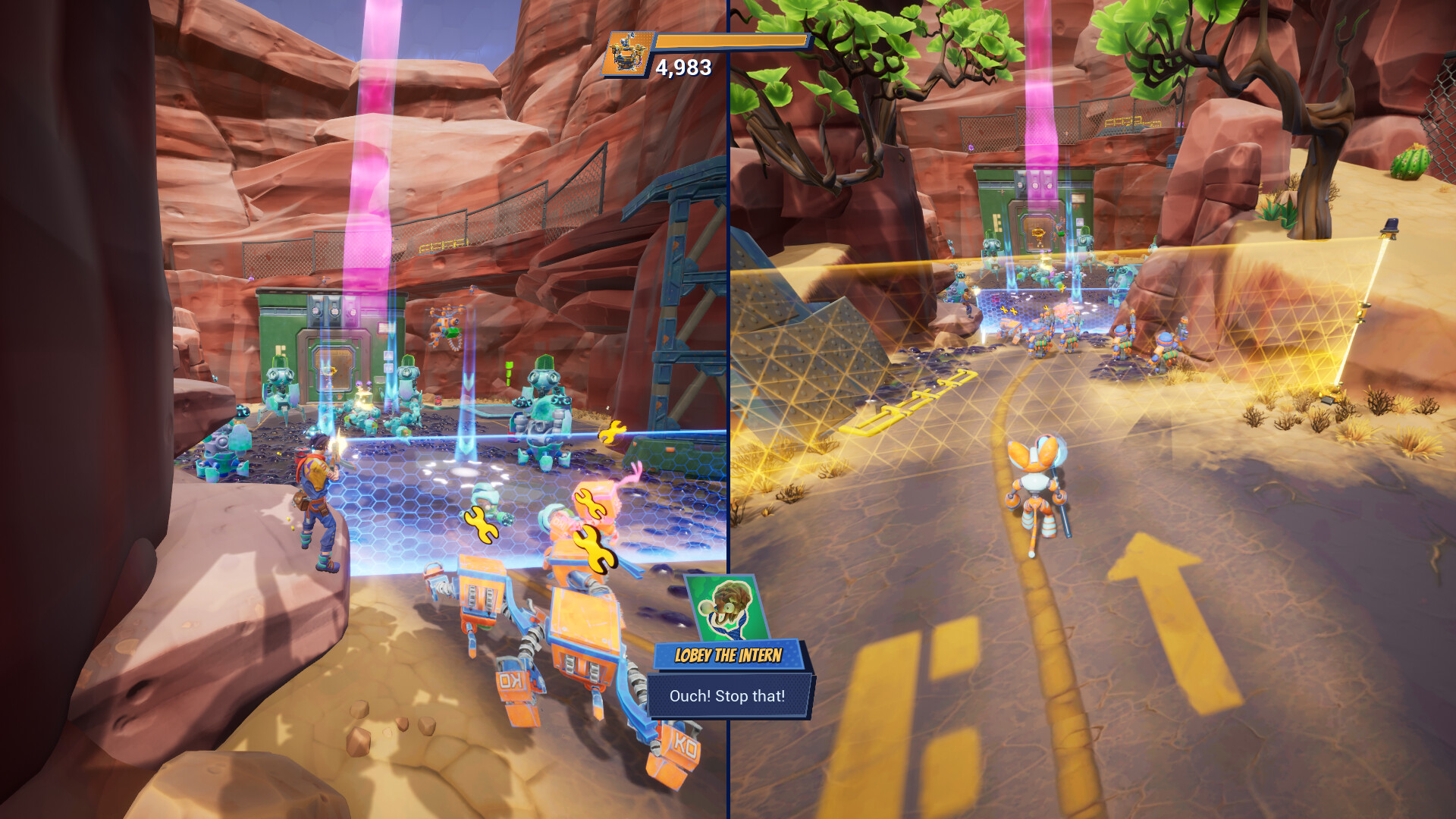
The idea took some refinement. Sharing Brainium, the essential building resource collected by miner units, had to be swiftly discarded due to several pain points. Arguments over which player builds which buildings could often lead to frustration, and quicker-thinking players tended to hog all the resources. Approaching release, those kinks have been ironed out, partly with the help of the kids who inspired co-op's inclusion to begin with. “They've been very useful in finding bugs, believe it or not!” says Gollop.
His kids’ influence runs deep. While Tim Burton’s 1996 oddball sci-fi cult classic Mars Attacks! is clearly present in the game’s schlocky, B-movie vibes and broad comedy, it also takes cues from David Solomons’ childrens’ books My Brother Is a Superhero and My Arch-Enemy Is a Brain in a Jar, once-favored bedtime reading for the Gollop household. He’s fond of these works’ satirical edge, which he emulates with the Brainioid’s haphazard bureaucracy stuffed with sycophants.
These preposterous antagonists are the perfect subject matter and a callback to the farcical comedy that the RTS genre once excelled in with the Command & Conquer series, among others. “The Brainioids are unpleasant; you have to deal with them, but they're also a bit ridiculous,” says Gollop. “And sometimes their brains will pop out of their little robot suits and you can squish them for interesting effects,” with a memorably gross sound effect to complement their in-game buffs.
Despite the enduring affection many players have for the genre, Gollop has the impression that RTS hasn’t significantly evolved since the 2000s. The latest RTS titles are often throwbacks to bygone glory days; “I don't know how far you can go with that, but I'm glad they’re still being made,” he says. However the action-strategy hybrid approach, as found in Chip ‘n Clawz and Capcom’s Kunitsu-Gami: Path of the Goddess last year, indicates a promising direction for the genre to harvest a crucial resource for its own survival: new players.
“I do want to see more games in this style,” says Gollop. “I think it does help reach a wider audience because these games can work very well on consoles, whereas before, RTS had become a bit of a PC ghetto.”
With crossplay multiplayer available from launch, Gollop firmly has that audience in his laser-blaster’s sights.
Chip 'n Clawz vs. The Brainioids is coming soon to the Epic Games Store.