Tin tức
ChromaGun 2: Dye Hard: the first-person puzzler looking to achieve the impossible
F
Francisco Dominguez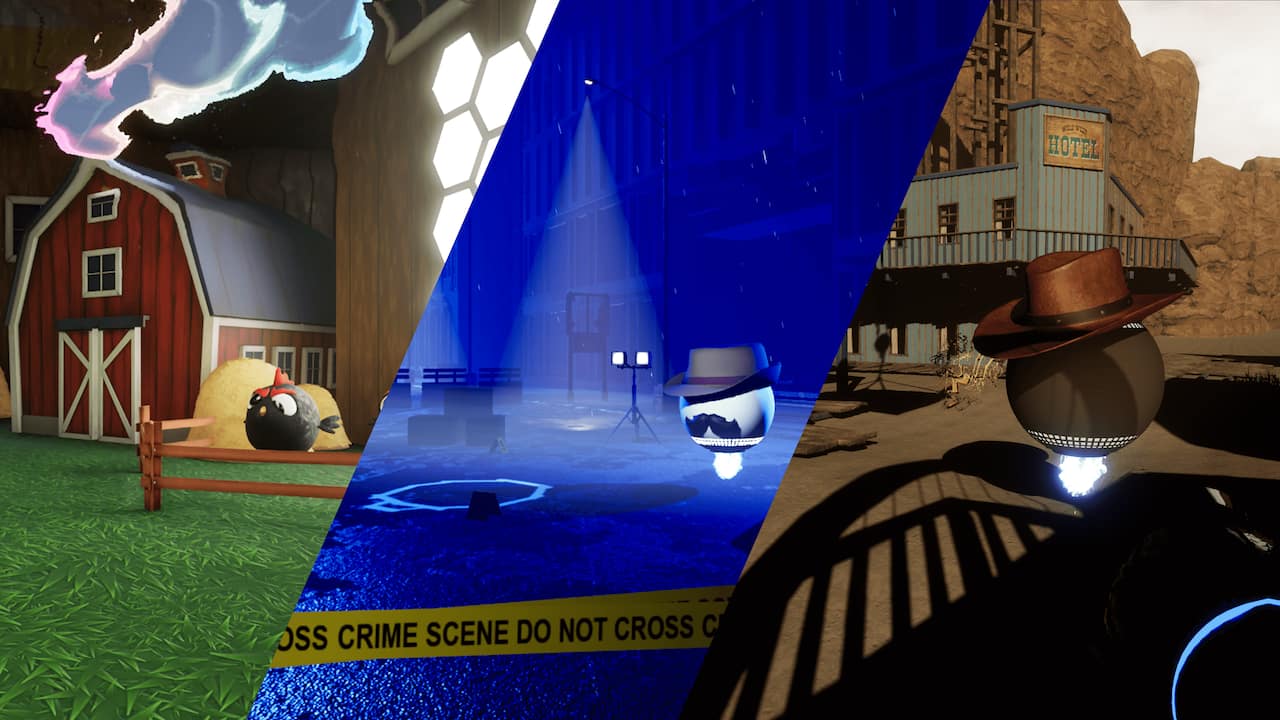
“It's really hard to be in the category of a series that invented and perfected a genre within two games. That sucks for us!” laughs Creative Director Steve Crouse, who joined Pixel Maniacs CEO Benjamin Lochmann for an interview with Epic Games Store.
Reinventing color theory
The team’s done a fine job distinguishing themselves with their invention of Magnetoid Chromatism, the surreal color-based physics system we got to try for ourselves in our Summer Game Fest demo. Your gun shoots magnetic paint, and enemies and objects you daub in new pigmentation are irresistibly dragged towards walls you paint in the corresponding color.
“We felt like magnets are cool, colors are cool. Let's make the two the same thing,” says Crouse. But reinventing the color wheel proved to be harder than it sounds.
We all learn color theory in primary school, but that knowledge often joins crayon drawing and the multiplication table as skills that get forgotten before graduation. Game developers are exceptions, using color as a tool to guide players, define mood, and establish a core aesthetic. Crouse says many players forget which colors combine to create purple or orange (red and blue, in case you forgot too). That’s a surprising problem within the confines of ChromaGun’s chambers because color-mixing is a core mechanic, although one that's easily fixed with a color-wheel available on command in the pause menu.
Taking color from scenery into a gameplay mechanic rather than set dressing also limits how the team could decorate their levels. When the color red now has an important meaning, you can’t use it liberally elsewhere. This limitation resulted in the first ChromaGun’s comparatively bland white stages—since then, they’ve learned to bend the rules without confusing players by exploiting muted saturation effects and the strange psychological exceptions that come from players’ visual processing.
“Certain things don't register as colors in people’s brains," says Crouse. “Plants aren’t necessarily thought of as ‘green,’ which is good for us. Like how people don't think of jeans as ‘blue’, which is weird because they are blue! People don't see wood as brown or orange. That's just wood!”
Accessibility takes on special importance in this kind of game, and when you consider that 4.5% of the global population is estimated to have color blindness, that’s a lot of players to risk leaving behind. Fortunately there was a solution: a color blind mode which superimposes symbols on painted surfaces, a decision which won them the Horizon Award for Technical Innovation at GG Bavaria 2025.
A multiverse of puzzles
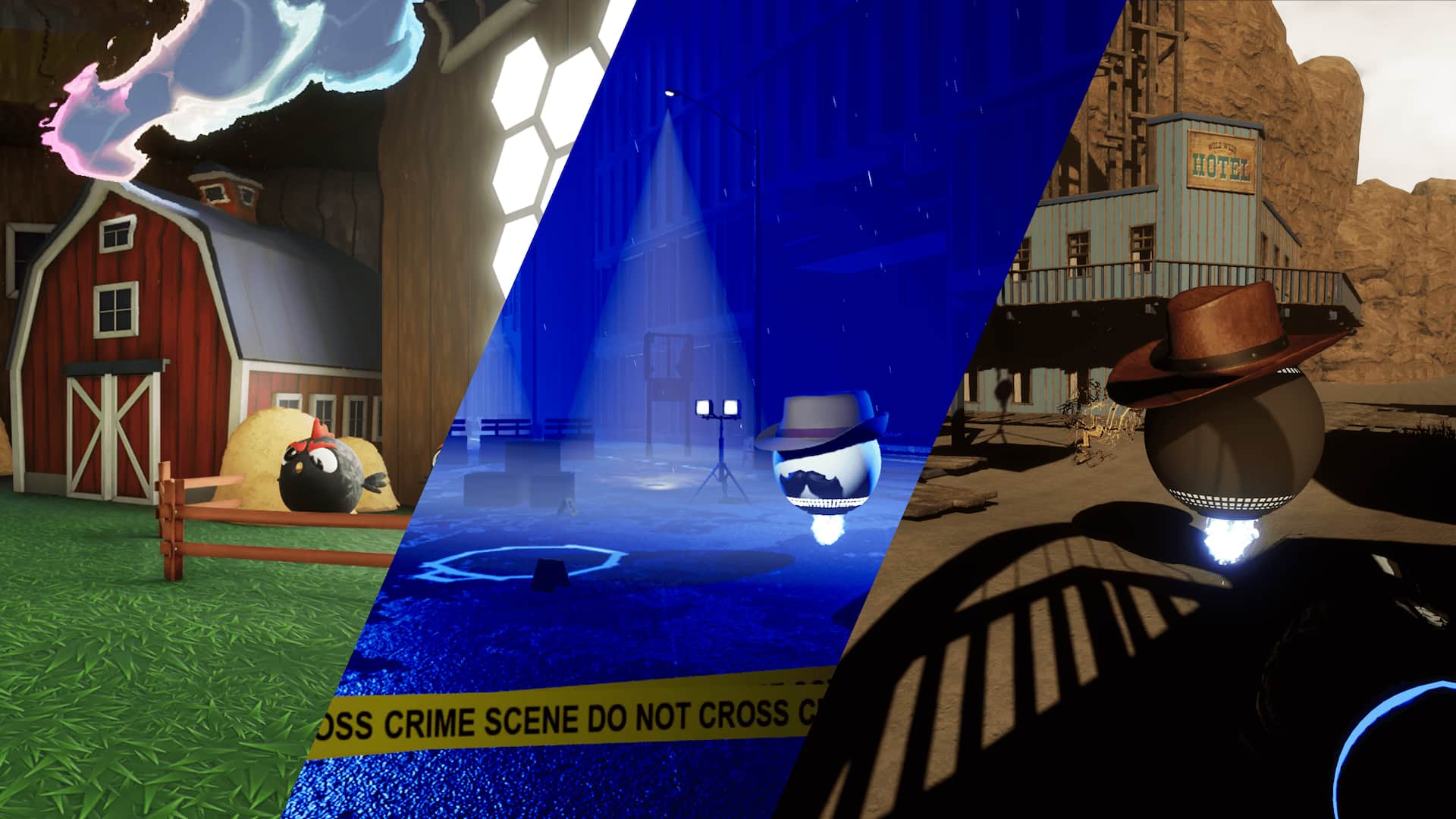
Not content with a decade of enhanced knowledge and technology, ChromaGun 2 has entered the multiverse in a bid to shake up the formula. “We found if you have the mechanics down at a fundamental level, one of the weirdest things you can do isn’t changing how the mechanics work, but how they look,” explains Crouse.
Everything Everywhere All At Once took viewers to bewilderingly off-kilter universes where people’s fingers are replaced with floppy hot dogs, and ChromaGun 2 aims to destabilize what players think they know in similarly audacious fashion. In one universe, the deadly droids players have become used to circumnavigating are now replaced with equally deadly chickens. It’s a cunning and genuinely hilarious way to put players in a state of cognitive overload.
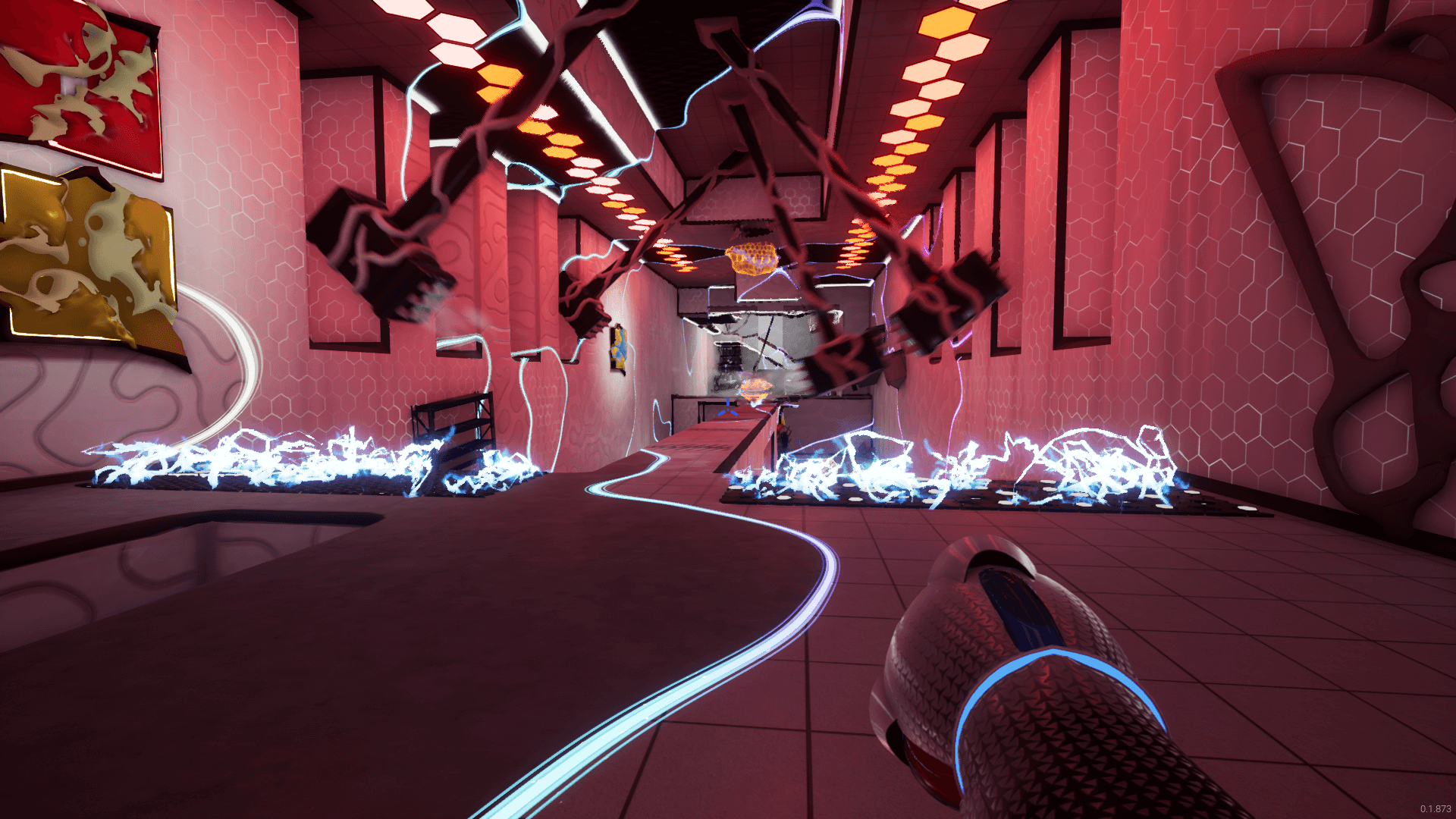
The ample possibilities extend far beyond poultry. While shy about giving away crucial details, Pixel Maniacs have plotted out universes where physics works completely differently to reality, and where colors stop working the way they should. But they always respect the necessary constraints of a puzzle game.
“We had to find a balance between what we wanted to do, which is having the craziest multiverse experience in the world where everything looks different all the time, and just having two different universes,” says Crouse. It’s not just about maintaining enough consistency and readability so players can focus on the puzzles that really matter; if everything is different all the time, the experience loses its impact as entire universes flicker past in a rapid blur.
The entire team gets involved in level design, enjoying the complex geometry they can produce with Unreal Engine compared to the original, whose maps were composed of straight lines and rigid angles. Thanks to their combined efforts, the levels themselves establish their own kind of multiverse. Left to their own devices, following only the dialogue beats from Crouse’s script, he’s been regularly surprised by what they produce within the game’s mechanics: an eclectic mix of personalities and sensibilities.
Lochmann observes that the old cliches proved true: With the systematic mindset and complex logical pathways clearly seen in their levels, programmers really do think differently to artists. “At first I didn't really know which levels were made by which colleagues, but after some time you could tell because they had their own signature,” he says.
Creating head-scratching moments
As a technique to convey the chaotic jumble of the multiverse, the decision is pure brilliance. As a method to guarantee a considered difficulty arc that ebbs and flows from one chamber to the next, however, the method had its flaws. In particular, puzzle games demand aggressive iteration to smooth out headache-inducing difficulty spikes—something the team takes great pains to avoid.
Clever touches like a decoy that was just that little bit too convincing at misleading players had to be treated with care. “That just felt unrewarding,” says Crouse. “It felt like the game was leading you on and sticking out its tongue at you.” In the end, after a huge ongoing playtesting effort, only two levels had to be discarded entirely, thanks to the experience of a team that mostly carried over from the original ChromaGun.
The question of difficulty may perhaps be the hardest puzzle of all. Portal’s secret was that it was never really that difficult; Valve left the truly devious creations for players to upload to Steam Workshop. The joy of Portal was letting yourself be guided into an epiphany that made you feel clever. ChromaGun 2 intends to make players work harder for those gratifying moments where everything clicks.
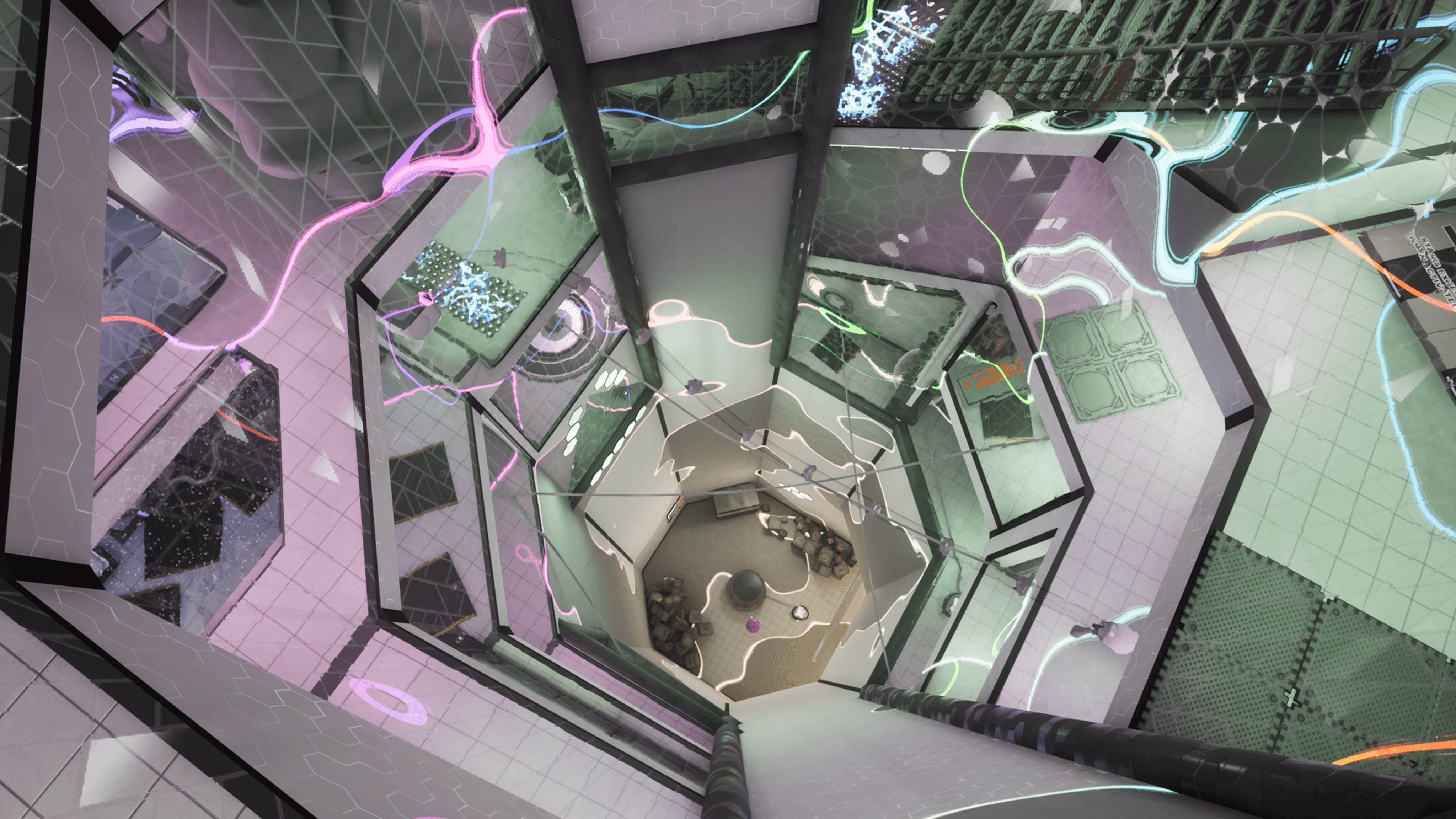
“We wanted it to come to a point where you scratch your head and you go ‘I have no idea what to do!’ …You need to turn around and look at it from a different angle, then you see it was right there the whole time,” says Crouse, adding that he's seen this work in playtests. On later levels, players will often take 30 minutes before reaching an epiphany for a puzzle solution that takes all of 15 seconds to complete.
The psychopathic robot in the room
Over a decade since Portal 2, the shadow the series casts over first-person puzzlers looms unfairly large. When the first Portal came out in 2007, it became an instant classic. Little has rivalled it except its own successor. The power of nostalgia has only grown, coming up to two decades since the original game, which gives teams like Pixel Maniacs a problem.
“It's weird. We've noticed certain games become genres instantly. Vampire Survivors, Rogue became roguelikes. First-person puzzlers are still considered Portal knockoffs, not Portal-likes!” says Crouse, who feels ChromaGun 2’s multiverse angle and the variety that comes with it helps set their game further apart.
The comparison may be unavoidable, but it has its perks. For one, it’s a compliment to the team’s evolution; Lochmann explains they evolved from a mobile game developer producing entire games in a single day to one making high-production efforts comparable to gaming all-timers. Just watch the trailer to see how far they’ve come!
Secondly, they’ve noticed whenever they go to trade-shows like Gamescom or PAX demoing the game, players stop in their tracks. Their interest is piqued precisely because its clinical environs and paint-splattered chambers bear a resemblance to Portal. An audience that’s been long starved for attention might finally get a long overdue fix.
They’re not looking to dethrone Portal with the help of a magnetic paint-gun, but with a decade of experience under their belt, Pixel Maniacs are confident they know exactly how to deliver the first-person puzzler players have been waiting for.
Wishlist ChromaGun 2: Dye Hard on Epic Games Store today. It releases on February 12, 2026.