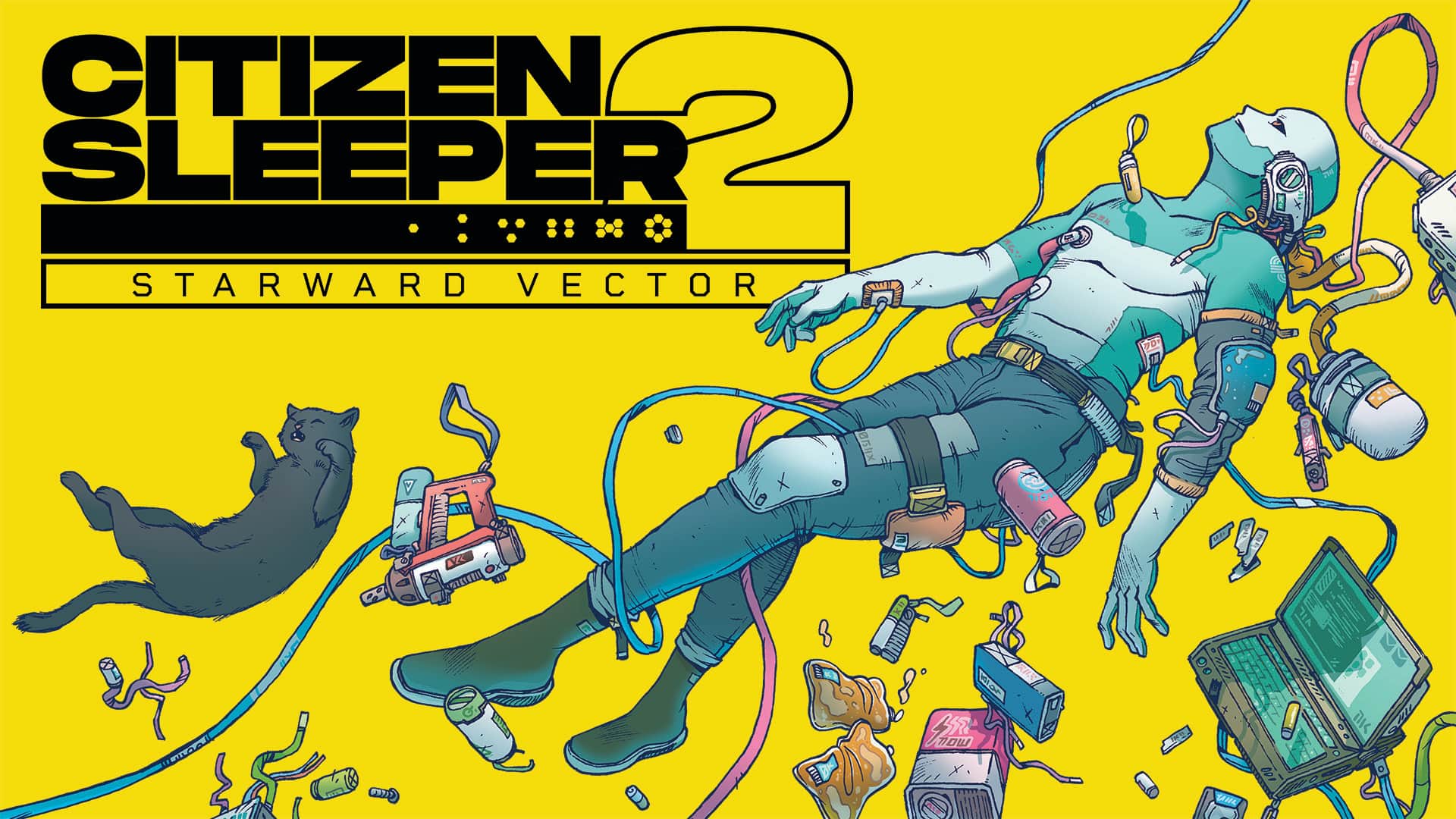
Stress will tear you apart in Citizen Sleeper 2: Starward Vector
Do androids dream of escaping the gig economy?
That unlikely question made Citizen Sleeper one of 2022’s most fascinating RPGs. Playing a Sleeper—an android emulating human consciousness—you flee the corporation that created you for unending labor, scraping together a disjointed living on the space station Erlin’s Eye. Hard-won freedom came at a (literal) cost, as you fended off recapture and your own planned obsolescence in a race against time, your dwindling cryptocurrency stores, and an ever-depleting supply of Stabilizer that staved off terminal malfunction.
In the upcoming sequel Citizen Sleeper 2: Starward Vector, you play as a new Sleeper whose interrupted reboot procedure left them as bewildered as any amnesiac, exploring another scattered pocket of civilization in the furthest reaches of the Starward Belt. And precarity, the overriding theme, is embedded in every one of Citizen Sleeper 2's systems—more than ever before.
Fighting combat
Citizen Sleeper's creator, solo-dev Gareth Damian Martin, knows there’s more to tabletop roleplaying games (TTRPGs) than Dungeons & Dragons. They wanted to move away from familiar conventions of Wizards of the Coast’s immensely popular system (especially its reliance on combat) and draw from games that are more overlooked. Fantasy TTRPG system Blades in the Dark, for instance, doesn’t separate combat out from everything else. All actions use the same dice, whether infiltrating a mansion, negotiating with a drunkard, or slitting a bandit’s throat.
“It really opens up games. I don't think people realize how combat-focused games force game designers to tell combat-focused stories,” says Damian Martin. “If you have a combat system, it's almost inherent there must be combat during quests, whether or not that's the story the narrative designer wants to tell! If you have a system that can represent any action through dice, then you can have loads of different kinds of questions.”

Citizen Sleeper follows in that spirit. Each Cycle spawns a new set of six-sided dice rolls, tools to deploy when advancing objectives. Pre-generated dice rolls don't free players from the drama and uncertainty you get from waiting to see if you’ve rolled a natural 20 or a critical fail. They simply define the range of outcomes, with varying degrees of chance and danger depending on each scenario. A five risks of a neutral outcome, a three a risk of failure. The odds can be manipulated, but never escaped.
Intergalactic freelancers
Damian Martin wants Citizen Sleeper 2 to tell an anxiety-inducing story of an android on the run across the stars, a roving odyssey from port to port, job to job. To do so, they needed a mechanic that added a new layer of tension and represented the malfunctions caused by straining your treacherous mechanical body: Stress.
Your dice now have health bars. They're in constant peril as your Stress rises. They can take damage, glitch, or be totally destroyed—a severe loss equating to one less action per Cycle. Mounting Stress creates unpredictability. Dice rolls take on an aspect of Russian Roulette when the wrong number means you see cracks form, widen, and eventually shatter the die.

Mission locations create a vicious cycle. In an early contract on a derelict space station, failing actions adds Stress, instigating crisis events that accelerate the need to withdraw. It’s like spinning multiple plates, if each plate held a stick of dynamite with a lit fuse.
In Citizen Sleeper 2, the mission structure involves selecting a contract, then choosing a crew to depart for extended missions. It's a huge expansion beyond the original game’s tightly confined space station setting, with its fleeting relationships with fellow citizens. Rather than starting from scratch on the Eye, this time you have something to offer: your ship. And that vessel means company, wanted or unwanted.
“You have a ship, and you're in an asteroid belt where having a ship means something,” explains Damian Martin. “It means the potential of work. It means the potential of escape.”
And also the potential for a lot more unpredictability, since you'll choose who to bring on contracts—an episodic structure that adds the unruly crew dynamics of Firefly, Farscape, Cowboy Bebop, or even Mass Effect 2 to proceedings. No longer housed in a mere empty container (as in the original game), your ship is your home and it's one you can share.
Damian Martin wants the crew to cause trouble for you as much as for the obstacles you face.
“It's quite common in an RPG to gather a party,” says Damian Martin, “but what I wanted to do was explore a much more emotionally real social experience, where people aren’t just power-ups that you equip and your ship isn't an inventory where people stay and stare at the wall. I want these characters to be active and really push back against you. Your pilot Serafin—if he doesn't want to leave a place, then you don't get to leave! He might go off and do his own thing. There's lots of things like that going on.”
Choice of contracts and choice of crewmates adds a huge amount of complexity. Despite every outcome being handcrafted by Damian Martin, they want to reward players, especially those who pay attention to character dynamics. Even failures should be rewarding—and full of surprises.
The secret behind Citizen Sleeper’s storytelling
Citizen Sleeper 2’s world feels vivid and lived-in, a striking accomplishment when you know it’s the product of a three-person team—mostly Damian Martin, plus returning collaborators Guillaume Singelin and Amos Roddy, whose character artwork and soundtrack (respectively) are important contributors to the tone of both games.
The overworld in Citizen Sleeper 2 may look sparse, but it holds so much more—an apt choice for a game set in outer space. That rich texture and sense of life arises from Damian Martin's advanced worldbuilding and storytelling, employing a skill often underutilized in games: prose.
“So much game writing is just dialogue, and dialogue is great,” they explain, “but prose is where you get that descriptive space where you can give the interior space, the detail, the depth. Games have slowly eliminated prose from their language—usually the only place that it’s used is a codex or a tutorial. It's a secret trick for me. People don't realize how good, how exciting and fun, reading prose is. If they only read my prose, they're like ‘Wow, this is amazing,’ but there are entire libraries of great prose out there!"
"It sometimes feels a bit cheeky—I'm just sneaking it into a video game to get people to read it.”

For Damian Martin, the second-person point of view (constantly addressing you, yes, you!) lends itself to techniques that anchor the imagination in another reality, which they note mirrors not only the dramatic stylings of any Dungeon Master, but also the contemplative prompts of guided meditation.
“It's all part of a process of taking someone out of their body for a moment to be in another space,” they say. “Those little, beautiful details in the world that make them connect, that make someone go ‘Oh, yeah, I'm there now. I feel the texture of the fabric or the smell of the air or the expression of the character as they look at me,' those are linchpins for giving someone an immersive experience.”
Prose proved its worth as an effective technique to invite players into the body of the Sleeper, the way sci-fi luminaries from Philip K. Dick to Kazuo Ishiguro have done previously with their literary androids.
Twisted mirror
The Citizen Sleeper games (and Damian Martin’s previous game In Other Waters where players play the AI companion to a microbiologist) follow an enduring cyberpunk tradition: robots enable us to talk about humans in a way we often don’t, a twisted mirror of human experience that upends the existing paradigms and ways we regard our own fragile bodies of flesh and bone.

Before beginning work on Citizen Sleeper 2, Damian Martin undertook an operation—not once but twice, as the first attempt didn’t work. That experience directly inspired the sequel's intro and its failed reboot procedure. The Sleeper’s experience (and the players') mirrors its creator’s: waking up, piecing together what happened, and uncovering how they’ve changed, while entertaining frightfully existential questions like “Am I even the same person as I was before I went to sleep?” Our bodies are ours, but often unknowable, with an unyielding will of their own.
It's ambitious. Citizen Sleeper 2 combines big philosophical questions (like the disconnect between body and mind) with contemporary societal concerns (like the grubby hardship of the gig economy), all in the capable hands of a DM with a PhD in experimental storytelling who knows precisely what they’re doing.
Citizen Sleeper 2: Starward Vector releases soon on the Epic Games Store.