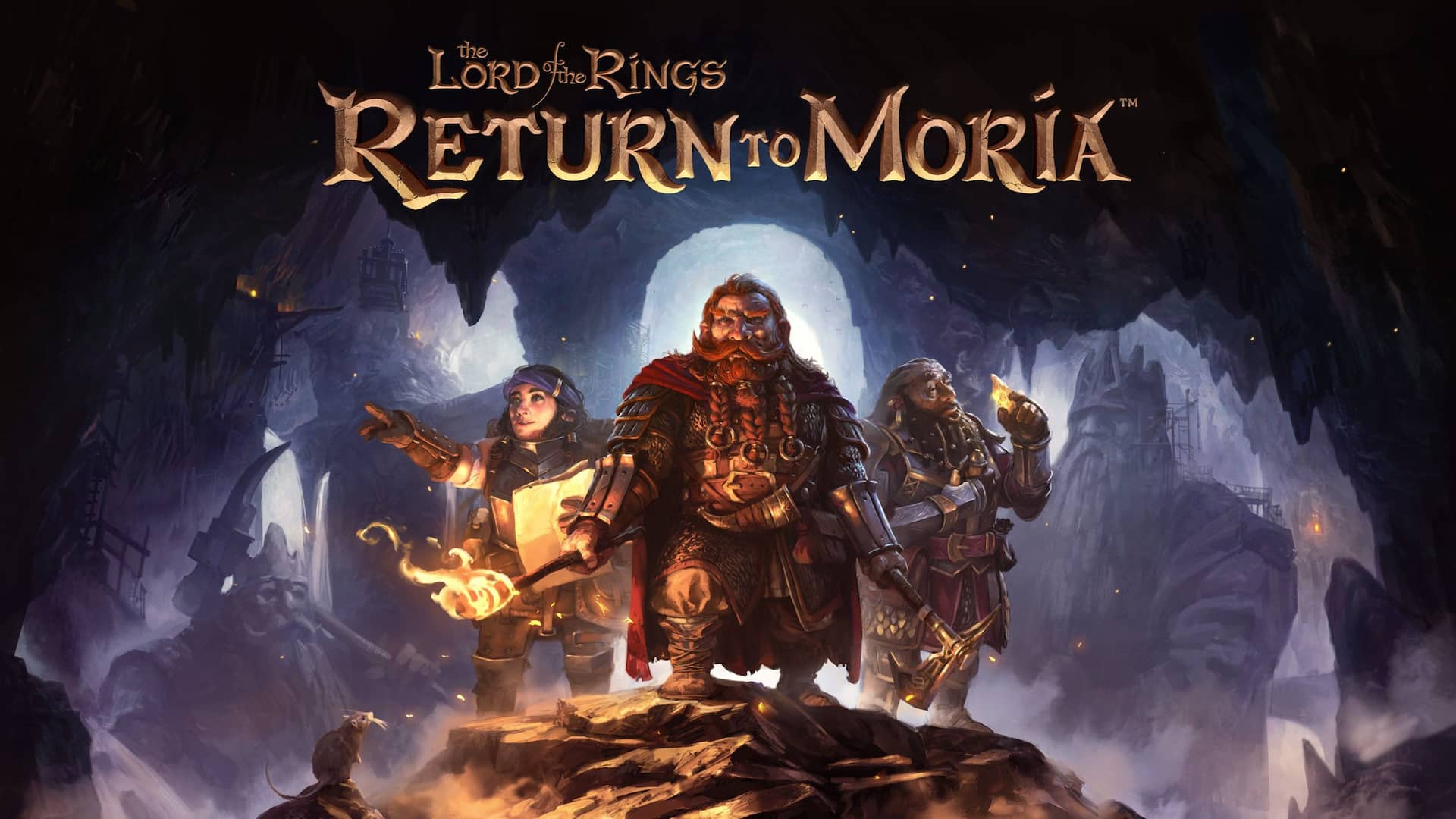
Delving deeper: A look inside the creation of The Lord of the Rings: Return to Moria
"We must face the long dark of Moria. Be on your guard. There are older and fouler things than Orcs, in the deep places of the world," said Gandalf in The Lord of the Rings: The Fellowship of the Ring.
Developed by Free Range Games and published by North Beach Games, The Lord of the Rings: Return to Moria is a survival-crafting game that marries strategy and survival with the ancient dwarven civilizations of Middle Earth. From fanfiction to canon lore, the passion and love for the source material is palpable the moment players step into the game, making Return to Moria feel unique and authentic.
In this interview with Game Director Jon-Paul Dumont and Narrative Designer Farrha Khan, we delve into the depths of Return to Moria's lore, peering behind the scenes to unveil the inspirations and challenges that brought the fabled mines to life. Join me as I explore the sprawling caves of Khazad-dûm and the creative minds of its passionate developers.
Ihâruz amtarmênu! (Khuzdul for "Welcome to the mountains!")
What considerations did you and your team need to make when thinking of ways to carry the story forward, post-Sauron? Were you given free creative reign or did you work directly with the Tolkien estate?
Farrha Khan: Our approach to The Lord of the Rings: Return to Moria has always been “lore first,” so when thinking about the game post-Sauron and the events of The Lord of the Rings trilogy, our first goal was to make sure the world and story felt authentic and enjoyable.
With that in mind, the first consideration for the team was always to go back to the core books—The Hobbit and The Lord of the Rings trilogy—for references related to Khazad-dûm/Moria, the Misty Mountains, and Dwarven culture and history, including related characters and key moments in Middle-earth history.
We also brought on three lore experts. T. S. Luikart has worked on tabletop role-playing games and he helped with constructing the story early on. Corey Olsen, the Tolkien Professor, we brought on later (when we had the full story written) for feedback on the themes and worldbuilding. We also brought on linguist David Salo, who helped us create the Khuzdul language. And of course, we regularly shared what we were developing with Middle Earth Enterprises.
Finally, we also took into consideration the player’s experience, their journey as they progress through the game and story. The team was constantly thinking about how to technically tie together all the in-game experiences, from enemy encounters to new environments, to make sure players really felt like they were a Dwarf in the Fourth Age going into Moria for the first time after answering the call of Gimli.

Since there is so little information about the Fourth Age, how did you go about deciding what lore to include and what to create?
Khan: The Fourth Age is an interesting time in Middle-earth because there is so little known, especially when it comes to the Dwarves. In terms of deciding what lore to include, we first looked at the story we were trying to tell within the game, with a focus on the player experience—and what they would logically find as they journeyed through Khazad-dûm, particularly from a Dwarven perspective.
As mentioned, the core books were our first reference point. We tried to pin down the “knowns” to create a timeline of events into the Fourth Age, as well as looking at the key locations and environments that had to be included.
From there we started looking at the “unknowns,” where we had space to be creative. Our approach to filling in the blanks was to first ask “What are we trying to understand, showcase, or share with the player?”
For example—and without spoiling anything—some of the questions we asked early on were “Why is Mithril only found in Moria?”, “Why was Durin the Deathless given the symbol to build Khazad-dûm here, specifically?”, “Why did the Balrog choose the Misty Mountains to flee to?”, “What happened in the year after Durin VI’s death, before Nain was killed and Khazad-dûm was evacuated?”, and “What happened to the different factions of orcs after Sauron was defeated?”
Then, we’d look at how to best share that detail with the player in a way that feels natural to their experience and the story we’re telling in Return to Moria.
How faithful to the books did your team set out to be? Or did you feel that the books were more of a guide for your creative process?
Khan: Everyone on the team has deep respect for Professor Tolkien’s writing and the world he created, so the books were very much our North Star. We want players to feel like they are a Middle-earth Dwarf walking through the ancient halls, mines, and caverns of Moria.
Of course, we made some specific choices—but even those choices were very much based on still being as authentic as possible to the themes and messages found within Tolkien’s writings.
How did you handle the lore implications of a game that revolves around Gimli and the Dwarves re-taking their lost ancient kingdom?
Khan: The key for us was really looking at things from a Dwarven perspective, and what we know from the Appendices. For example, we know Gimli promised to Aragorn that he’d rebuild the gates of Minas Tirith with Mithril. We know Khazad-dûm was eventually recolonized by Durin VII.
Specifically, for the story of Return to Moria, we looked at what that means for Gimli. He is Lord of the Glittering Caves and a close friend of the King of the Reunited Kingdom—yet he still has to deal with the King of Durin’s Folk, Thorin Stonehelm, and Durin VII hasn’t yet appeared. So we asked ourselves, does Gimli taking charge and leading an expedition in Moria to mine Mithril and potentially reclaim the ancient kingdom change or impact those known details in a way that goes against Professor Tolkien’s themes and messaging? How well does it fit?

How did you handle weaving the narrative into the survival elements of the game?
Khan: There are key narrative moments that happen in real-time for the player, and many of those are fairly straightforward. But the history of Khazad-dûm spans a very long time and the player Dwarves are essentially exploring ancient ruins.
We tried to find fun and interesting ways a player could stumble upon these narrative mysteries or moments in a natural kind of way that also fit the characters involved. For example, we wanted to show that Gandalf had been in Moria before he journeyed with the Fellowship. We know Gandalf used runes to communicate with Dwarves—after all, his rune on Bilbo’s door is what started it all—so we used runes to show where he would have gone during this journey looking for Thrain.
It really was about finding those opportunities to highlight a narrative moment that fits well within the worldbuilding.
Lîmin barak, lîmin tagaz! ("Time for axe and sword!")
Was it intimidating working with John Rhys-Davies, a.k.a. Gimli himself? I’d imagine that would add some pressure in regards to writing Gimli’s voice lines and making him sound authentic. Did he have any creative input on the character or Dwarves in general?
Khan: As a fan of John Rhys-Davies, yes it was absolutely intimidating presenting him our writing. But even before he was confirmed to voice our Gimli, it would be a lie to say I wasn’t hearing his voice as we wrote his lines. He has embodied Gimli for more than two decades and knows this character in ways that we cannot.
A lot of John Rhys-Davies’s input involved how his lines were delivered, the tone and emotional weight. And of course there was some ad-libbing, which was a lot of fun! It was an absolute delight and privilege to have had the opportunity to work with him on this project.
I do want to add that while there was some additional pressure to writing Gimli’s line as authentically as possible, we approached all of our work with the same kind of pressure and responsibility in regards to authenticity.

From a worldbuilding standpoint, how did your team tackle the task of making the game feel like time had passed since players would have last seen Gimli?
Jon-Paul Dumont: The opening prologue sets the stage for the game taking place in the Fourth Age. We knew we’d want to show an older, greyer Gimli, and we put a lot of thought into his appearance. Players will see that there’s construction around the Doors of Durin, so they might pick up that the Dwarves have been working on getting in for some time.
Little touches, like Dwarves bantering in the game about the Balrog being dead, or the state in which you find the Bridge of Khazad-dûm, are things that we strived to feel natural to the state of the world.
Crafting new lore for a fictional culture sounds like a daunting task. How did you go about making things like the music, clothing, Dwarven language, and even food all look and feel like they belong to and stem from a living, breathing culture?
Khan: Aside from just focusing on the Dwarves and their culture, we also really looked at Khazad-dûm and the Misty Mountains as characters themselves.
From there we took an almost archaeological and anthropological approach when looking at the clothes, music, language, food, and even things like furniture and statues. We tried to show the passage of time just through the different areas of Khazad-dûm by looking at what was happening in the history of the Dwarven kingdom (and Middle-earth) at any given time, and using that to help inform how we showcased their culture, and how the environment and nature under the mountain itself was reclaiming certain spaces.
For example, you might be surprised to find some Elven influences in Khazad-dûm, but we know in the Second Age that Dwarves and Elves worked closely together before that relationship soured, so we used that as an opportunity to explore the impact that might have had.
When working with the Dwarves of the Fourth Age we took into consideration that they are living in a post-war period, in a time of relative peace and cultural exchange between the different races still in Middle-earth. So we thought about things like where are the Dwarves traveling from, how do they speak to each other about different things, and what do they sing about and eat.
I read that the team had book club meetings about the lore of Middle Earth. Is there anything fun or interesting you’d like to share with the community about what those were like?
Khan: During the development of the game, we held at least two official book clubs where we read The Hobbit and The Lord of the Rings trilogy. What I found interesting, even outside of the book clubs, was every time we would reread a passage or section, there would always be something new or different we found that we could incorporate into the game.
Dumont: We surprised ourselves with what great ideas came out of the book clubs. For instance, our Audio Director would read passages and find inspiration for the songs the Dwarves sing in Return to Moria.
There were a lot of moments where we thought of an idea and at first we would think “Oh, we couldn’t do this, this is kind of goofy,” but then the idea caught on and became real. The fact that the Dwarves drink different ales for different benefits, as opposed to something along the lines of potions, was another one of those ideas that first seemed silly, but actually made perfect sense in the game.
Khazâd dashkîn! ("Dwarves have returned!")
Do you find yourself using Khuzdul in your everyday life now that you’ve worked with experts on expanding the language? (I know I’m going to start!)
Khan: There are a handful of phrases. I’ve used “Takfa Durin Khudrir” (Till Durin wakes!) and “Barkû yaggin” (My axe is restless!) more than I thought I would. I’ve also called my cats rubble-head a few times, though not in Khuzdul. I really should incorporate Khuzdul more in my life.

If you don’t mind sharing, have you ever written The Lord of the Rings fanfiction in the past—and if so, what was your reaction to getting to work on an official The Lord of the Rings property?
Khan: The Peter Jackson movies came out when I was a teenager—I absolutely wrote The Lord of the Rings fanfiction that I will never share publicly.
Put simply, it’s been a dream to have had the opportunity to work on an official The Lord of the Rings property. It was fun and an absolute delight—but I also felt a huge amount of responsibility in respect to the lore and writings of Professor Tolkien. Looking back, it makes my heart so full to see people truly enjoying being a Dwarf, running around under the mountains with their friends.
For fellow The Lord of the Rings fans, I hope they are able to enjoy and appreciate where we took the story of the game and the connections we made.
Lastly, just for fun: If you existed in the world of Middle-earth, what would you be, where would you live, and why?
Khan: I really want to say I’d be a Dwarf reclaiming Khazad-dûm, but if I’m being honest with myself, I’m very much a Hobbit. I’d love to live in the Shire enjoying a simple but happy life with my family, friends, and good food. But I think I’d also get the Bilbo urge to go see mountains every now and then.
As we emerge from the depths of Khazad-dûm, the spirit of adventure on our heels, it’s evident that the developers behind Return to Moria have mined their creativity and smelted their passions into an adventurous experience that will leave even the most hardcore The Lord of the Rings fans satisfied.
The Lord of the Rings: Return to Moria is available now on the Epic Games Store!