Digging into The Lord of the Rings: Return to Moria development
As all good Tolkien stories do, it started with the Dwarves.
Back in 2020, when Free Range Games was just starting work on what was to become an epic survival crafting game set in the Fourth Age of Middle-earth, the developers were still grappling with the totality of J.R.R. Tolkien’s rich fictional world and exactly where and when to set The Lord of the Rings: Return to Moria.
 In the game, players will take control of the Dwarves as they reclaim and restore their homeland of Moria. The Free Range Games title, which hits in spring 2023, kicks off with Lord Gimli Lockbearer summoning a company of Dwarves to the Misty Mountains and ordering them to reclaim the lost spoils from Moria–also known as Khazad-dûm or Dwarrowdelf.
“We started with the Dwarves,” said Jon-Paul Dumont, the game director. “We love them and wanted to tell an authentic story all about them.”
The team started to nose around the different stories they could tell, Dumont said, including things like Balin’s Expedition, Khazad-dûm at its height, or even rebuilding Erebor after Smaug’s death.
“Each of them were interesting in their own way, but we kept coming back to that one section of the Appendices where Professor Tolkien describes Durin the Last and the dwarves finally coming home,” he said. “That felt like the authentic, high stakes story that would be important for the characters the players are playing.”
 That decision meant the game would be set in the fiction’s Fourth Age, a period that Dumont describes as a fascinating time.
“Aragorn is king,” he said. “The Ring Bearers have left for Valinor. Gimli settled Aglarond. The dwarves promised to remake the gates of Minas Tirth with mithril. We don't really know a whole lot more than that, so it's a pretty green field to create in. We can tell a new story that no-one will expect, and can really add to our understanding of Middle-earth.”
Once locked in, the setting and story of The Lord of the Rings: Return to Moria helped to shape the game’s story and play mechanics, Dumont said.
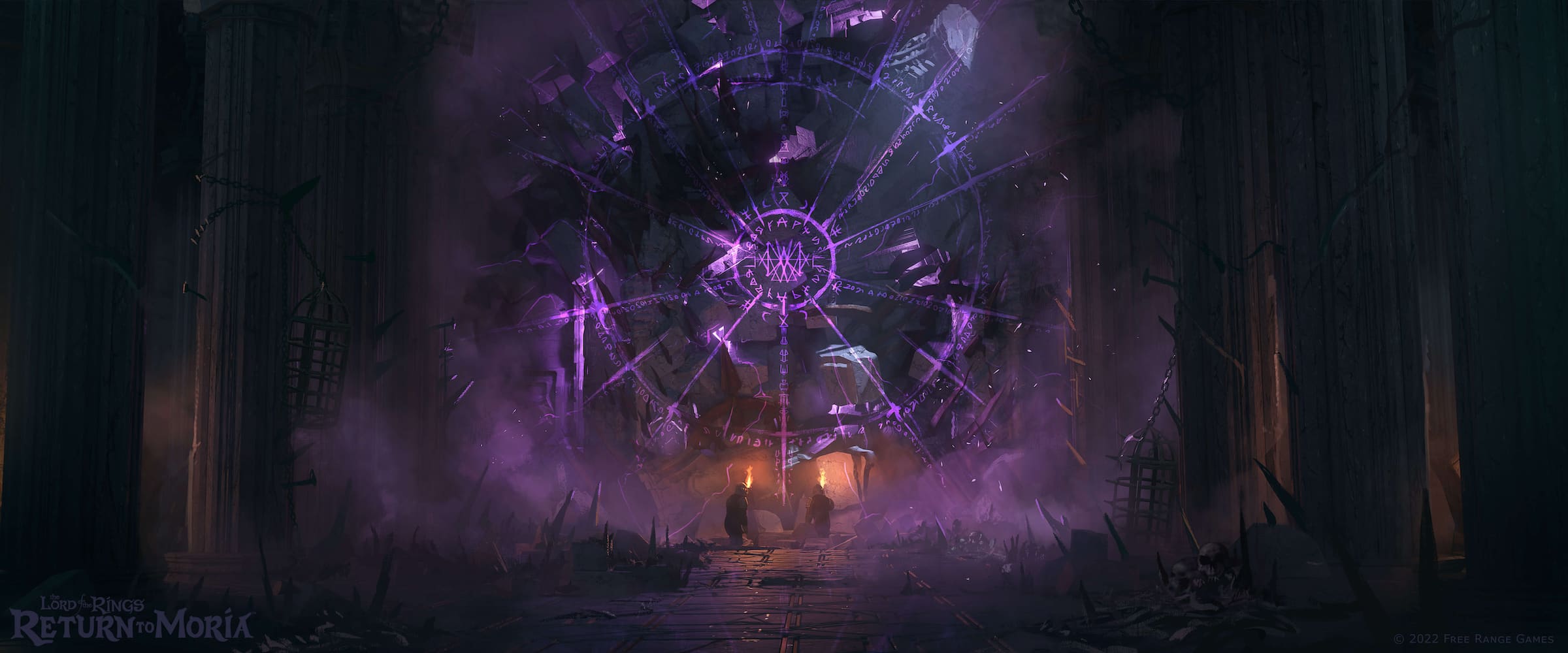
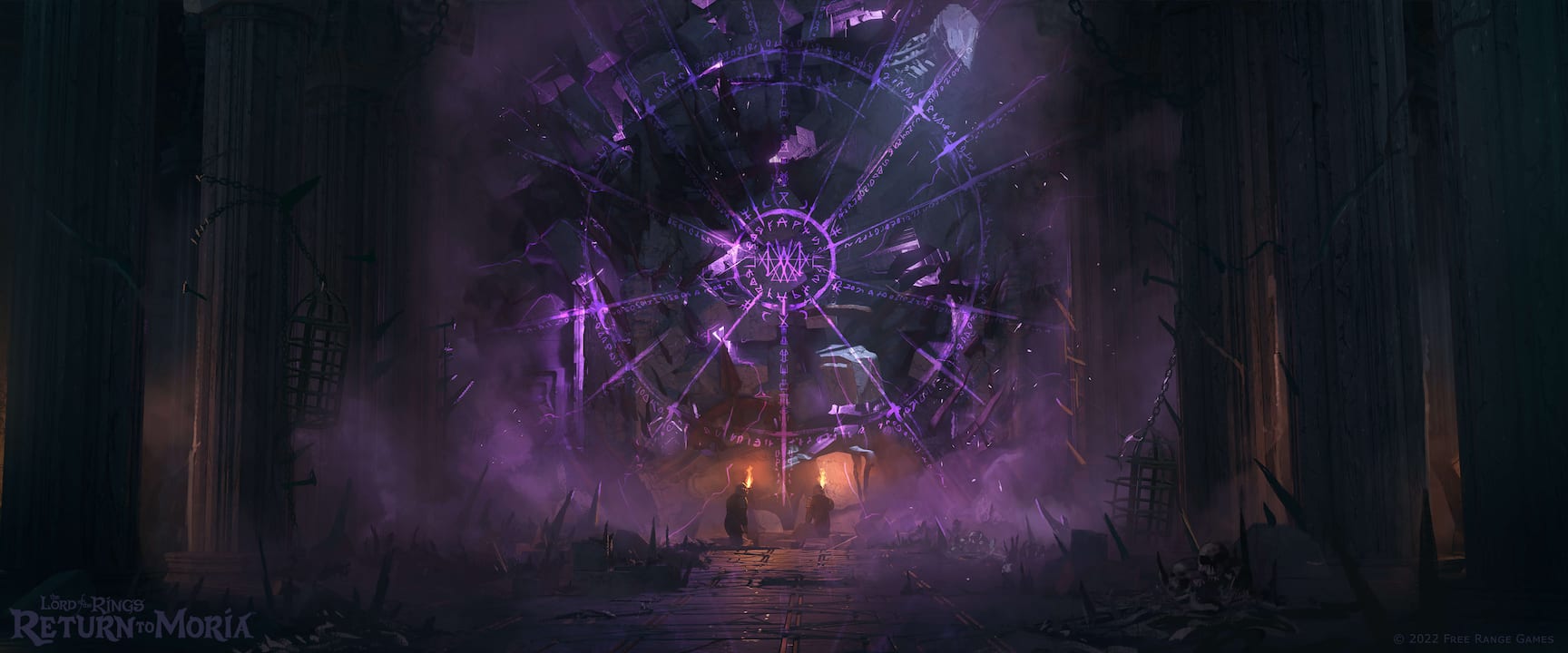
 “A major part of the game is exploring the ruins of Khazad-dum,” he said. “That means city areas, caverns, mines, the darkest depths and flooded chambers. Some lit naturally, some with ancient crystal, and some totally dark. Moria is a deadly, mysterious, and dark location. It’s also a site of major catastrophe for the Dwarves. Like any good post-apocalyptic setting, different flora and fauna has creeped back in, allowing for players to hunt and gather for food. There are also plenty of predators and monsters to avoid.
“Part of the world building is also asking the question of how many orcs survived after the fall of Sauron? Do they believe their dark lord will someday return?”
Working in such a well-read, and fan-loved, fictional world also means ensuring that the team’s creation is authentic and consistent with what Tolkien had in mind. Dumont said the team went to great lengths to make sure that the game would feel like it was made by fans of the works.
 “Aside from reading Tolkien’s works (we held team book clubs even) and doing extended research on our part, we also consulted with experts to make sure we’re getting things right,” he said. “So Corey Olsen, the Tolkien Professor, TS Luikhart, who has written official LOTR tabletop RPGs, and David Salo, inventor of our Dwarven Language - have all been tapped for their expertise and extensive knowledge.”
In The Lord of the Rings: Return to Moria, players will work to build their base by clearing locations and creating architecture on a grand scale, they’ll also have to survive the unspeakable evils that lurk below and combat hordes of Orcs. That means conserving resources, hunting, and gathering for food and managing sleep, temperature, and noise levels. The game supports the ability to craft and loot legendary Dwarven armor, tools, weapons and structures. Rebuild ancient forges to strengthen, repair and enchant gear. Upgrade and unlock new technologies and fantastical machines. If all of that weren’t enough, the game is packed with the sort of magic artifacts you’d expect from any The Lord of the Rings game, like swords that glow when Orcs are near, veins of Mithril to mine, and crafting plans for amulets that can impart strength or wisdom.
 We don’t know a ton about the inner workings of the game yet, but Dumont was able to shed a bit of light on the survival-crafting systems and mechanics.
“Much of the team are fans of the survival-crafting genre, so many of the mechanics gamers are familiar with are here: you’ll need to hunt, gather and cook to eat,” he said. “You’ll need to craft yourself a bedroll to rest. And these factors play a part in maintaining your health.
“For crafting you’ll be using all kinds of forges for metalworking, furnaces to smelt down ore into ingots, workbenches and much more. Some of these stations are rare and - without giving away too much - are points of interest in the game. Unlike other survival crafting titles, Dwarves are master metalworkers, so you get to craft using metals very early in the game.”
He also explained how cooperative play would work in the game.
“One player hosts their own Moria for their friends or other gamers to join,” Dumont said. “Moria is a fairly different experience in single player versus multiplayer. With more Dwarves you can be a little bit more bold, perhaps louder, as you make your way down. And you’ll be building and mining in real time with each other, so coordinating where platforms go, who retrieves what resources, maybe half the party is fending off orcs while the other half goes to make food for everyone.”

While we’ve seen a bit of the game in action, we were also interested in how the team came up with the look and art style of the game. Bradley Fulton, The Lord of the Rings: Return to Moria art director, said the aesthetic, like the entire conceit of the game, started with the Dwarves.
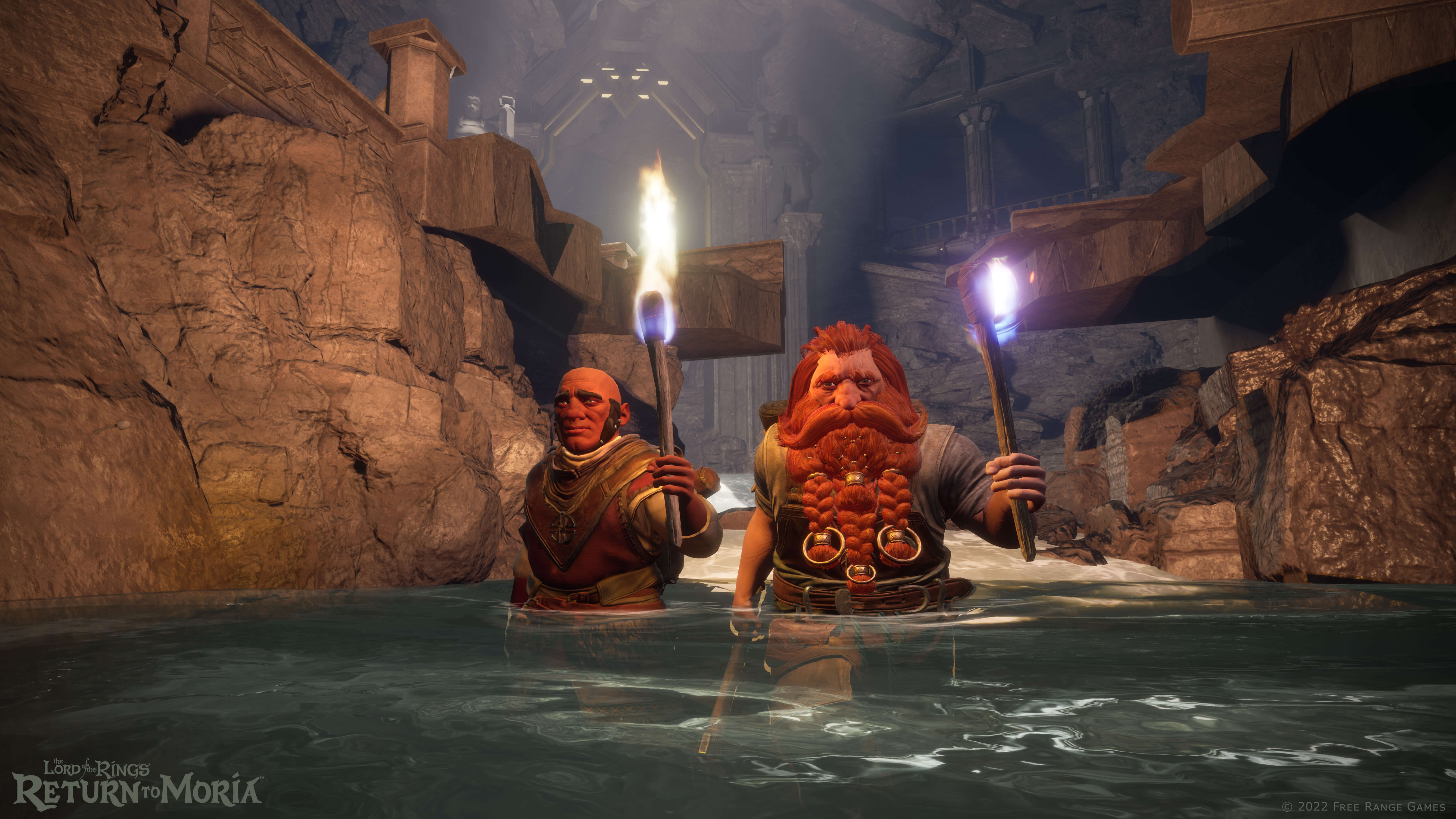
“We knew from the start that Dwarves, as our central characters, have a reputation for personalities that are larger than their stature,” he said. “Likewise, we wanted the Orcs, Goblins, and Trolls that infest Moria to be very outlandish villains full of character. This led us to assemble a small team of wonderful concept artists that are accustomed to working in a loose and expressive style. The result was a set of 2D concepts with instant charm that everyone can relate to.”

Fulton added that in creating the game’s look, the team also knew they had to recreate the grounded, real-world setting of Middle-earth, which does such a great job of playing off the fantastic characters and creatures.
“It’s still a world where the mundane realities of daily life on Earth also rule,” he said. “We want players to use their knowledge of the real world to solve problems of survival. For these reasons, it is important to us that the world of Moria under the mountain feels believable. It’s a hazardous place down there, for the unprepared Dwarf. The more realistic it is, the more convincing that danger will be.
“We combined these two ideas: expressive character designs with realistic materials, lighting, and animation to create a world that feels real, inhabited by characters full of life.”
Make sure to wishlist The Lord of the Rings: Return to Moria now on Epic Games Store, and if you missed the Durin’s Day live stream, check out the deep dive video for the game featuring Dr. Corey “The Tolkien Professor” Olsen and members of the development team over on the Nerd of the Rings YouTube channel.