Hexes, drugs, rock and trolls: The rise and fall of Dungeon Keeper
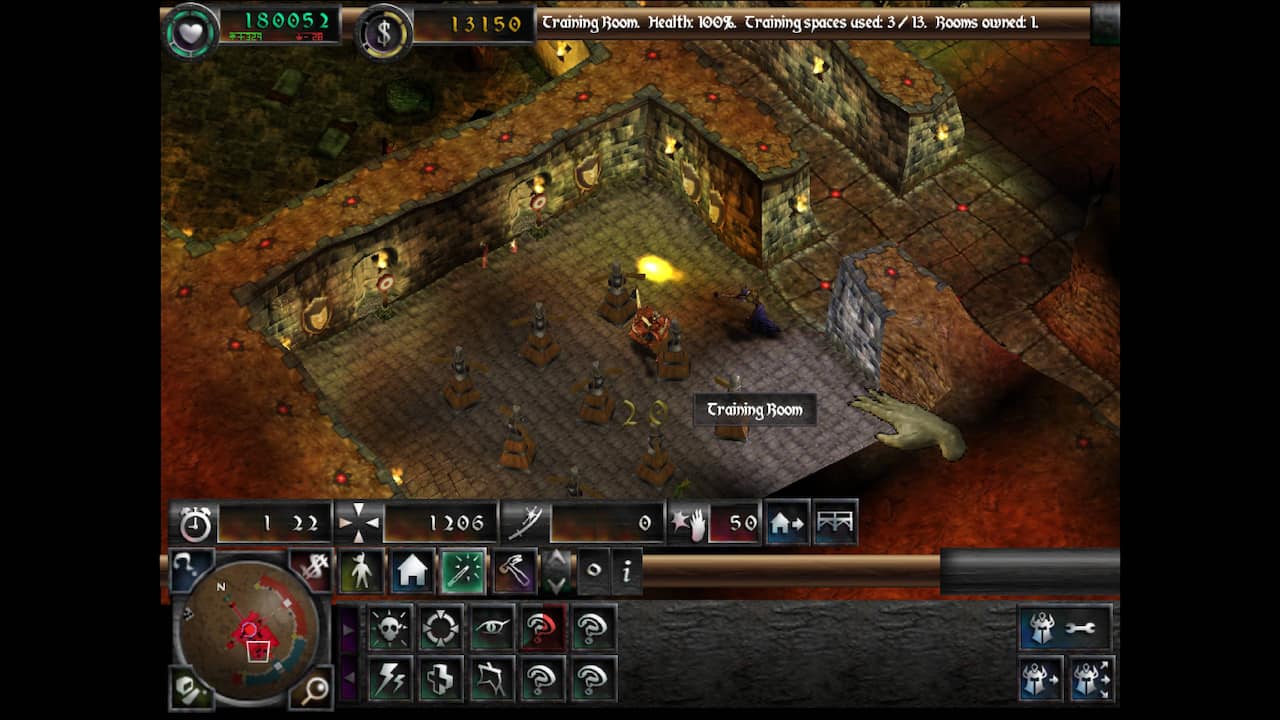
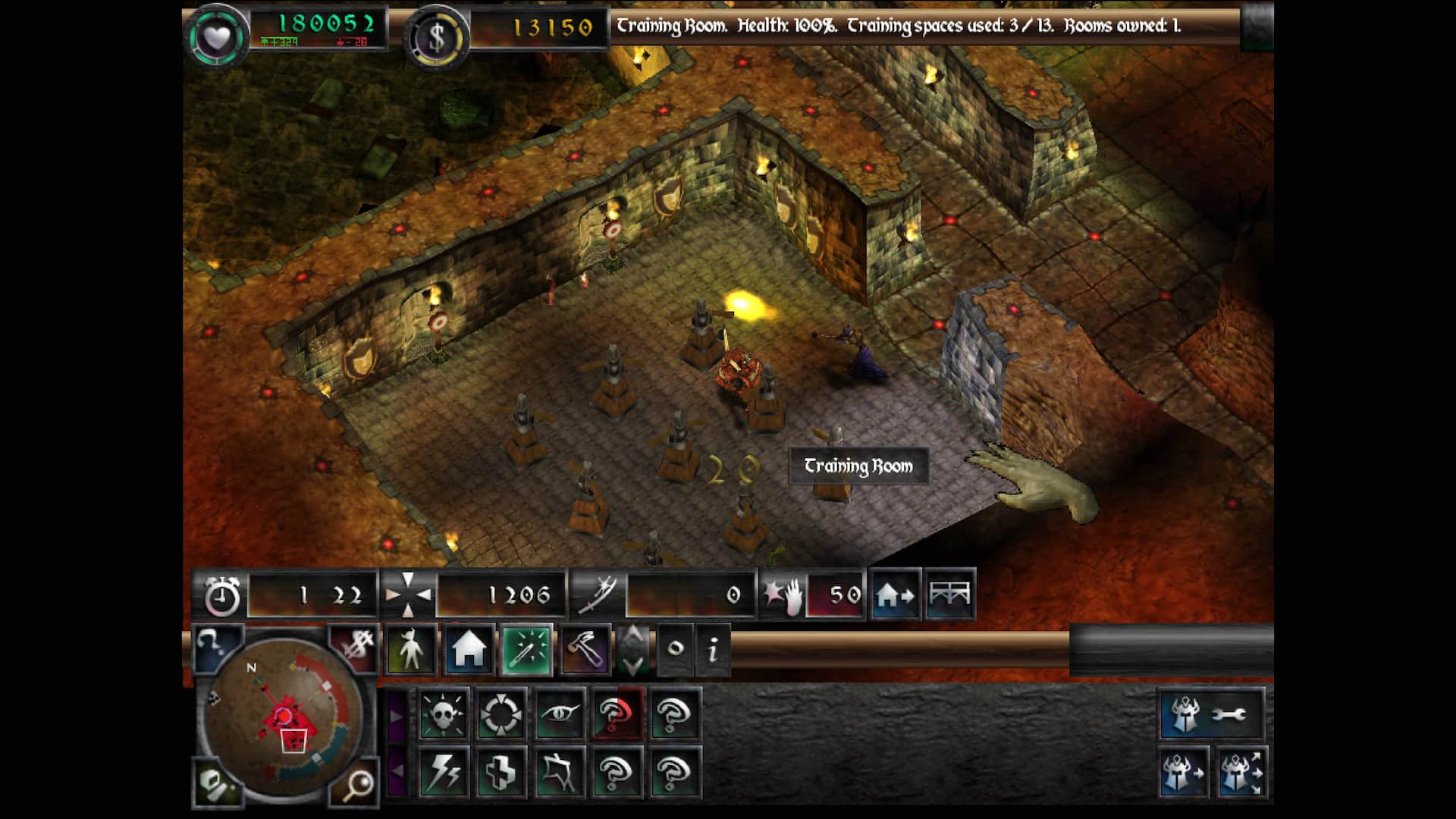
What if you were the evil overlord hell-bent on conquering the world? In 1997, Dungeon Keeper burst through the walls of PC gaming to bring players this gleefully wicked concept, tasking them with mining out an underground dungeon from brown rock and soil, before raising an army of monsters to wreak havoc upon a disgustingly pleasant (and verdant) fantasy realm.
It’s a video game premise that still thrills nearly 30 years later. More than just a clever inversion of video games’ typically heroic narratives, Dungeon Keeper also flipped the concept of management gaming on its head. Rather than creating a well-oiled infrastructural machine like a theme park or a hospital, you instead had to wrangle a menagerie of minions who fundamentally did not want to be governed—spiders and flies who hated each other, warlocks who preferred reading to fighting, dark mistresses too busy torturing themselves to bring pain to your enemies, and the intractable Horned Reaper, who was as much of a danger to your dungeon as the heroes trying to raid it.
Dungeon Keeper was a messy, mischievous, and miraculous design, one that has still never been surpassed in its specific mixture of management, strategy, and god game. Perhaps it’s unsurprising, then, that the story of Dungeon Keeper’s creation is similarly chaotic.
It’s a tale that involves death-threats, drugs, discord, and the decline and fall of one of gaming’s most singular studios. Though Dungeon Keeper eventually conquered the world of god gaming, its reign of terror was tragically short-lived. Here's the story, straight from the mouths of its creators.
Nefarious designs
Developed by Bullfrog Productions, Dungeon Keeper was originally conceived by co-founder Peter Molyneux in the summer of 1994, following the launch of Theme Park. The story goes that the idea came to Molyneux while he was stuck in a traffic jam, but thirty years on, Molyneux no longer recalls this.
“I can imagine me getting really annoyed,” says Molyneux from the office of his current studio, 22 Cans. “When you're in a traffic jam, you start shouting at everyone, and there's this evil side of you that comes out and the idea of road rage, so I can imagine that would be inspirational.”
What Molyneux does remember is the general idea as it came to him. “It was this slight obsession I had with ‘bad guys never succeed’” he says. “If you watch James Bond films, James Bond flies in and destroys the bad guy by pressing the wrong button or something, and then the life’s work of the evil guy is destroyed in a second. I always felt ‘No one thinks about the people that the evil guy employs. There’s no fairness here.’”
This, Molyneux believes, was the thought from which Dungeon Keeper emerged. “If we were to do a game where the player plays the evil guy, what would that game look like? And the thought of having a dungeon which you have to design so the goody-two-shoes heroes would come in and not be able to take your ultimate treasure—that would be a fun twist.”

At the time, Bullfrog had just finished working on Magic Carpet, a first-person flying game which boasted an advanced 3D graphics engine. Using this, Magic Carpet’s programmer Simon Carter built a prototype for Dungeon Keeper—which, like Magic Carpet, was played from first-person.
“Pretty quickly we had this idea of being able to possess different creatures, and then we came up with the idea of tunnelling out [rooms],” Molyneux says. “It was like all of our projects at Bullfrog, and later the projects at Lionhead…you don’t sit down and write a design document, you say ‘Oh it’s a game about this,' and start. That is probably a very unprofessional way of working—but if you're trying to discover something new and explore something new, it’s quite a useful technique.”
Prototyping Dungeon Keeper moved along rapidly, but in early 1995, two events pushed Molyneux away from the project. Bullfrog was acquired by Electronic Arts, with Molyneux becoming the publisher’s Vice President and Head of Europe. Following this, EA told Molyneux that they didn't have any games to release next quarter, and asked if Dungeon Keeper could launch in six weeks.
“I said there’s just no way. It wasn’t even in Alpha,” Molyneux says. “I brokered a deal with them to write an entire game, which was called Hi-Octane, which Sean [Cooper] wrote in six weeks.” (In recollections from other interviews, Cooper has stated the time period to be eight weeks.)
This project, alongside Molyneux’s new duties as VP of EA, kept him away from Dungeon Keeper through 1995. In Molyneux’s absence, Dungeon Keeper was driven forward by Simon Carter and his brother Dene Carter, programmers Jonty Barnes and Alex Peters, and lead artist Mark Healey, who had joined Bullfrog during the development of Magic Carpet.
“One of the first things I had to do was learn how to juggle, because everyone in the office would be walking around juggling,” says Healey. “And at any point in the day, there would be someone going around either on a unicycle, or someone rowing up the corridor on a skateboard with a baseball bat. Quite a lot of eccentric people.”

Healey designed nearly all of Dungeon Keeper’s graphics, with the game’s distinctive aesthetic deriving from two key visual design decisions.
First, rather than simply painting textures onto the world geometry, Healey modeled them in 3D and then rendered them to create the textures. “Even though it was just a flat face, it looked like it had more polygons in it than it really did,” Healey says. He also persuaded Dungeon Keeper's engine designer Glenn Corpes to add what he refers to as a “wiggle thing” to the graphics renderer that warped the world geometry. “So instead of just being upright columns of cubes, there was actually this weird, random sort-of wonkiness.”
Healey also designed most of the game’s characters—both the creatures players kept in their dungeon and the heroes they fought against. The concepts for characters came from many different places within Bullfrog, however.
“There were certain things Peter knew he wanted," says Healey. "We had the concepts of the Imps that were your little workers. There was going to be some kind of wizard that did the research. I remember looking at White Dwarf magazine to get inspiration for the Games Workshop-type stuff, your dwarfs and barbarians.”

Healey’s own concepts included the Dark Mistress (the leather-clad sadomasochist who delights in torturing other creatures and herself) and the Horned Reaper. “I loved the idea that there was this character who just hated everything, even your creatures, and it was just this complete uncontrollable force.” The Reaper was loosely based on an ex-girlfriend of Healey’s.
“Something about her smile,” he says.
Housekeeping
Although work continued steadily on Dungeon Keeper throughout 1995, by Christmas it remained a long way from finished. “There wasn’t really a game there,” Healey says. “For a long time we were just getting it to look nice, but all you could do was shoot fireballs down a corridor.”
In 1996, Molyneux returned to the project. Missing game design and having struggled to adjust to his more executive position at EA, Molyneux resigned as Vice President—and indeed, from EA entirely. But he’d persuaded EA to let him finish the work on Dungeon Keeper. They had agreed, but only under certain conditions.
The nature of those conditions remains up for debate. “Peter had already been banned from the office in the middle of Dungeon Keeper,” Healey says. “Something went on, and they basically didn't want him in the office anymore, as far as I understand.”
Molyneux describes the situation as being less acrimonious. “I had handed my notice into Electronic Arts, and quite very understandably, they didn't want someone as disruptive as I can be hanging around in the studio. So I said ‘Look, I’m not going to leave until Dungeon Keeper’s finished. How about I take the team to my house and we’ll finish the game at my house?’”

However it went down, EA accepted Molyneux’s suggestion, and the core design team of Dungeon Keeper—which included Healey, the Carter Brothers, and Alex Peters—all moved their workstations into a room in Molyneux’s house.
“[Peter] had a nice house at the time with nice grounds and all that, so I could at lunchtime go out and wander around some trees,” says Healey.
For some of the designers, it became a temporary home. “Simon Carter stayed at my house for quite some time—years, in fact—with his now wife,” Molyneux reveals.
It isn’t clear whether the change in environment had any direct effect on Dungeon Keeper’s design, but Molyneux’s return certainly did. “He was like, okay, we actually need to design a proper game here,” Healey says.
At this point, Dungeon Keeper was redesigned from the ground up. “We wrote a little test bed to allow us to play the game in 2D and that gave us a lot more features that we needed to work on to enable us to balance it,” Molyneux says. When these features were stable and fun to play with, they were then transposed into the 3D game engine.
This was when Dungeon Keeper’s signature mechanics became formalised, like the unique creature behaviours that caused them to squabble and fight.
“This is the power, if you like, of not having a set-in-stone design,” Molyneux says. “You can wake up one morning and say ‘Why don’t we give the creatures a personality? They’re supposed to be evil creatures, for God’s sake! Why can’t they be bad tempered?”

Other ideas that arrived at this time included the ability to highlight tiles for the Imps to dig out, and slapping creatures to make them work harder, the latter of which was Healey’s contribution. “The hand was probably already there—as in, that's how you point to stuff. But then I had this idea, ‘Wouldn't it be cool if you could slap them to make them go faster?' And we put that in. That worked really well.”
Alongside Molyneux’s return and the shift in work environment, there may also have been other influences on Dungeon Keeper’s design. Healey, for example, was struggling with an injury that he was self-medicating. “I’d managed to slip a couple of discs in my back. For most of Dungeon Keeper I was suffering from that,” he says. “I was chain-smoking weed, and it helped, and probably had a big influence on the graphics.”
This isn’t the only appearance of unusual substances in Dungeon Keeper’s story, either.
“I was famous for making a chili with a special ingredient in it. Not a completely legal ingredient,” Molyneux reveals. “I made this chili and had a party at my house and invited some of the senior execs from Electronic Arts. And unfortunately, I was just grating this ingredient in—it was in a kind-of block format—and one of the execs said ‘Oh, chili!’ and took a spoonful with an enormous amount of grated substance on it. And he—yeah, he was worse for wear.”
Healey also recalls Molyneux’s special chili. “It would cause lots of chaos,” he says.
Creatures unleashed
Molyneux describes the run-up to Dungeon Keeper’s launch as a “Messy, messy time.” The team was crunching heavily to get the game finished, a practice that was normalised during the '90s.
“I used to just get up in the morning and work until I went to sleep in the evening,” Molyneux says. “It was more convenient to be at my home because I didn’t have to commute.” On top of this, he was also thinking about life after Bullfrog, talking to Demis Hassabis (later co-founder of Google DeepMind) about forming Lionhead, and musing upon ideas for what would become Black & White.
It was around this time that Molyneux also received a threat to his life. “Someone wanted to come down and threaten to shoot me with a shotgun,” he says. “This one person had written this letter to me and to all the magazines, saying he was going to do it that weekend—he was going to come down and kill us.” The police were informed and investigated the situation. “They found out that someone with his name did have a shotgun, but it actually wasn’t him.”
Fortunately, the threat proved to be no more than that. Molyneux explains that he had been previously corresponding with the individual via letters. “I responded to the first few because I’ve always loved helping people in their careers,” he says. “And then I think he went a bit crazy, and so I stopped responding to him.” Molyneux believes the threat was the individual’s way of getting back at him for ceasing correspondence. “‘I think this was a way of him saying ‘Right, you’re not talking to me anymore, I’m gonna kill you.’”

Healey likewise remembers the closing stages of Dungeon Keeper being an intense time, as well as the moment he personally downed tools on the project. “We were working quite a lot, working quite late. Peter was probably quite stressed. And I had literally—I was sitting at my desk in the corner of this room, and I finished my last little task,” he explains. “And I remember just making a big point, sort-of leaned back and got a newspaper and was like ‘Well, I’m finished!’ That really pissed him off. He threw some slippers at me or something.”
Dungeon mastered
Dungeon Keeper was a critical hit on release, receiving rave reviews. It sold well too, shifting 700,000 units by 2003. Though it wasn’t the commercial smash Theme Park had been, it sold well enough for EA to greenlight a sequel.
The team that would design Dungeon Keeper 2 was very different, however. With Molyneux’s departure, many of the company’s designers—Healey among them—followed him to join Lionhead. Of Dungeon Keeper’s key design team, only Alex Peters remained at Bullfrog, while engine programmer Martin Bell also stayed on.
This isn’t to say that Dungeon Keeper 2 was made without the Bullfrog spirit. Numerous Bullfrog designers not on the original Dungeon Keeper project jumped to work on the sequel, including Hi-Octane’s Sean Cooper, who assumed the role of lead designer. Dungeon Keeper 2's lead producer, meanwhile, was Nick Goldsworthy, who had worked closely with Bullfrog since the days of Syndicate.
“When Bullfrog became part of EA, I got involved with Populous 3 initially. But as soon as the team for Dungeon Keeper 2 started forming, I couldn’t resist—it felt closer to my heart, so I jumped over to that project pretty quickly,” says Goldsworthy.

For the sequel, Bullfrog didn’t want to mess with the core concept of Dungeon Keeper too much. Instead, the team wanted to improve the experience of the game wholesale. This started with the visuals. While Dungeon Keeper’s graphics were cutting edge at the project’s outset, they looked outdated by 1997 after the advent of true 3D and 3D acceleration.
“We developed a custom engine that could render the entire dungeon environment and its inhabitants in 3D, which meant bringing in a much larger team—3D modelers, riggers, animators, the works,” Goldsworthy says.
Alongside this, Bullfrog also wanted to redesign the UI. “Some players found the original a little cluttered and unintuitive,” Goldsworthy says.
It wasn’t just players who felt like this—Molyneux did too. “The thing I hate about Dungeon Keeper is the interface,” he says. “The sheer number of icons and things, different menus that would come up. That was so messy that it led me to say ‘Right, in Black & White, we’re not gonna have any HUDs.’”
While Bullfrog left the core game largely intact, the studio made several tweaks to creature behaviour for Dungeon Keeper 2 to stop them “wandering off or ignoring critical tasks." Bullfrog’s designers also worked to make the core loop more varied. “While the original was fantastic, it could feel a bit repetitive at times,” Goldsworthy says.
What changed most during Dungeon Keeper 2’s development, however, was Bullfrog itself. “Bullfrog had this reputation for creating incredible games. EA’s approach was a little more corporate, so there [were] some growing pains at times,” Goldsworthy says.
EA wanted to maintain the culture of experimentation at Bullfrog. “Core R&D engineers were given the freedom to work on new ideas, and failure was seen as part of the process," Goldsworthy explains. That said, they also wanted better organisation, which included adding a dedicated project manager. “He came from a completely different industry, but he brought in a milestone-driven structure that proved invaluable."
Heartbreak
Dungeon Keeper 2 released in June of 1999, garnering similarly stellar reviews to its predecessor. Reliable sales figures are hard to come by, but Bullfrog and EA clearly had high hopes for it, as it shipped with a teaser trailer for Dungeon Keeper 3 included on the disc.
In hindsight, this seems highly presumptuous. Yet not only did Bullfrog wholly intend to make Dungeon Keeper 3 at the time, but the plans for it were far more ambitious than those for Dungeon Keeper 2. The game would take players out from the subterranean warrens and into the overworld, where they would build not just dungeons but full-blown castles.
“I remember we watched the Warcraft 3 trailer around that time, and it was incredible,” Goldsworthy says. “It even inspired some ideas for the third race, the Elders, which had a bit of a Night Elf vibe to them.”

The Dungeon Keeper 3 team used Adobe Flash to experiment with new systems, with plans to build a more sophisticated colony simulation. “One of the big design questions was whether we could take the autonomous mechanics of the Imps and apply them to things like building castle battlements or interacting with forests, woodland, or burrows,” Goldsworthy says. “It had so much potential, but unfortunately, it never got far enough to really take shape.”
Indeed, development of Dungeon Keeper 3 barely shifted beyond the conceptual phase, and the sequel was formally cancelled in August, 2000. The reasons behind its cancellation were coldly financial.
“EA decided to shift resources to bigger productions, like the Harry Potter games, and many team members were reassigned,” Goldsworthy says. “It was heartbreaking for us—we were so passionate about the project. But looking back, it was probably the right move for EA strategically.”
Legend
After Dungeon Keeper 3’s cancellation, Bullfrog went on to make two more games—Theme Park World and Theme Park Inc. By the time of the latter, however, Bullfrog was mainly a brand name rather than an actual company, with EA folding most of its designers into EA UK.
Despite its innovation and near universal acclaim, Dungeon Keeper’s reign lasted little more than two years, and outside of a mobile game released in 2014, the series has never been revisited—not that some of its contributors haven’t thought about it.
“If there were ever a chance to revisit the series, I wouldn’t want to make just a spiritual successor. I’d love to double down on the idea of being a truly evil dungeon entity, with a much sharper contrast between good and evil,” Goldsworthy says.
Though the original designers have never gone back, the spirit of Dungeon Keeper has lived on. Numerous games have aspired to be the next Dungeon Keeper, from Kalypso Media’s Dungeons series, to 2015’s War for the Overworld, which brought back Richard Ridings, Dungeon Keeper’s narrator, to provide the voiceover for its take on evil overlord simulation.

The core ideas brought to life by Dungeon Keeper have also spread to countless other games, not least Molyneux’s own Black & White, which carried over many of the management systems.
Molyneux also says his new project, Masters of Albion, likewise draws upon several ideas that originated in Dungeon Keeper. Where Dungeon Keeper’s heroes were out to destroy your dungeon heart, in Masters of Albion, the enemies that prowl Albion’s nights are after the treasures kept in your town crypt.
Masters of Albion also features a character possession mechanic, which Molyneux wants to be more instrumental in play. “In Dungeon Keeper you could possess Flies and Imps and all the other creatures, but there wasn’t really a reason for doing it. It was more of a gimmick,” he says. “I really want to return to this idea of being able to possess things, but this time, let’s make that feature a lot more integrated into the game.”
It's worth noting that Masters of Albion isn’t solely inspired by Dungeon Keeper. Fable and Black & White are also heavy influences. Despite his best efforts, Molyneux can’t help but share his anticipation for the project.
“I'm so immensely excited, so much so I'm always losing sleep over the thought of people who enjoyed Dungeon Keeper, Black & White, and Fable being able to play Masters of Albion,” Molyneux says. “Because it is—I mean, it's probably my last game, simply because I'm getting too old to do this. I’m putting everything, you know, my heart, my soul, my passion into the game.”
As for Dungeon Keeper itself, given all that happened during its development—the death-threats, the tensions with EA, his departure from Bullfrog—how does Molyneux feel about that game today? “I think Dungeon Keeper ranks at number three in my favorites,” he says, with no hesitation. “It’s Black & White, it’s Fable, and then it’s Dungeon Keeper.”
Dungeon Keeper and Dungeon Keeper 2 are available now on the Epic Games Store.