The Thargoid threat: Humanity's fear of the unknown in Elite Dangerous
Despite being part of the Elite series for 40 years, little is known about the galaxy’s alien antagonists, the Thargoids. The species has endured immense suffering at the whims of war, battling humanity across four games, driving them to the brink of extinction. We thought they were gone—until they returned in Elite Dangerous.
“For those who don’t remember the culmination of what happened, we released a terrible mycoid,” explains David Braben, President & Founder of Frontier Developments. “A horrific fungus based upon real-life cordyceps—which is also the mycoid on which The Last of Us was based—that can infect a host (usually insect) and control how it behaves.”
“Thargoids don’t build things—they grow them, which is why all their ships look organic. They are experts at manipulating what we call genetics,” Braben continues. “This is why a mycoid was so terrible for them. It grew in and destroyed almost everything for them. We almost killed them off. Almost…”

The choice to kill the Thargoids off at the end (or at least in one of the two endings for) 1995’s Frontier: First Encounters didn’t work. The Thargoids hid like a wounded animal, somewhere within the 400 billion star systems that make up the known galaxy in Elite Dangerous. Then they returned in 2017, almost casually. Thargoid vessels began pulling players from hyperspace travel into real space as they went about their business.
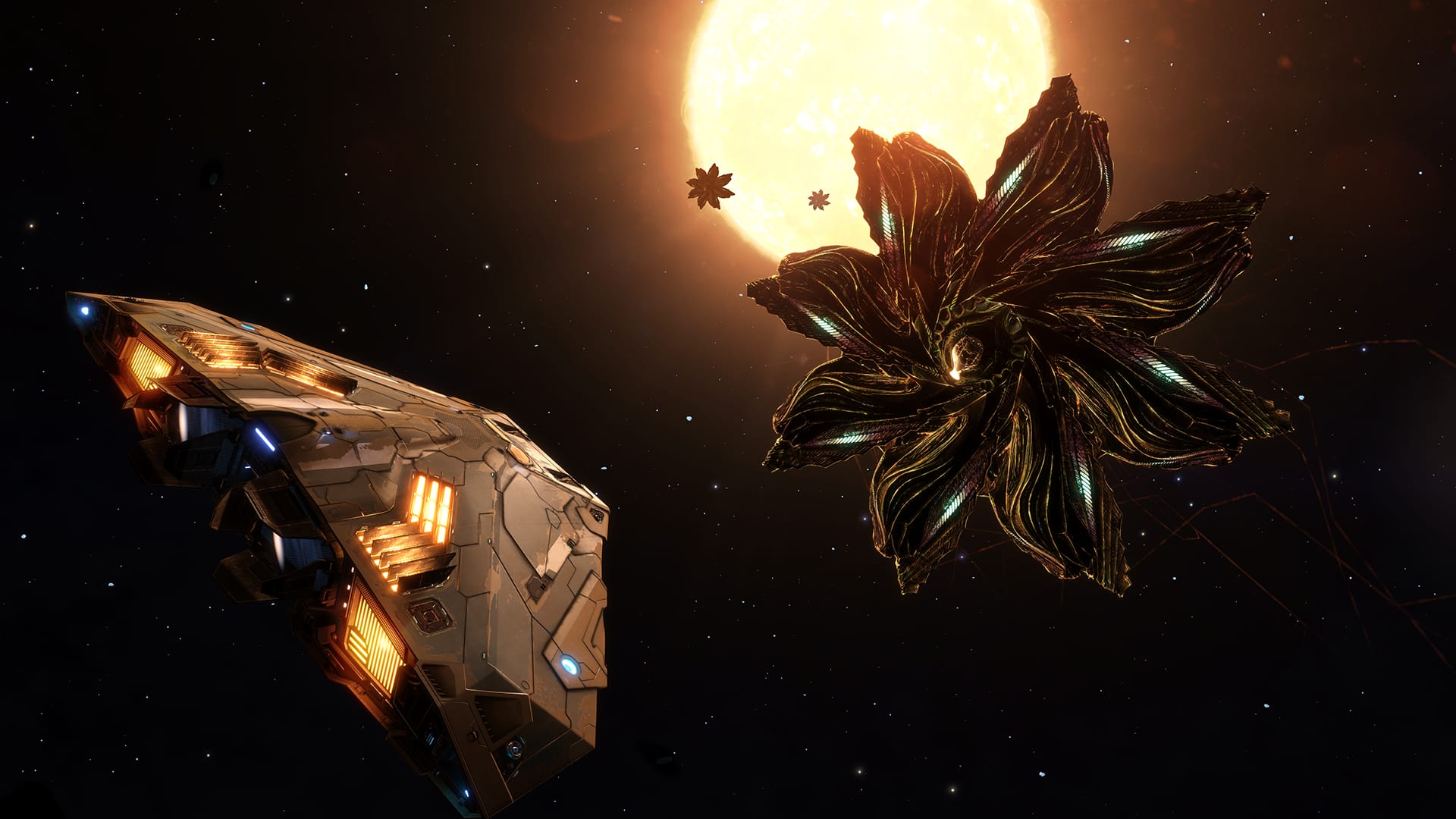
For the first time in over 30 years, we got a clear look at our supposedly extinct neighbors in the Milky Way. Ships that were previously polygonal—limited by the tech of the time, though their text descriptions always hinted at something insectoid—were now fully realized organic ships, shaped like flowers or distant galaxies, with intricate and overlapping petals radiating from a gem-like eye in the middle. The ships trailed blood-red gas as they maneuvered through space.
Importantly, they didn’t attack the first player they encountered. That player, CMDR “DP Sayre,” recorded the moment for everyone. We see the Thargoid powering up a weapon, its petals twisting and shifting around the central eye—but when it eventually unleashes hell, it kills a bounty hunter that had been tailing the player, not the player himself. It then simply drifts off, leaving the player alone in the Black. We were not alone.
At the time, players didn’t know what to think about the actions of the ship, but most were scared. “Fear is a perfectly sensible response,” Braben explains. “Humanity is so used to being on top of so many things—the food chain, technology, intelligence—but this is not the case when compared with the Thargoids, and that is why they are shocking to us. They think incredibly differently to humans, so we will always find them hard to relate to.”
In the years since that first encounter, we’ve seen much more of Thargoid technology (but not the creatures themselves). They seed planets to extract resources, which they turn into ships, bases, and more. Some of these encounters involve Scouts, small and fast ships that look like they’re cloaked in bat skin, their canopies pitted, wrinkled, and stretched between rib-like protrusions. Then there’s the Hunter, a Glaive-like ship with vast, sharp petals.
And then there’s the Maelstrom. Peak space horror. Thargoid Caustic Generators churn out a 100-kilometer diameter cloud of caustic gas, enveloping ships and turning the vast reaches of space into a claustrophobic red prison for anyone who wanders in. You can get lost in there, or find yourself chased by patrolling Hunters. At the core of this bloody red gas, a Thargoid Titan waits—the biggest ship they have (that we know of), a colossal whorl of organic matter. The scale is terrifying.

This is how the Thargoids now go on the offensive, arriving in an acidic cloud like a Lovecraftian fever dream. They’ve deployed eight Titans into space (though humanity has destroyed six, and a seventh is close to being defeated), pushing further into the Bubble than ever before, culminating in a direct assault on a system called Shinrarta Dezhra, in the heart of human space.
Piers Jackson, Senior Director of Projects at Frontier, said, “The unexpected arrival of eight Titan vessels and their desire to take control of areas of the human Bubble shows a conscious design—but the reason for this design currently remains clouded to humanity. The escalation step at Shinrarta is another step in this process that we’ll just have to assume has a purpose, and maybe one day we’ll understand the motivation and what it ultimately means for humanity.”
Of course, this could all be a misunderstanding. Elite Dangerous’s story, unfolding over years, is somewhat in the hands of the players and their itchy trigger fingers. Fearing the unknown might be sensible, but it could also be damaging us.
“The human reaction is to fight,” says Jackson. “The build-up to and the subsequent activity of the war on such a scale is no small undertaking. For anything to be this extensive, it requires significant set-up from both humanity and the Thargoids.
“It’s been really important for us to make this story something that can be owned and driven by our players rather than something we create for them to just experience,” Jackson continues. “We've created a fully procedural war that has been determined by player activity. We have not been in control of where players would interact or how they would plan as a collective to take down the Titans. Watching Commanders play the game in this way has truly been one of the highlights of the Thargoid storyline so far.”

With all-out war now at hand, we’ve probably pushed things too far. Perhaps conflict could’ve been averted if we’d known what the Thargoids wanted—but what is “want” for something this mysterious and alien? We fear them, but do they fear us?
“What makes you think a Thargoid can be scared?” says Jackson.
“Or even that they have any emotional responses we can understand?” Braben chimes in.
“Assuming that they do, there’s surely some historical scars from the mycoid biological weapon…” Jackson continues.
“Seeing fellow Thargoids destroyed from within by a terrible fungus that destroyed their bodies and their minds probably concerned them a little,” says Braben. “Without understanding the motives for the Titan attacks, it is hard for us to understand—but you would think seeing thousands of Commanders taking out a Titan would instill fear. Or it may be something as simple as being on a human world—the inferno-like (for them) high temperatures and blinding infrared light gradually destroying their low-temperature bodies.”
“Most likely though, they don’t know fear,” says Braben, ominously.
With the war between humanity and the Thargoids reaching new heights, Elite Dangerous continues to evolve. The recent update, Powerplay 2.0, revamped faction mechanics, giving players even more influence over the galaxy’s political landscape. As the conflict deepens, the choices players make now could shape the future of the galaxy more than ever before.
If you want to help shape that future and battle the Thargoid threat, you can find Elite Dangerous on the Epic Games Store.