Artikkel
How John Romero's newly-released Sigil 2 brings the ultra-violence back to Doom
R
Rick Lane
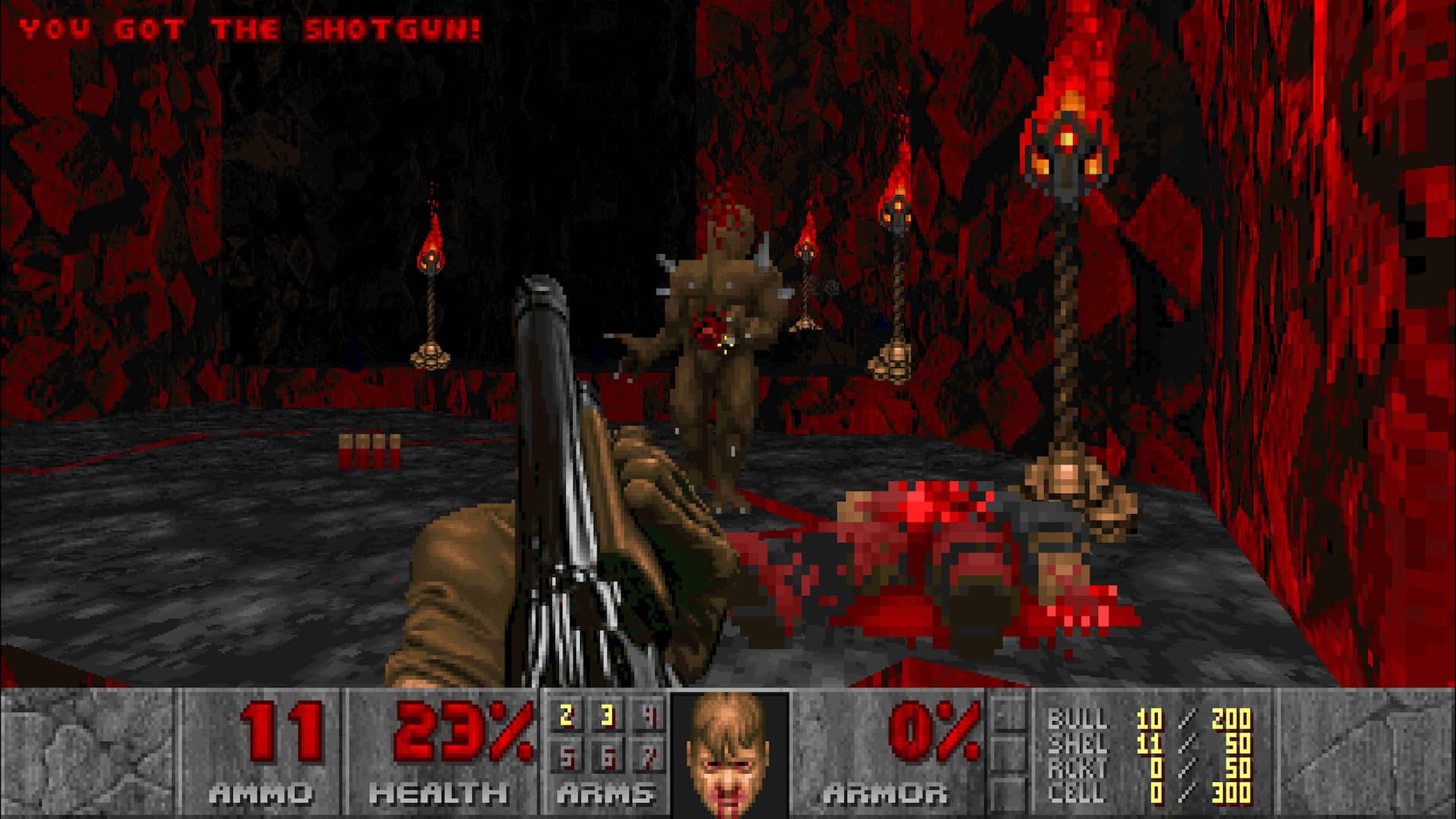
So I make a dash for it, sprinting between the islands and rushing past all the enemies. I reach the end of the path in seconds, which, incidentally, is exactly how long my feeling of triumph lasts. Because now I'm here, I can see there's no key. Somehow, I've run right past it. Now I'm trapped against a locked door without enough health to wade back through the fire, while every demon I legged it past closes in for the kill.
The original Doom set the standard for surprising, exciting 3D level design back in 1993, but Sigil and its recently released sequel are devious and delightful in whole new ways. Freely available to download with any copy of Doom, these two episodes were designed and released by Romero to celebrate the 25th and 30th anniversaries of the game's launch. Sigil and Sigil 2 revel in testing both your reflexes and your sphincter, and in doing so, they celebrate the original FPS hit's genre-defining action and game design in its purest form.

Unlike many Doom mods (or WADs, as they are better known in the community), Sigil and Sigil 2 don't seek to change how Doom plays. The weapon roster is identical to the original game; even Doom 2's double-barrelled "super shotgun" is considered a step too far from tradition. Likewise, the enemy roster is the same menagerie of imps, pinkies, and cacodemons first encountered in 1993. The sole mechanical change Sigil makes is that "Baphomet eyes"—floating eye sprites that appear in the original game's later levels—can now be shot from a distance, which open doors and new passageways.
The two episodes also stick closely to the original game's aesthetic, though they do add a few extra visual flourishes. The floors of hell are often riven with jagged cracks that glow with infernal fire, while the end-of-level switches have been replaced with titular sigils. Both episodes also include their own soundtracks, the first composed by the guitarist Buckethead, the second written by another musician who goes by Thorr. Yet even with these elements added, Sigil is always recognizably Doom—brightly colored, moodily lit, and slathered in blood.
What the Sigil episodes add is eighteen new single-player maps (plus eighteen deathmatch arenas) designed to test your FPS skills to the limit. Sigil's opening sets the tone, with you spawning inside a glowing pentagram gouged into the Earth, surrounded on all sides by fireball tossing imps. With only a pistol in hand, you're already on the back foot, forced to react instantly or suffer a quick, toasty death.
And this really is just the start. Sigil and its sequel strive to press you in every conceivable way. Where earlier Doom episodes always ensure you have big guns to deal with big problems, Sigil will regularly pitch you against cacodemons and even barons of hell with just a shotgun to fend them off. Likewise, where Doom generally affords you plenty of room to maneuver, here you'll be pushed for space in most encounters. Sometimes this is as simple as being stuck in a small room with a big monster. But later levels find more creative ways to test your movement skills. Winding ledges are a common theme, with you often required to tightrope-walk across a meandering strip of rock while dancing around projectiles fired by enemies from higher vantage points.
It's fierce, frantic, back-against-the wall stuff. But for the most part, this is exhilarating rather than frustrating. Sigil's intensity provides a similar thrill to the more recent Doom reboots. Yet where the modern games transform you into a godlike super-soldier, Romero emphasizes your squishy humanity. Even on Hurt Me Plenty, which is generally regarded as Doom's default difficulty (though Romero initially designs his levels for one difficulty level higher, Ultra Violence, like most Doom modders), you'll often find yourself foregoing the last few enemies and scrambling for the exit, your guns run almost dry, "Doomguy's" face a mop of blood.
Part of this thrill is how frequently Sigil and Sigil 2 throw you for a loop. Each map is a highly dynamic, amorphous creation, where a door is very rarely an actual door. Usually it's a cavern wall, or a hidden stairway, or a rock bridge that elevates to neatly connect with your current path. Typically, revealing these pathways comes with a side order of monsters, but the scenario setups are rarely obvious, and you'll either gasp with surprise or grit your teeth at the meat grinder that lies ahead.

Each map tests you in different ways. Sigil's fifth level, Abaddon's Void, takes place in a large open area with multiple mazey buildings, and the challenge is figuring out the right path between them. Oh, and there's a cyberdemon in one corner of the map that harasses you with rocket fire (until you find the secret, spectacular way to kill it). The seventh map, Nightmare Underworld, is a test of endurance and orientation, riddled with secret teleporters that throw you back into different parts of the map, often with new monsters waiting to eviscerate you.
Sigil 2's design is largely of a piece with the previous episode, but there are some differences. The sequel folds in more of Doom's sci-fi stylings, bringing back the gunmetal corridors, exploding barrels, and glowing sludge ponds. The levels, meanwhile, are generally larger and swing to greater extremes. The second map, fittingly titled "Violent Hatred," really puts you through the wringer, making every shot count. Whereas the following level, Twilight Desolation, is considerably more generous, giving you room to dish out some hatred of your own. But the highlight of Sigil 2 is Vengeance Unleashed. A bulked out variation on Paths of Wretchedness, it too sees you battling along three paths to grab three keys. But the paths are longer, and the surprises are nastier, including a treacherous scramble through a perilously narrow canyon and a labyrinthine encounter with the cyberdemon.

Ultimately, the two Sigil projects are a testament to the power of good level design. Thirty years ago, Doom was a technological revolution and a mechanical revelation. Nobody had seen anything like it. Today, it can't rely on either of those qualities to get players to buy in, and all its remaining power lies in its game design; the balance of its weapons, the AI of its enemies, and the flow of its levels. In Sigil and Sigil 2, Romero takes these elements and focuses down on what makes them truly special, constructing an utterly thrilling FPS experience that could stand alongside any shooter. And not just other retro-oriented shooters like Turbo Overkill or Warhammer 40,000: Boltgun, but modern gun-fests like Call of Duty and id's own more recent Doom games.
If you want to try Sigil for yourself, you'll need a copy of Doom, which is available here on the Epic Games Store. From there, you'll need to navigate to the game's "addons" menu and search for the two episodes. When you activate the WAD, it'll replace Doom's menu with that of either Sigil or Sigil 2 (you can only activate one at a time). After that, choose your difficulty, ready your pistol, and prepare to bleed.