How One-Eyed Likho brings Slavic folk horror to life
After releasing their sophomore effort, Black Book, Russian development studio Morteshka found themselves burnt out. The scope of the game, a 30-hour deck-building RPG steeped in the region’s 19th-century folklore, had been a tall order, especially for a six-person team. The studio needed a change of pace. Something short and punchy.
The result, One-Eyed Likho, looks toward the recent indie horror game boom for inspiration. First-person and monochromatic, its style differs so drastically from Black Book that you’d hardly know the same studio is responsible—save for one constant, that is: the moody, folkloric backdrop. Along with Morteshka’s debut game The Mooseman, that’s three for three.
Studio Founder and Game Director Vladimir Beletsky was interested in folklore even before he started making games, but he never envisioned it becoming the studio’s calling card. “The first impulse was to make something unusual,” Beletsky says. “I thought, ‘Alright, let’s choose a setting that has not been overused in the media, not a general fantasy with elves and goblins.’ And it turns out that folklore is the thing that we can leverage to achieve this.”
Although the game begins with a “Once upon a time,” it sidesteps the more sanitized, child-friendly atmosphere of the fairy tales we remember today. The studio wanted something darker, something truer to the original works. For that, they were drawn to the tale of a malevolent entity called Likho. “It’s not 100% commercial decision-making,” Beletsky laughs. “We weren’t researching the market like, ‘Oh, here’s a niche for a creepy Slavic monster.’”
Many of the decisions that went into the game are, in fact, decidedly uncommercial—the spoken dialogue is all in Russian, and the graphics are black and white. Initially, they’d even experimented with a 4:3 aspect ratio (which remains only in a few of the non-interactive sequences).
The name Likho, too, is less familiar, particularly to a western audience. “Everyone knows Baba Yaga, right?” Beletsky says. “But not everyone knows this one-eyed Likho.” Even in the Slavic countries where the story originated, Likho is a little more obscure. The most famous version of the story appears in 19th-century ethnographer Alexander Afanasyev’s seminal folklore collection, the Russian equivalent of Grimms’ Fairy Tales.
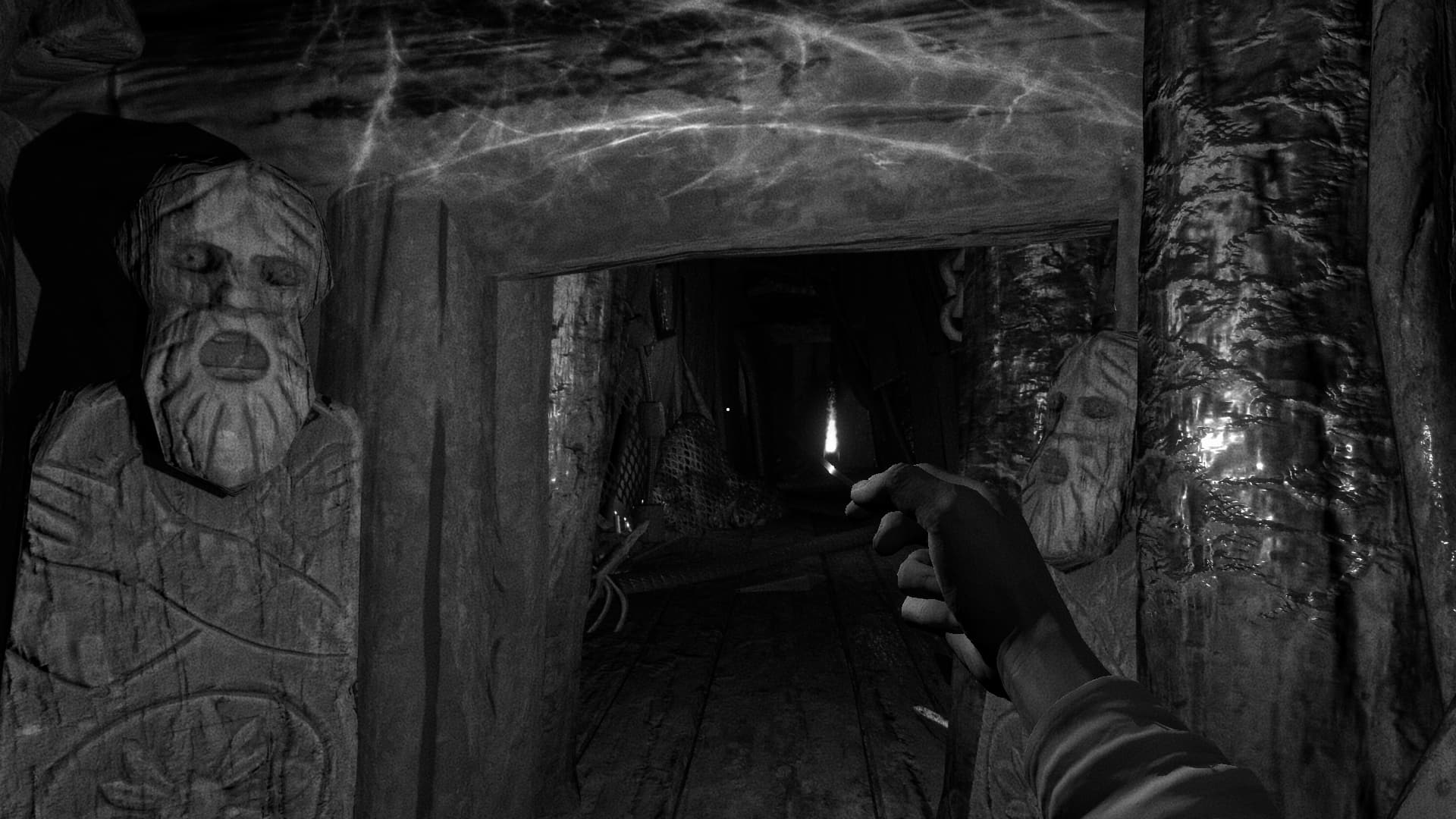
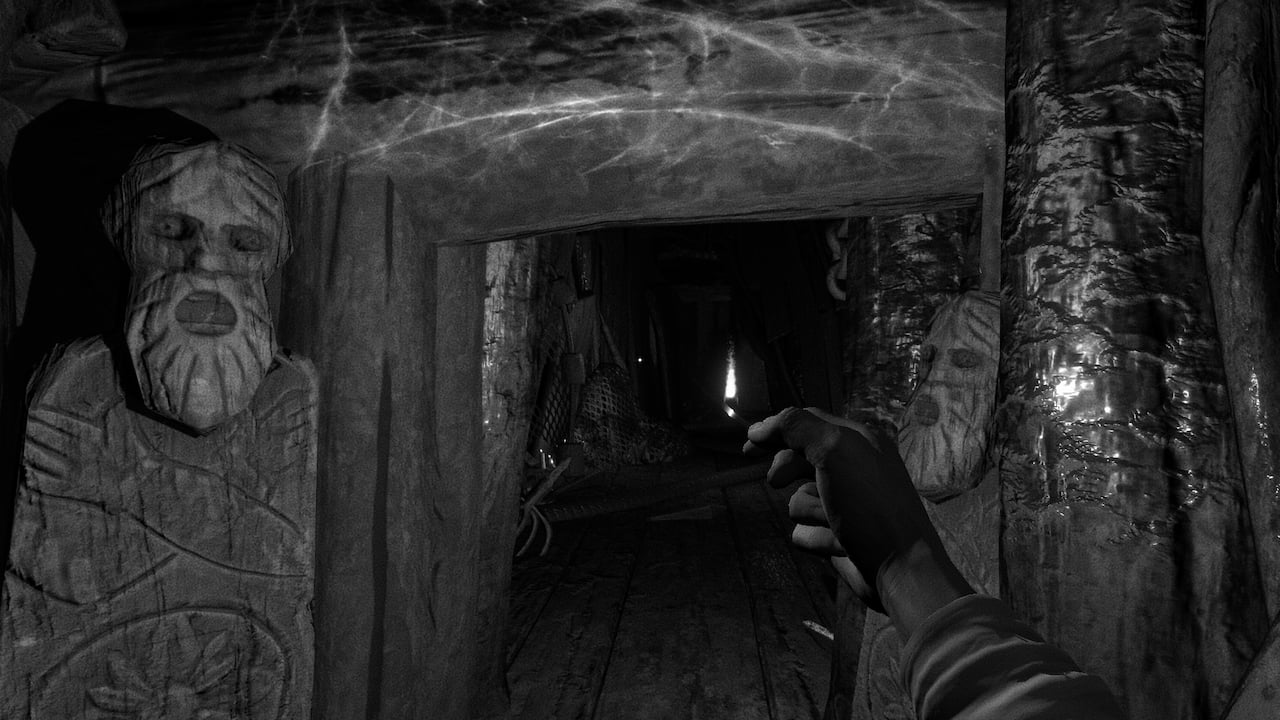
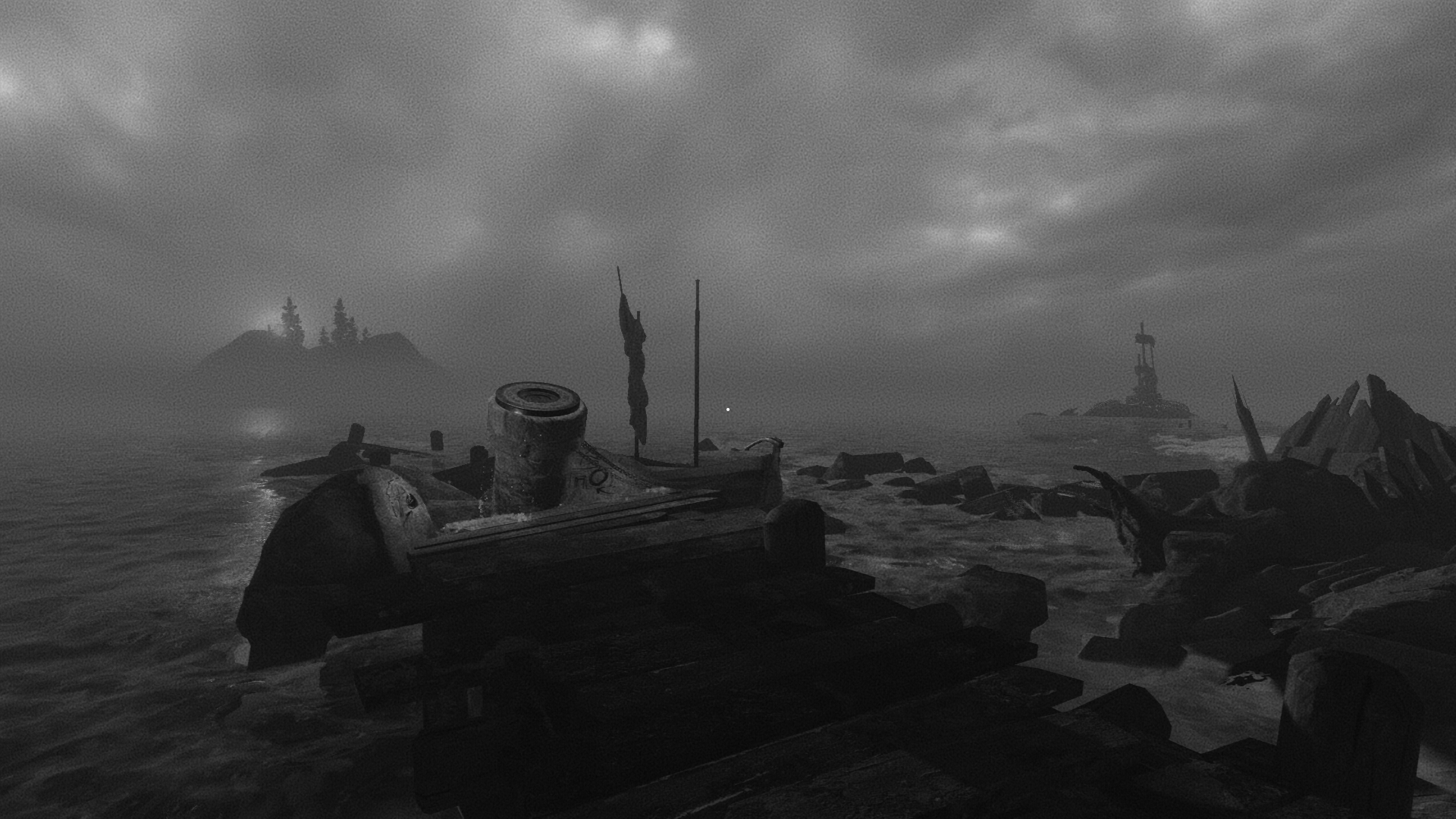
Morteshka’s game roughly follows the outline of that story. Having never experienced misfortune, a blacksmith goes looking for it in the woods. He finds the very personification of it in the form of Likho, a bent old woman with one eye. He ventures into her shack, where choked corridors give way to sprawling cliffs and a vast ocean with an island in the distance. From there, the game becomes a puzzle adventure, with the smith trying to find his way out of Likho’s realm before she catches and eats him.
“I chose this fairy tale not knowing much about it,” Beletsky explains. “I read it a couple of times, and knew it was grim, dark, fit for horror. And it turned out that this is a world-spanning motif that is cataloged in the Aarne-Thompson-Uther index, number 1137.” The Aarne-Thompson-Uther index is used by folklorists to catalog story archetypes from around the world, noting recurring elements and themes between cultures.
The most famous literary version of this story, the index notes, is the cyclops Polyphemus in Homer’s Odyssey, and the most inspired touch for Morteshka’s version is in how it references these other retellings by using them as collectible pages. Acquired through certain puzzles, the pages fill up a vast tome, with some versions diverging quite heavily but all, essentially, belonging to category 1137. For the player, the recurrence of these elements creates a sense of doom and inevitability, while also serving as foreshadowing: It is hard not to notice, for example, how many of the protagonists across cultures survive their encounters only after a particularly dire sacrifice.
One-Eyed Likho, then, is not simply a retelling of the fairy tale; it’s as though the blacksmith protagonist is forcibly assigned a part in the staging of a drama, and he must perform the role until the end. “The characters ask themselves, ‘All these fairy tales, what do they mean?’” Beletsky says. “And we as developers don’t have an answer, so we leave that for players to answer themselves. What does this particular fairy tale mean? Why did the smith go to search for this monster, this one-eyed ogre? What did he discover in the end, and what the hell is going on?”
Moving through Likho’s realm, the smith has few tools at his disposal. The most critical is fire, manifested through a sort of bottomless matchbook. Though you never have to worry about restocking your supply, each match burns out quite quickly—meaning it’s easy to get distracted by what’s happening in the background until you hear the smith yelp because he’s singed his fingers.
“There is a wave of tension and release that the match creates,” Beletsky explains. The team experimented with a few light sources, but the match ended up being the one that worked best; a “horror lantern with benefits,” Beletsky calls it.
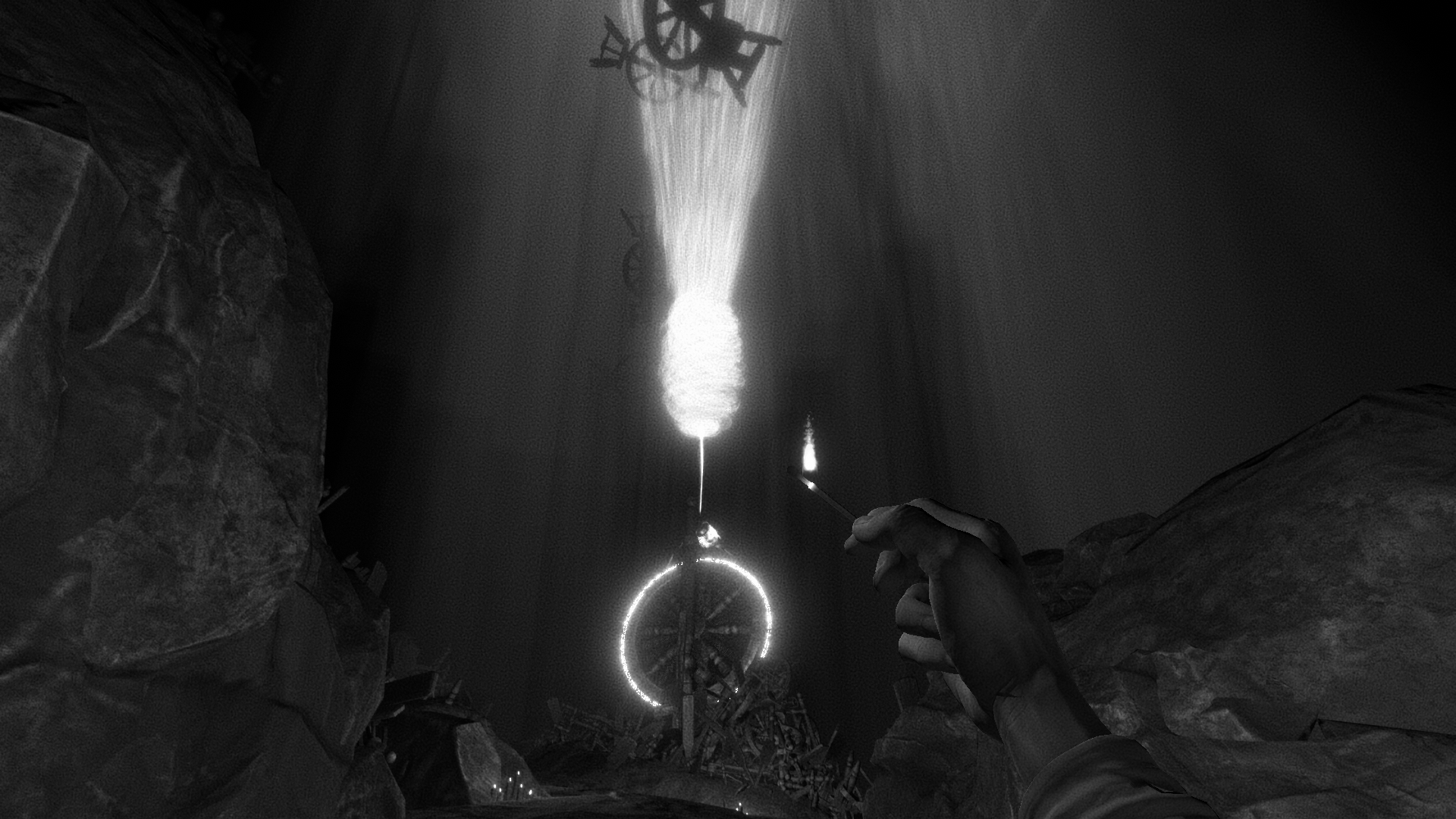
The game’s striking monochrome visuals presented a unique set of challenges. “Black and white has less information than full color,” Beletsky says, “so it’s difficult to make coherent level design…[and] lead players where you want them to go. So you have to make different kinds of lighting and different object placement so that the levels are readable visually, so the player won’t get lost.” Midway through development, the team experimented with limited colors to highlight special items, but they ultimately kept the whole game grayscale. “We started making props for the game in color first,” Beletsky says, “and it was hard to get the contrast right. So in the end, we made all the props black and white from the get-go, while painting the textures in a high-contrast way to make them readable.”
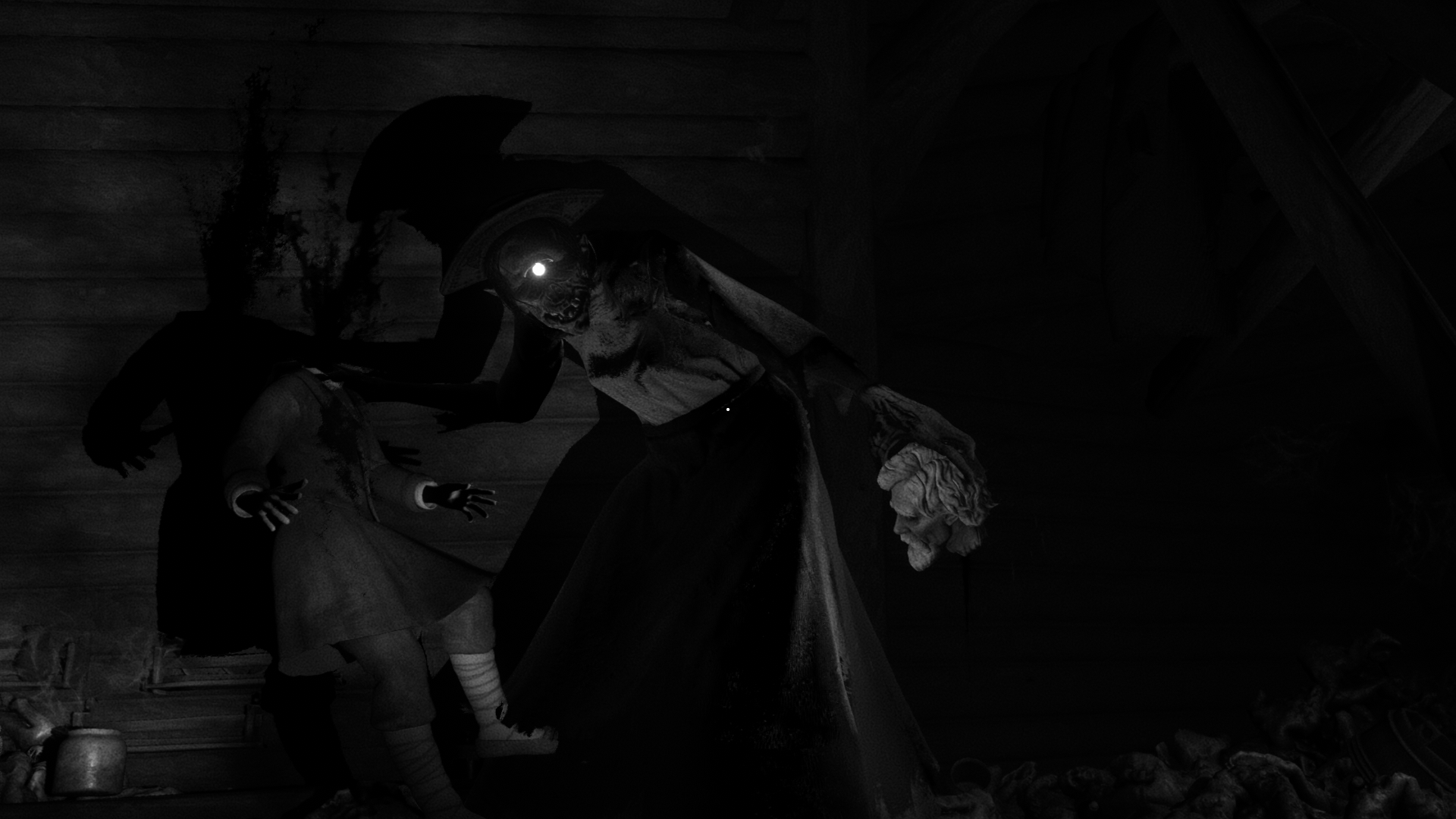
They’ve made some tweaks to the source material, of course. One is the design of Likho herself. “If you read the fairy tale,” Beletsky says, “the character does not have a single eye socket. If you read carefully through the text, it seems that the woman is one-eyed but she has another eye that is bad, basically. And first, the character was like that, but it didn’t feel right when compared to all the other stories.” She remains in a traditional sort of Russian attire to pay homage to the Afanasyev story, but her eye places her closer to the lineage of other versions around the world, like Polyphemus.
The other is the presence of a companion character, the tailor. “He is swiftly disposed of in the original,” Beletsky says. But in the game, the tailor sticks around even after his apparent death, as a disembodied head that eventually gets spider legs. He fills a role that’s not in the original story but is present in much other folklore: the presence of a sort of magical helper. “We decided that we wanted a literal magical helper that will accompany the player, relieve the tension, and create some space for us to explore this narrative of the game, so you can discuss with him,” he says.
One-Eyed Likho is culturally specific, but much like the source material itself, it’s in conversation with works from all over the world. Throughout the interview, Beletsky cites A24 films as inspiration, like the work of Robert Eggers on folk horror film The Witch and the black-and-white movie The Lighthouse. In terms of games, he mentions the monochromatic styles in Return of the Obra Dinn and Mundaun, itself a game steeped in a region’s highly specific folklore. But the one he brings up most is MADiSON. In one sequence, Beletsky explains, you play an old gramophone to advance, but you’re periodically stopped by the monster, which means you need to run and hide before starting again. For One-Eyed Likho, there’s a section where you need to shear some sheep to sneak past Likho. While you collect their fleece as Likho stalks somewhere in the background, the sheep sing to you about the imminent death you’re facing.
“We wrote a song specifically for the sheep, in the folk tradition,” Beletsky says. Music has been a significant part of the studio’s games, particularly Black Book. For this sequence, they turned to their previous collaborators along with the student choir of Perm State College of Arts and Culture, who performed the sheeps’ voices. It’s the only song in the game, but musician Mikhail Shvachko, who has worked on all of Morteshka’s games, couldn’t help but go all out, reconstructing an obscure folk instrument called the letchan-vuzj that he’d only been able to use samples of previously. “Now he has a full thing ready-made, and he played the theme and this sound is so primal and plutonic and fits the game perfectly."