How the devs behind Shoulders of Giants: Ultimate are using their own XP to level up
The thing about once-in-a-lifetime opportunities is that sometimes you have to be willing to accept their radical consequences. Patrick McAvena and Kyle Erf of Brooklyn-based developer Moving Pieces Interactive—the studio behind Dodo Peak, Shoulders of Giants, and the upcoming super-sized Shoulders of Giants: Ultimate—are living proof, because they weren’t even really, entirely game developers when they said yes to an opportunity to make a video game, and it changed their lives.
In 2019, McAvena and Erf were just a couple of guys who loved video games and dabbled in game development, but they’d spent their working lives in semi-related fields. Their passion for the games they loved wound up not just earning them the opportunity to become independent developers, but the ability to sustain it.
“I always wanted to be a game maker,” said McAvena, now President at Moving Pieces Interactive. “When I was in college, I started doing film, and then I kind of landed in visual effects. I got a little bit burned out from doing advertising stuff.”

A wildly impressive independent game became the catalyst for a change.
“Maybe this is silly, but when No Man’s Sky came out, I was like, ‘Man, I really wish that I made that game. It’s just everything that I would [make]. This is so cool.’ And that was an inspirational moment for me where I’m like, ‘Maybe I should really actually try to get into games.’ So that’s when I started picking up Unreal and teaching myself and started working on little projects here and there.”
One of those little projects became another catalyst.
He met Kyle Erf in a Playcrafting video game development class, where they teamed up to make what Erf describes as an “inscrutable puzzle game that was basically like an arcade shooter/match-three thing that no one understood how to play.”
Erf also loved games from an early age, when he drew map ideas in the notes section of Spyro the Dragon's instruction booklet. Like McAvena, his love for games never dissipated, but he steered his career in a different direction. He majored in computer science and made his living as a programmer.
“I kind of ducked out of the games thing because you heard all these bad stories about labor, especially 15 years ago. I also do comedy writing. That’s why I’m in New York. Everyone I was with was like, ‘I want to write for TV. I want to write for TV. I’ve got to get this TV job.’ And then at some point I was like, ‘I don’t even watch TV. I play video games. Maybe I should look into that.’ And I just decided to try and get serious about it and met Pat pretty much right away.”

In his spare time, McAvena was developing a love letter to ’80s Atari games like Frogger and Q*bert called Dodo Peak. The funding for its development as an Apple Arcade launch title allowed him to enlist Erf’s help. They started Moving Pieces Interactive together in 2019 to finish Dodo Peak.
“So, in the span of a month, it went from, like, ‘Hey, Kyle, do you want to help us with this?’ To like, ‘Hey, Kyle, do you want to quit your job and start a game studio?” Erf said.
Apple Arcade launched in 2019, and after some Dodo Peak content updates, the only thing left to do was to keep making games.
But what game? The answer to that question would dominate the next few years of their lives. And just as before, they found inspiration in games they’d long loved and admired—but not before a lot of experimentation.
“I was free to start experimenting,” McAvena said. “And we played with a lot of different ideas for a while, but we hadn’t been in that place before where we literally had a full-time, you-go-and-make-the-game-that-you-want-to-make situation, which we didn’t have with Dodo Peak because that was kind of like a side project at first.”
That experimental attitude took them down a bunch of divergent paths, but eventually led to Shoulders of Giants.
“It was just kind of like, let’s try this, let’s try that, let’s prototype things here and there and see what works,” McAvena said. “It initially started out as an RTS game actually, which had some cool elements, but it slowly evolved into third-person action.”

Erf said that Shoulders of Giants came not from a clear idea of what, exactly, the game was going to be but a riff on some games they loved. They didn’t have a game design document like they would today, but they had inspirations and ideas that worked.
“It was kind of like Ico where you had this big robot and you were a small guy and you had to run past all these dark monsters and collect the energy power robot,” Erf said.
“Yeah,” McAvena said. “The robot was sort of like Yorda from Ico. It was cool, but it was hard to get an established gameplay loop where you felt like you were progressing. And we were not going to make this massive story, we were more interested in making a systems-type game.”
That was the sprout from which Shoulders of Giants grew, but it wasn’t an obvious or linear path they followed.
“I would characterize it as very improvisational, almost,” said Erf, who’s a house writer at the Upright Citizens Brigade, a comedy theater that specializes in improv. “We were really inspired by games like Ratchet & Clank—funny, comic-book duos. We were really interested in making a game that had a really big character and a small character that rode on its back.”
They settled on a small character and a big character who operated independently. That’s where they found a lot of the initial fun.
“The one thing I will say is we landed on the name Shoulders of Giants immediately when we were like, ‘Oh! a small guy on a big guy!’ That’s kind of the only thing that didn’t change dramatically. I think even once we settled on it being an action game, it was still a lot of playing just as the frog. That’s why it’s a frog—because frogs jump.”

The only problem was that, when you got off the big character, it didn’t have much to do. They had the characters, but the gameplay wasn’t quite right. So they kept iterating until they found the solution: chase simplicity.
“We ended up just thinking to ourselves, ‘OK, how can we simplify it?” McAvena said. “Let’s just make them attached at the hip and use the tried-and-true thing that everyone’s just used to, ranged and melee, but we make it feel as if you’re controlling two characters.”
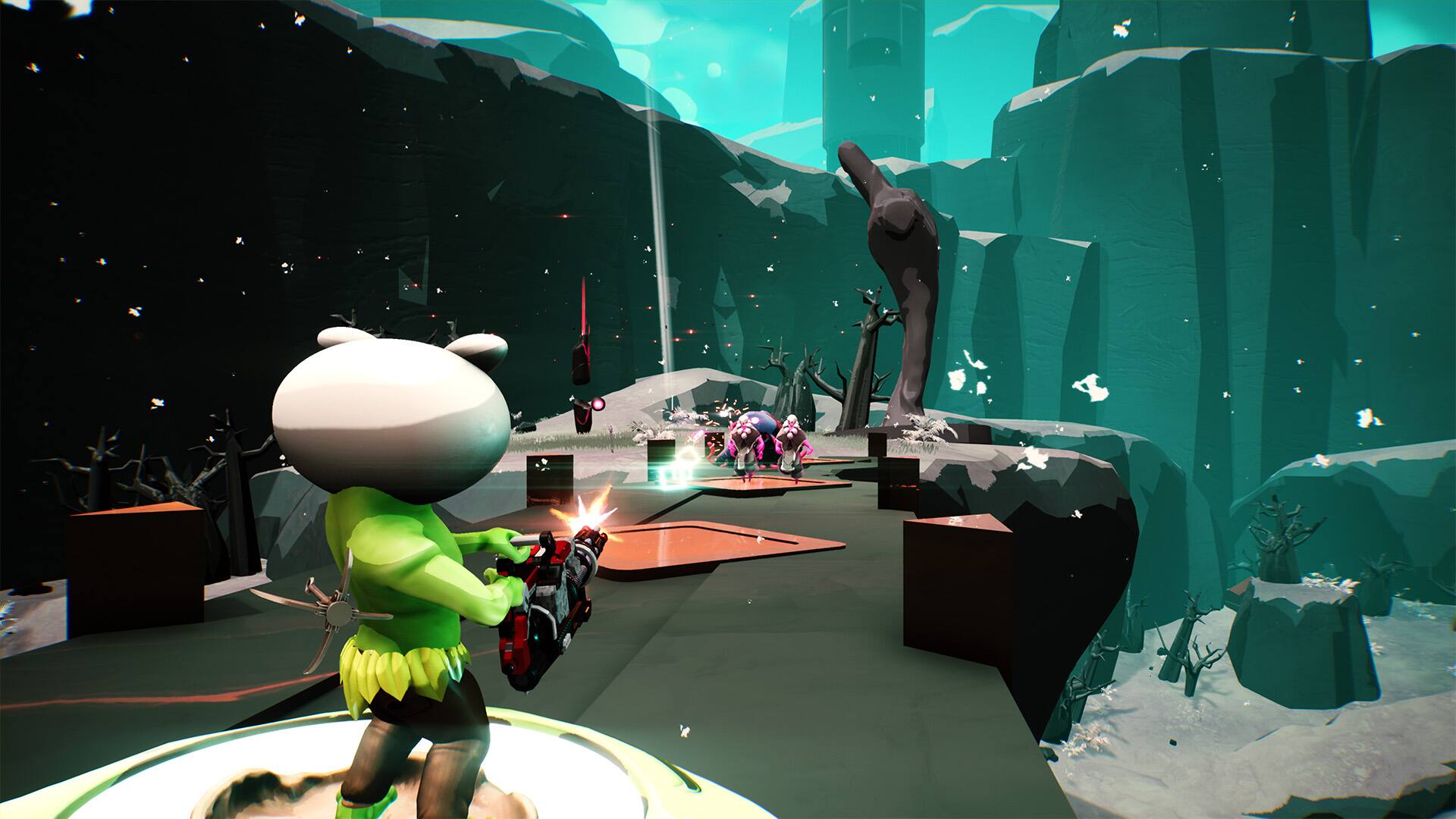
That remains the core of Shoulders of Giants, where players take on the role of GERM, a sword-swinging robot, and its friend Froggie, a space frog gunslinger. Shoulders of Giants evolved away from real-time strategy and into a roguelike. Froggie and GERM travel from planet to planet, fighting the evil forces of Entropy spreading through the galaxy, collecting and assigning power-ups that improve their innate talents.
Shoulders of Giants is also playable with a friend or up to four players in online co-op, which was a welcome addition during the depths of the pandemic when McAvena and Erf didn’t see each other much face-to-face.
And now these guys who’ve always loved games and kind of still can’t believe they make games for a living get to do something special: revisit their first game. That’s the story of what’s next for Moving Pieces Interactive—the opportunity to return and create Shoulders of Giants: Ultimate.
“We think of Shoulders of Giants: Ultimate kind of like the director’s cut of the game, taking everything that we’ve learned,” McAvena said. The developers released Shoulders of Giants in early 2023 and followed up with balance updates and content additions—but in some ways, Shoulders of Giants: Ultimate is the result of not working on the game.
“We kind of paused for a little bit so we could really think about the game and come back to it with fresh eyes,” McAvena said. “So one of the biggest changes that we’re making is basically a lot of changes to the pacing of the game. We knew Shoulders of Giants was about combat, but taking a break reinforced that it’s about combat. And so basically there’s going to be a lot more enemies that spawn at faster rates. You can also kill them faster.”

Erf framed returning to the game as a privilege, in part because he gets to make his own game better.
“It’s impossible to experience the game you’re making as a new player, unless you put some distance in there,” Erf said. “So coming back—most things I’m really happy [with], but every few hours there will be, for instance, a level-generation thing where I have to walk way too far. What were we thinking? And it’s like, we were thinking about a hundred other, bigger problems.”
The time spent away from Shoulders of Giants was on a new project, and McAvena and Erf got to bring some of what they learned from that experience into Shoulders of Giants: Ultimate.
“One of the cool things, too, with the new project that we’re developing is we’ve actually figured out some new tech for the new project, and it allows us to have a lot more enemies on screen,” McAvena said. “We were able to use our new game’s tech and learning and bring that back into Shoulders of Giants and that’s going to get the enemy number up to where we always wanted it to be but couldn’t quite do it before.” They're also upgrading the game to Unreal Engine 5, which McAvena said will bring updated visuals.
Patrick McAvena and Kyle Erf make the most of their opportunities, even if they’re twice in a lifetime. They’ve spent decades loving games, and now they’re making games that they love based in part on games that they love. It’s steered them in the right direction so far.
But it’s not just love and inspiration that will change Shoulders of Giants: Ultimate. Now it’s their experience. “We're just kind-of better at making games than we were five years ago,” said Erf.
Shoulders of Giants is available now on the Epic Games Store.