How Vampires Crawlers does and doesn't reinvent the deckbuilder wheel
It's not often that a game studio gives birth to a new genre. That was the case for Poncle's illustrious and absorbing Vampire Survivors back in 2022. The "reverse bullet-hell" has fostered a myriad of iterations from other studios in the years since launch, accruing critical acclaim along the way. Now, Vampire Crawlers: The Turbo Wildcard from Vampire Survivors is on a different landscape altogether, with the mission to leave a mark in a mix of genres that have been oversaturated for years now.
Vampire Crawlers introduces itself as a turn-based, card-driven blobber with roguelite elements. It mimics old-school dungeon-crawling games, but at its heart, it's a tactical deckbuilder through and through. Capitalizing on the spirit of its older sibling, this spin-off is all about creating the most overpowered combination of cards you can come up with and obliterating any creatures that come your way with ease.
The premise is intriguing, to say the least, considering Poncle, as well as co-developer Nosebleed Interactive (of Vostok Inc. and Arcade Paradise fame), have thrown themselves in front of an audience with high standards that have had no shortage of titles to play, especially in recent years. Yet, the studios have turned this predicament into an opportunity. By leaning into what made Vampire Survivors stand out and carefully examining the current deckbuilder and roguelite landscape, Vampire Crawlers understands when to reinvent the wheel and when it's best to lean on familiarity instead.
Building upon a legacy
Luca Galante, the main developer of Vampire Survivors, took the success of the game to heart when thinking about the name and the aesthetic of Vampire Crawlers. Speaking to GameSpot, the developer quickly made the business decision of continuing to build upon the IP and idea rather than starting from scratch.
"If I wanted to make a game like this, and make a new IP to go with it, it's just going to be one among the other hundreds of deckbuilders out there," Galante told GameSpot. "The Vampire Survivors name gives us the strength and the ability to tell people, 'This is a Vampire Survivors deckbuilder. You will find elements that you're already familiar with in this game, and it will capture the feeling of the original.'"
This approach also allowed the teams to avoid having to come up with new settings, characters, and lore before getting to work on building the game. To Galante, the mechanics were the main focus. Yet, despite having a trove of assets and ideas to draw from and iterate upon, it took the teams about four years to develop the spin-off. As explained to Xbox Wire, Vampire Crawlers is part of what Poncle calls "experiments" internally, with Galante and his crew getting in touch with other independent studios to work on spin-offs. Crawlers showed promise from its prototype phase, and proceeded faster than any other, making it the first one to come to light with an official launch.
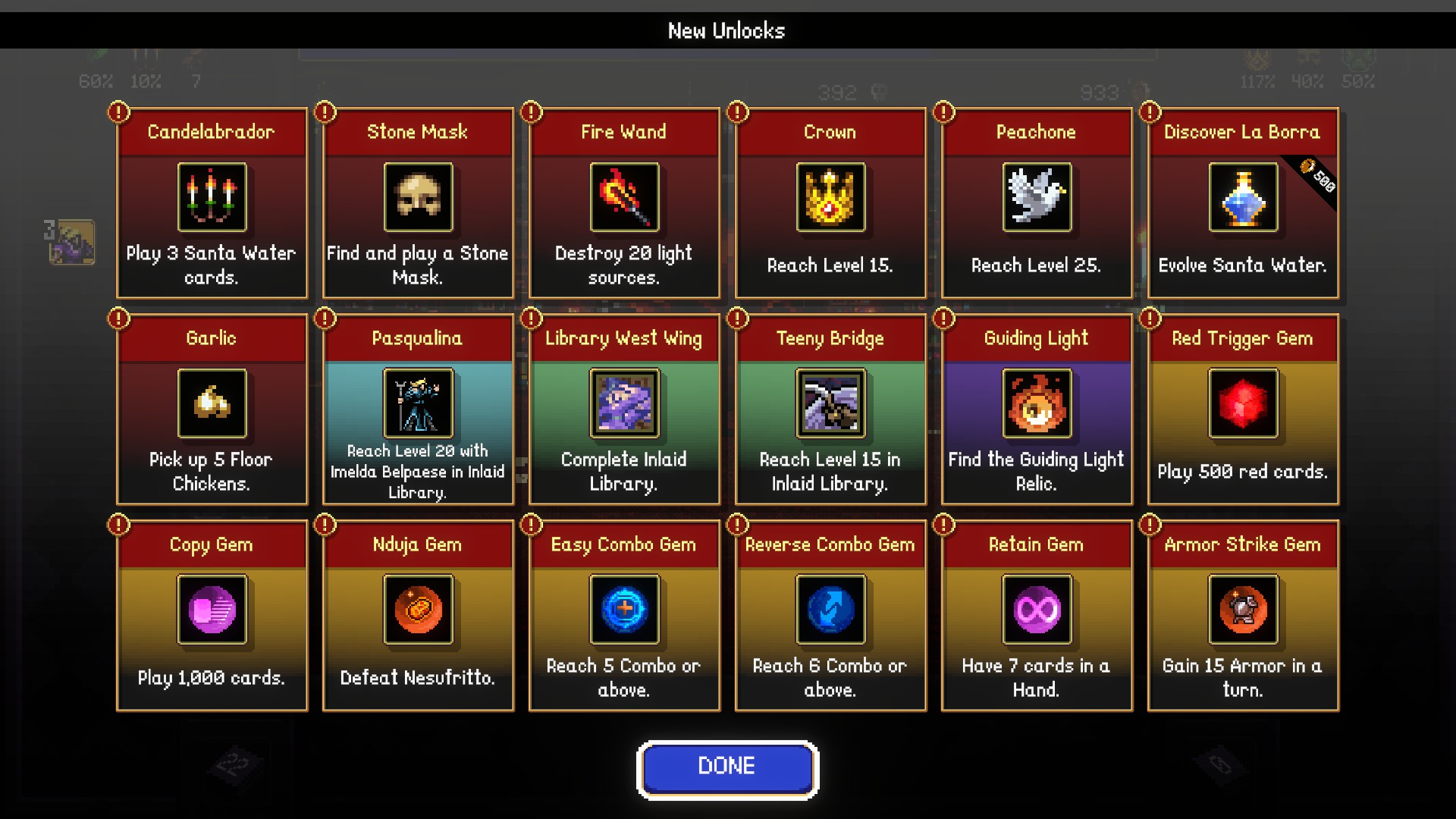
Boot up the game, and all of the aforementioned decisions come to fruition. Regardless of how many hours you've spent in Vampire Survivors, you'll immediately feel at home here. From characters to textures and sounds, they all capitalize on an existing universe, and no element feels out of place. Features like the extensive unlock list of Vampire Survivors also make a comeback, greeting you with 128 tasks to keep track of over time—a number that will surely increase as Poncle and company keep adding onto the game. Moreover, familiar maps, such as the Mad Forest, are turned into regions to explore from a first-person perspective.
The latter is an important shift. In Vampire Survivors, you control characters from a top-down view, usually moving left or right as countless enemies try to stop you. In the spin-off, you take a more methodical approach, as the game displays a minimap that shows exactly where enemy encounters are, as well as question mark icons for secrets and treasure chests, among other artifacts. Of course, you can expect plenty of surprises along the way, but the most crucial information is clear from the beginning, and you can take your time with each region's floor.
This classic RPG approach, where you move one tile at a time and have to manually rotate your camera in any of the four directions around you, isn't just an aesthetic change. It serves as a powerful distinction. If you've played Legend of Grimrock or Darkest Dungeon, Vampire Crawlers strikes a balance between the two, honoring the classics while making all necessary modern tweaks to maintain the spirit of Survivors intact.
"What sparked the idea was the fact that in a lot of roguelike games today, you get a rather bare-bones choice-tree that doesn’t feel that interesting anymore," Galante told Xbox Wire. "It's practical, but I wanted to create something just a bit more involved, to give a little more meaning to exploration (just not too much or we’d be walking into RPG territory). It’s been challenging to make sure exploration isn’t a too heavy component of the game! The dungeons exist mainly to offer more interesting choices about what to do in between fights and to help in giving the feeling that you are moving through a world where a large variety of things could happen, instead of just navigating menus."
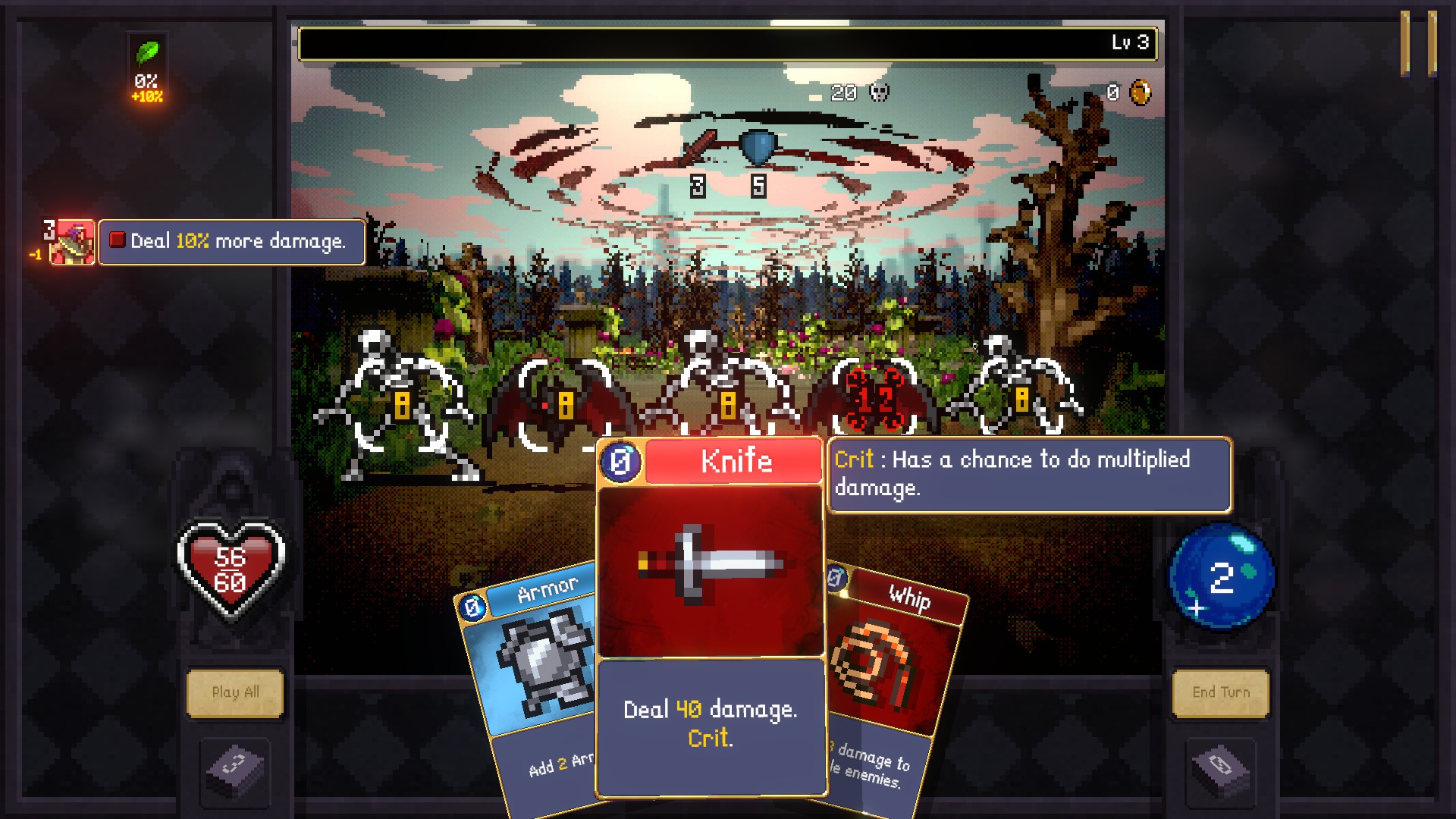
Once the team nailed what they wanted to do with the concept of a blobber, it went ahead and built just enough new ideas to adapt the breakneck rhythm of Vampire Survivors into this tactical iteration. You can still find items like the King Bible and the ever-mighty Garlic, but you now have to take positioning and deck-building into consideration, with enemies moving one tile forward toward you with each passing turn, which is what allows them to attack. Properties such as causing knockback or targeting multiple foes simultaneously can turn the tide of combat easily if used correctly.
How much mana you have available, too, can really set a limit to your actions. This becomes a crucial trade-off mechanic, as you can use mana to give yourself bonuses, like playing the Spinach card that grants 10 percent more damage, for example. It's a choice you have to make in every turn, and one that can be tantalizing in either direction—these bonuses can be stacked, but you'll also be using mana that could otherwise be spent on cards that grant you shield, health, or that actually cause damage to your opponents.
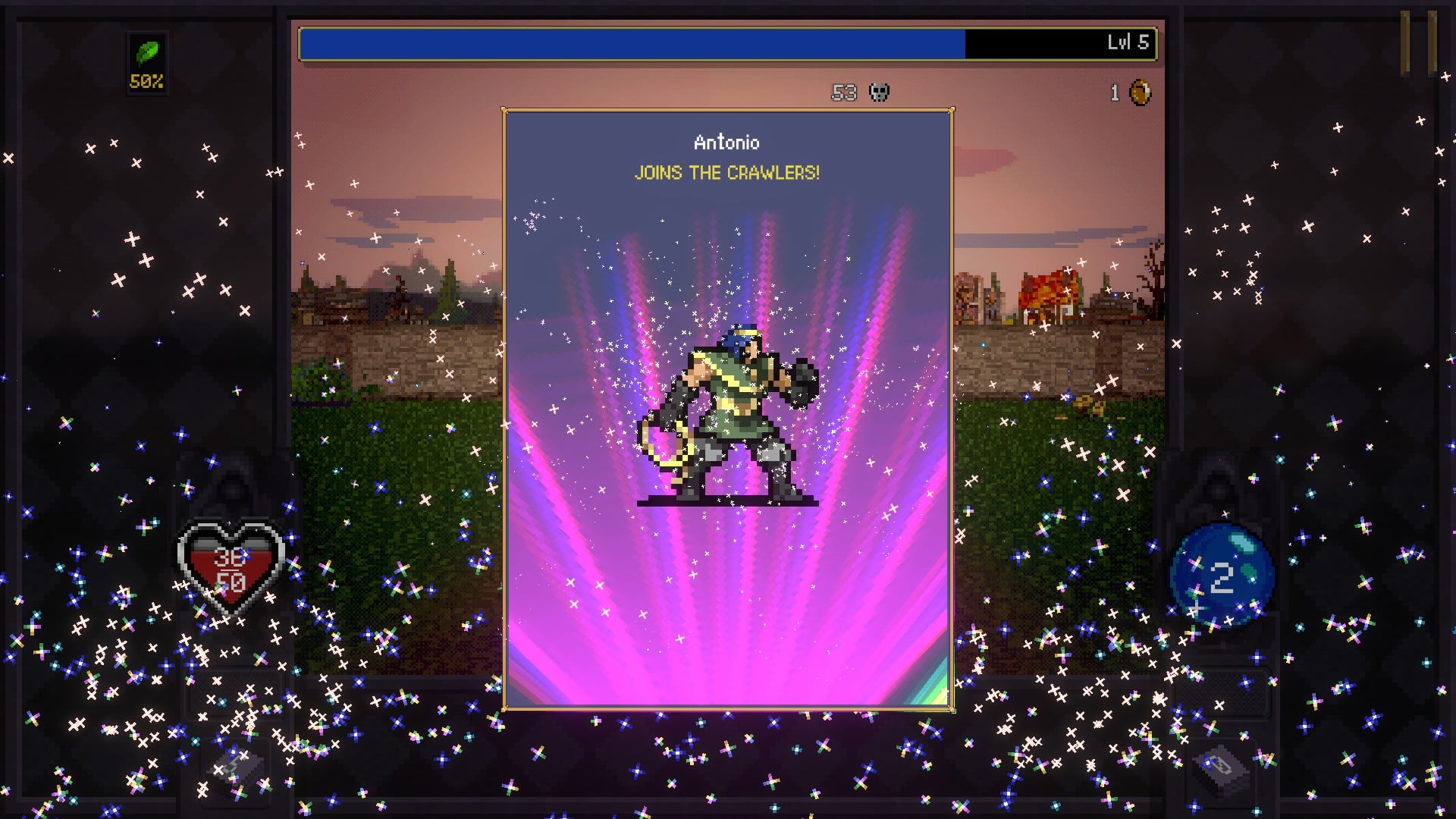
Yet, there are familiar elements from Vampire Survivors that remain as satisfying as ever. The action of opening a chest is still as ridiculous as ever, with a flurry of lights coming out of it and a disco-style song accompanying the moment. It's moments like this that reinforce what made Survivors a standout, and it's such an interesting study to explore exactly what the developers decided to keep for the spin-off.
Don't think, feel
"I wanted to keep bringing the core principles, the core ideas of Vampire Survivors, to other genres," Galante told GameSpot. "I started Vampire Survivors for fun. It was something I was just doing for myself. And to me, what makes Vampire Survivors what it is is the fact that it's easy to play, makes you feel good, and tries to avoid frustration. I wanted to transfer all of that into this game."
Galante took this principle to heart. When you boot up the game, you're immediately thrown into the fray. There's no tutorial, but the lack of hand-holding isn't daunting. It's an easy-to-read game that, at first, only asks you to explore and play cards. There's an element of challenge, of course, especially as you progressively gain access to regions with tougher enemies. Yet, there's an almost arcade-inspired sensation to playing Vampire Crawlers that is immediately arresting. Unnecessary friction is removed from the equation—most of the time, you don't even know how much health an enemy has left—and you're left with fewer, yet thoughtful mechanics that make it easy to pick up and play.
The look and the sound design also make for a standout experience. In Vampire Survivors, actions like leveling up and the aforementioned chest sequence would make for a dopamine-driven moment that never got old. That element is retained in Crawlers, with these simple actions being almost a celebration of your efforts, making use of bright colors and flashy animations like a rain of gems falling across the screen.
Even the newer actions, such as drawing cards and playing them, carry an engrossing feedback. You can use cards in a rapid manner, which helps to make it more enticing. The more confident you are in your current deck, the faster you can get through combat encounters, which makes it quite hard to drop the game when you're on a roll. And even harder to not start a new run if you fail.
Vampire Survivors had a clear influence on many of the popular roguelites we've grown to love in the past couple of years. It's impossible to look at games like Balatro and Ball x Pit, with their flashy presentations and dopamine-driven mechanics that are reminiscent of real-life casino games, and not think of the fanfare that is to open a chest in Vampire Survivors. Simple, well-designed mechanics can be elevated by engulfing your senses, which Vampire Crawlers understands all too well.

Carving a new ground
As with every other good roguelite, Vampire Crawlers quickly becomes a numbers game. Seeing the numbers go up, as they say, never gets old. The deck-building aspect is fine-tuned to elevate this pursuit, with different characters having their own passive abilities, bonuses, and starting decks to keep things varied.
Gaining a level allows you to pick from multiple cards, adding to your deck. But there are also mechanics, such as the option to pursue evolutions like Vampire Survivors by combining different cards or adding passive abilities to them, that further add to the customization aspect. On top of all of this, there's a town that acts as a hub, with facilities where you can spend your hard-earned gold on permanent upgrades, new characters, and much more.
It's surprising, then, that Vampire Crawlers isn't short on mechanics, yet it never feels overbearing. In his conversation with Xbox Wire, Galante said that his aim was to take an existing genre—a quite popular one, at that—and attempt to remove everything he usually finds frustrating about it.
"I really like card games, especially deckbuilders, so ultimately I approached this game from a completely different perspective," he told Xbox Wire. "I tried to take everything I like from the deck builders I’ve played in the past, focus only on those aspects, and cut out all the things I find frustrating. That’s where the idea to be able to play as fast as you can came from: once I become good at playing a card game, I usually don’t like to have to wait for animations to complete or artificial pauses to be able to play my whole hand and complete my turn."
Vampire Crawlers, which was launched on April 21, accrued one million users in its first week, according to Poncle. Numbers aside, when examining the game up close, the appeal is clear. There is no shortage of deckbuilders and roguelites, but there's only one Vampire Survivors. By leaning on the strengths and peculiarities of this existing universe, as well as carefully removing friction points without sacrificing complexity, the spin-off oozes confidence. When you pair this attitude with an equally enchanting presentation, you don't need to reinvent the wheel.
Vampire Crawlers: The Turbo Wildcard from Vampire Survivors is available on the Epic Games Store.