Hírek
How Where Winds Meet brings Chinese wuxia fantasy to the open world
A
Alan Wen
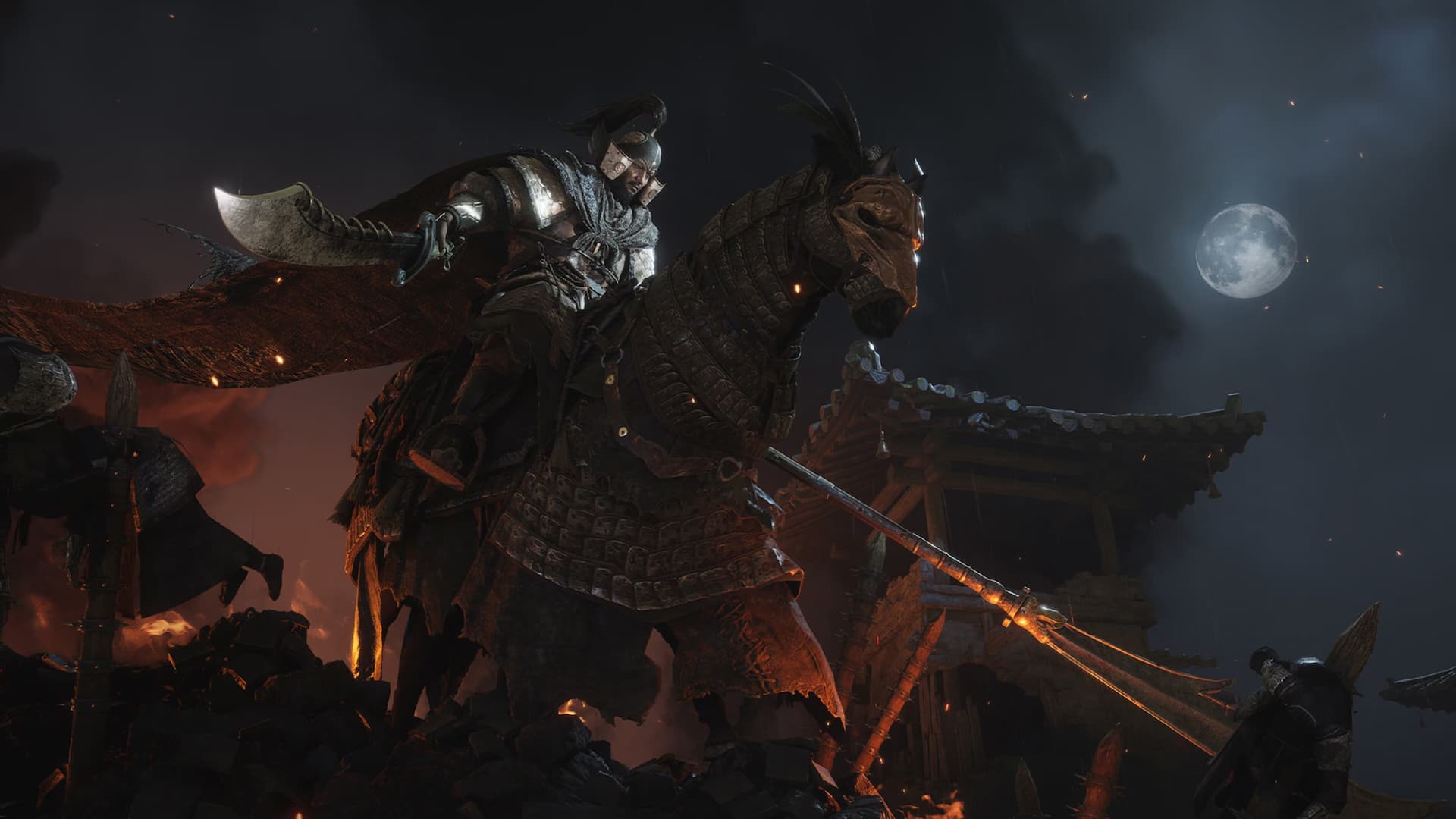
As a live-service open-world action RPG, you might compare it with Genshin Impact, though it eschews an anime style for something more realistic. Instead of a map that consists of a whole world of different nations, it's set across multiple provinces of ancient China that are every bit as breathtaking as Ghost of Tsushima's representation of Japan. But there is also more than just a picturesque setting, as it is a world that Everstone Studios uses to bring the beloved wuxia fantasy to life.
Wuxia has long been a popular genre of Chinese fiction, with grand epic tales of chivalrous martial arts warriors in ancient China. The genre has also broken through to an international audience with films like Crouching Tiger, Hidden Dragon and House of Flying Daggers. But just what does it mean to make an authentic wuxia game?
"Our starting point was to create something truly different," Where Winds Meet Lead Designer Chris Lyu tells the Epic Games Store. "The flourishing Tang and Song dynasties, or the turbulent Three Kingdoms, Yuan, Ming, and Qing periods have already been explored extensively in countless works. During our research, we found that the Five Dynasties and Ten Kingdoms period was particularly fascinating. Historically, it was an era of great disorder, positioned between the prosperity of the Tang and the Song—a moment when chaos was about to subside, prosperity was just within reach, old heroes had faded away in the smoke of war, and new ones had yet to rise. This complexity gives the era its unique charm."
Yet while the game is set in 10th century China and inspired by notable historical events from that era, it isn't meant to be historical fiction like Assassin's Creed Shadows' re-creation of Sengoku-era Japan. Wuxia is often set in what can be described as an alternative universe that co-exists with the real one—the Jianghu, a term that Where Winds Meet also uses to refer to its open world. This gives license for wandering adventurers, known in China as "Youxia," to explore the world, dealing out their own brand of superhuman feats. You need only see how your own hero is able to effortlessly triple-jump, air-dash, and run up walls right from the start.
The wuxia experience manifests in combat, where there's multiple weapons to learn and acquire, each with their own distinct playstyle, from swords and spears to fans and umbrellas. However, the Jianghu techniques inspired by traditional Eastern martial arts—kung fu—are the most tantalizing tool to have in your arsenal.
"It encompasses both realistic hand-to-hand combat techniques and those that transcend physical laws, filled with poetic imagination," Lyu explains. "For example, Dim Mak [Death Touch] involves using special internal energy techniques to project force from a distance, striking specific points on an opponent’s body to immobilize them. This may be the first time such an ability is authentically realized in a game, and we hope it matches players’ expectations."
As a skilled and growing martial artist, you're not just wading into a new place fists or blades first. Your Jianghu techniques can be used not just in combat, but also in exploration. For example, Tai Chi can both counter an opponent by redirecting their force to throw them and clear away leaves with a gust or change the flow of water as part of an environmental puzzle.
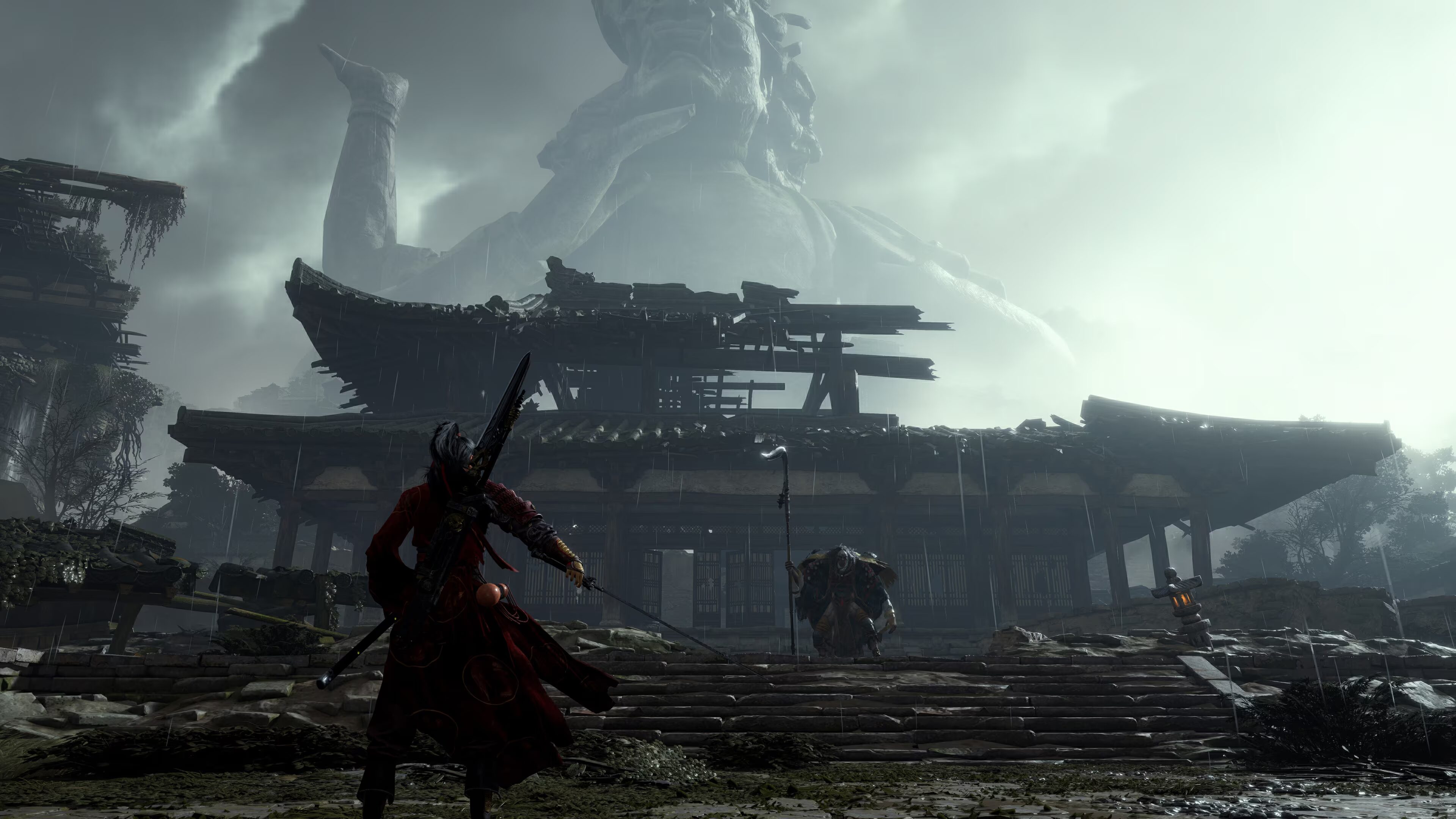
"We aim to apply a 'multiplicative' design philosophy to build a rich network of layered exploration challenges,” Lyu says. “While maintaining a strong sense of wuxia immersion, we integrate these unique martial abilities with environmental elements—combining factors such as time and space—to create an exploration experience that is both deep and continuously engaging."
Rather than focusing solely on the martial arts aspect, Where Winds Meet also gives players the option to pursue different professions too, such as a scholar, a doctor, or musician, and freely craft and build hundreds of different objects and components. Lyu says these are integral to the game and story rather than mere side activities that risk derailing your journey.
"In our view, a Youxia is not a profession—it’s an identity and a state of being. In our game, the various 'professions'—such as physician, musician, or craftsman—are not separate or opposing choices to the path of the Youxia; rather, they are the very foundations that shape a hero’s journey. We hope these experiences will enrich their understanding of the wuxia world. As a doctor, for example, you may not only cure injuries but also face enemies who wield deadly poisons. As a musician, your melodies might unlock ancient mysteries. These professions make your presence in the Jianghu feel authentic and meaningful. You are not just a fighting machine—you are a living, breathing individual with skills, stories, and a life intertwined with the world around you."
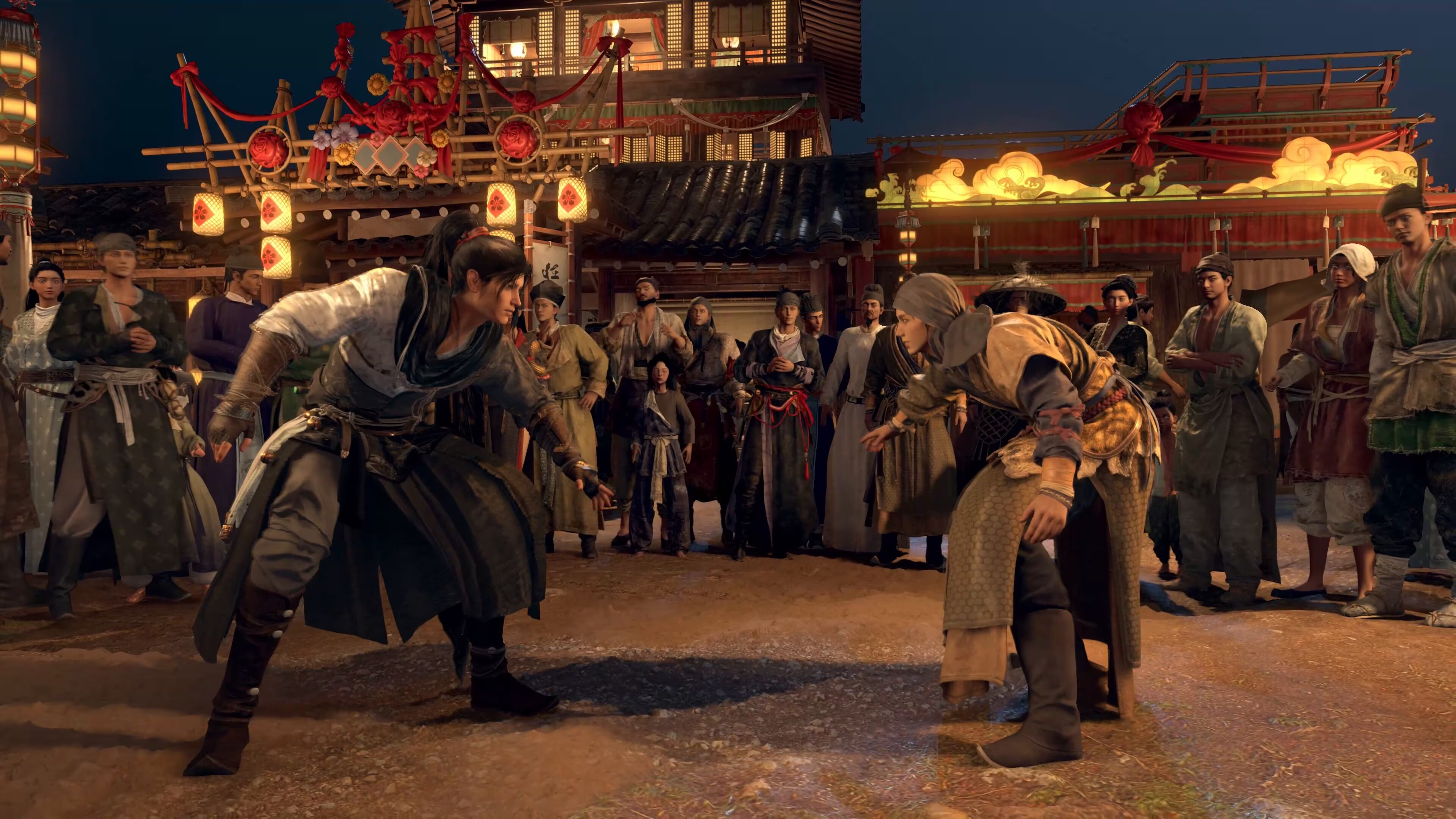
You're also not a sole traveler, since Where Winds Meet can be played with others, whether in co-op or PvP. But that's not the only way to feel like you're part of something. Just like most martial artists belong to a school and master, you can also seek out various sects and join their cause, which is also a way of learning new martial arts. These include Well of Heaven, who value honor above wealth, or Silver Needle, who heal those in need in exchange for payment, along with many others that are so mysterious, it will take time and exploration to even figure out how to join.
While there's still a kind of linear progression in the way the story advances, as circumstances will result in your hero leaving their tranquil home within the starting region of Qinghe before advancing to the vast city of Kaifeng (one of the ancient capitals of China), Lyu says that the world has been designed to offer freedom of exploration, but without chaos.
"The difficulty of exploration itself becomes a natural form of guidance. You may stroll leisurely through peaceful low-level regions, but venturing unprepared into lands teeming with masters and danger will test your limits," he explains. "Meanwhile, the progression of the main storyline and your relationships with different factions form an invisible web—subtly guiding you toward exploration in a more organic and immersive way. You will always know where the heart of the story lies, yet you remain free to decide when and how to approach it. In this world, losing your way can sometimes be part of the beauty—and when you wish to return, the path will always be waiting beneath your feet."
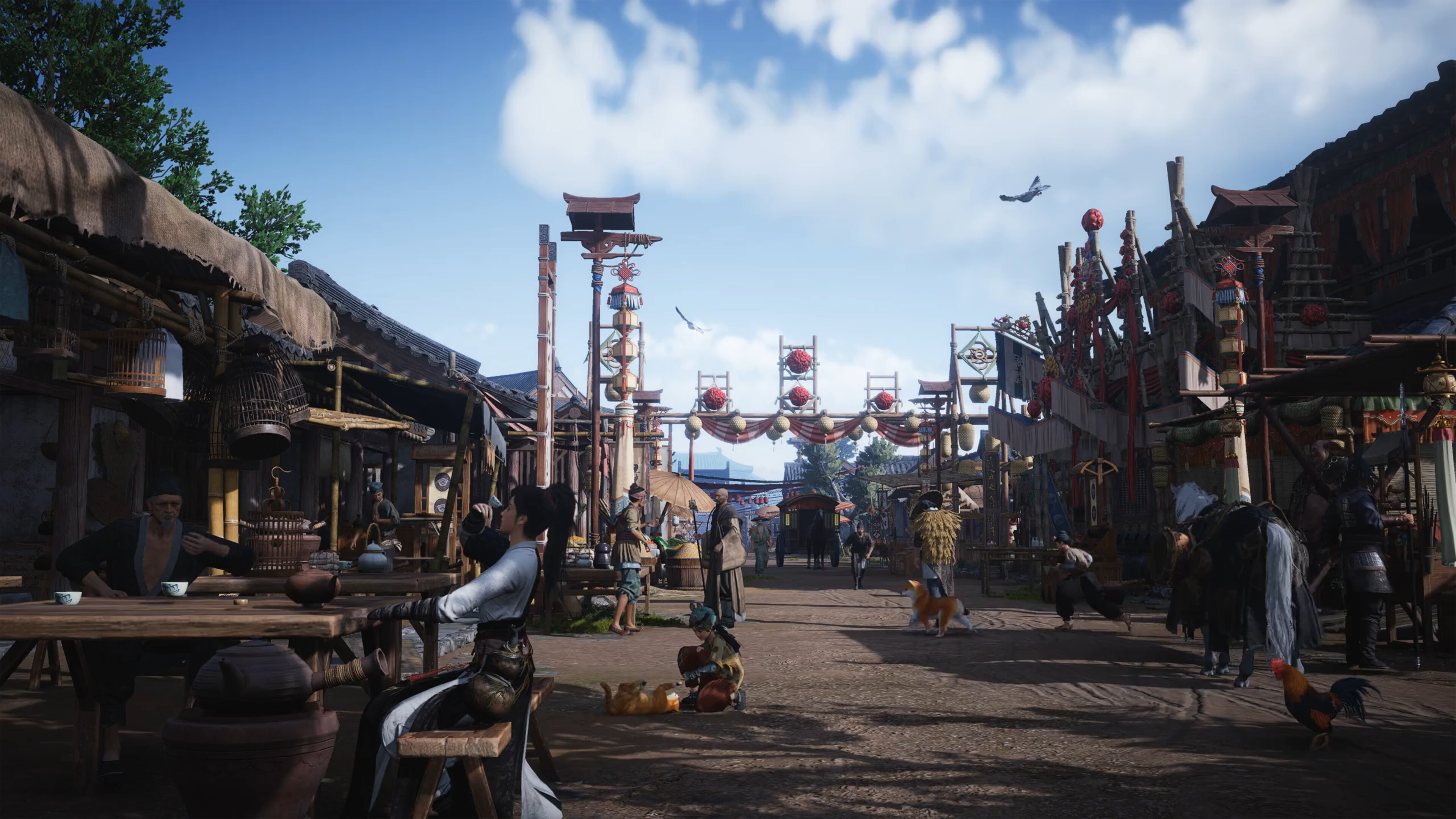
Another way to engage with the world is through a dynamic Jianghu encounter system, where quests organically and spontaneously pop up as you traverse the world or learn of rumors by talking to or eavesdropping on NPCs. "This sense of accidental destiny captures the poetic spirit of wuxia far better than a checklist of conventional quests ever could,” Lyu adds.
There's certainly a lot that will feel familiar for those who have spent over a decade playing open-world games, from dungeons to outposts with enemies that also scale to your level, as well as all manner of currencies and materials for upgrading your gear. So is Where Winds Meet doing more than just draping over these conventions in elegant wuxia aesthetics? Of course it is.
"The essence of a wuxia open world is immersion and enlightenment; it emphasizes the relationship between the individual and the world—between the self, nature, and the ever-shifting Jianghu," says Lyu. "Our systems of internal arts, inner cultivation, and sects are not merely skill trees; they form a holistic philosophy of growth. True strength does not come solely from numerical progression, but from a deeper understanding of martial principles and the pursuit of one’s own Dao—the Way."
Yet while committing to be a true wuxia game, it's surprising that the game gives you the option to subvert the genre's traditional chivalry to pursue a less noble path. "The Five Dynasties and Ten Kingdoms was an era steeped in moral ambiguity, providing the perfect stage for exploring the complexity of human nature," Lyu explains, though that is not to say that this is presented as a binary good and evil choice. "Choosing a path of 'chaos' or one that is 'less than noble' is not a rejection of chivalry, but rather an expansion and reflection on its deeper meaning. Your decisions will reshape your relationships with key characters and redefine your place in the world."
You don't have long to wait to see for yourself how Where Winds Meet redefines the open world RPG when it launches on the Epic Games Store today, November 14.