
Article
Inside Outbound with vanlife true-believers, researchers, and cozy game dev Square Glade
D
Dave Tach
He was an ocean and a continent away from his native land, developing a hobby of video game programming, when he met Tobi Schnackenberg online. The pair teamed up to co-develop Above Snakes, from Square Glade Games, and Volger left the U.S. and returned to Groningen to turn his lifelong gaming hobby into a career.
But not before he and his wife took a five-week vacation in a camper van across the U.S., which would inspire Outbound, a cozy game about exploring an idyllic, near-future world in your own, fully customizable electric camper van as you live sustainably off the grid.

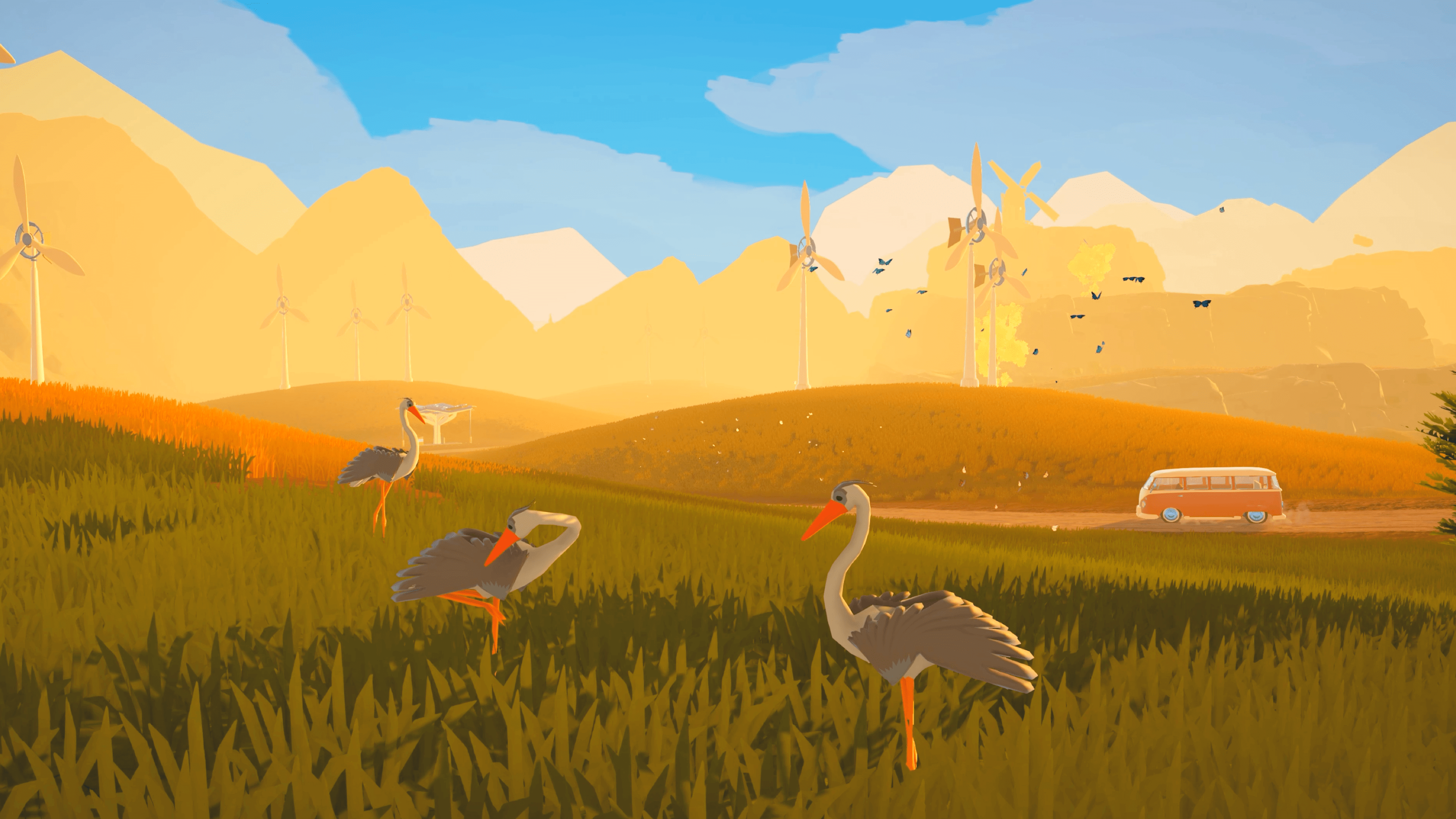
Outbound, which is headed to the Epic Games Store on April 23, 2026, isn’t trying to be an accurate vanlife simulator, but it’s clearly inspired by the growing subculture whose adherents transform vans into portable homes and live their lives along the road, often in nature. Like the road trips and vanlifers who inspired it, Outbound has no narrative, except the one that every player creates as they drive, explore, and customize their mobile home, alone or with friends.
And in that last sense in particular, according to academics, a documentary filmmaker, vanlifers, and the developers we spoke to, Outbound sits comfortably at the cultural intersection of cozy games and the vanlife phenomenon.
According to Dr. Rachel Kowert, an author and researcher specializing in the uses and effects of digital games, there’s a natural convergence.
“Vanlife games and cozy games are both fundamentally about intentional living — making deliberate choices about your space, your pace, and what you prioritize,” Kowert told the Epic Games Store. “Cozy games have always had this thread of stripping away excess, finding richness in simplicity. The fantasy isn’t about making the most money or having the most power. It is about being present in the here and now.”

From snakes to vans
Above Snakes created Square Glade Games. It gave it its name, too.
“It’s an isometric game in which you are able to plan to place land, and those land tiles are square,” Marc Volger told the Epic Games Store. “One of the more beautiful tiles was a glade which you could walk around, gathering resources. And it just had a very nice light shining on it. It was just a beautiful, serene glade. And so basically we used that as a title for our studio, Square Glade, which is also why the logo is a little tile with some trees on it.”
After the successful launch of Above Snakes, it was time to figure out what to work on next. Schnackenberg and Volger didn’t just declare what their next game would be. They hit the books.
“At first,” Tobi Schnackenberg told the Epic Games Store, “when we create prototypes as a studio, what we usually do is look at the market on Steam, on Epic, on consoles, and we look at games: what is already there, what are people liking, what they are disliking, what kind of games are played a lot, what kind of games get good scores, bad scores, what are people criticizing, what are they missing?”
In other words, they were determined to make an educated guess, pulling from their research and their experience with Above Snakes. Mile by mile, that drove them toward what would become Outbound.
They also leaned on their community, which emerged through the crowdfunding platform Kickstarter, where the developers funded Above Snakes, as well as their Patreon community.
“We had a crowd that was already used to the survival genre (from Above Snakes), and we were seeing that there was a need for survival games that are less survival-like,” Schnackenberg said, “Survival games with less pressure, more laid back and relaxed because people seem to enjoy taking care of themselves, doing things with the world and interacting with it, cooking and all that kind of stuff. More of the life simulation side of life of survival, I would say.”
In part based on what they learned, the co-founders started prototyping games and sharing them with the community that had formed around Above Snakes. One idea clearly stood out.
“These were like, I don’t know, 50 people or something like that [or] 30 people who were looking at it,” Volger said. “We were trying out all kinds of different things, really ranging from a sort of a shooter with bullets that were symbiotic onto each other, to sort of like a piratey game with square tiles, to a very serene ‘let’s go outdoors’ adventure in a camper van. We tested those all against the community, and they were very enthusiastic about this one idea.”
With the proof of concept validated internally and externally through the community, they decided to test out the idea publicly.
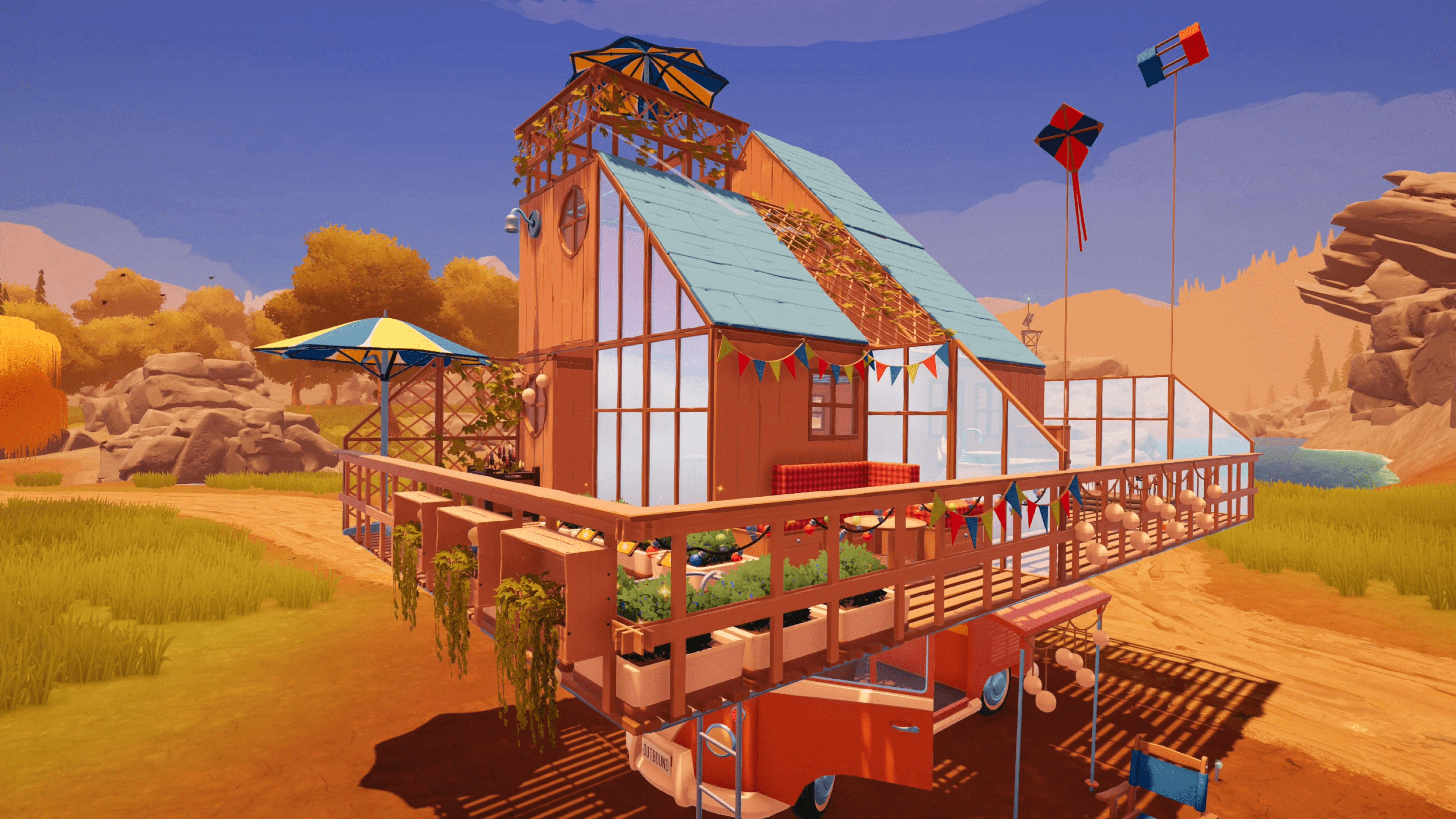
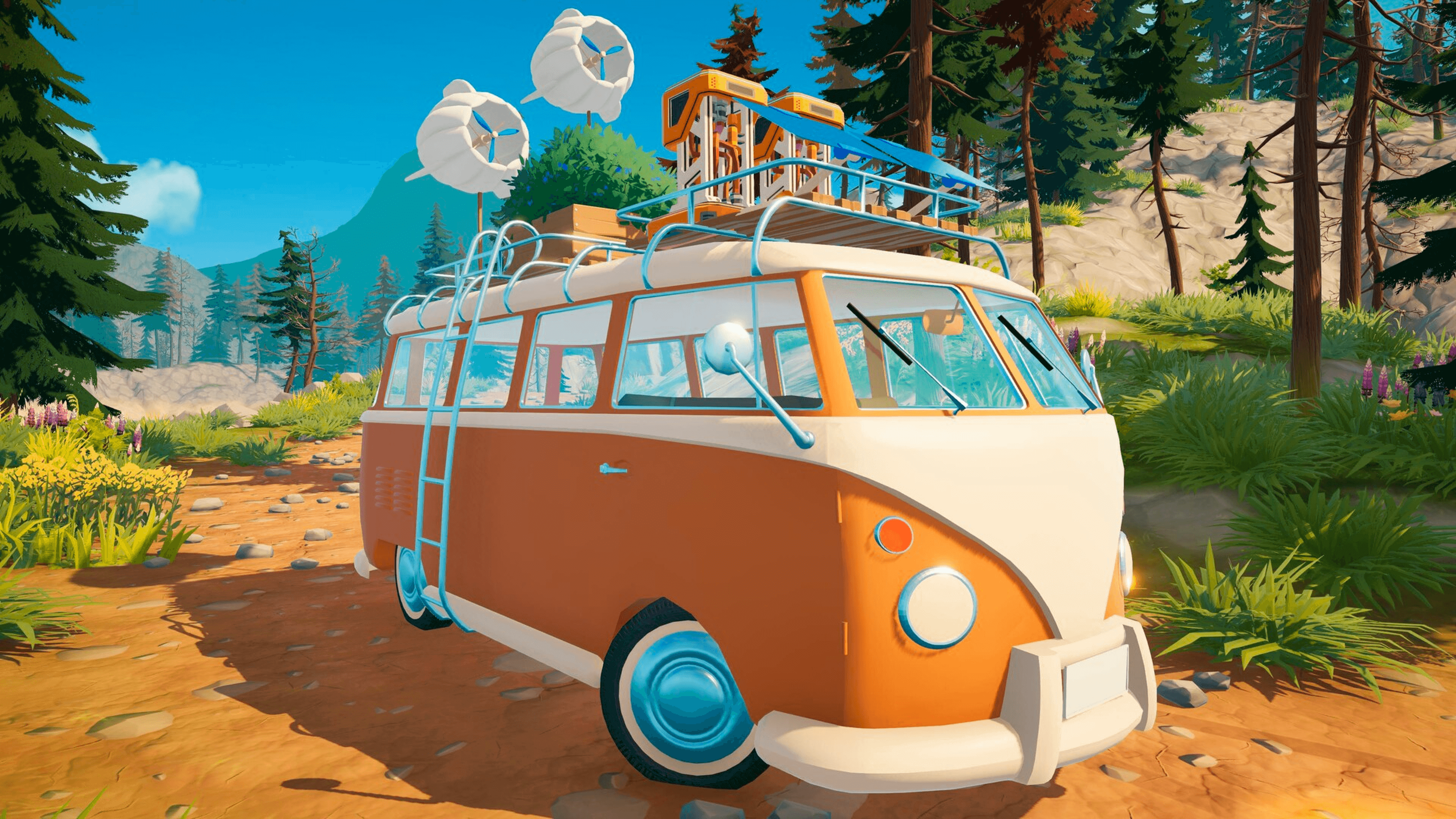
“So then we made a tweet, basically a diorama of what this game could be,” Volger said. “It was literally a van next to a lake. It had some solar panels, had some kites in the air, so we could clearly see it was electric because there were some fuel cells lying around, and just little things waving in the wind. And that one tweet blew up. So then we knew, ‘OK, we may have something here.’”
The goal from the market research was, as Volger put it, to help them “make a game that players were waiting for, that players didn’t have.” And they kept finding interest in a game about living deliberately in a van, a concept that shares more than a little similarity with vanlife.
Heading toward vanlife
In Freakonomics, journalist Stephen Dubner and economist Steven Levitt tell a story about two brothers from New York whose parents named one Winner and one Loser.
Their conclusion is that nominative determinism, the theory that names can have a measurable influence on lives — that they can become destiny — was less than bulletproof. Turns out that Winner was more of the loser, and Loser was more of the winner in that family.
But a YouTuber who goes by the handle HumanInterfaceTV has a different experience with his real first name.
Born in the American West in the ’70s, his varied entrepreneurial enterprises include window cleaning, website building, SEO optimization, internet marketing, and running a head shop with a friend who owns dispensaries in Colorado.
Several years ago, that friend introduced him to the concept of vanlife, and he spent “hundreds of hours watching vanlife videos,” a subculture that gained wide popularity on social media and YouTube over the last decade or so. The core idea behind vanlife is pretty perfectly summed up in the name: Adherents live their lives deliberately from a van that they customize and convert into a home.
They do, in other words, a lot of what players do in Outbound.
They live simply. They travel. They park. They camp. They meet up. And increasingly in the age of ubiquitous internet availability, they share their lives and even their hobbies, like gaming. Their followers and viewers provide income, as does gig economy work.
“Then I moved down from the mountains during COVID and was doing DoorDash and Uber Eats and all that kind of stuff for income, trying to just figure out what I wanted to do. And then I decided, ’You know what? I could probably do this while I’m traveling around doing vanlife.’”
He received a fair bit of pushback when he made the decision to embrace vanlife and stream his adventures, but he’s always been one to try things out. And he traces that desire directly back to his name.
“Everybody thinks I’m stupid for doing either one or the other, either for streaming or for living vanlife,” he said. “So I, personally, with the name I was given at birth, I kind of just half feel like I’m obligated. And that’s why I think I’ve lived such an untraditional life, just overall, outside of making this step because of my first name being Freedom and hearing everyone’s description of that in my entire life.”
From its earliest prototypes and teases, the developers of Outbound tapped into the same sort of interest, even pulling inspiration from vanlifers on the internet. And they were able to relate the emerging game to vanlife-adjacent experiences in their own lives, too.
“I’ve gone through the entirety of North America with a van during my time there,” Marc Volger said. “So that was definitely something that we knew the feel of. Tobi, with his partner, also went on these kinds of road trips. We knew this feeling of camper van as vanlife and wanted to put that in the game.”
Far fewer of the people who follow vanlifers across the internet adopt the lifestyle, but given the large follower numbers for vanlifers, there’s clearly a fascination with the alternative lifestyle and an appetite to ingest their travels, even vicariously.
The meaning of vanlife
Jim Lounsbury, a filmmaker from Sydney, Australia, by way of Seattle, Washington, got so interested in vanlife that he not only created a documentary called The Meaning of Vanlife, but he also lived the vanlife experience for several months as he chronicled several vanlifers.
“I’ve always had a lot of wanderlust and have always been attracted to stories of people trying to find that,” Lounsbury told the Epic Games Store. “So I think that leads us into The Meaning of Vanlife and the interest in examining it as a culture, touching on what does it mean? What does it mean that people are living in vans, or what caused it to happen? I started asking all these questions, and that’s what kind of led me to making the documentary.”
There’s no single narrative to explain why someone chooses an unconventional lifestyle of life on the road in a van, but Lounsbury did see one recurring story, and his documentary explored it.
“So the common story that I heard among people that I chose to make the film about was, ‘Well, we were living in a city. We’re spending $40,000, $50,000 a year in rent and making, between us as a couple, maybe $120,000 a year or $150,000. We’re thinking, why? Why are we in this rat race, just pouring money into rent?’ They would feel like this sort of hollow idea of ‘What’s it for?’”
Cody Rodriguez knows the feeling. He’s a lifelong gamer and learner, who has lived and studied across the globe from Hawaii to Japan and England and, now, Australia, where he’s an Assistant Professor of Sociology and Anthropology and working toward his PhD in Sociology from the University of Melbourne, Australia. He’s writing his thesis, which he currently calls “Liminal Lifestyle Mobilities: Betwixt and Between 'Living the Dream' of Vanlife and' Surviving the Nightmare'of Vehicular Homelessness.”
He’s not only studying vanlife, but like Freedom and Lounsbury, he’s lived it, too.
“My thesis research sought to disentangle the real everyday lived vanlife experience from the romanticized aesthetical fantasy of vanlife online,” Rodriguez told the Epic Games Store. “To do so, I conducted a mobile hybrid ethnography that involved living in a four-door Mini Cooper and attending various vanlife gatherings for a short time throughout Oregon and the American Southwest, then continued engaging with vanlife community members I had met in person through Instagram over the course of two years.”
There’s clearly a cultural appeal to vanlife, though its often idyllic appearances on social media don’t always comport with some reality.
“In the process of doing fieldwork,” Rodriguez said. “I came to realize that many full-time vanlife nomads in the wake of the pandemic are neither fully ’living the dream’ of vanlife nor surviving the nightmare of what is known as vehicular homelessness. Rather, they occupy a space somewhere in the middle of the two. So my challenge as an academic researcher is to create a more nuanced description of that liminal middle space.”
It’s that liminal space where Outbound lives. And in the gaming world, it’s a pretty perfect fit for the cozy game ecosystem.
Vanlife, meet cozy gaming
Technically, Dr. Agata Waszkiewicz is a literary scholar at John Paul II Catholic University of Lublin, Poland. Practically, given her focus and interests, she’s a video game scholar.
Much of her research centers on cozy games, a phrase she sought to introduce into academic literature with her 2020 paper “Towards the aesthetics of cozy video games.”
“They are defined as those games that evoke the fantasy of safety, softness, and abundance,” Waszkiewicz told the Epic Games Store. “But for me, cozy games are predominantly about safety. So everything is safe, right? Or many things are safe. The gameplay is safe, or narrative is safe, or aesthetics are safe. So the softness is also just aesthetic. Safety and abundance are also just about safety.”
Cozy games predate the pandemic, but she sees that time as a catalyst for the genre by helping people think differently about what video games could be.
“In [2020 with] Animal Crossing[: New Horizons],” she said, “it started to leak into the popular awareness that games can be different, that can be softer, it can be slower, and all that.”
That’s explicitly what Outbound does, in a post-pandemic world.
“We’re trying to be as clear as possible in our communication,” Marc Volger said, “that this is a relaxed game, and that there’s no hunting, that it’s not really a survival-crafting game in the original sense, because there’s not really pressure to do a lot of things. Even if you get too hungry, you faint, and you get back next to your vehicle, and you can go again. So it’s not really a harsh environment or anything. And that’s what also felt like a vacation, a road trip.”
Inspiration, not simulation
Outbound takes a different path than a game like Power Wash Simulator 2. Rather than go for direct simulation, it is inspired by both vanlife and road trips, and in its own way, it imbues some of the most pleasing aspects to players through a cozy experience.
“Outbound is not a simulator,” Tobi Schnackenberg said. “We don’t want to simulate vanlife experience 100 percent as it would be in real life. What we want to do is, we take your romanticized image of vanlife — what you think it might be — and put that into a game, and make you experience that as you wish it would be.”
That’s a core tenet of many cozy games, according to Dr. Waszkiewicz. They allow a bit of role-playing and fantasy, devoid of the stress inherent in many other games.
“I wrote a book about food in games,” she said, “but I’m a horrible cook. I don’t cook. But I know that if I open that game, and I follow these instructions, I will make it a beautiful dish, right? And it’s very satisfying, and it’s very nice. So the effort and reward are always balanced out, which in real life, you don’t get.”
Cozy games like Outbound also tend to have a sense of soft predictability. There’s a direct correlation between your effort and your results.
“In a cozy game, you know that it’s reliable,” Waszkiewicz said. “You know that if you go into Animal Crossing, you will get what you went into Animal Crossing for, right?”
Dr. Rachel Kowert has seen this kind of thing emerge in video games and in her own life.
“I think this reflects something games are uniquely positioned to do, which is let people try on a way of living without dismantling their whole life to do it,” she said. “In this sense, vanlife is aspirational, with an exploratory quality that translates well into interactive form. And Outbound seems to be doing this thoughtfully by drawing from the ethos rather than just the aesthetics — the sustainable van, the open world movement, the sense of making somewhere home. When games engage with subcultures respectfully, they can actually deepen interest in the real movement and introduce people to values they might not have encountered otherwise.
“As for other examples, growing up in a small town in Texas with a strong local skateboarding culture, I may have to suggest Tony Hawk games did something similar. The best entries in that series felt like love letters to the subculture, not exploitations of it.”
A movable base
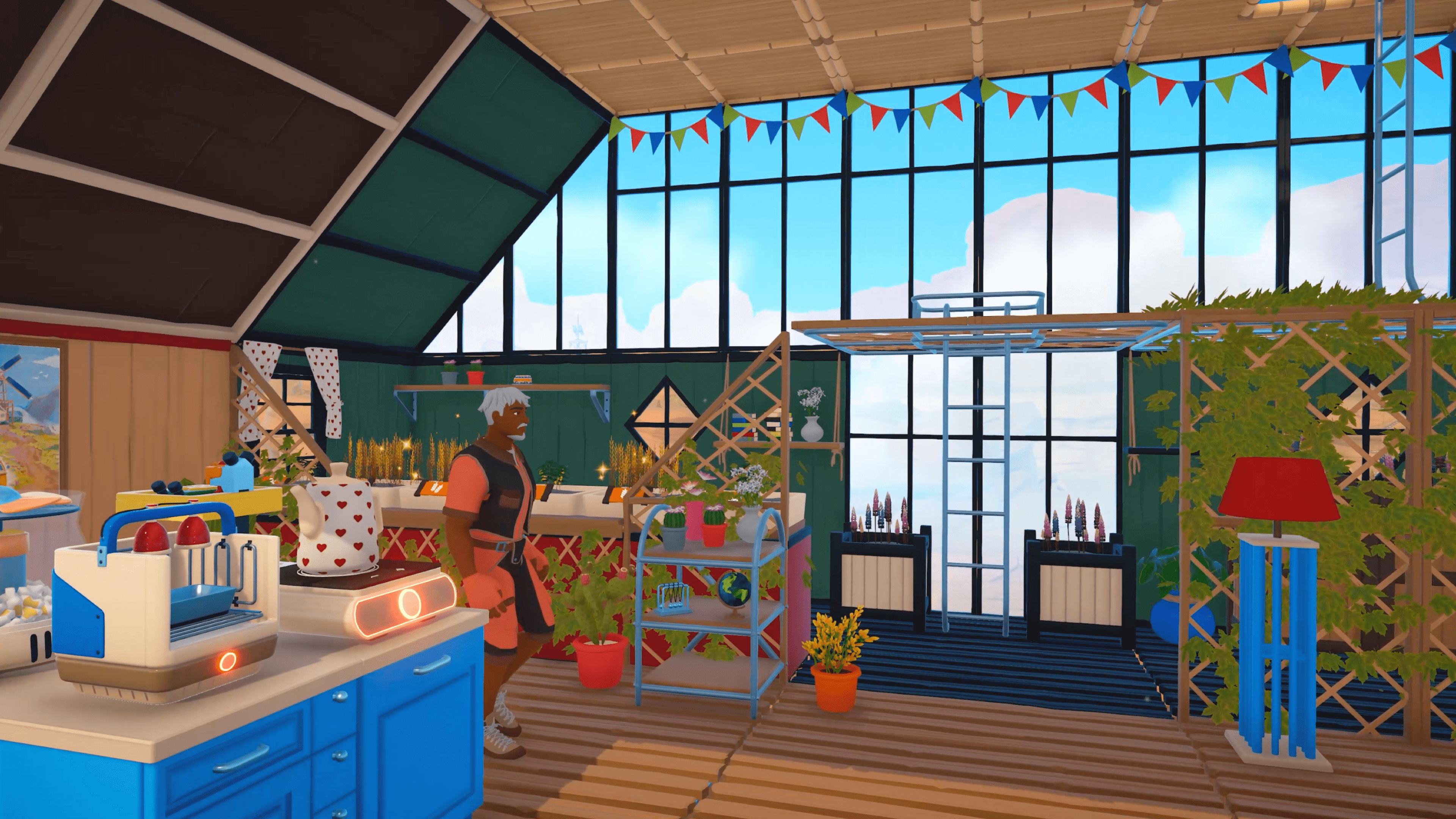
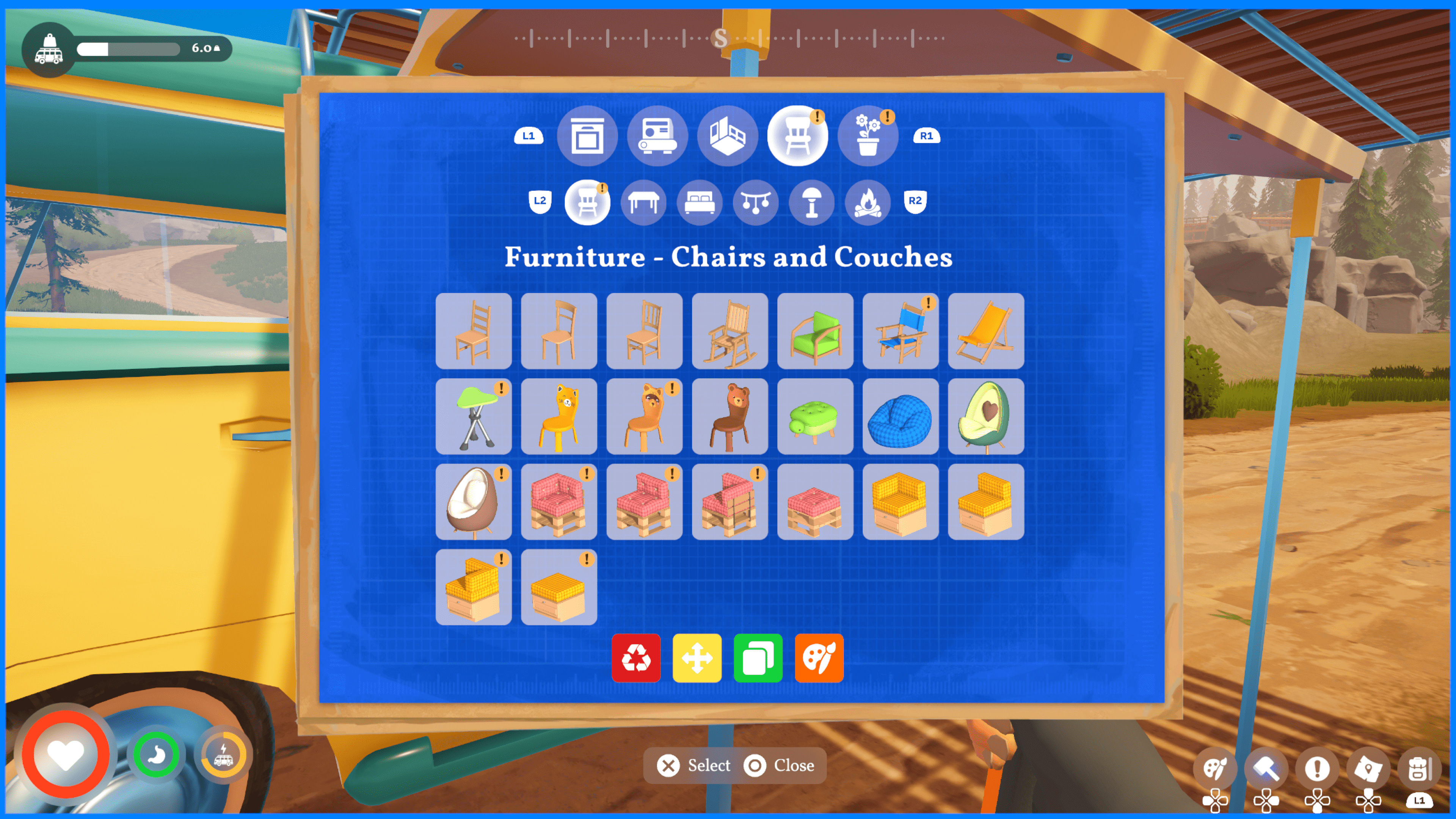
As development on Outbound continued, the developers at Square Glade Games drew inspiration from survival games, which tend to be inherently stressful as you fight for sustenance and survival, but with an added cozy twist. And a lot of that coziness is centered directly on customizing your van.
“The idea was, if we have a vehicle in the world, what we can do is you can build your base on or around that vehicle,” Tobi Schnackenberg said. “And you can always take it with you because, in many games, you build your base somewhere, and then you don’t need anything from that area anymore, and then you move further. And we saw that need from these survival gamers. They said, ‘OK, it’s kind of tedious. Either I have to go back and forth all the time, or I have to create a second base, or I have to tear down my first base and create a second one somewhere else.’ Some games do like teleportation systems and that kind of stuff. There are all kinds of issues with that.”
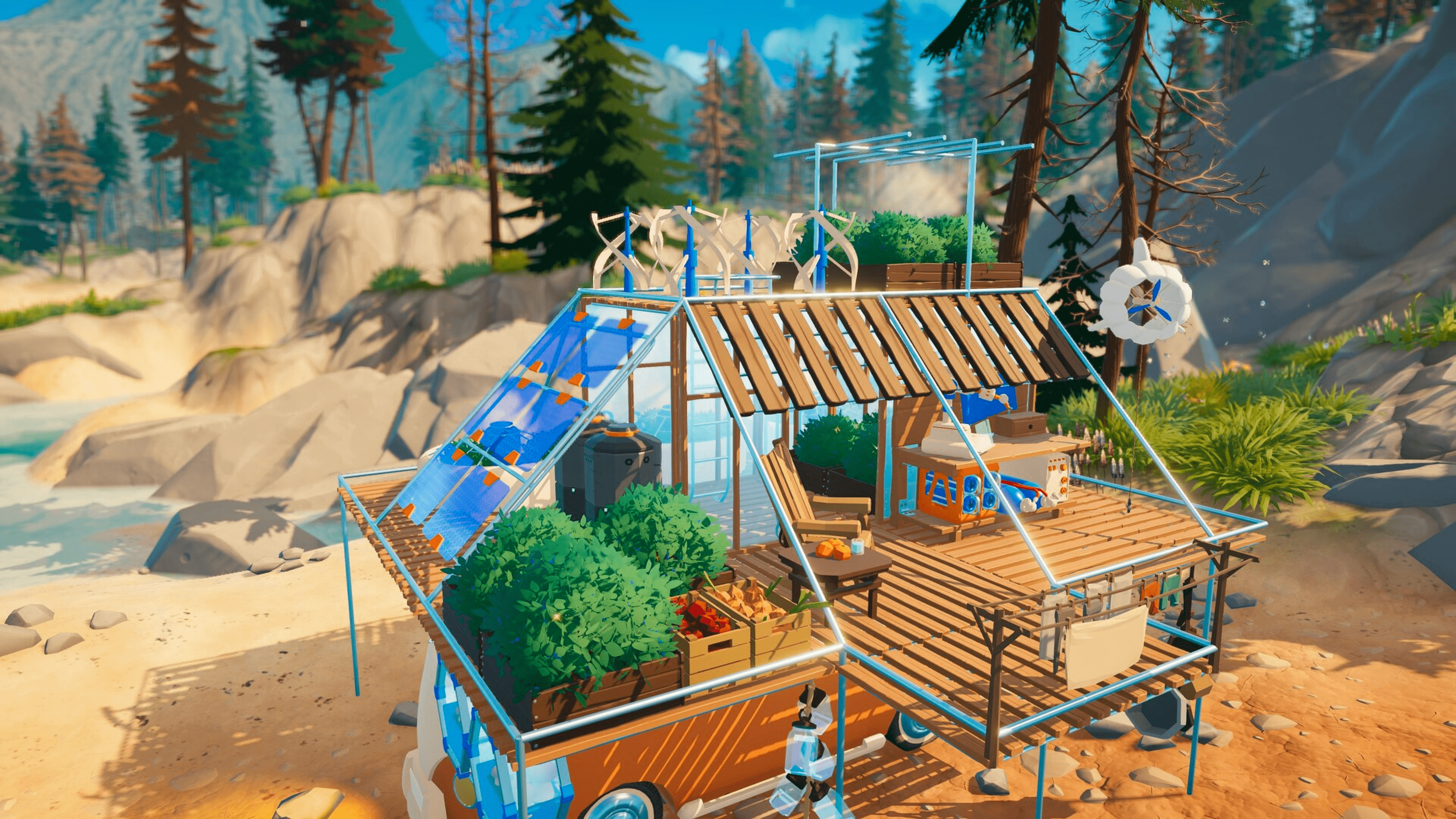
Their solution: Keep the basic idea of the base, but make it mobile.
“We saw an opportunity of, ‘Hey, it would be cool if you could take your base with you. And that was where the idea for Outbound came from, basically, and then we combined it with the vanlife fantasy right after. But the idea was, first, we want some kind of moving vehicle in the world. And we wanted to be chill and relaxed because people seem to really enjoy that. And then we combined it with vanlife because it just made so much sense.”
That parallels the real-life experiences of those we spoke with.
“From my own personal experience,” Cody Rodriguez said, “I was surprised to learn how much I enjoyed living in a minivan as minimalistic as possible. I had accumulated quite a few spectacular experiences from my international travels, but I felt most at home and in control of my life while in the van.”
That sense of control resonates with Freedom. “When I left the first time,” he said, “I literally had $50 and a full tank.” There were tough times on the road. It wasn’t, he said, always like you see on Instagram. And when he took a look at Outbound, he saw some interesting similarities to his experience.
“The biggest connector between them all is the freedom you do have to go do like ‘Oh man, I wonder what it’s like over there.’ You can just drive over there, and essentially, yeah, it’s the same idea. You have your own little setup. One of my favorite things, being mainly from the mountains my entire life (Idaho and Colorado), is to just back up onto a beach that you’re allowed to drive on, pop open the back of my van … pop open the double doors, or pop open the hatchback on the minivan, and your home is right there. So that makes me feel different about the game, that’s conceptually where they’re coming from. Again, it’s an unrealistic, cartoon cozy type of game, so it’s more extravagant, if you will, but the same concept, which that’s cool because that is what it’s about, really.”
Drive your own adventure
When speaking with cozy game developers, a theme emerges. Many video games have built-in motivation of the “If you don’t save the world from the evil alien invaders, who will?” variety. Many cozy games explicitly reject that formula, which would be anathema to the cozy part of the phrase. So the question becomes: How do you create compelling gameplay in the absence of inherent stress?
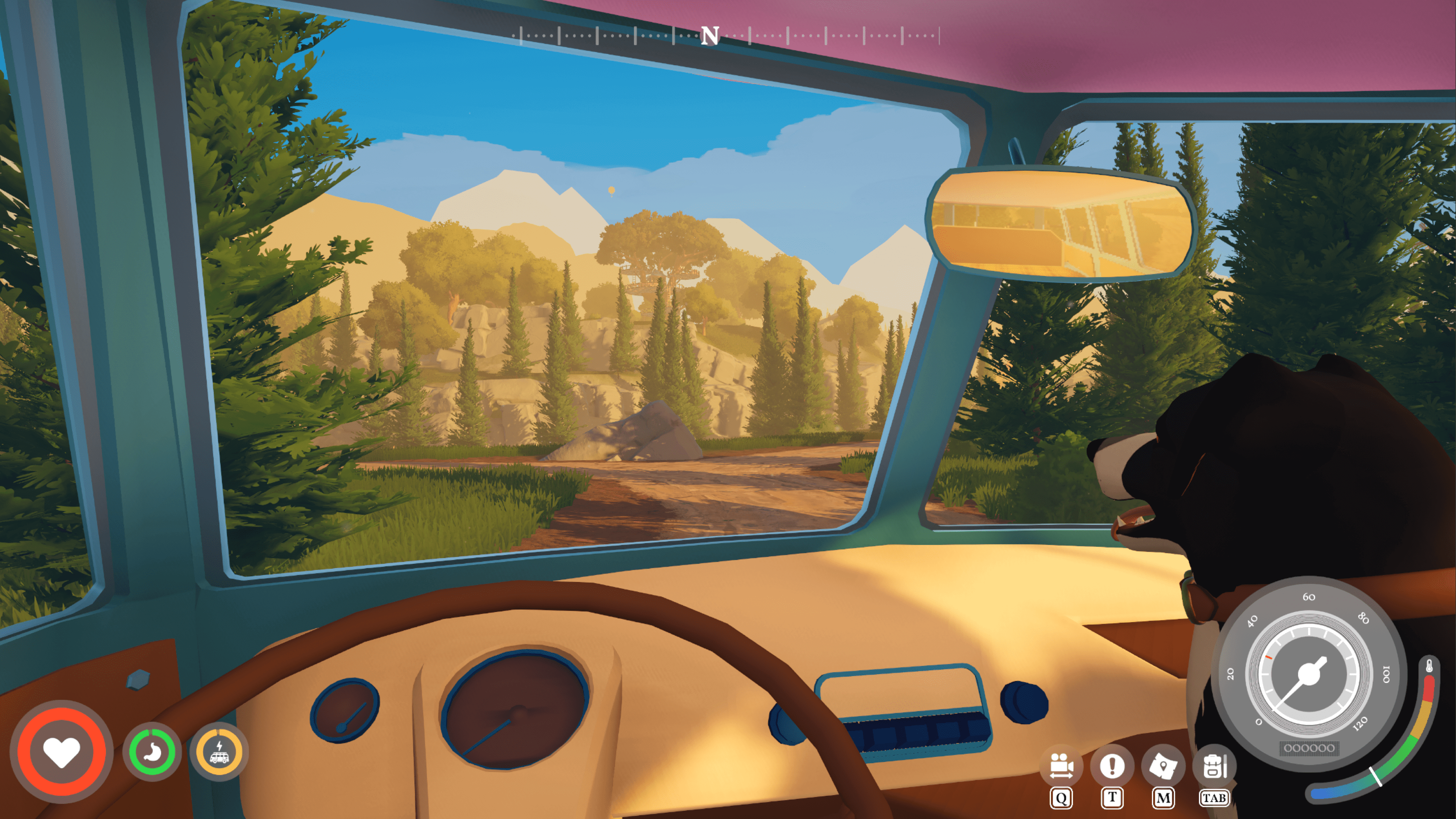
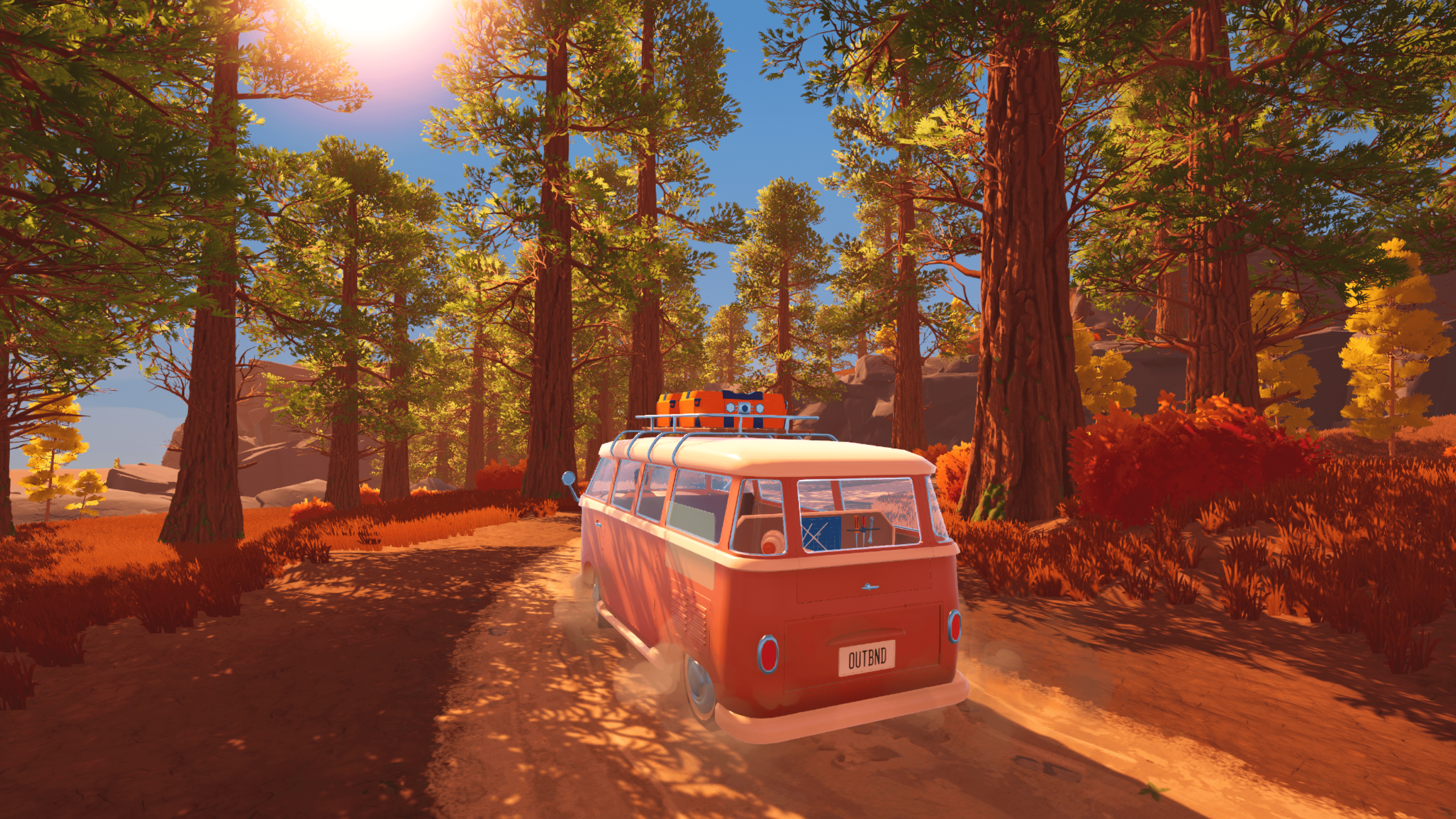
“From a mechanical standpoint,” Schnackenberg said, “it works that, in the beginning, you just begin with your very, very basic camper van. It’s just like every other camper van, basically. It’s just empty. It has a bed, it has a workstation, and that’s it. And in the beginning, you can start furnishing it from the inside, putting a couple of counters where you can put your workstations, your production units, and your gardens, and everything you could put in there. And at some point, you can just, of course, drive further to wherever you want, and then you can set camp. Setting camp and Outbound works by opening like the side door of the vehicle.”
“I don’t want to call it a problem (because it’s not a problem), but it’s an interesting topic in this game design because you’re right, it’s not as straightforward as ’go and shoot this guy’ or ’go and find this guy.’ We didn’t really want to make it a narrative game, either. So we had to use the different tools that you could come up with in a cozy game, which at first it’s really the tutorial, and it’s way more than hand-holding and telling the player, ’OK, now go to this signal tower because there’s something interesting there. Go and download that thing so you can build something extra for your van,’ which is literally a counter, and then ’OK, go build a recycler, which shows you have workstations that can do stuff for you.
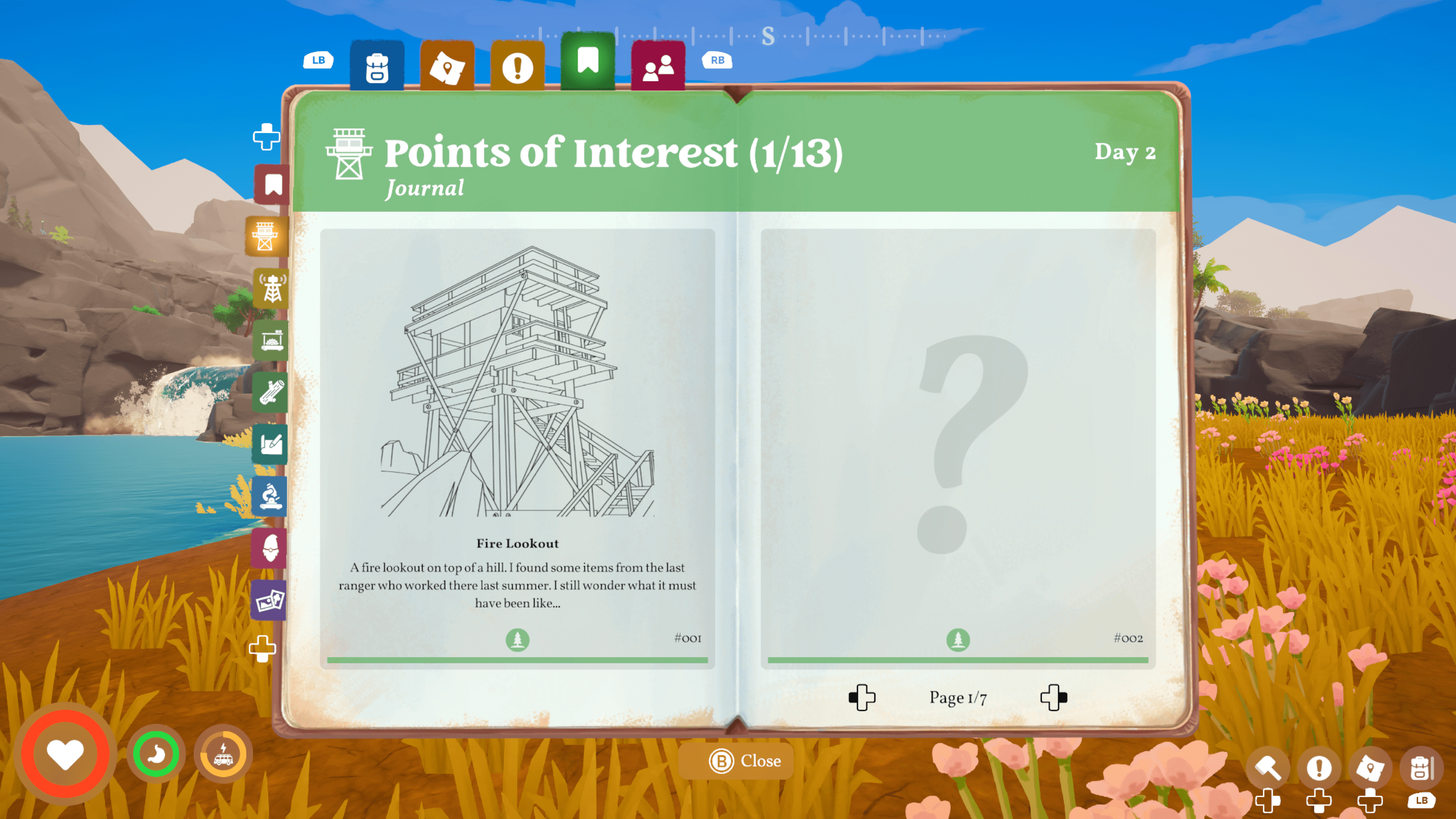
“And the further you progress through that quote unquote tutorial, the intro, the further we let the player go do their own thing, and they basically get a first area to explore and they can do it basically on their own pace at their uh you know uh at their own choices. Do they go left, do they go right? And then we, certainly at the start, we do try to keep a task sort of on the top right where people still have a goal if they want to follow it but those goals are more of like, ‘Hey, go and visit a landmark,’ and those landmarks are clearly placed in the world where you can see them from afar. Even, you know, within the first two minutes of driving, you can start seeing those landmarks.”
 Vanlife and community
Outbound was created as a single-player game, but it expanded during development to become something more, which is perfectly natural, both to the developers and to the larger vanlife ethos.
Vanlife can seem like a solitary pursuit, but it isn’t always. Vanlifers often meet up and hold events, as the documentarian Jim Lounsbury has seen for himself as he’s attended and documented what he calls “vanlife gatherings.”
“I think those festivals … provide a chance to connect with other like-minded people — people who understand the same things that you do,” he said. “They’re going through similar things to you. People walk around in those events and look at each other’s van setups and are like, ’Oh man, I need to do a reverse cycle battery! I can’t because I keep blowing my fuses! People just have those conversations, and then check out each other’s vans, celebrate what they’re doing, and commiserate and connect with each other.”
Many of these events have the atmosphere of festivals, as Cody Rodriguez has also seen during his research.
“Generally, events all consist of music, food, dancing, and outdoor activities that are related to camping over the course of three to five days,” he said. “Music is performed on a stage that consists of acoustic folk and alternative country during the daytime, electric rock or reggae during the evening, and electronic dance music late at night. After a few days of this shared feeling of excitement and euphoria, vanlifers part ways and go separate directions like two steamships in the night. The first few times it happens, it can be a devastating feeling, but once they see first-hand how likely they do meet again somewhere further down the road, the act of bidding farewell becomes a bit easier.”
Outbound’s expansion from single-player to multiplayer came both from experience and from serendipity.
“Going on a road trip with friends for me has been a great joy in my life,” Marc Volger said.
“So you’re really making your own adventure, and then if you want to play multiplayer, then yeah, you get to invite your friends on your adventure, of course.”
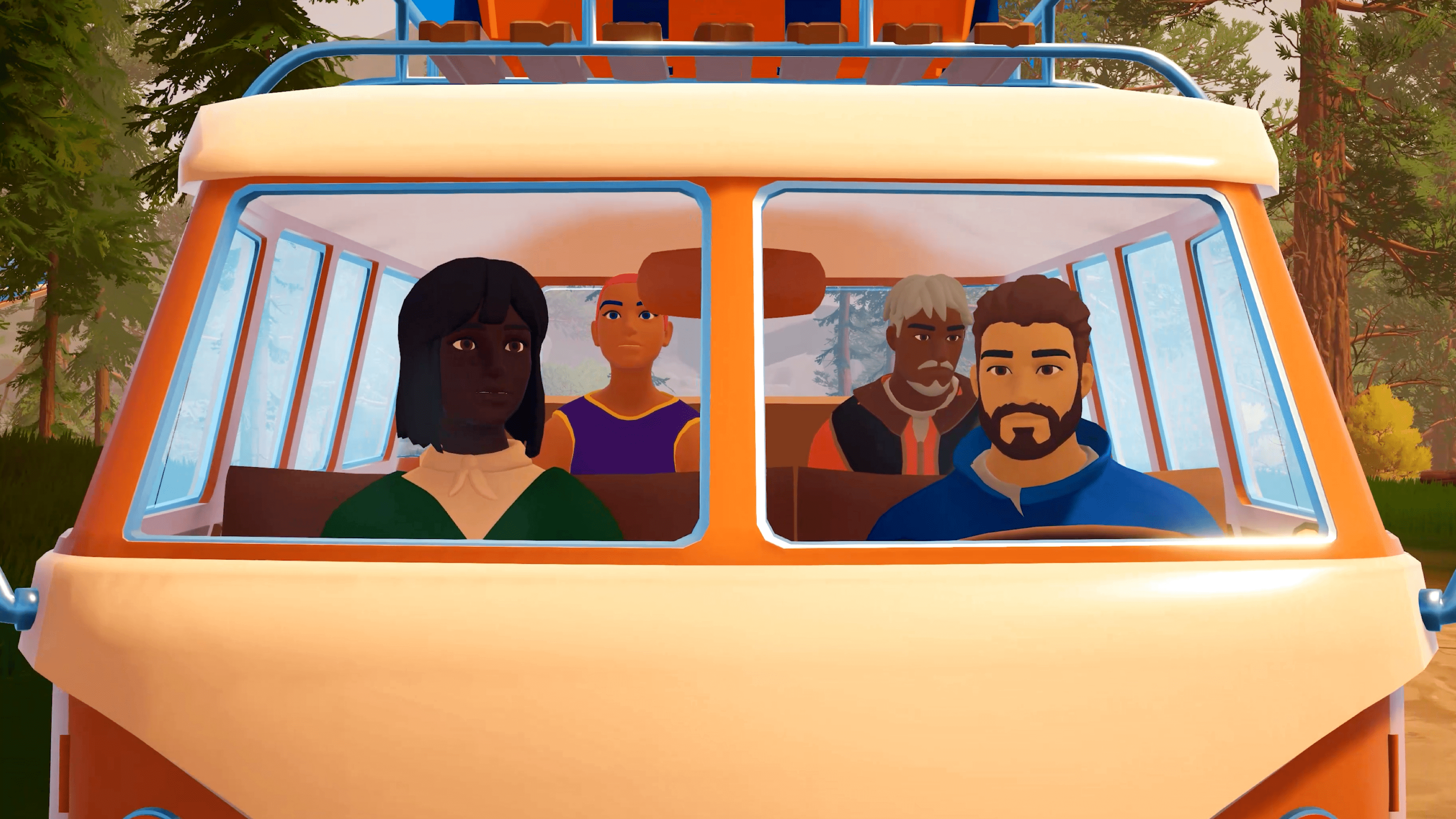
During development, a programmer working in the same coworking space as Square Glade Games offered his services to implement multiplayer in the game. And doing so changed the game significantly.
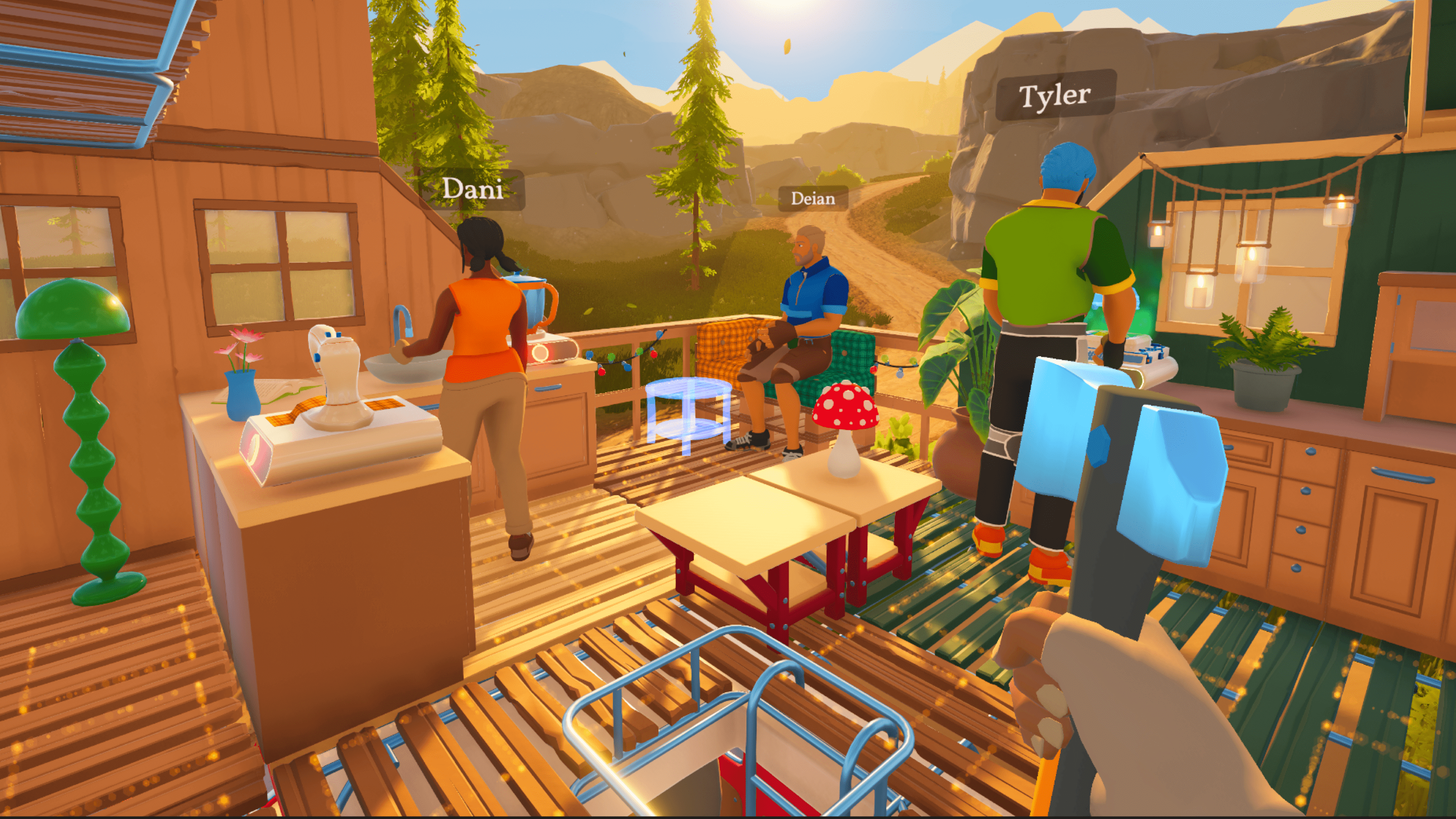
“What we see is that when players play together with friends, the tone of the game drastically changes. In single player, it is very laid back, relaxed, like a grounding, down-to-earth experience,” Tobi Schnackenberg said. “It’s almost spiritual, I would say. And when they play together with friends, it suddenly becomes like a road trip, like a party where they go wild and have fun. The tone changes a lot, but the tasks and the points of interest — everything is the same.”
That welcome change in tone actually convinced the developers to limit multiplayer to sharing one van. When you’re playing Outbound, you can generate a code and share it with friends to invite them in. That creates the sort of experience that’s been at the heart of Outbound since the beginning, as Marc Volger explained.
“A question that’s very often asked is, ‘Can everybody have their own van?’ And we, of course, thought about this and explicitly went with one van for the whole group, just so you have that experience together. You’re building on something together toward a common goal, instead of all having their own vehicles trying to, you know, ram into each other, sort of like racing for resources.”
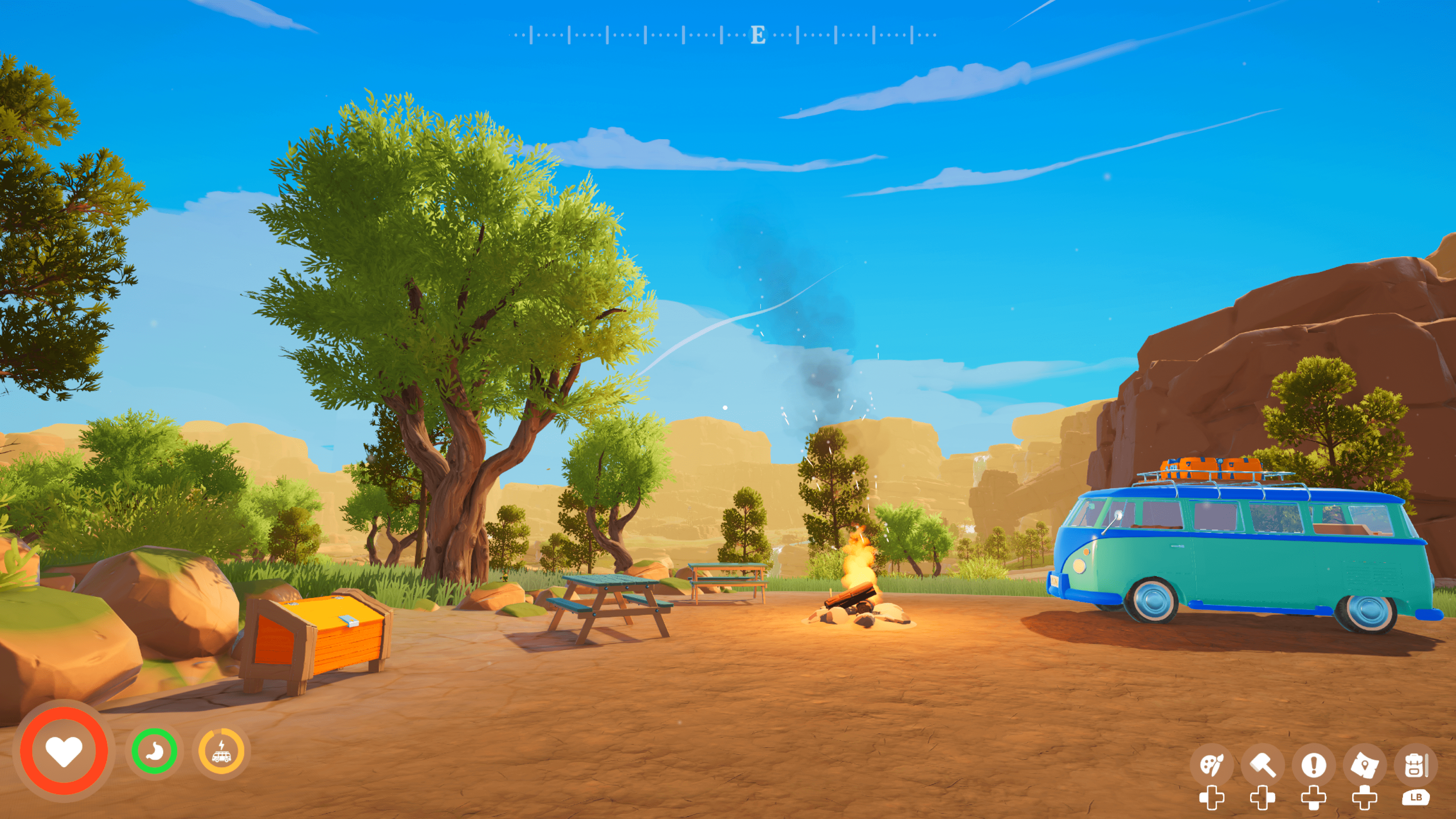
Balancing authenticity
Outbound isn’t didactic. It doesn’t wag its finger at players or preach a message. But you don’t have to look at much subtext to find some subtle messaging.
From its appearance on Kickstarter, its developers described Outbound as “an open-world exploration game set in a utopian near future.” The vans in this particular version of vanlife are electric. Players will harness the sun to create power and be rewarded for picking up litter. And the only trees you can chop up are already dead and lying on the ground. In Outbound, as in real life, it pays to keep the beautiful world beautiful.
“That was just a conscious decision that we said, ‘OK, it’s not like we would punish people,” Schnackenberg said. “It’s more like it’s a subtle undertone that sets the tone of the game, basically.”
Still, there are plenty of quality-of-life affordances in Outbound, too. Packing up your mobile home is easy. So is unpacking it.
“We kind of hide all of the ugly stuff,” Schnackenberg said. “There are no camping toilets, for instance, no dirty showers that you have to use at some parking space or whatever. We take away all of the dirty stuff, and we only put in the romanticized site that you would see online, and we know this is not reality.”
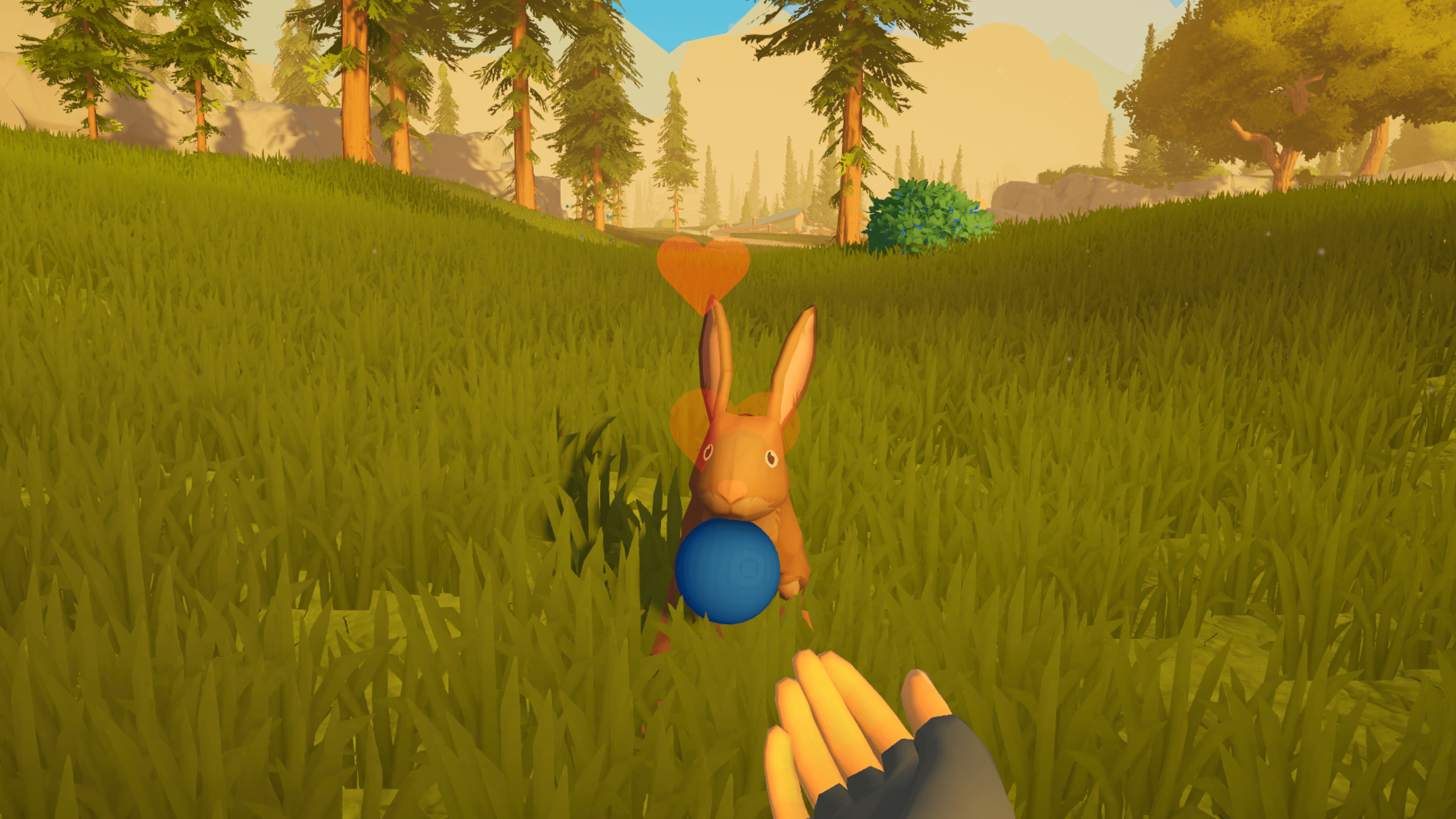
The Outbound team at Square Glade Games, which at its peak included approximately eight or nine simultaneous freelancers, has been carefully balancing authenticity, realism, and respect for the vanlife subculture since the earliest days of development.
According to Dr. Rachel Kowert, that’s a common challenge and a potential opportunity for video games.
“I think the biggest challenge might be authenticity,” she said. “Vanlife as a subculture carries real values — sustainability, anti-consumerism, community — and those can feel hollow if they’re just aesthetic dressing on a standard progression loop. There’s also the tension between the freedom and unpredictability that makes vanlife compelling in reality, and that can compete with the need for (well-designed) games to offer structure and satisfying feedback. Too much structure and you lose the spirit of it; too little and players feel unmoored. The design challenge here would be building meaningful freedom (to tap into the reality of van life) rather than just the illusion of it.
“I will add that I do think the current appetite for cozy games specifically tells us something interesting about the cultural moment we’re in. When the world outside feels relentlessly chaotic (politically, socially, environmentally), there’s something genuinely meaningful about choosing to spend your leisure time tending a garden, building a community, or driving a van through a quiet, open world at your own pace. That’s not escapism in a pejorative sense. That’s people intuitively reaching for experiences that offer agency, calm, and a sense of completion.”
And as someone who’s lived vanlife, Freedom’s experience seems to line up well with Outbound, particularly its open-ended call to exploration.
“What made me actually go for it, especially during COVID, starting then, was because I really wanted to find out what freedom actually is. What is that concept? Does it exist? Is it attainable? What do you need to have that or feel that? Then couple that twofold with just, I want to go to these places that I’ve never been to before on the South and the East Coast and understand the country that I live in and the people that I live with, firsthand. And what better way to do that immersively than actually going there and working there and being a part of the places that I went to that I stayed at for a couple weeks? I feel like I lived there because I worked there. I streamed there. I did all that stuff.”
Check out Outbound in the Epic Games Store ahead of its April 23, 2026 release.