Murder they wrote—investigating The Case of the Golden Idol and Agatha Christie—Hercule Poirot: The London Case
Detective fiction tells its bloodthirsty readers that out of many possible, equally plausible alternatives, only one scenario can possibly be true. The life of a detective game developer, however, is more complex. Players may hunt through a web of lies, seeking to follow the single thread that leads them to the truth, but conversations with the developers of The Case of the Golden Idol and Agatha Christie—Hercule Poirot: The London Case reveal there’s many different ways to pen a compelling mystery and guide players to its fateful conclusion.
For Blazing Griffin, story always comes first. After all, the Glaswegian developers are part of a transmedia company that works across film and TV. Neil McPhillips, Co-Head of Games, told the Epic Games Store how their latest Hercule Poirot adventure game contains page-turning mysteries worthy of his creator Agatha Christie. Still, the staff behind the game acknowledged the daunting task of continuing the legacy of history’s best-selling novelist with their upcoming title.
A famous detective's unexpected past
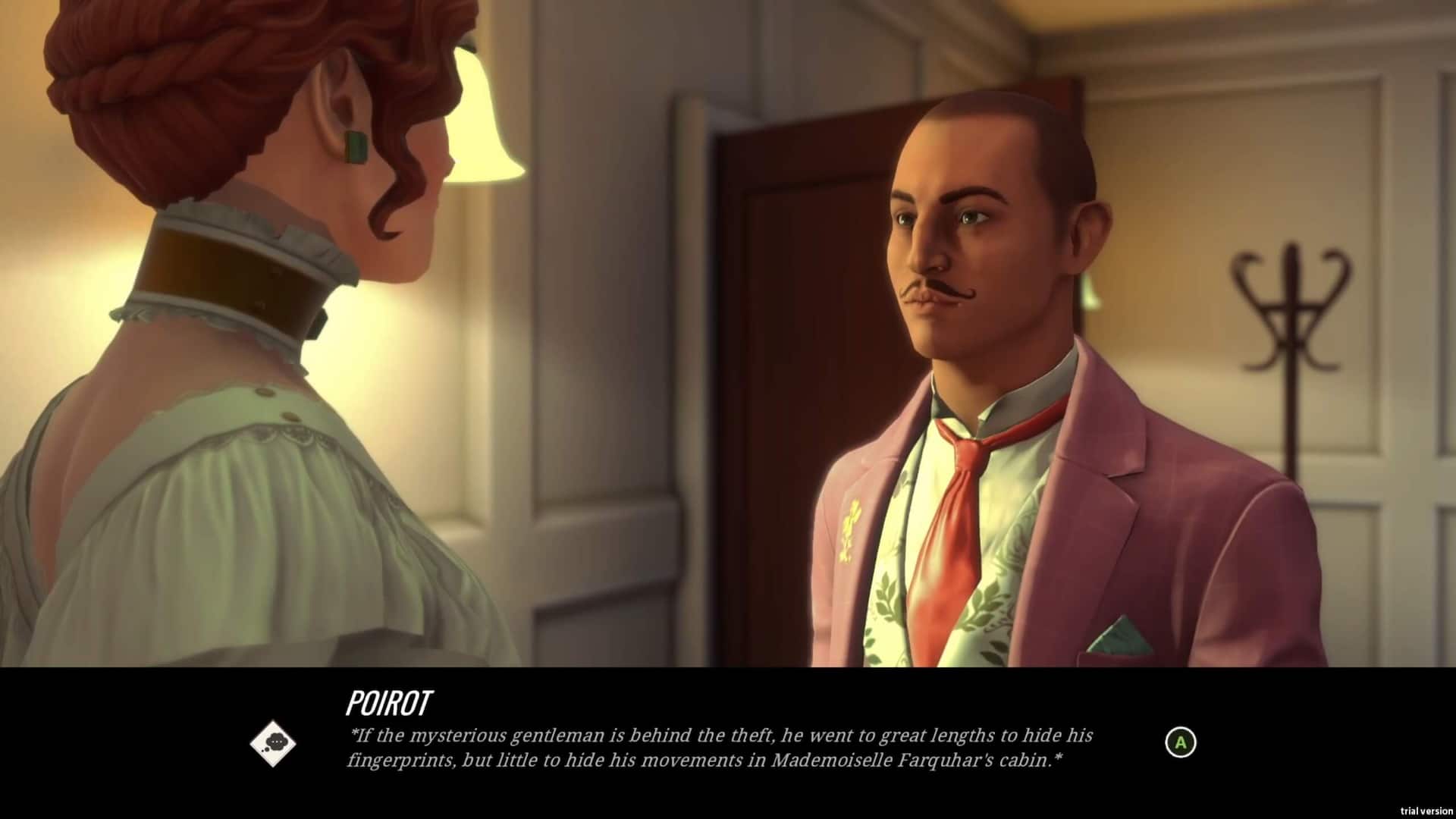
The popular image of Poirot is that of a middle-aged dapper gentleman that sleuths his way through crime-scenes and intellectually outflanks his suspects. Unlike Kenneth Branagh’s recent adaptations of Death on the Nile and Murder on the Orient Express, Blazing Griffin wanted to avoid the character's best-known tales and familiar plot beats. “Some of these stories are very famous now,” McPhillips said. “We want to do something original and try and fill in some gaps in this character's life.”
The London Case is the studio's follow up to Agatha Christie - Hercule Poirot: The First Cases, which focuses on Poirot's time as a young detective, and serves as a prequel to Christie’s works. But McPhillips stressed that there’s always been more to Christie’s character than the portly, quizzical figure we know today. After diving into the original short stories, McPhillips explained how Poirot’s murky past could lead them in unexpected directions.
“When he's younger, he dresses up as a plumber and breaks into someone's house. He’s actually a really good lockpick and a master of disguise at points. He became a spy, and these are the things you only really find out if you read these little filler stories that Agatha Christie wrote.”
Working with the Agatha Christie estate, the developers had creative freedom to expand on details from his past, so long as they preserved the core essence of Poirot’s character. But even events that occur in Christie’s canon must be handled with care. For example, Poirot's freelance detective career began during his police days, when he killed a drunk nobleman who was sniping at strangers in the street. Though he was the only one with the courage to stop this reckless murderer, he was demoted from his post, which forced him to leave the force. But as it’s a scene where Poirot uses a gun and not his formidable IQ to solve a problem, McPhillips recalled how the estate encouraged Blazing Griffin not to make him a gun-toting action figure.

“That's not his skill, that's not his strength. He's not the guy that's sliding across the bonnet of the car and shooting a gun…ultimately he’s a guy who deals with order and reason, that's his whole thing.”
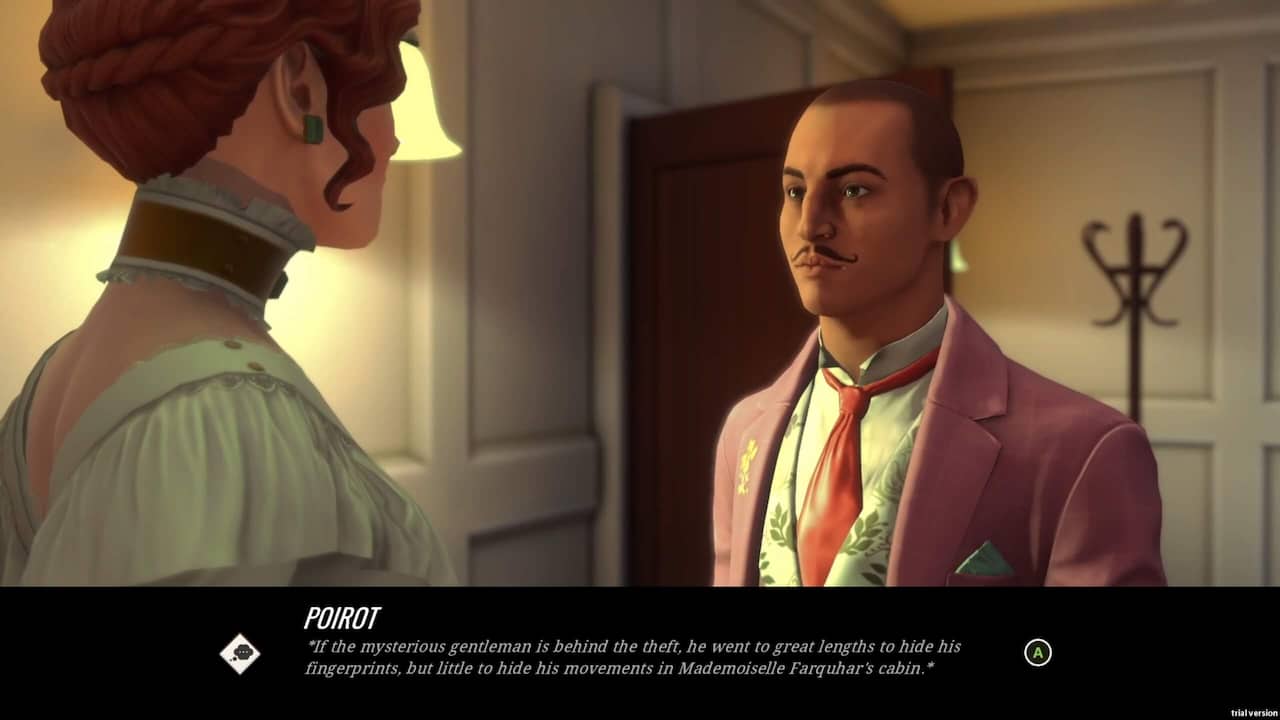
The hero of The London Case is recognizably Poirot, but he’s a good deal younger than his usual appearances on the screen or the page. Honestly, this is also the sexiest Poirot has ever been, too. McPhillips claimed they weren’t trying to design an underwear model, it’s simply an extension of his obvious vanity. It’s always been there in the source material. “He's absolutely obsessed with his appearance," he explained. "He's constantly grooming his mustache and he's always super well dressed. He thinks he's just wearing a sweater and he's wearing a three-piece suit for breakfast.”
One part of his design that sticks out is his hairstyle. When quizzed about Poirot’s unexpected buzzcut, McPhillips said it all comes down to character. “He's a peacock. He's that kind of guy who very much cares about his appearance. And the fact that he's just a bit handsome is a side benefit of that. He knew he was going bald. So he just shaves his head.” McPhillips gestured to his own fully shaved head as he added with a knowing smirk: “I have a lot of experience with that, I really identify with it.”
Becoming a detective
According to McPhillips, Blazing Griffin's guiding principle was this: “The player needs to be doing detective work, not following the story of a detective." It’s an area the developers have worked on since the first game by adding close examinations through first-person sequences. The detective experience is a common one in gaming, but McPhillips said that the medium has yet to master it.
“I love the Batman: Arkham games, but the detective mode is just magic, you know, you're going from point to point and then it recreates a big virtual thing that recreates this crime. For me, you're just ticking boxes as you're going through." Instead, they looked elsewhere for inspiration. “Looking at film and TV was a big thing for us. [one of Blazing Griffin's previous games] Murder Mystery Machine was based on things like The Wire and like True Detective, you're creating a detective experience. That was what we tried to do.”

Blazing Griffin's developers follow a golden rule. McPhillips explains how they want the player to feel like Poirot, instead of simply sitting back and watching the deductive genius make all the connections for them. The painting theft the game opens with provides the perfect case study of this approach, which links puzzles to story. The player steps through the space and builds up their own timeline, uncovering clues that they build into a hypothesis with the help of their Mind Map mechanic. This helps the player build their own mental picture of what really happened, with a reactive flow-chart that allows them to test the suspect’s statements against that timeline and other people’s testimonies.
It’s a logical challenge McPhillips called a “huge spaghetti mess," but it’s worth the clutter if it helps players fully inhabit the role of a detective figuring out the bigger picture.
Teasing those little grey cells
Despite over 30 years of history, adventure game developers still struggle to calibrate the difficulty of puzzles. Blazing Griffin are no exception, but their commitment to minimizing frustration guides their approach.
McPhillips spoke about how even in a murder mystery, you can’t just kill the player or lead them to an actual dead end: “It's hard to put fail states in. We don't have any points in the game where you talk to someone and you can say something stupid to the person, like in LA Noire where you can just keep aggravating this person until they like go crazy. And then you fail the case and you have to redo the case or whatever. We don't have that because we need to keep pushing it forward.”
It's also clear that puzzle design that relies too heavily on decoding branching dialogue can lead to frustrated players. McPhillip said it's the kind of roadblock that Blazing Griffin are keen to avoid. “It's not fun to go through a conversation twice. It's like, 'I'm just going to mash through this as quick as I can to pick the second option I should have picked instead of the first option.' To me, that isn't fun.”
McPhillips said that he understands the appeal of player agency, which the developers introduce through dialogue choices and scenarios that react to your decisions. But Agatha Christie would smile if she could hear his defense of the authored approach.
“I know there's the idea that choice is exciting, but it needs to have a purpose. And when you're trying to just tell a story, which is what we're trying to do here, we want you to be a big part of this story, it doesn't necessarily add up. And if you're 'oh, but I went through this by making Poirot be a total bastard.' It doesn't work for me, so we made that conscious decision to have dialogue be more about understanding the characters and getting deeper into them so you can build a case against them.”
Creating Poirot’s London
London may be an incredibly familiar setting, but McPhillips described what makes Poirot’s version of London different from what you've seen before: “Sherlock Holmes' London is smokestacks and street urchins. Poirot’s London is more middle class. More nice apartments and clean streets. We're based in Scotland, and there's actually quite a bit of Edinburgh’s old architecture that made it into the game and the exteriors of the buildings. They're all that kind of very grand, big townhouse kind of thing.”
McPhillips went on to describe how a huge depth of research, reference materials, and friendly advice from the Agatha Christie estate’s resident historian informed every aspect of the game’s locations. “It was based on a lot of reality, the things that have survived, but we've got stacks of books. It's funny: our concept artist, when we were doing a police uniform for example, she's got a book that's just British police uniforms through the centuries. And it's like, why does that book exist? I don't know, but it was useful.”
Their in-depth approach shows in every environment, which all are littered with painstaking period details.
The unexpected buddy cop influence
How you guide the player is a difficult consideration in any adventure game. Fortunately, the detective genre comes with a ready-made solution that allows for character-driven methods to drive the plot forward.
McPhillips gave a blunt explanation: “A common trope in these stories is the sidekick. The sidekick exists for a reason, and the reason is to be an idiot. The sidekick is there to just say 'I don't understand, explain it to me.' It's such a trope, and I kind of love it.”
This is a good place to introduce series favorite Arthur Hastings. In the books, Poirot’s friend is an established supporting character, and often even the story’s narrator. However, Blazing Griffin got to invent their take on Poirot’s first meeting with the insurance clerk who is destined to be the Belgian detective’s useful idiot. McPhillips elaborates on the gameplay function of the sidekick: “There's a trope of the sidekick saying something stupid. And that being the catalyst for Poirot saying 'wait, of course!' And then the sidekick saying 'what did I say?' And then they run off and solve the crime, because the sidekick said something daft.”
For all the sidekick’s rich history in detective fiction—between Sherlock-Watson and Hastings-Poirot—McPhillips drew on a less-likely inspiration for The London Case.
“My template for the Poirot-Hastings relationship is Beverly Hills Cop. Eddie Murphy shows up and then you've got Judge Reinhold, who's this buttoned-down kind of guy. When we meet Hastings, he's still working in an insurance company; he's not a policeman, he's not a detective and he's quite buttoned-down. He knows London, but he doesn’t know crime, he's never seen a dead body or anything like that. Then Poirot comes in and he's a little bit of a whirlwind for this guy's life.
“Poirot is not a policeman in London, so he needs his help. So they're going around investigating a crime that they're not allowed to investigate. It's giving Hastings a taste of this other life, which ultimately is a catalyst for the rest of their life together when they become partners solving crimes. This is that Breaking Bad moment for Hastings.”
The Case of the Golden Idol
Unlike Blazing Griffin, Color Gray Games—the developers of last year’s historical puzzler The Case of the Golden Idol—could start completely fresh. In their game, where players piece together the murders that follow a sinister golden idol across the decades, the developers could embrace the lack of preconceptions and simply make everything a mystery.
Players are dropped into vivid pixel-art crime scenes as disembodied spectators. Often witnessing the fatal moment yourself—like an early instance where a victim seemingly bursts into flames out of nowhere—you take advantage of this freeze-frame setting by omnisciently rifling through these scenes to understand exactly how these characters got into such a terrible mess.
The brothers behind the game, Andrejs and Ernests Klavins, explained to the Epic Games Store why they decided to set their mystery game in the 18th century—a full hundred years before the first detective novel was written. (Wilkie Collins' The Moonstone is often given this honor by critics like T.S. Eliot.) Andrejs explained that 19th century murder mysteries felt overdone to him and his brother, but the 18th century is rich with evocative details like royalty and castles, while also remaining familiar to most players.

Ernests added: “It's an interesting time. It's Enlightenment and at the same time it’s the start of modernity. It's colonialism. And it's the introduction of a lot of cheap alcohol. We decided to make this a parallel world, and it allows us to make our own story that's not connected to actual events.”
While they wanted to make a game with a historic feel, they didn’t want to feel tied to real events. In a game featuring major political figures vying for power, they felt their research into 1700s British politics led them too deep into the weeds. Rather than become experts in 1700s law, they decided to simplify, instead following their story’s theme of political events that lead to terrible consequences—a theme that remains as relevant today as it was in the revolutionary 1700s.
The brothers said that writing a story about people without a paper trail—in an era before passports, police, and photography—offered a challenge, but also a certain simplicity. They don’t envy mystery writers who have to work within our modern era of smartphones, along with the wealth of information modern technology can capture.
Morbid fascination
Gaming is no stranger to bloody murder scenes. In some genres, you can’t take a step without tripping over a grotesquely murdered body—just look at The Outlast Trials or Dead by Daylight. But we all know how powerful the hold an unsolved murder has on the imagination; these days, it also has the capacity to launch a thousand podcasts.
Andrejs described how he channeled that very common curiosity about murder: “I think that there is something very evocative about a murder scene. If you open the game and you see someone dead, ideally in some kind of strange situation, you immediately have questions that you want to answer.” Ernests added that murder is simply a much more exciting topic than white-collar crimes, such as financial embezzlement. Andrejs continued: “I think there is a strange fascination with murders in society. People are obsessed about serial killers, I guess we use that fascination.”
Andrejs pointed to Games Maker’s Toolkit’s video on detective games as an example of what drew them to the genre. “They promise the detective experience, and they have a detective setting but actually, you don't feel like a detective when you play them. Only a few games delivered this, most notably Return of the Obra Dinn. We thought that had been a breakthrough game, but there are no followers.” Lucas Pope’s game inspired the brothers to try their own spin on the detective game.
Cryptic fun
While the brothers wanted to make something new and thoroughly unexpected, since they were working within the storied murder mystery genre, they couldn’t resist including certain fan-favorites. This included a poisoning at a mansion’s dinner party.
The Klavins brothers particularly wanted to include secret codes and letters in the game, which created huge difficulties. They added ciphers which—as it turns out—are designed to be near-impossible to crack.
Andrejs explained: “Most real life ciphers, they are not fun. They are quite hard to use even when you know the principle. The problem with ciphers is that people can invent lots of ways to go in the wrong direction with them. Whenever they do something with letters, it opens a box of dangerous possibilities. Then we inevitably provide a bad experience.”
The brothers admit they haven’t perfected the method of gamifying codebreaking—and who has, really? However, they were pleased with how they tied it to its chapter’s world. Players couldn’t brute force it, and the game didn't ask players to work through an entire alphabet of ciphered symbols. They’d found an achievable way to create the elation of cracking a code.
Everything Everywhere All At Once
One of The Case of the Golden Idol's most-unusual aspects is its lack of gating. Each level is a snapshot of a murder scene that's frozen in time while you tease out what happened—it's just another dead body on the pile.
For Andrejs, keeping each chapter entirely static served a clear purpose. “We want to control only the pacing of the knowledge of the player, not its access to clues and the environment. And, if I'm honest, unlike detective fiction here, you can do it. In fiction, it's often not necessarily fair game. You as a reader often can't figure out anything. Only the detective of the book can.”
It’s a story with no protagonist, merely a sequence of unfortunate fatal events around one fateful object: the Golden Idol. Ernests admits the contradiction of basing a game of logic and reason around a magical artifact. “The idol caused some problems as well, because it’s a magical item. People use it and spend the rest of the game trying to constrain it. Magical items are probably not a good idea for the detective game because you can explain everything magically. We took great effort to explain the idol can do that, but it cannot do everything. It’s magical, but it’s not a weapon. A gun is a better weapon than the idol.”

The developers faced a persistent challenge of delivering information about the game world without a narrator, or even a player character. Ernests described their approach as “information starvation." He continued: “We want people to know more. We want to dispense it in minimal portions.”
Notes, letters, diaries and the contents of each character’s jacket weren't enough; they felt it was important to add motion comics between chapters to make the flow of the game’s events more explicit. However, they rejected an early idea of including newspapers, a very familiar trick more often used as worldbuilding flourishes in games that don’t demand such close examination. They worried that players simply wouldn't read them.
Just like Blazing Griffin’s approach, character is key to The Case of the Golden Idol. “We try to design stories so that the actions make sense. When you watch a modern TV series, very often, it's like OK, there’s mystery, but the events behind this, this mystery doesn’t make sense because people don't act like that. People don't have to be perfectly logical. But even when they like acting irrationally, there should be some sense why they're doing that.”
In what’s a quietly revolutionary choice, players are simply spectators in Golden Idol. They can only observe and understand. Andrejs explains they considered introducing player agency and some kind of tools, but they discarded the idea, as they felt it risked diluting their core narrative. “One of the reasons why we kind of got rid of the agency was that the agency sometimes implies some kind of choice and non-linearity. But we wanted to be honest that this is the game you play only once.”
Thinking aids
Players could easily be overwhelmed by The Case of the Golden Idol's scenes, as they present several screens packed with rich environmental detail. Color Gray Games’ solution to this problem was its “thinking” mode, which gave players a space to arrange and test their observations. These screens inventively let players place the words they collect into fill-the-gaps sentences.
This mode is the place where players present their thesis in order to advance to the next chapter. However, it also provides desperately needed guidance through its optional sub-objectives. Players are encouraged to put names to faces in portrait galleries, as well as generally making sense of the subplots that exist between these feuding characters.

Andrejs explains the crucial role this mode played in guiding the player: “As this game can be super-overwhelming, it asks a lot from you. So we felt that we needed to introduce these small wins, smaller panels, smaller puzzles, where you input something.” It helps players understand a small piece of the puzzle, even if the bigger picture still eludes them.
These smaller puzzles are often sentence-based, which let Andrej’s deep understanding of language (from his background in English philology) shine. “When working on the texts of thinking panel puzzles, often their contents would influence the difficulty of the scenario as much if not more than the number of clues we would offer to the players in the environment.”
These intricately plotted games ask a lot from their players, but they give just as much back in suspense and sinister drama. They also offer a fascinating window into the past.
The game is afoot! Unravel a sordid historical mystery in The Case of the Golden Idol and Agatha Christie—Hercule Poirot: The London Case on the Epic Games Store.