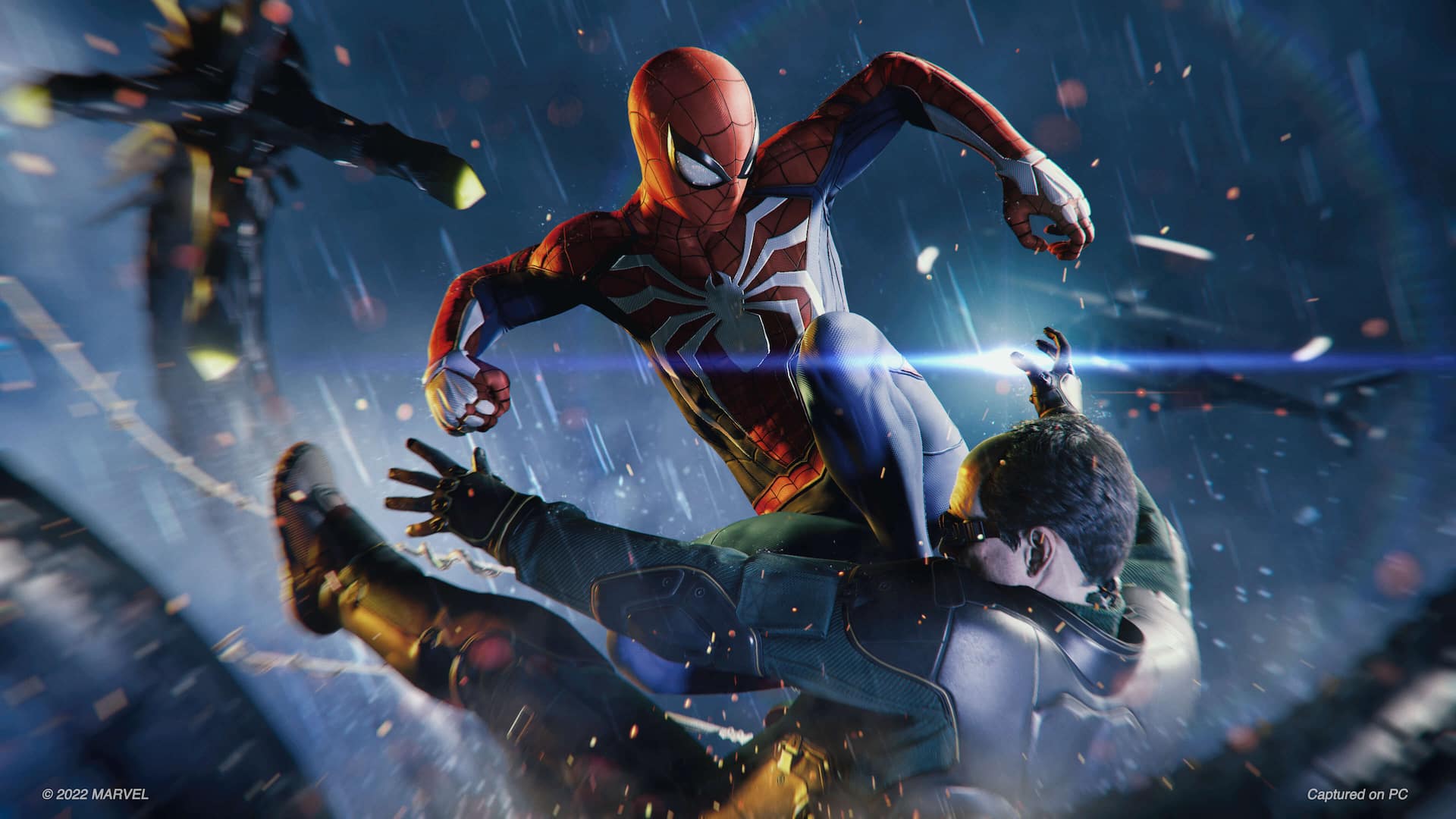
Nixxes and Insomniac discuss bringing Marvel’s Spider-Man Remastered to PC
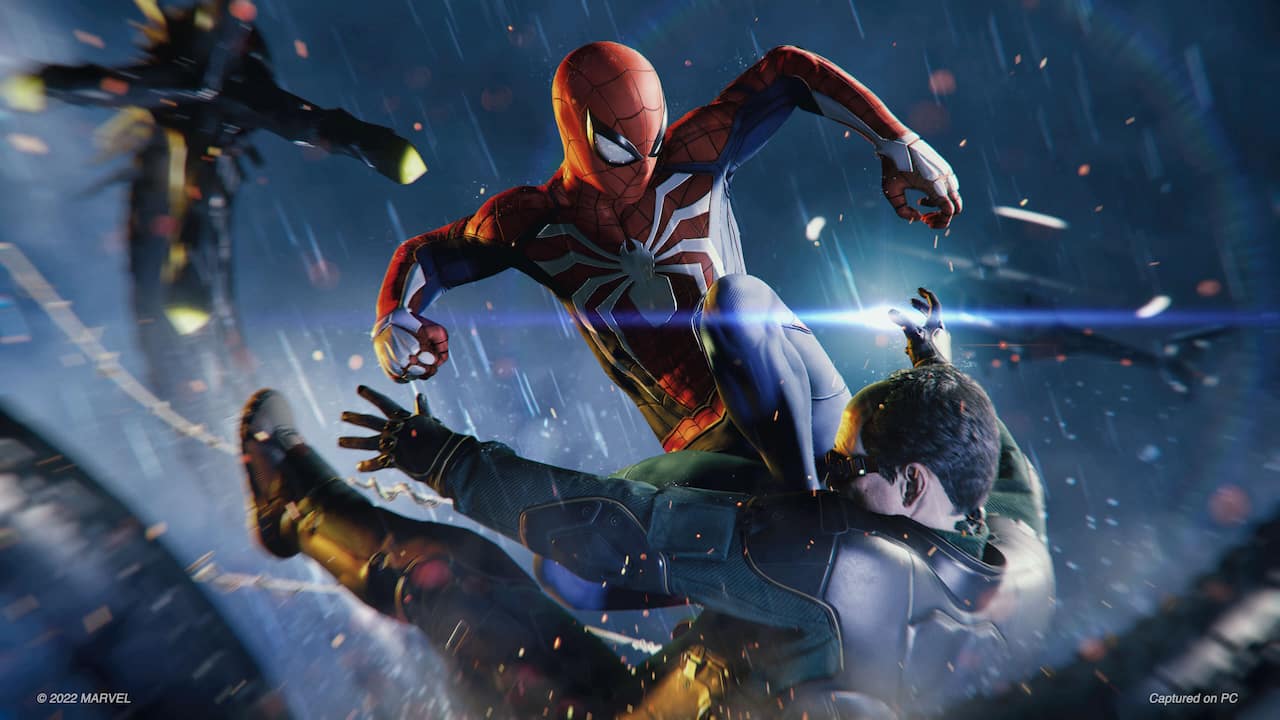
Two years after its arrival on PlayStation 5, Marvel’s Spider-Man Remastered arrived on PC, with acclaim from critics and fans alike.
That’s in large part thanks to the work of Dutch video game developer Nixxes Software, a studio that’s made a name for itself specializing in bringing massively successful, and visually delightful console games to the computer – often with the sorts of bells and whistles that delight PC players.
Last year, the studio was acquired by Sony Interactive Entertainment and Marvel’s Spider-Man Remastered was Nixxes’ first project following the acquisition.
Following the release of the game to Epic Games Store and Steam, we caught up with Nixxes’ Founder and Senior Director of Development Jurjen Katsman and Insomniac Games’ Core Technology Director, Mike Fitzgerald, to discuss the challenges the teams faced bringing the game to PC including delivering new controls, custom upscaling, and – of course – support for a wide range of computer specs.

What challenges did Nixxes face while bringing Marvel’s Spider-Man Remastered to PC?
Nixxes’ Founder and Senior Director of Development Jurjen Katsman: The project certainly brought several challenges. One recurring theme is that Marvel’s Spider-Man Remastered already was extensively adapted for the PlayStation 5, making the most of that hardware. Turning that into a game that scales across the wide range of PC hardware, including hardware significantly less powerful than a PS5, while also being a showcase on the most high-end PC hardware, was something that took a lot of effort and tuning.
As a foundation for that we had to build an entirely new DirectX 12 renderer, expand on that by extensively using DXR ray-tracing, and add a lot of other features to allow players to tune the game to their liking.
In a way, the largest challenge is trying to ensure that we accommodate all the desires PC gamers have. That includes supporting a wide variety of different display types, input devices, and providing settings for visual and performance preferences. To me that is both the beauty of PC gaming, but also a challenge for us as a game studio.
The game also supports mouse and keyboard, were there any particular challenges in translating the controls of a game designed for a haptic feedback controller to something as nuanced as mouse and keyboard? Do you feel like anything is lost without the ability to feel that haptic feedback during play?
Katsman: We wanted to ensure that traversing Marvel's New York while playing as Spider-Man felt just as heroic when using mouse and keyboard, as it does when playing with a gamepad. This was no small effort and took a lot of iteration and feedback. I personally now even prefer the mouse over the gamepad, because it allows me to look around quickly and rapidly turn around to jump to the next building.
 This was Nixxes first standalone project as PlayStation Studios subsidiary, did that change or streamline the process at all for the studio?
Katsman: Our team really enjoyed the partnership with Insomniac Games for this game. There is a lot of casual dialogue between our team and Insomniac Games, with everyone adding their own expertise. We’re excited to continue this partnership with Insomniac Games for the upcoming release of Marvel’s Spider-Man: Miles Morales on Nov. 18 as well.
I am convinced that joining PlayStation Studios made it much easier for that cooperation and trust to exist, while for us as a studio, all the support from PlayStation Studios makes it much easier to focus all our attention on making the best possible games.
The PC version of the game offers quite a broad range of configuration options for the game’s graphics. How did you go about deciding what it was you wanted to support in terms of graphical upgrades?
Katsman: We have tried to provide quite a few! I think that is a large part of what makes PC gaming special, allowing each player to set up the game just how they like it. Sometimes we would try having fewer settings to simplify things, but mostly we end up finding that giving players control over anything that can be used to balance CPU use, GPU usage, or visual quality, is worth exposing. Even just before launch, we added more options to ensure we give players enough scalability.
How do you think ray-traced reflections, in particular, impact the look and feel of the game?
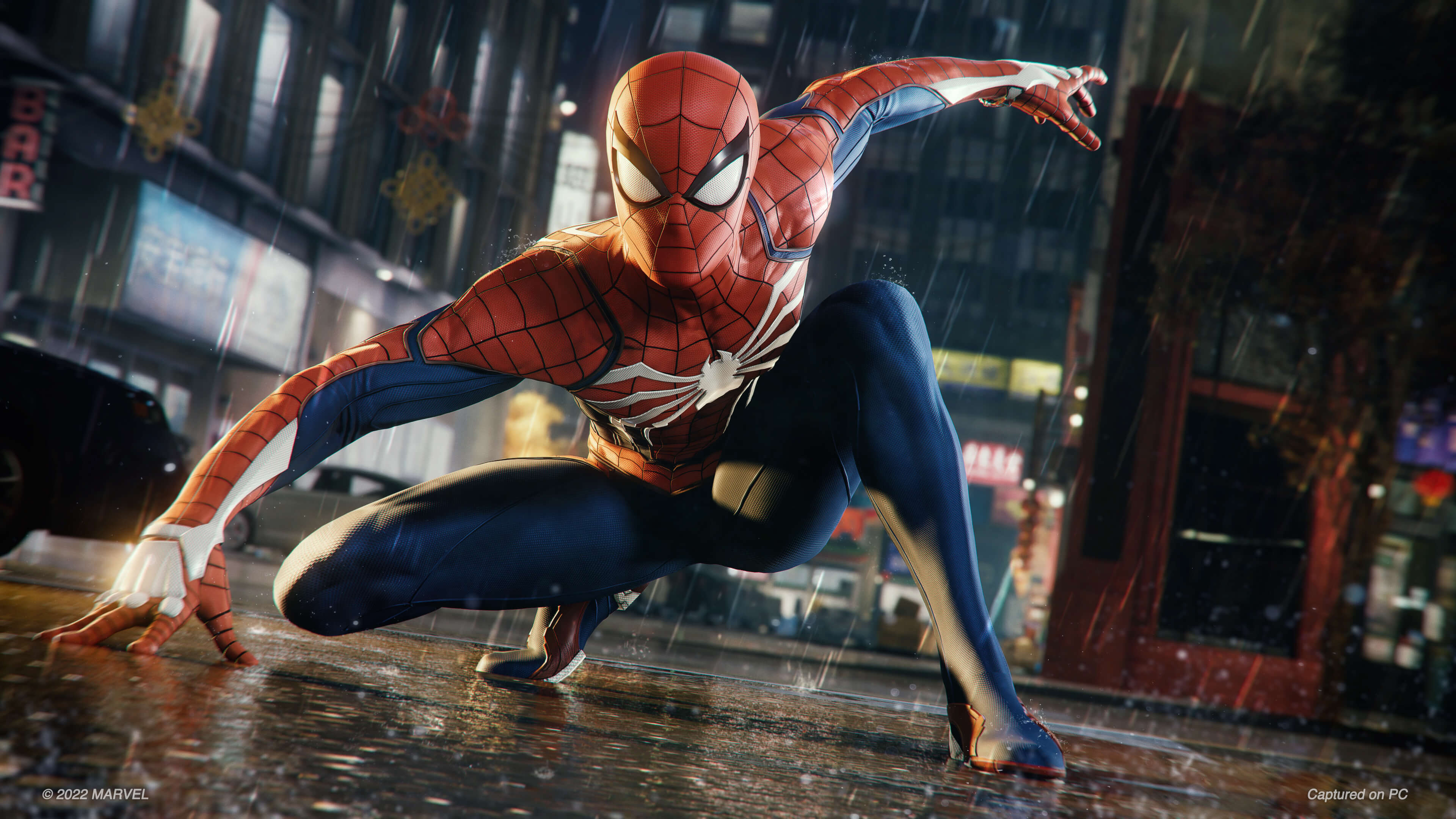
Katsman: I think it really suits the game wonderfully. A large part of the game plays out on the streets of New York, and the city is full of modern glass skyscrapers that reflect the entire city around them. It looks great without ray-tracing, with cube maps rendered throughout the city, but the real-time ray-tracing can show the reflections with so much more detail, with all the pedestrians and cars fully reflected. The buildings around you being reflected using an extra high detail geometry mode that is exclusive to the PC. It really makes the city feel so much more realistic and vibrant.
 Can you walk us through how the game’s custom upscaling system works?
Katsman: We have chosen to support a wide range of upscaling algorithms to ensure that you can use them no matter your hardware as well as your personal preference. This includes NVIDIA DLSS 3 and also IGTI (Insomniac Games Temporal Injection), an upscaling algorithm developed by Insomniac Games that Marvel’s Spider-Man also uses on PlayStation. It is fast as well as supported across all hardware.
I recommend using our upscaling algorithms in their “Dynamic” mode, in which the level of required upscaling is automatically determined. If your GPU has enough horsepower or when the location in game is a little simpler, it will use full native rendering, paired with amazing DLAA anti-aliasing when used together with DLSS. When the action in the game is a bit more hectic, or when you are running at a resolution that pushes your GPU, it will smoothly scale down to lower internal rendering resolutions to maintain your frame-rate target. But of course, we also support fixed quality levels for all these algorithms. Again, customization is key here.
How did Nixxes manage to nail the way the game seems to adjust automatically for the different screen ratios?
Katsman: Our philosophy is that a game should look good automatically, regardless of the aspect ratio of your screen. For normal gameplay, that usually can work well, and it certainly does in Marvel’s Spider-Man. But we went a step further and adjusted all cinematics, which are typically tailor-made for specific aspect ratios, to use the full screen on very wide aspect ratios like 21:9 and 32:9.
The game even has a special mode to support cinematics up to 48:9, with a blur effect being used to keep the focus in the center of the cut scene. Creating all these modes required our team to go through all cinematic moments in the game and adjust their animation and set dressing to make them compatible with these wider aspect ratios. It takes quite some effort, but it really pays off!
 What challenges did you face bringing PlayStation DualSense support, along with the adaptive trigger feedback and haptic response to the PC?
Katsman: Bringing over the core feature itself was not that hard. All the tuning on the haptics and triggers themselves was already done on the PS5. However, supporting it on PC can still be a challenge. Ultimately, the game supports all the DualSense features when the controller is wired. Fully supporting the triggers, haptics, and audio features was unfortunately not possible over standard Bluetooth. But when connecting the controller using USB-C, it gives you the full-featured experience, just like on PS5.
What does it feel like for Insomniac to see this game released to a broader audience?
Insomniac’s Core Technology Director Mike Fitzgerald: We couldn’t be more excited to have new players experiencing Marvel’s Spider-Man Remastered! As a game developer, you put a lot of yourself into the titles you spend years making, so there are few better feelings than seeing a player getting their hands on something you’ve built and having an absolute blast. For us, getting to feel that joy again from the PC audience has been fantastic, and we’re thankful for the quality work the Nixxes team has put in to do the game justice on the platform.
With the advent of the Steam Deck– and a number of other handheld PC gaming rigs– what are your thoughts about the game being playable on a handheld system?
Katsman: These devices are a great example of how flexible the PC gaming ecosystem is. You can play on a laptop, on a portable device, or on a high-end desktop, and all these devices have their own benefits. I certainly feel it is impressive for a game that so far has been restricted to playing on your TV, is now playable on the go wherever you are.
Anything else you’d like to add?
Katsman: At Nixxes we are proud to bring these amazing games to PC gamers, and we try to ensure they offer all the features PC gamers are looking for. We are also very committed to engaging with the community, so please continue reaching out to us on social channels to help us understand what PC features you would like to see in our games!
Marvel's Spider-Man Remastered to PC is on sale from Oct. 25 to Oct. 31 in the Epic Games Store.