
खबरें
Path of Exile 2: 7 tips to help you survive your return to Wraeclast
J
Jason Rodriguez
Our Path of Exile 2 guide covers numerous topics, including the available classes for the early access period, the gem system, and the complex passive skill tree. We also discuss what you can expect from endgame activities should you survive the long road ahead.
Choose the right class for your preferred playstyle
Path of Exile 2 is expected to have 12 character classes once it fully launches. However, only six are available for the current early access period. Since your trek all over Wraeclast takes numerous hours, it’s important to consider the class that you’d choose at the start. These are the options:
- Warrior: This doughy fighter excels in melee engagements thanks to attacks that can stun and knock back foes. Warriors also tend to have high defense and armor.
- Mercenary: The Mercenary class can eliminate foes from a distance with its rapid-fire crossbows as well as interchangeable ammo types.
- Ranger: Similar to the Mercenary, the Ranger is also a great pick for those who want to pick off targets from afar. The class also has utility functions for crowd control and disengaging.
- Monk: The Monk exemplifies frantic battling while on the move. This champion’s high mobility is further complemented by lightning-fast melee strikes.
- Sorceress: This spellweaver is a master of the arcane arts, drawing upon scorching fire, freezing cold, and debilitating lightning magic.
- Witch: This renegade member of a coven makes use of enchantments of blood, bone, and darkness. The Witch can also call upon the undead to do her bidding.
Make use of Skill Gems and Support Gems
An important tip in Path of Exile 2 is to consider the gems that you’re likely to find throughout your journey. The most important types are Uncut Skill Gems since they unlock new abilities that can be equipped via a panel (G key). Bind this action to a key so you can use it in combat.

Using the Witch as an example, you can have undead summons like Skeletal Warriors and Skeletal Snipers. However, you must reserve a resource called Spirit so that your minions can be automatically revived. Note that Uncut Skill Gems can also be used to level up existing abilities.
Support Gems, on the other hand, complement active skills. You select from three potential boosts or effects, which you then socket to a specific skill. Going back to the Witch’s abilities, the Skeletal Warriors can get buffs like Last Gap, which makes them fight longer before they crumble, and Minion Instability, which causes them to explode when at low health.
Take note of item identification, rarities, and upgrades via orbs and runes
You’re going to find a lot of loot in Path of Exile 2, many of which need to be identified. You can either use a Scroll of Wisdom or choose the “Identify Items” option when talking to the Hooded One NPC—the latter option becomes available a few hours into the campaign.

Items are also subdivided into several rarities including common (white), magic (blue), rare (yellow), and unique (orange). Moreover, certain orbs and runes can upgrade items based on their rarity:
- Orb of Transmutation: Upgrades a normal item into a magic item with one modifier.
- Essence of Enhancement: Upgrades a normal item into a magic item with one defense modifier.
- Regal Orb: Upgrades a magic item into a rare item.
- Orb of Augmentation: Augments a magic item with a new random modifier.
- Exalted Orb: Augments a rare item with a new random modifier.
- Chaos Orb: Removes a random modifier and augments a rare item with a new random modifier.
- Iron Rune: +20% increased physical damage (weapon) or +20% increased armor, evasion, and energy shield (armor).
- Desert, Storm, and Glacial Rune: Increases inflicted damage (weapon) or resistance (armor) for fire, ice, and lightning elements.
The passive skill tree: Attributes, dual-class, respecs, and trying not to get overwhelmed
Path of Exile is known for its robust passive skill tree, and the sequel is no exception. In Path of Exile 2, you can expect no fewer than 1,500 passive nodes—some boost main attributes like Strength, Dexterity, or Intelligence, while others bolster miscellaneous stats like armor value, evasion, and mana.
Resetting your skill points is quite straightforward in Path of Exile 2. All you need to do is chat with the Hooded One NPC and pick the “Refund Passives” dialogue option. Bear in mind that resetting your passive nodes costs gold and the cost increases the higher your level.
Another facet to remember is that all classes tend to share the same passive skill tree, but they start at different points on the board. This means that as you level up, you can eventually gain the passives that are tailored for another archetype. Lastly, you may try the dual-class specialization feature, which allows you to pick passives that are weapon or skill type-dependent. Your character will automatically have those perks activated when you swap equipment or skills.
Explore the map thoroughly and check points of interest
Path of Exile 2 currently has three acts or chapters. Each portion of your adventure also has its own world map, which is accessed by pressing the U key. This interface shows interconnected dungeons as well as rare monsters, bosses, and notable treasure chests.
Be sure to check these points of interest to obtain more rewards. Taking out bosses is fairly integral, too, because some of these opponents grant permanent stat boosts for your character.
Beware of bosses and enemies, even those encountered early in the campaign
Path of Exile 2 is a difficult game; clearing each act won’t be a walk in the park. You’ll face countless foes, from wild animals and undead to vicious monstrosities and nightmarish hordes.
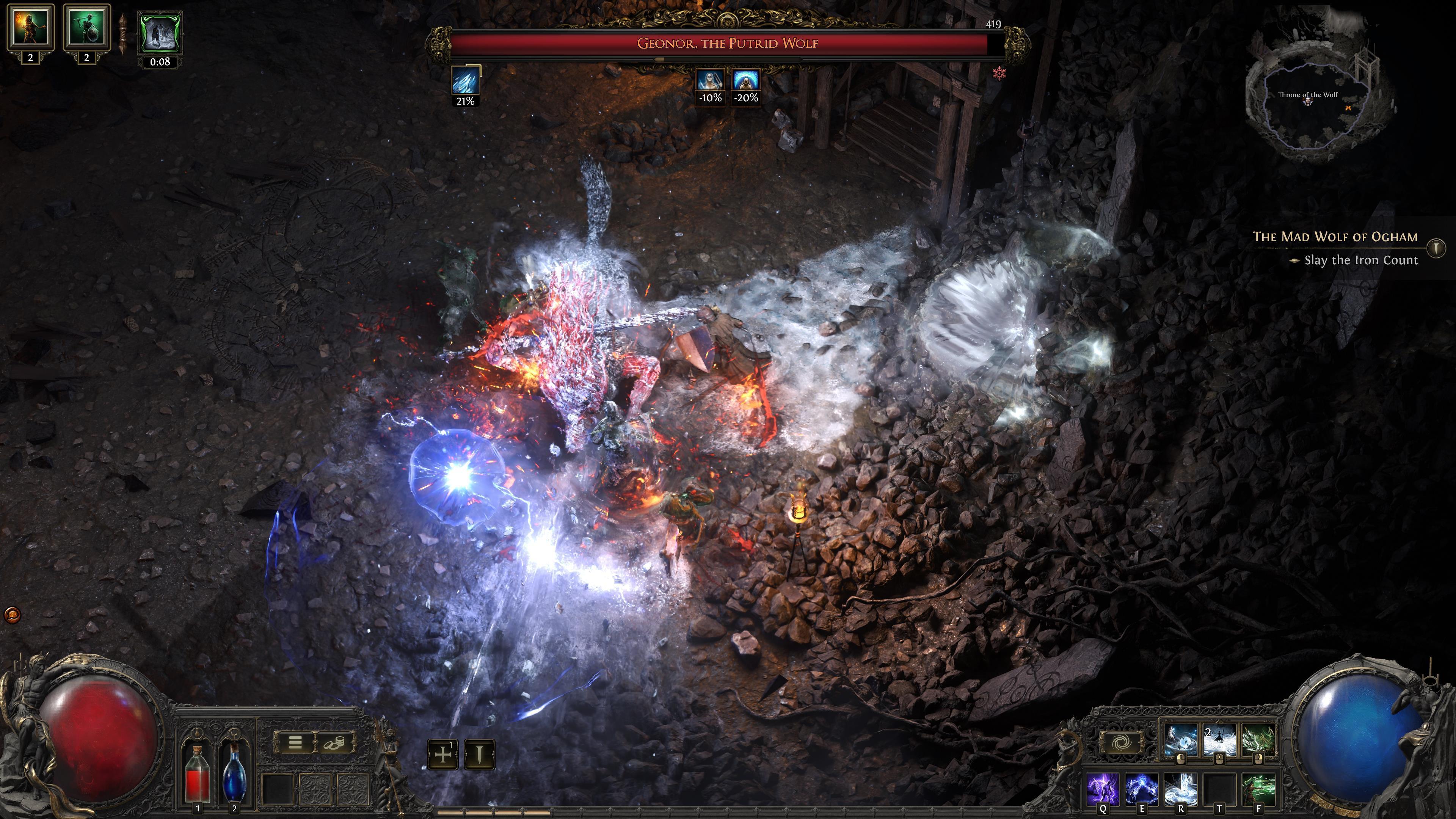
Of note is Count Geonor, who resides in Ogham Manor in Act 1. This foe initially fights you in melee, assisted by his wolf minions. However, once you’ve whittled down his health bar, the encounter reaches its second phase where Geonor transforms into the Putrid Wolf. In his beastly form, Geonor can cast area-wide ice spells and even call down deadly beams from the skies.
The endgame and Atlas map
Should you manage to brave the dangers of Path of Exile 2’s available acts, you’ll reach an infinitely more complex endgame that involves the Atlas. The Atlas is a vast, expansive map that’s full of nodes representing points of interest. Some are short romps through mini-domains, while others are longer and more difficult dungeon delves.
We don’t want to spoil all the details, but we can tell you these important features:
- Locations in the Atlas are interconnected, which means you have to travel and clear nodes to reach a particular point.
- Deaths are tantamount to failure. If your character perishes in a dungeon, then the initial path you took will be closed off. You’ll have no choice but to find another way around the map. Because of this, too many deaths can actually lock you out of certain areas.
- Solo players must be careful because of the above mechanic. Those with a party, meanwhile, need to consider the limited number of revives.
- Some fixtures in the Atlas are shrouded in mystery. You may need to explore further if you want to learn their secrets.
- Lastly, you can choose a location for your player hideout. This will be your home away from home while you’re busy tackling endgame challenges.