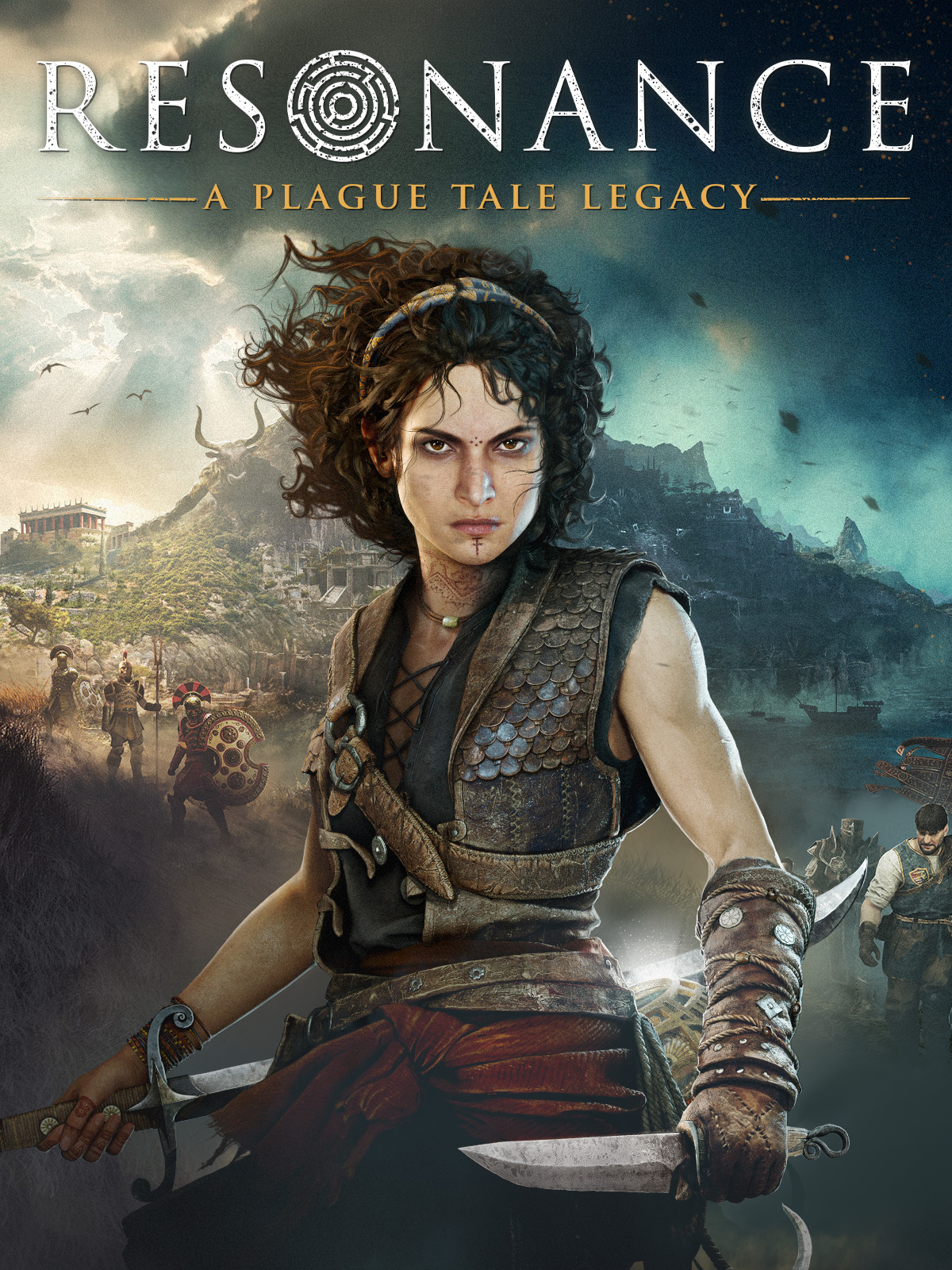
Resonance: A Plague Tale Legacy Interview and Hands-On with a Minoan Masterpiece
Resonance: A Plague Tale Legacy | Asobo Studio | Releaase Date: Aug. 27, 2026
Lost in the bowels of an ancient Minoan cistern, Sophia seems nearly as jangled as I feel.
Echoing, esophageal sounds make the already bizarre setting that much more surreal as I guide the smuggler-turned-explorer through the dust-filled cavern.
Her clear discomfort makes the entire experience more unnerving. Up to this point, Sophia has shown her fearlessness, her guile and her ease with sword and dagger, dispatching enemies with parry, thrust, counter and the occasional well-timed grappling hook toss. She's dodged deadly traps, hunted down artifacts and solved complex puzzles. All without missing a step.
But now, winding her way through these collapsed caverns beneath a complex of long-disused Minoan challenges, Sophia seems unsure of what might come next.
Resonance: A Plague Tale Legacy takes place some 15 years before the events of A Plague Tale: Requiem, which first introduced Sophia.
In this prequel, the young plunderer is in search of answers to the questions that plague her: her connection to the Minotaur's Island, her early years in a convent and her ties to the Macula.
It's through the Macula, an ancient curse, that Sophia can glimpse the island's ancient past through the eyes of Theseus and, on occasion, travel back to the Minoan era to fight in the trials.
As Sophia and her friend Leni explore the Minotaur's Island, they have to avoid capture by roving enemies while navigating a maze filled with deadly traps and clever puzzles.
Resonance does double duty as a prequel, both filling in the backstory of Sophia and her connection to the Macula and expanding on her combat skills as a young rogue.
In fitting Sophia's future into the past of this game, developer Asobo Studio wanted to ensure it didn't rewrite what happened in A Plague Tale: Requiem, said David Dedeine, co-founder and creative director of the studio.
"At the same time, there was still room to better understand why a character as bad ass as Sophia would care so deeply about two vagabond kids, and why she would be willing to take so many risks to help them," he said. "As we explored Sophia's past and developed the story of Resonance, it became increasingly clear that her promise to Arnaud was only part of the answer. There was something much deeper driving her actions."
In Requiem, Sophia helps Amicia and Hugo, the sibling stars of the game, escape danger to repay a favor she owes Arnaud Malpart, who once spared her life when he was ordered to take it.
"Throughout development [of Resonance], we regularly went back to Sophia's scenes in Requiem to make sure everything remained consistent," Dedeine said. "And sometimes, I was surprised by how naturally Resonance seemed to fit. It almost felt as if Sophia already knew her own story before we did."
Chief among the changes to Sophia are her deft combat skills, which allow her to parry, counter and attack, then deal a second, often deadly blow with the dagger in her off hand. She can also throw a grappling hook at an enemy and drag them toward her.
Dedeine said Ghost of Tsushima and SIFU were the most common references used internally during the redesign of the game's combat. But he added that Sophia — along with the game's lore, story and length — required the studio to find its own path.
"The initial approach was very much in line with the philosophy we had for many features in Innocence and Requiem: how do we create a combat system that feels as grounded as possible, allowing players to stay connected to Sophia as a person rather than turning her into a killing machine, while still making her a credible and talented fighter?" Dedeine said.
The answer was a character who can be killed quickly if you’re not careful, but also can survive by health restored through enemy kills.
"The idea that Sophia could go down after just a few hits was a key principle from the beginning, and it ultimately led to our mantra: 'Every shot counts,'" Dedeine said. "But Sophia is also smart and crafty, so we introduced the dagger as her signature move, guided by another principle we often used internally: 'A sword keeps you alive, but the dagger wins the fight.'
"Finding the right balance between vulnerability and mastery was incredibly challenging. The team worked extremely hard, breaking through wall after wall to get it right, and we're really proud of the final result and of how seamlessly combat blends with the rest of the experience."
The result is combat that feels fraught with danger but ultimately satisfying when you clear a room with dagger, sword, grapple, kicks. and the occasional killing flourish.
Of course, the development team didn't just have to ensure that Sophia's story fit neatly with her previously unwritten past. It also had to make sure nothing that happens in Resonance changes the details of Requiem.
The approach was to shed new light on that later timeline rather than alter it.
"Sophia's relationship with the Macula plays a role in the story, but our intention was never to rewrite established events or create contradictions," Dedeine said. "Instead, we wanted to explore some of the deeper motivations behind her actions and offer another perspective on a character players thought they already knew. At the same time, it was very important for us that Resonance remained approachable as a standalone experience. You don't need any prior knowledge of A Plague Tale to enjoy Sophia's story and fully understand her journey."
As an entry point, Resonance plays like a deftly crafted action-adventure, one that, in some ways, reminded me of games like Tomb Raider and Uncharted.
"We definitely wanted to push the action layer of the experience further, with more varied environments, brighter landscapes, and a stronger sense of scale and exploration," Dedeine said. "In that regard, it's easy to see why players might think about games like Tomb Raider or Uncharted.
"But I also think Resonance has an identity of its own. The Plague Tale universe brings a particular tone, somewhere between historical realism, fantasy, and darkness. That heritage influences everything, from the story and world-building to the way we approach characters and their motivations."
Wandering the Minotaur's Island, complete with towering edifices, crumbling ruins and the spectacle of combat in two distinct eras, turns every moment of gameplay into something memorable and rewarding.
The story is deeply engrossing, offering up a new take on the tale of Theseus and the form of the Minotaur in a surprisingly effective manner.
As the game progresses, it becomes a sweaty affair, with a mix of incredibly challenging bosses and a gameplay mechanic that is as unnerving as it is fun.
This latest Plague Tale also continues the magnificent work of Olivier Deriviere, who composed the original soundtracks for the first two games. This time around Deriviere composed and wrote original songs that were, in part, performed in Green Cypriot dialect by singer Vasiliki Anastasiou and the Amalgamation Choir.
To crank things up a bit more, the soundtrack also makes use of the Turkish yayli Mesopotanian tambur, Arabic rebab, Greek bouzouki, and carnyx, an ancient Celtic war instrument. The result is, at times, chilling, but always emotive and effective.
When it all comes together, Resonance delivers the sort of experience that envelops you in its sense of wonder, pulling you along for a 15-to-20-hour journey that feels much too short once you're done.
It’s been awhile since I’ve stayed up late and gotten up early to complete a game. I’m happy I did with Resonance. It’s the sort of experience that leaves you wanting more. Fortunately, it has an ending that hints that might just be possible.