RPG meets intriguing puzzle game in the deeply lovely Arranger
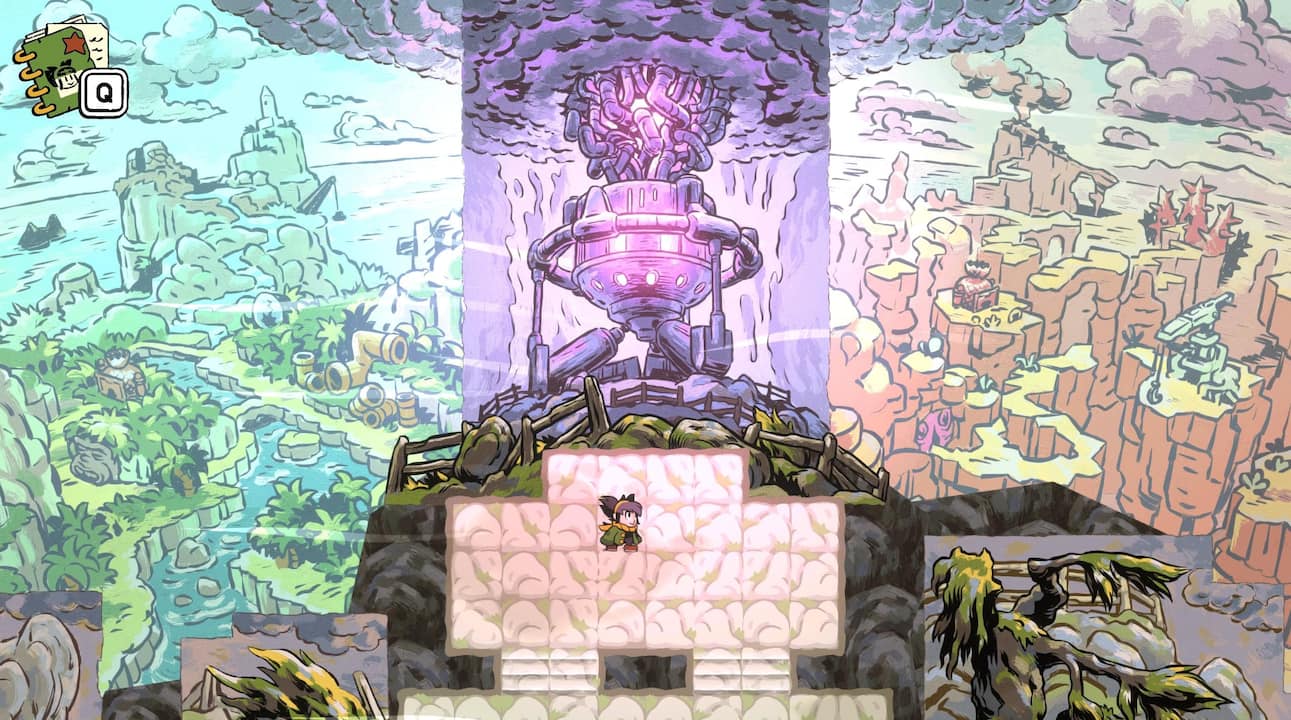
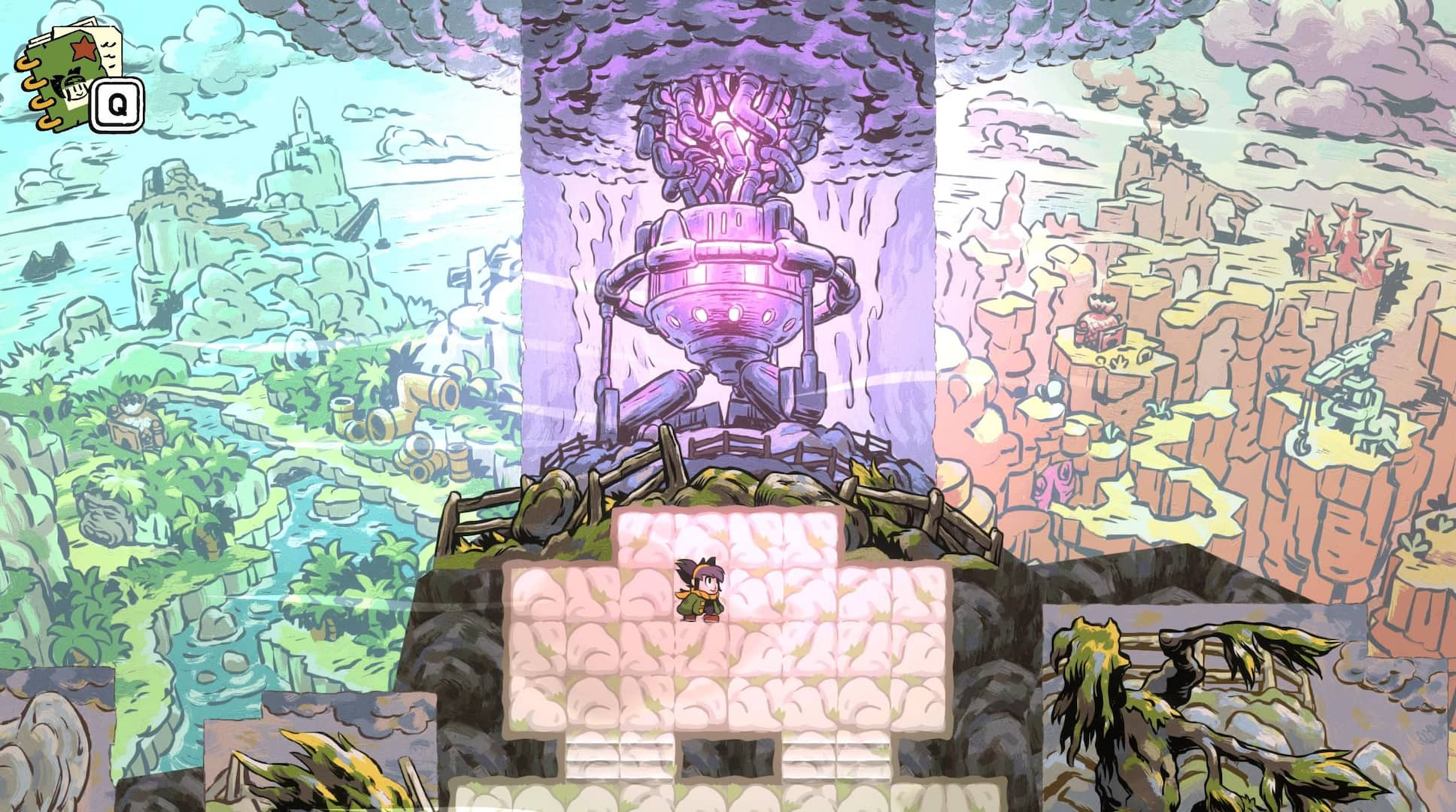
Every now and then, you realize you’re not just playing a good game but a special one. Arranger is a prime example of this: What at first appears to be a heavily gimmicked puzzle game very quickly proves to be something far deeper, far smarter, and much more wonderful than you expected.
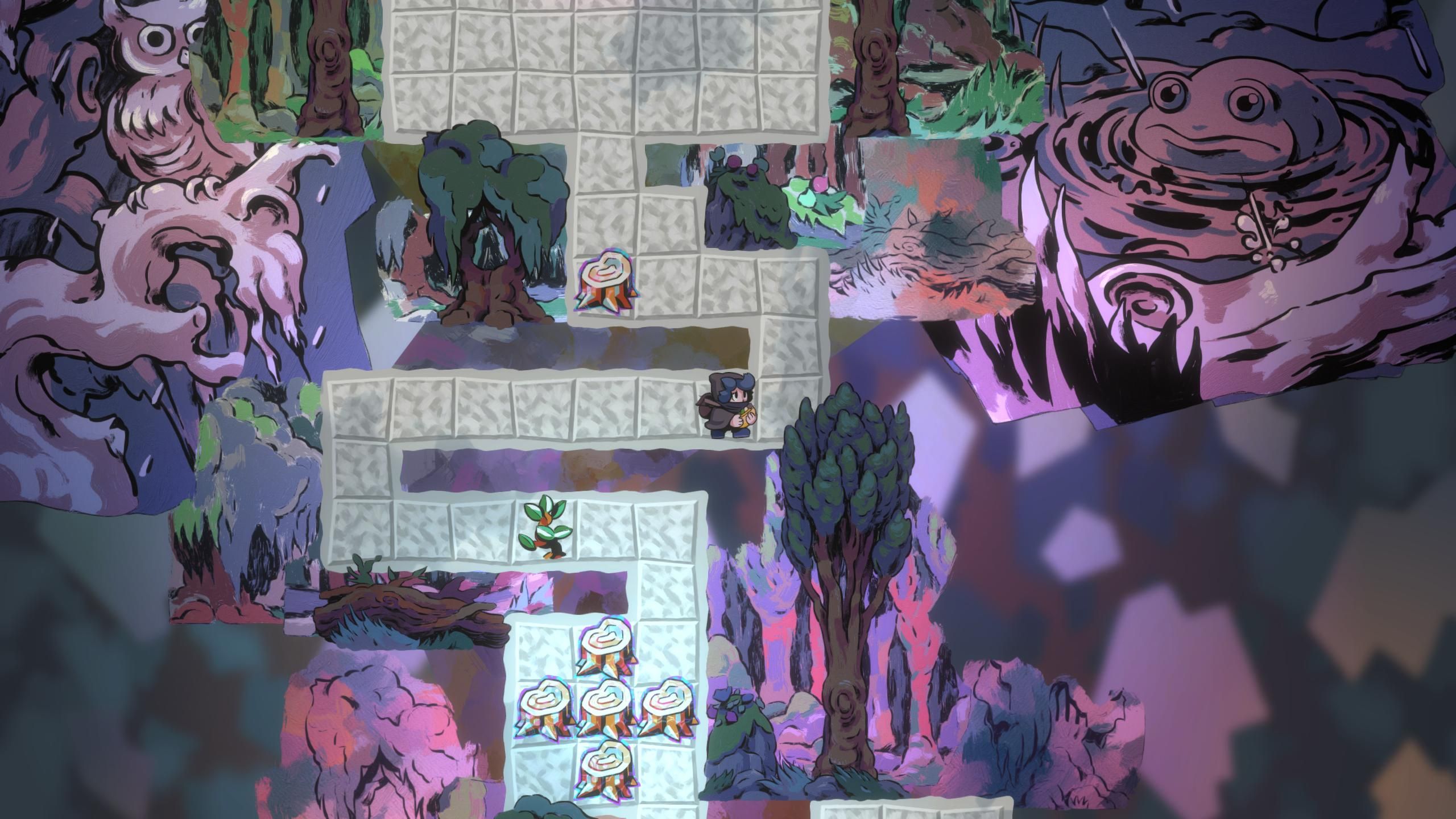
That gimmick is a significant one. You play as Jemma, a young girl who moves through the tiled world by sliding the rows or columns around her. Essentially, her feet never leave the tile she’s standing on; the whole row or column moves right, left, up, or down with the farthest tile at one extreme rolling around to the other side. If Jemma’s on that farthest tile, she pings to the other end of the line. And the game sticks to this, persisting with this as the core movement throughout. It sounds (if I’ve successfully described something for which English has no word) like it should be far too restrictive, something that could only provide a series of staccato puzzles rather than a complex and involved RPG world. And yet that’s exactly what Arranger is.
I wondered if the four-person team behind the game had similar concerns when they began development. “I think I was overly optimistic at the start,” says Nico Recabarren, who originally conceived the game. “Given the basic movement and constraints, in my head, it felt like we could add all sorts of different mechanics on top of it—that was the impetus of the whole idea.” But there was no “overly” to this optimism. “Thankfully, that did turn out to be the case, but it could have gone very wrong if that turned out not to be!”
Recabarren has form. His previous game was ETHEREAL, an exceptional puzzle game where the beautiful but simple art belied a depth and complexity that earned it the Audience Award at the 2019 IGF Awards. After meeting Nick Suttner (Celeste, Carto) at the same event, the two decided to pursue a prototype of an early version of Arranger, bringing on artist David Hellman (Braid) as well as musician and sound designer Tomás Batista, who worked on ETHEREAL. The result is quite the collision of talent.
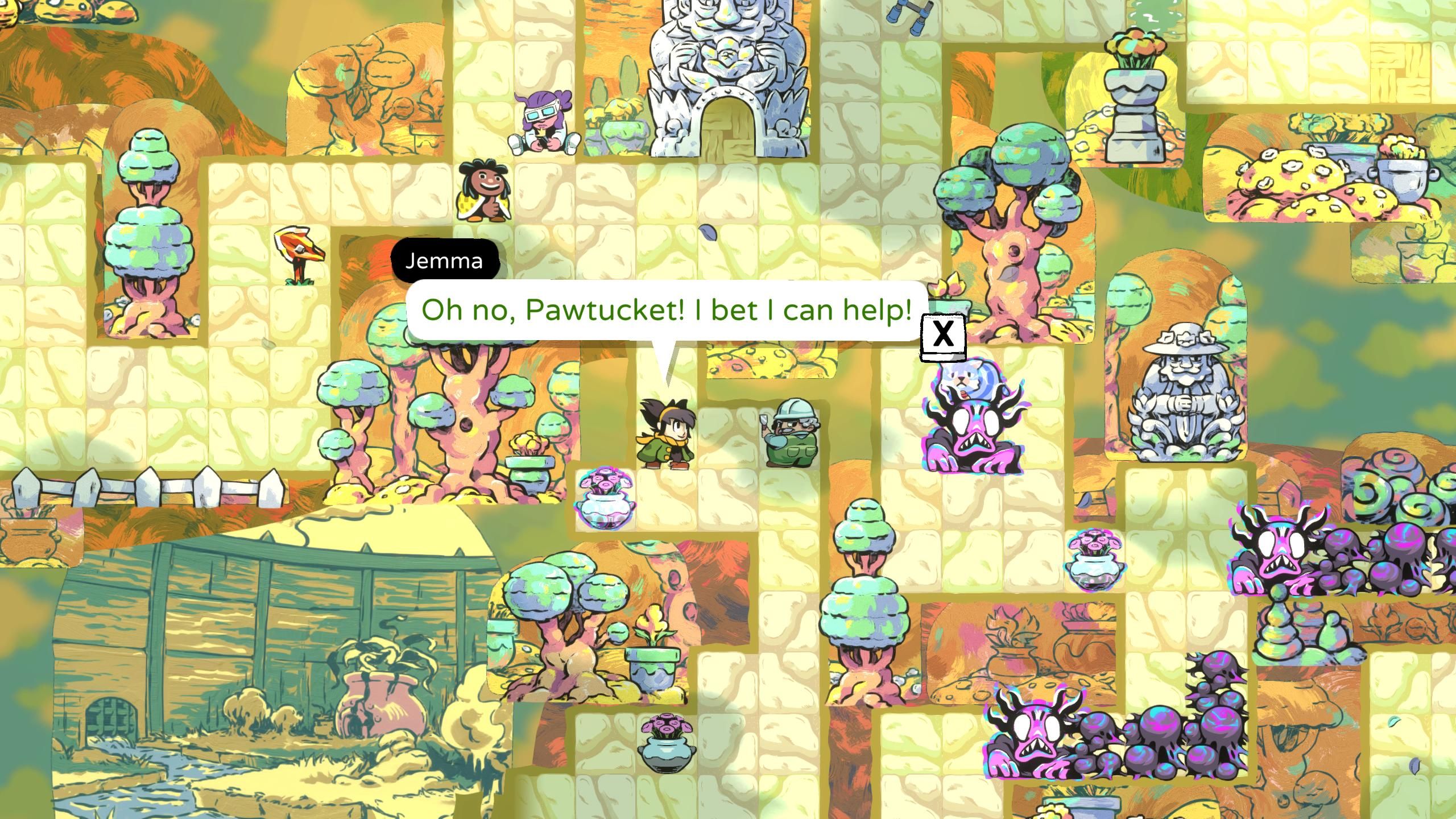
Arranger makes its RPG status clear from the very start. You begin by playing a different character, one who similarly moves through the world through sliding reality, as he reaches the place where he plans to abandon a baby, hoping it will be raised by whoever finds her. That’s Jemma, and while she is brought up in a loving home, she’s very much an outsider in her village (it’s unclear if others move the same way she does, or if hers is a personal affliction, but there are many who simply don’t trust her). After coming of age, Jemma decides it’s time to venture beyond the only home she’s ever known, and she sets off through a cave to reach the wider world.
But, in a twist that I just loved, she has to return to the village only moments later. She’s just said all her goodbyes, all the fuss has been made, and then you’re forced to return because of an impeded passage. The bell needed to magically open the doorway is broken, which is when Jemma recalls a cat wearing a bell back home. This twist speaks to the game’s movement—the way reality circles around on itself, where the left-most point becomes the right-most—and I wondered what inspired this opening gag.
“I think it probably started from mechanical reasons—the desire to encourage the player toward some outside-the-box thinking,” says Suttner. “It seemed pretty funny from a story perspective too. Just when everyone thinks they’ve gotten Jemma out of their hair, she awkwardly has to go poking around town again. Like when you say goodbye to a friend, and then end up walking the same direction as them.”
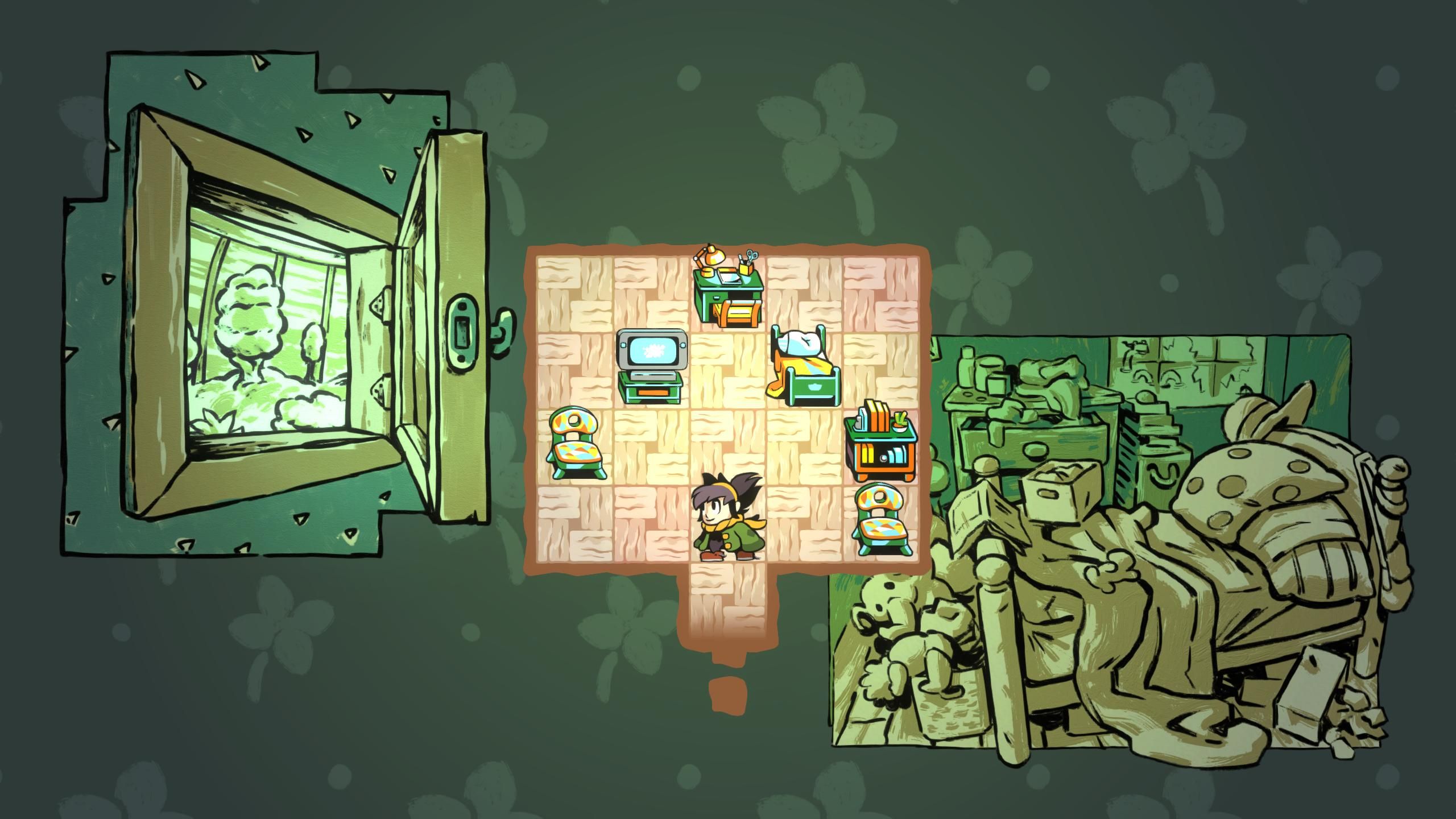
It’s also funny because Jemma’s movement leaves behind a trail of chaos. If you’re in someone’s house, you’re likely to scatter furniture all around the room or even accidentally drag some out when you leave. Occasionally there are jokes where Jemma’s movement breaks something important, which might then become a quest to fix, but it also means there needs to be in-world rules for what cannot be moved. This is called Static.
Static appears to be some sort of outside influence that is growing more powerful, and it becomes Jemma’s mission to investigate what might be causing this. Affected objects twinkle purple and teal, and they will remain in place while the tiles slide beneath them. Meanwhile, there are other more permanent features like rocks that will slide along a row or column but will stop any further movement when they reach an edge.
But despite the seemingly enormously restrictive nature of this style of movement that would normally lend itself to a series of single-screen, level-based puzzles, Arranger feels like it’s incessantly reinventing itself and innovating within its own rules. As you reach each new area, the nature of the puzzles feels fresh, original, and ever-surprising. I kept wondering as I played how much of this was premeditated, and how much came from iteration and experimentation during development.
“We actually had a lot of the currently showcased ideas from very early on,” says Recabarren. “During pre-production, I had a lot of time to explore these ideas since we were developing the plan and the full scale of the game at the time. Those ideas were first developed in isolated rooms where I could play and make builds for the rest of the team to test them out as well. The main challenge was to find a good spot for them in the game later.”
But despite this forethought, Recabarren says experimentation was still a major factor. “I’m pretty sure 90% of everything in this game came from just experimenting with different ideas. Things rarely worked right away, exactly as it did in our minds. Every single step was trial and error and iteration.”
Arranger has an intriguing approach to combat. Jemma never carries a weapon, but she still uses them. One of the key puzzles orients around this as you attempt to move a sword on a tile until it’s adjacent to a static enemy, and then slide it toward them. The result is something that, while still undeniably deadly, feels very hands-off and unthreatening. Jemma faces physical obstacles more often than enemies, and figuring out how to remove them is a huge amount of fun. But surely the designers tried out other ideas?
“[Combat] was the very first thing implemented in the game,” says Recabarren. “[It] ended up being a guide for many other things. We never discussed making it more complicated, as I think we were all drawn to the simplicity. We also loved the ‘comedic’ aspect of it.”
However, there were areas they were tempted to make more complex. “The inventory, for example,” Recabarren mentions. “The original idea was that we didn’t want to have a ‘proper’ inventory. Instead, the world was your inventory.” And that is the idea they stuck with, despite having ambitions to let Jemma carry things “instead of having to actively drag items around,” he says. “In the end, we decided to keep the original, simpler approach, and I believe it was a good decision!”
I entirely agree. There’s something very pure about the mechanic that Jemma simply exists on her tile. She can never hold something, never step onto a single-tile raft with an object, because that would break the core concept that when she moves, the world around her moves too. It’s amazing how important that begins to feel as you approach reality in this entirely new way. It’s something that struck the developers too.
When I asked Recabarren what aspects of the game surprised him the most, he picked up on the same theme. “I love how the main mechanic is connected with the context and the story. At the beginning, it felt impossible to achieve, but now it feels so obvious and natural. I’m so happy we were able to make that work.”
His second response also reflected a thought I had while I was playing. Making Arranger feel more like an RPG and less like a series of puzzles is crucial, and a big part of that can be attributed to the art. Backgrounds are this sort of wonderful conceptual art where specific objects are rendered like enormous posters around the scene. You know you’re in someone’s sitting room because there’s a huge picture of an armchair by a fireplace and another of a side table with a steaming cup of coffee on top. Recabarren brought up the same thing.
“I was very worried that having scenery around the gameplay area was going to make the grid harder to read, making the game very noisy and awkward,” he says. “But (co-founder and artist) David Hellman found this way of exploiting the empty area around the grid in a very unique and effective way. It doesn’t just fill the gaps, it really increases the quality of the experience overall.”
That’s indicative of so much that makes Arranger feel more than just very good, but into that special territory. For a 2D top-down RPG (or “Role-Puzzling Game,” as they call it), it goes the extra mile in so many areas, supporting a game that’s far smarter than you could possibly guess.