The Alters: Many hands make hard work for Jan Dolski and his clone crew
The Alters is all about multiple personalities.
First (and most obvious), there’s the multiple personalities of Jan Dolski, sole survivor of a planetary mining expedition gone terribly wrong. Post-disaster, Dolski solves his newfound manpower problem by cloning himself, staffing his base with Dolski variants that possess artificial memories, granting them different skills—and strong opinions. They'll need to work together to escape the intensely hostile planet, with its searing sun, wild magnetic storms, and dangerous deposits of mysterious time-warping Rapidium.
Then there’s the multiple personalities of The Alters itself. It features an eclectic mix of mechanics, from base-building and overworld survival to worker-management simulation and even an RPG-style conversation system.
For 11 Bit Studios, making a game with this much variety is a challenge on par with Jan’s own struggles. Why did they invent such an unexpected combination? “The short answer is: We were crazy,” says Game Director Tomasz Kisilewicz, with a confident smile that suggests the risk’s paying off.
What if?
When it comes to high-concept science fiction, The Alters' surreal clone-driven premise is about as high as Everest—or maybe even Olympus Mons.
In the real world, we’re spared the knowledge of where the road untaken might have led. The aftermath of the death of a loved one. The choice to stay or depart a difficult home-life. Who to date, where to study. We make our choices, then live with them.
In The Alters, when Jan’s genetic code was transcribed, his entire life path was recorded along with it. This so-called Tree of Life captures the significant moments in Jan's life where one pivotal decision changed everything.

Instead of living with his choices, Jan must instead simulate different outcomes and meet the resulting alternate-selves, or Alters. The base’s artificial Womb facility doesn't birth replicants with memories identical to Jan's, nor uninteresting blank slates like Emma Stone’s Bella Baxter in Poor Things. These are fully developed variants, ones you could take to a bar and have deep conversations (or furious arguments) with.
And unlike Jan Version 1.0—an everyman figure who works as a simple builder—the Alters he creates have highly specialized capabilities. Jan may be able to make use of their skills—but he’s also forced to confront his many shortcomings, and a past life full of pain and regret.
“We were looking at the emotional core of what we want to do, and we came up with this question of ‘What if?’” says Kisilewicz. “What if these were real human beings with real experiences, real pasts, real memories? Those memories—their past—changed them, influenced their skill sets and made them into unique human beings.”
As players assemble their crew, choosing from numerous personality profiles in each playthrough, Jan may even find himself outclassed. For example, his scientist variant is smart, driven, ambitious—and thoroughly unimpressed by the lowly original.
“He soon starts undermining you, questioning why you’re in charge. Definitely the smarter one in the family,” says Kisilewicz.
A survival story
11 Bit Studio made its name with titles like This War of Mine and Frostpunk, survival games with a focus on resource-economy management. Kisilewicz says this hasn’t changed despite The Alters’ more cinematic ambitions.
You’re responsible for Jan's energy, for instance, which is depleted by tasks and restored by sleeping. The resource economy also feeds into The Alters' conversation-RPG aspects. Everything you do or say has an effect on the Alters. Serve poor quality food and they’ll be sad or even angry, depending on their personality. Hoard resources for utilitarian ends rather than provide creature comforts, and you’re likely on a crash-course towards a huge argument.
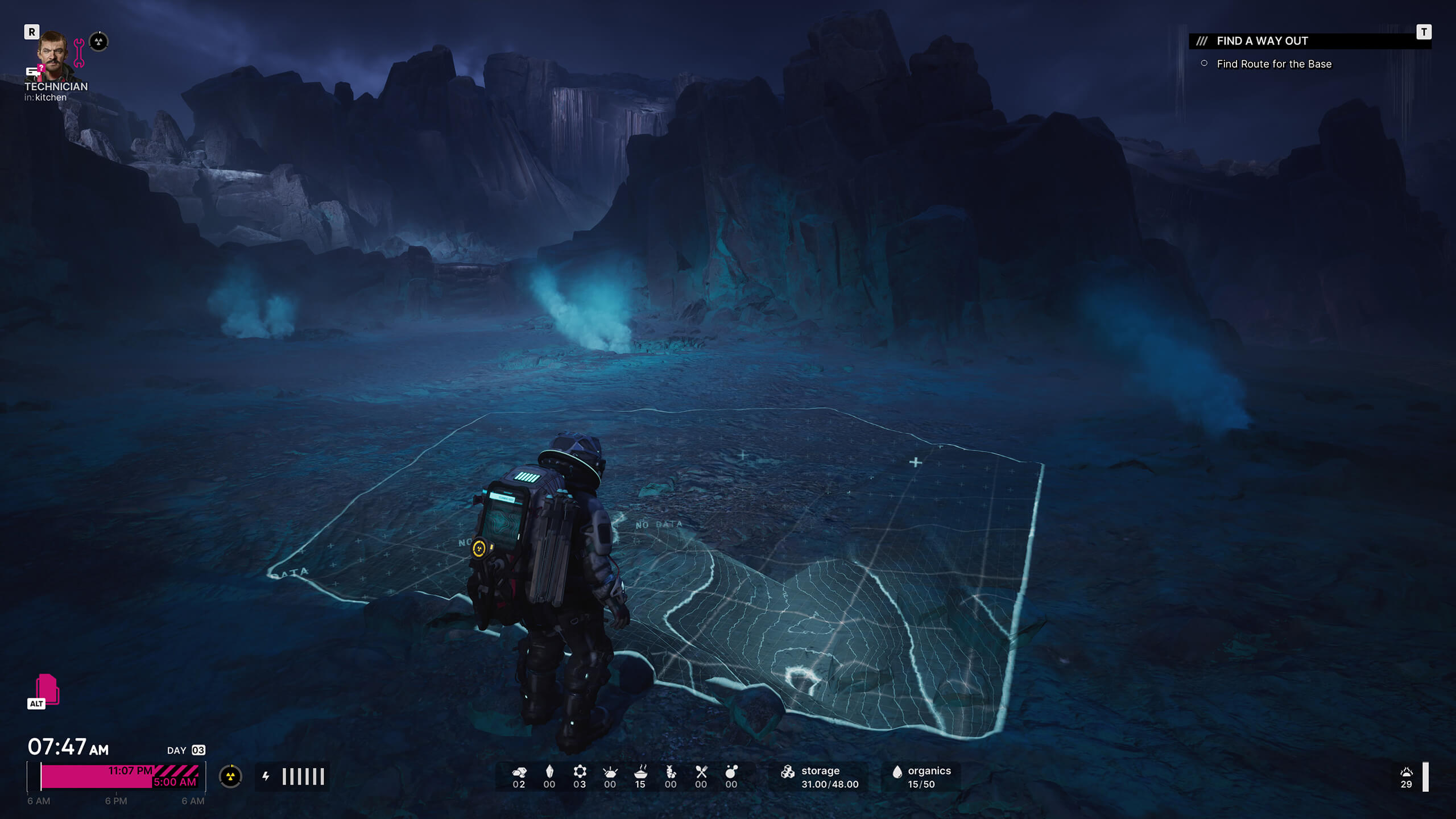
The story-driven focus of The Alters meant reevaluating survival fundamentals. The genre traditionally needs extended timelines, repetition, snowballing obstacles, and the capacity to start from scratch. Here, you’re always up against a ticking clock. One second corresponds to one minute in-game, and the real-time countdown demands you meet your objectives and progress the story before facing obliteration from sunrise.
It’s a fantastic method to create tension. Kisilewicz particularly enjoyed how the original Fallout used a 30-day deadline to deliver water supplies back to the bunker. But early in development on The Alters, he also saw how imminent peril warped player behavior.
“We saw during the focus tests that people were like, ‘Oh no, the sun is coming. Jesus! I have to run fast!” says Kisilewicz. The team modified The Alters to give players gentler preludes in which to mingle with their crew, before the pressure ramps up and they start sprinting around the planet for resources yet again.
Planetary pylons
Survival necessitates ransacking the planet for resources, either easily found as surface deposits or hidden deep underground in promising deposits that you'll need to scan to discover. The latter are accessed by building mining outposts, then setting up an extended series of pylons to connect a power supply from your base—as long as you have the materials.
Our demo contained just the linear prologue before The Alters truly opens up, but 11 Bit Studios promises far more. What comes afterwards includes three huge areas, giving players total freedom to construct their own economies, manage their small workforce of Alters and a network of mining outposts. As in Death Stranding or Subnautica, the intent was to create an immersive location for players to explore and exploit in-depth. “We really wanted to make it physical,” says Kisilewicz. “We never wanted to make a shooter with aliens behind every corner.”
There are also physical anomalies to deal with, caused by the dangerous Rapidium. This mysterious resource and its gravitational effects threaten the one resource that can’t be mined from the rocks: time. And while magnetic storms may encourage you to bunker down, collecting buffed irradiated resources has benefits that might just outweigh the ill-effects on you—or on the unfortunate Alter sent out on this thankless expedition.

As a location, the planet’s surface is vast and spectacular. Kisilewicz’s background as an artist is clear, especially after seeing one early anomaly turn the sea’s waves into jagged spikes of water vibrating under Rapidium’s influence.
It’s an impressive undertaking for a studio not known for lavish third-person environments, but it's also very intentional about its use of space. “That's what's great about the game,” says Kisilewicz. “It's big where it needs to be big. It's smaller where it doesn't need to be that big. So you don't have a lot of empty spaces to make content for the sake of making content. It's complex, but also compacted.”
One place you will find empty spaces—at least before you fill it with modules—is the sections where you can construct your own ideal base. Like Fallout Shelter or XCOM 2, you assemble the specific rooms meeting your needs on a grid, slotting storage rooms, kitchens, and all sorts of necessary utilities into place, careful to use space efficiently and create access points by elevator. From the exterior, your creation looks like a shanty town of shipping containers strung precariously across the midsection of your giant planetary base. From the interior, it's your home, your workstation, and the vital nexus of your economy.
Emotional budget
That economy includes the emotional state of your Alters. Whether they’re truly human may be up for debate, but they’re inarguably sentient beings able to feel pain, discomfort, and annoyance, and they’re rarely shy about telling you. You’re not managing an aggregated satisfaction score like in SimCity or Against the Storm. You’re managing an individual’s feelings, represented by stats like Frustration and Rebellion. They’re personable, and your crew is also small enough to ensure you’ll feel awful for letting them down.
“Having more than five or six Alters, you start treating them like units—not like real human beings but little robots you send here and there. And if they were little robots, dying would happen over and over again,” says Kisilewicz. Instead, you need to balance their needs and wellbeing against your own goals.

They’re unafraid to press their demands. Each is a unique individual, with an associated sidequest. They have their views on how to run the base or accomplish specific requests—and the capacity to make your life much harder if you don’t comply.
The death of an Alter is a rare but possible outcome, with a profound impact on the base’s morale, as you’d expect for a tight-knit crew. A bigger threat, however, is rebellion. Displeased, they can band together and present you with an ultimatum, or even overthrow you. Keeping your various selves in-line is a core part of the game’s challenge, and one that informs every decision you make—like choosing whether to send an Alter into a magnetic storm and risking their resentment or venturing out yourself for a potentially smaller reward.
Throwing a one-person party
The Alters’ lives are inherently tragic. Their memories and experiences—the very foundations of their being—are false. How they react to finding they have nothing to return to back on Earth is very individual. Some will be angry, some despairing, some may even be (against all odds) hopeful. Kisilewicz makes the case that discovering your past never existed can be liberating.
“That's something I really love. It seems so depressing, right? There's no hope for them, but some of them can be hopeful. They have traumatic events in their memories and they realize they're just in their head. They have to deal with it, but the world can be better because these things never really happened, or maybe there's someone on Earth who in their memory is dead, but in this world that person can still be there. Maybe I can save him. It opens a very broad spectrum of topics to explore.”
One example is the botanist Alter, who presents a particularly challenging dilemma. He and the original Jan Dolski share the same ex-wife, and the botanist is still deeply in love with her. In his branch, he even boasts a better relationship. Do you stand aside and let them rekindle a better version of your old relationship, or stand in the way and suffer the consequences?

Narrative Designer Katarzyna Tybinka is the one responsible for developing Jan’s history and bringing his many Alters to life. Making an entertaining and distinct cast out of a single character played by a single performer sounds like a daunting task, but she’s unfazed.
In realizing these characters, Tybinka sees herself much like Jan, following the same pragmatism when creating his counterparts. You don’t need an artist or landscape gardener on a forlorn planet. You need mechanics, scientists, botanists and technicians. Following that logic, she assessed how Jan arrived at his career in his original timeline, and what personality he developed along the way—whether an optimist or pessimist, a hard-worker or a party-animal.
“Suddenly, this person became a very individual being,” says Tybinka.
Being Jan Dolski
A cast of one person playing multiple characters is an audacious proposition. 1999's Being John Malkovich was a daring experiment that’s yet to be repeated, though I have high hopes for Bong Joon-ho’s Mickey 17—a movie with a superficially similar premise to The Alters wherein Robert Pattinson and his clone are laborers in a space colony.
For The Alters, Jan and his clones are voiced by Alex Jordan, following up a starring role as Rook in Dragon Age: The Veilguard and Dahm in Eternal Strands. It's a tricky acting assignment, but left Tybinka impressed with Jordan's range and his ability to find unique vocal qualities to distinguish the different characters. In the recording booth, the first six Alters came easily enough. As more were added, defining the characters became harder, as they’d covered so much of the emotional spectrum. Jordan dug deep to find traits that resonated.
“Alex did a great job finding very specific accents for these other Alters,” says Tybinka. “They were different variants of American accents: Southern or Western or New York. It occurred to me that they relate really well to the core of the character, so even though I wasn't thinking of writing this character as a cowboy, the accent really fit with their mentality and attitude.”

The Alters is a journey of discovery for its creators, players, and Jan alike.
“We’re thinking of them as a team of companions in an RPG almost, because you can choose which ones to create,” says Tybinka. “So it's a team gathering experience, and for it to be fun for the player, they need to be treated as distinct characters. But of course there was this line that we never crossed. They are always Jan at the core. There's a lot of potential to create interesting dialogue because Jan can be surprised at the Alters. ‘I never liked cats, but you like cats—how is that possible?’”
The Alters is scheduled to release on the Epic Games Store in 2025.