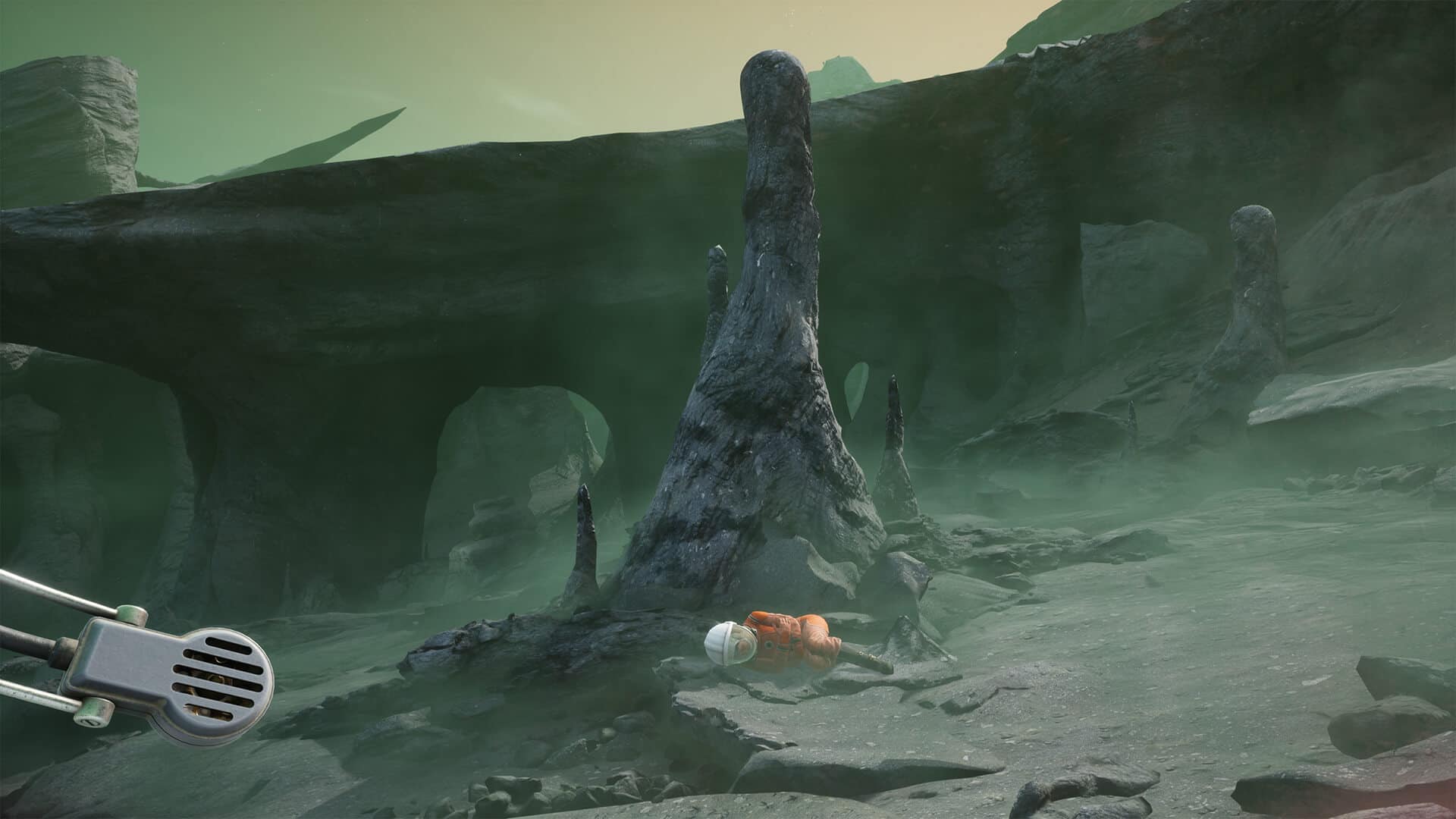
The Invincible: Experience cosmic terror in the red glare of a dying star
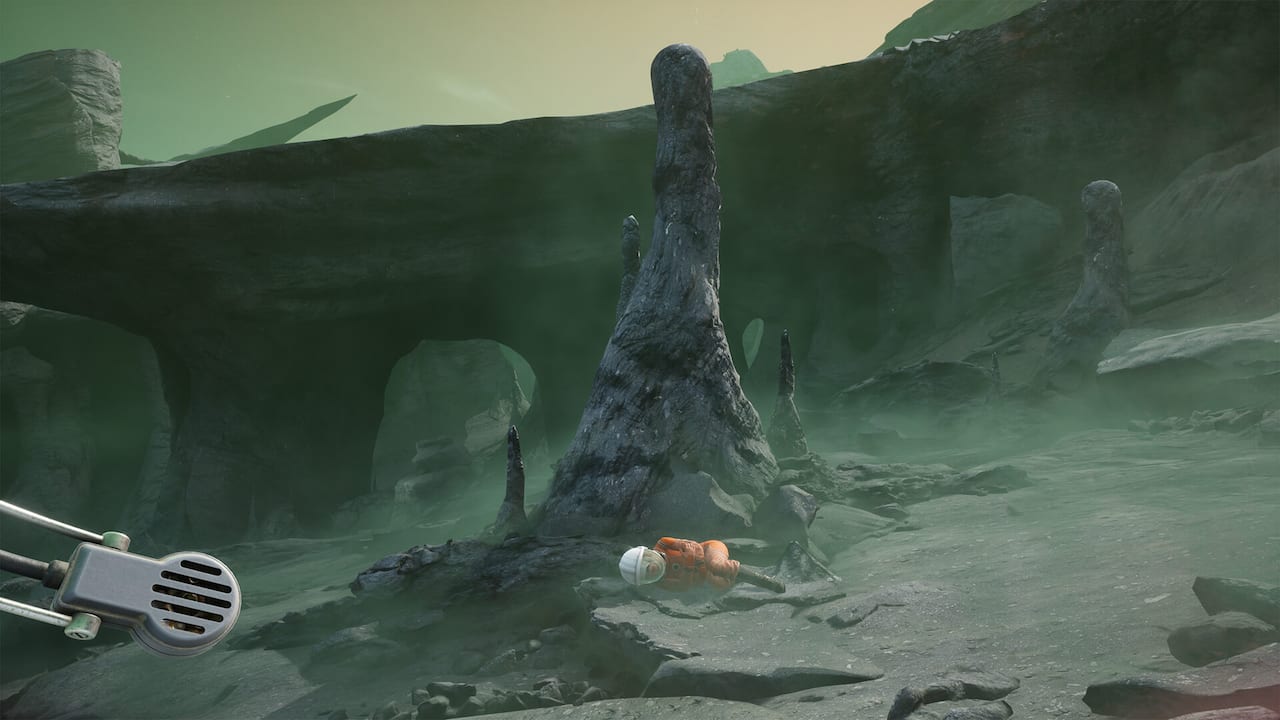
The Invincible is the first game from Starward Industries, but you wouldn’t know it. It impresses from the moment you set foot on Regis III, witness the desert planet’s vivid landscapes, and breathe in its rich, mysterious atmosphere—through the visor of a spacesuit, of course.
Marek Markuszewski left his Producer role at CD Projekt and founded Starward Industries five years ago, aiming to create his own ambitious AA first-person adventure games. The Invincible, the Kraków studio’s first attempt, is loosely based on Stanisław Lem’s 1964 sci-fi novel of the same name, a Space Race tale of human encounters with sinister, bewildering lifeforms on a distant planet.
Yasna—one of a crew of new characters—is an astrobiologist on an ill-fated expedition to Regis III. Her story follows in Lem’s footsteps, and those of Alien: Isolation and Firewatch too. Markuszewski cites Creative Assembly and Campo Santo’s absorbing worlds as inspiration, leading him to feel that the immersive first-person approach is best positioned to reach new heights of artistic focus and storytelling intensity.
But unlike the claustrophobic confines of the Sevastopol space station or the open expanse of Wyoming’s wilderness, The Invincible’s expedition blends contemplative mystery with cosmic terror in the faltering red glare of a dying star.
Making sci-fi the hard way
Hard science fiction writers like Lem demand grounded, plausible science above all else. In film, the difference between hard and soft sci-fi is the difference between 2001: A Space Odyssey and Star Wars. It goes without saying that many sci-fi games opt for the more forgiving and frenetic romp of George Lucas’s space fantasy rather than Stanley Kubrick’s fastidious masterpiece.
Not Starward Industries, though. Markuszewski outlined why, when choosing a tone for the studio’s first game, they felt more aligned with Lem’s meticulous hard sci-fi approach:
“We wanted to tell a particular story about humans in space and their place in the universe,” said Markuszewski. “It's very fresh because it's a much more scientific approach. It's much more hard sci-fi than humanoid green creatures with lasers that can speak English. It's a very different alien. It's a story about humans meeting this alien form: What's the limit of communication, of perception, of humans and how humans react to this?”

In a year that’s seen congressional hearings on UFOs and the rise of AI, the peculiar self-propagating metallic life forms of Lem’s original novel feel as relevant as they did in the ‘60s—or perhaps even more so. Markuszewski explained that Lem, like many sci-fi writers, was unappreciated early in his career despite his many predictions, which included computer networks, the internet, and even ebooks.
“He needed to wait some time for a broader audience to figure out ‘The guy is a genius,’” said Markuszewski. Hard sci-fi writers are practically synonymous with genius. There’s a reason the genre’s seldom seen in games: Its restrictions make it live up to its name. It’s hard.
Markuszewski described the painstaking efforts he and his team went to as “heavy work, but very satisfying.” Despite the many times their commitment to hard sci-fi blocked easy solutions to design or storytelling goals, Markuszewski feels that holding his team to these challenging constraints produced something strikingly original, both an aesthetic and outlook often missing from gaming.
Stick to the science
The principles of hard sci-fi underline every single mechanic, plot beat, and line of dialogue in The Invincible. “We try to stick to the science. We create things as close as possible to real simulations. We do not present something that is almost magical,” said Markuszewski. He added that The Invincible never defaults back to, “It works like this because it's a really far, far future.”
The Invincible’s plausibility pulls players into its world. That’s the draw of hard sci-fi. Regis III is fundamentally realistic, though it has a picturesque beauty that would make it a tourist destination if not for its hidden cosmic horrors. Early experiments for a lighter and more cartoonish look were dropped as it clashed with the story’s more somber turns.

A great deal of work also went into simulating Yasna’s spacesuit. Her meticulously rendered helmet is practically ever-present—you observe this alien world through a painstakingly realized orb of glass. Turn your character’s head and your helmet continues to turn after your motion stops. Gaze upwards, you’ll see its frame. She controls as you’d expect a heavily encumbered scientific researcher to control, operating bulky ‘60s-inspired analogue devices with the clumsiness of hands contained within an astronaut’s extravehicular gloves.
The same care was applied to simulating weather and physics on Regis III. Markuszewski notes with pride that his team’s accomplishments are often mistaken for next-gen tech when they still use Unreal Engine 4 for their game. The Invincible’s particle effects are particularly impressive, layering Regis III in eerie fog, windstorms, and alien heat hazes—and searing laser beams and molten rock and metal when called for.
Back to the retro-future
Beyond the player’s helmet, Chief Marketing Officer Maciej Dobrowolski shared how artists on The Invincible spent hours poring over schematics from Galina Balashova, an extraordinary architect associated with the Soviet space program. Another reference point was Chris Foss, who inspired generations of sci-fi fans with his retrofuturist book covers for Isaac Asimov and Philip K. Dick, as well as his concept art on Alien.
“[The Invincible takes place in] a pre-computer era,” Markuszewski explained. “All our devices are chunky, big. And in their construction and look we even show how it works. When we design all those devices, we really do the research on historical devices in space and we try really to design it to work correctly.”

Determined to fill Regis III with analogue technology that possessed a convincing sense of tactility, the team employed surprisingly lo-tech measures. Starward Industries’ designers made 3D paper models of their proposed in-game machines to test how they’d function and, crucially, model exactly how players would interact with these mechanisms.
Pre-digital technology sometimes took The Invincible’s puzzles in unexpected directions. If you need to extract data in a game set in the modern day, all you need is a computer terminal to hack and a USB drive. For The Invincible, facing the same problem but with older technology, the solution involves the whirring motors of an analogue printer that operates in zero gravity.
Just don’t call their resulting aesthetic “NASA-punk.” Markuszewski aligns Starward Industries’ chunky telemeters, trackers, and other technology with “Atompunk,” operating in a retrofuturist vein that preserves both the technological and political environment of the Space Race. Their robots take a decidedly Soviet turn, less of the angular designs of Wall-E or the Mars Rovers, more rounded automatons and drones.
Just deserts
The problem with desert planets like Regis III is there’s often very little happening across thousands of miles of windswept sand dunes. Many games struggle to make such environments interesting.
Regis III’s lack of vegetation proved challenging for creating points of visual interest. “If you have this soft layer of vegetation, you can paint a world with it very easily,” said Markuszewski. If you don't have it, it's pure surface. It's really hard to make it interesting and not monotonous”.

Luckily, Lem’s story provided many different geographic features—The Invincible’s striking imagery was a major reason the team chose it from all of Lem’s works. Guided by scenarios from the novel, they produced a range of distinctive environments within these barren limits. For example, a camp protected by a forcefield, with imposing rocky outcrops deformed into a curve around an impenetrable shimmering dome.
These simple opportunities for dramatic flair can elevate a barren expanse to terrain that inspires curiosity, according to Markuszewski. As he puts it, “It’s not walking, it’s a journey.” Simply descending from a ledge via a rope—a simple moment of drama—leaves players dangling precariously without a handhold, forcing unconventional solutions.
Radio-controlled
Solitary exploration alongside an enigmatic figure on the radio is an old trick, seen in System Shock, Metal Gear Solid, BioShock, Firewatch, and more. It nevertheless held unexpected challenges for The Invicible’s team who, inexperienced with the storytelling style, found it involved far more than scripting dialogue.
Some players may sprint directly to the next location rather than enjoying a philosophical back and forth with Novik the Astrogator. Others might walk straight past a rock, missing the probe tucked behind it. Behind the scenes, an adaptive system frantically strings dialogue together on-the-fly for each player, ensuring they get a bespoke combination that accounts for their actions in The Invincible.

The team also wants to challenge players. Dialogue may have plot consequences, at times—but it also invites players to engage in the philosophic questions raised by Lem, and mold their own response to Yasna and her faction, other agents on Regis III, and even the biggest decisions to be made around first contact itself.
Any sci-fi lover looks forward to the future, and Markuszewski is no exception. He’s proud of both the sci-fi world and close-knit team he has formed—enticing experienced staff to join from CD Projekt, Techland and Bloober Team—and plans to continue with both, likely creating an original story in the same broad Atompunk setting that departs from Lem’s work next time. Just as his former employer CD Projekt did with The Witcher, Markuszewski hopes his studio’s book adaptation will set his team up to make its mark on the industry. And with The Invincible, they’re making one giant leap in the right direction.
Starward Industries are making sci-fi the hard way—but they almost make it look easy.
Explore the cosmic mysteries of Regis III in The Invincible, out soon on the Epic Games Store.