The rise and rise of Amanita Design: we talk to the studio behind the Samorost series
Since 2003, Czech development team Amanita Design have created delightful, often peculiar puzzle games that combine nature and machinery with beautiful results. From the original short game Samorost to huge hits like Machinarium and Botanicula—and, of course, the epic Samorost 3—Amanita’s games remain distinctive regardless of the studio's approach. We spoke to Amanita’s head honcho Jakub Dvorský to find out a bit more about what motivates the studio’s projects, what goes into their exquisite design, and what's coming next.
When it comes to Amanita’s games, the art unquestionably comes first. Founded in 2003 due to the success of Dvorský’s online-only short game Samorost, the studio has always focused on collaborations with other artists.
“I founded the studio as an artist and animator,” Dvorský says. "From the very beginning, I worked with other artists. That’s why the art and also audio have always been crucial for our titles.”
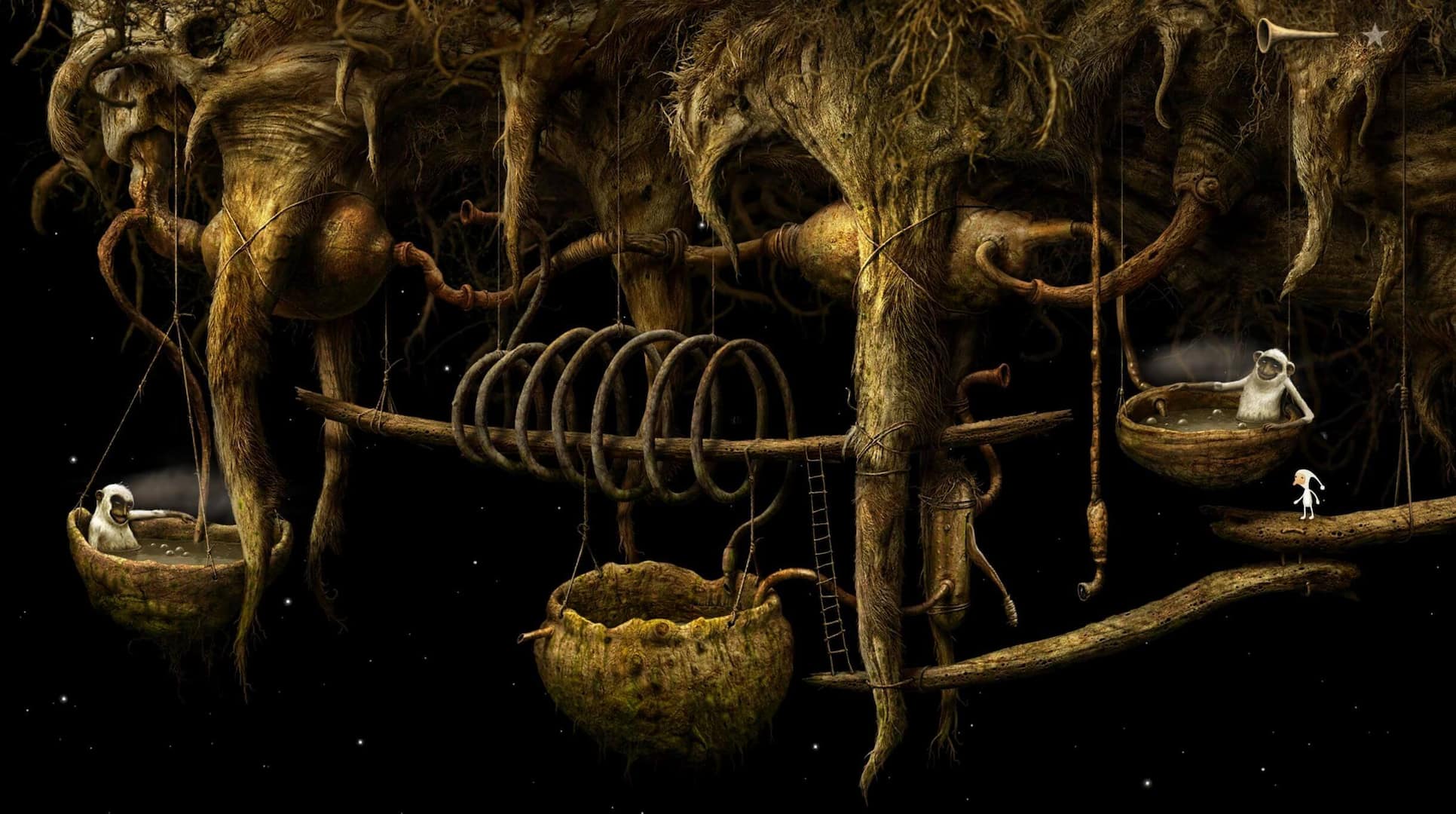
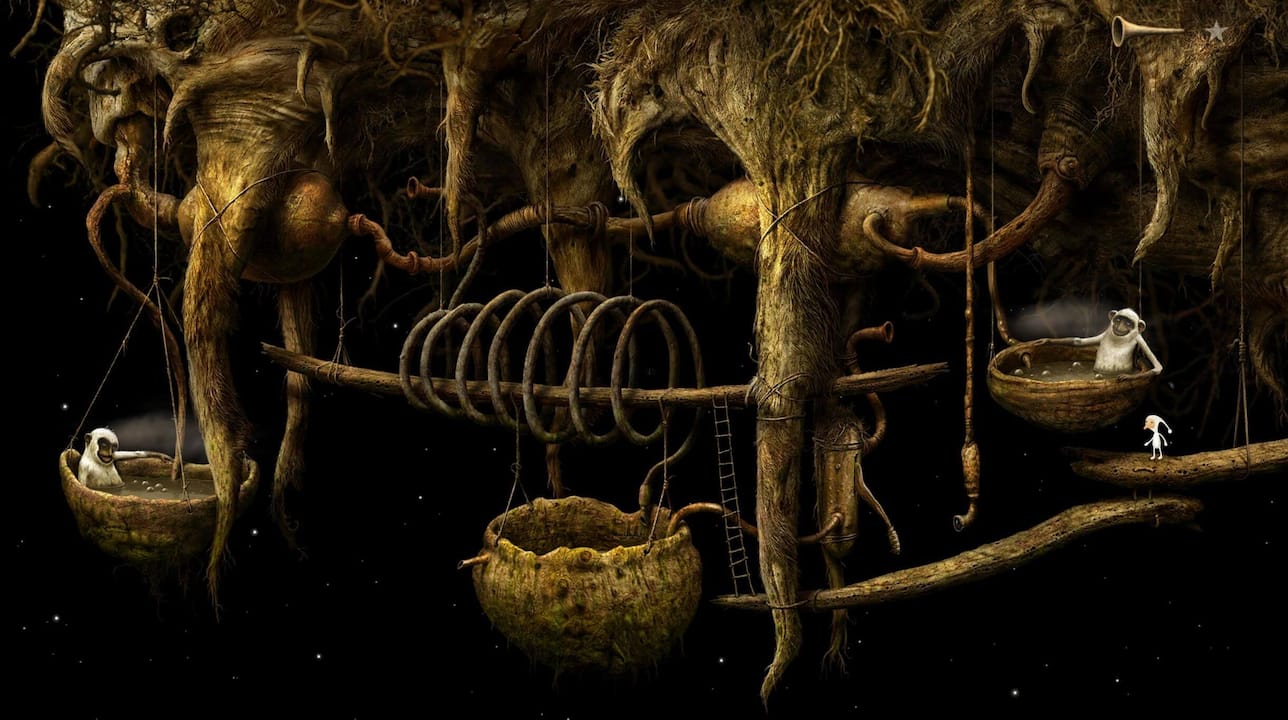
If you’ve ever played the original Samorost—which is free to download from the Epic Games Store—you know how true this is. From this auspicious start, all of the elements that make Amanita’s games so recognizable were in place. While you play as a teeny 2D guy, the world you explore is crafted from moss-covered logs, overgrown tree stumps, and machinery crafted from aging trash.

This lends the games an almost post-apocalyptic feel: where nature has reclaimed humanity’s excesses, and our little white-clothed hero scrabbles about the surreal landscape with an equally tiny dog for company. It's only natural to wonder what drove the design behind the Samorost series.
“The aesthetic itself is a little different for each title,” says Dvorský. “And it’s always a long process to find the perfect art style that fits the story and gameplay, but it always reflects my or our other game designers' passions in some way. I love wild nature in all scales, from huge mountains to microscopic structures, and I’m also a fan of technology—both old and new. Our aesthetic is also heavily influenced by the Czech and Eastern European tradition of animated films, and we hope to be followers of that famous school.”
It’s an influence that struck me, too. If you are of a certain age, you too might have hazy memories of taking a sick day from school, watching daytime TV and stumbling on broadcasts of 1980s European animations that feel like fever dreams. They're dark, weird, and entirely unlike the Bugs Bunny cartoons or Chuck Jones productions that you're probably used to. Given that Dvorský grew up in Eastern Europe, he's obviously far more familiar with the form.
“Yeah, old cartoons and puppet films are definitely a big source of inspiration for us even today,” he says. “They usually have a deep, dark aesthetic, a strong, often quite melancholic mood and atmosphere, and a weird, very subtle, and gentle sense of humor.” If you’re interested, Dvorský has plenty of suggestions. “I would recommend any film from Czech filmmakers Karel Zeman, Bretislav Pojar, Jan Svankmajer, Jiri Trnka, Jiri Barta, or the genius Russian animator Yuri Norstein.”

Amanita Design’s games tend to focus on experimentation, giving you freedom to explore a scene. Rather than following more traditional point-and-click patterns, the games’ puzzles are about clicking on anything that looks interesting and seeing how it reacts. In the Samorost series, this tends to involve poking at plants, peculiar creatures, and anything that catches your eye; these tend to animate in cute, surprising, or game-altering ways. This often produces a strange pattern of play: If you're anything like me, you’ll deliberately avoid clicking anything you suspect might advance the game before you’ve tapped on absolutely everything else.
If you go back to the original Samorost—which was remastered in 2021 to run on modern systems, along with a whole new soundtrack—you can see how all this was present right from the start. While the game is only about fifteen minutes long, it has all those distinctive Amanita elements: the unique collage of photographs, digital art, and animated cartoon, as well as a peculiar tone and an experimental playstyle. Clicking on insects causes them to react and scurry about—sometimes for fun, sometimes to trigger solutions to unknown puzzles. Perhaps a woodpecker will appear and gobble up all the worms, which will allow a creepy human-faced squirrel to be able to enjoy her vinyl records, and thus induce a (human-eyed) owl to start dancing. This all allows you to get down off a branch, of course.
However, that earliest game also feels expectedly crude compared to where Amanita is now. Its success in 2003—which built Amanita's reputation, but didn't necessarily result in financial rewards—saw the studio go straight onto Samorost 2, which Dvorský describes as “our first partially monetized game.” It was even more popular, which led the developer to conclude: “At that point, we became a true indie studio and publisher.”
The second Samorost, released only two years later, is leaps and bounds ahead of its predecessor. It’s a much more complete game, with an hour-long playtime and a greater sense of coherence. At the start, your little guy’s dog is kidnapped by aliens, prompting him to jump aboard his hotdog-tin spacecraft to rescue the little blighter. This sequel avoids the trappings of traditional puzzle games or point-and-click adventures, instead relying on speculative clicking and analytical exploration, as you try to divine what can do what in this bizarre alien world.

Samorost 2 was remastered back in 2020, allowing you to play what was once a tiny Flash game in glorious full screen—and without the defunct engine. However, unlike the original, this game’s incredible soundtrack (by Tomáš Dvořák) was always there. It remains a total joy.
Dvořák, who creates music under the name Floex, has been a core part of the Amanita Design catalogue of games for years now. The Czech composer’s electronica has an eclectic vibe that matches the games’ collage-inspired approach, mixing traditional instruments (especially the clarinet) with peculiar recorded sounds, along with a wide range of human voices. Added retrospectively to what’s now called Samorost 1, Dvořák’s work is an integral part of many Amanita games, especially Botanicula and Samorost 3.
Despite the relative brevity of the games themselves, the level of detail in Amanita’s output can result in some extremely long development times. A typical Amanita adventure will take between three and six hours to finish, but years to create. Dvorský cites Amanita's small team as a key reason for this disparity, along with the animation-heavy nature of its games. As a result, it takes many years to finish a project. Amanita's Creaks took eight years to publish, but Phonopolis has already surpassed that record, since the game is still in development after eight years of work.
Slated as Amanita's next game, Phonopolis is the work of a new team led by animators and artists Petr Filipovic, Eva Markova, and Oto Dostal. However, they are working hard to maintain the particular ethos of the studio. “The whole art style and setting were inspired by avant-garde artistic trends of the interwar period,” explains Dvorský.
These include constructivism, futurism, and suprematism. In Dvorský's own words, they "fit the dystopian theme of the game. It also has the look of paper-made models, and even the animation is intended to resemble old Eastern European puppet films.” However, should its development extend onward, it’s certainly not the only game in the works at Amanita.

“There's no plan or strategy for what comes next,” says Dvorský, in response to a question about a hypothetical sequel for the hilarious cartoon-logic adventure Chuchel. “It always depends on the current state of mind of each game designer who decides to start a new project. As for Chuchel, [project lead] Jara Plachy almost started making the sequel recently. However, after some internal struggles in his head, he decided to create a completely new IP that will be as crazy and funny as Chuchel. We hope to announce it next year.”
Internal struggles in Plachy's head might help explain the studio’s most recent release, the astonishingly unsettling Happy Game. This latest title appeared in the middle of the pandemic's most severe lockdowns, and feels like a deranged scream in gaming form. As such, it stands out from the Amanita's usual family-friendly titles.
“It's a very personal project of Plachy,” Dvorský explains. “And nobody really knows what is happening in his head. But I can assure you, he is fine, happy, and enjoying his little kids; everything looks fine with his life! He was just free to make what he wanted, and it took some time.”
Dvorský explains that he was unsure how this unusually personal project would fare with audiences, who weren't expecting that sort of output from the creators of Samorost. “We were interested in how our typical audience would react," says Dvorský. “Some people were disappointed, but the game managed to find its own, not huge, but very fond audience, which is always our goal—not to make a mainstream title that doesn't offend anyone, but rather to create something special that excites and inspires at least someone.”
This philosophy shines through in all of Amanita’s games, but perhaps none more so than the flagship Samorost series. It's the only game that the studio has turned into a series, with not one but two sequels. This brings us to 2016’s Samorost 3.

By this point, the studio had experienced the breakthrough successes of insectoid Botanicula and robot love story Machinarium. These are both full-length games with a much greater focus on a narrative structure than the studio's previous output. This directly influenced the design of Samorost 3, which realizes its signature nature-meets-technology collage as a five-hour, multi-chapter adventure. However, it doesn’t abandon any of its core principles in achieving this goal. In fact, this is a game that really wears its heart on its sleeve.
In Samorost 3, our character—seemingly known as the Gnome—finds a magical flute. It works both as an ear trumpet and an instrument, which allows him to listen to the sounds of the world around him and play them back. This idea of listening to nature and using its voice to communicate is perhaps an unsubtle motif, but it’s not preachy: It's just a simple mechanic for solving puzzles within the game. The results are glorious. Samorost 3 is a game about enjoying symphonic displays of delightful mushrooms, insects, and peculiar creatures playing beautiful music. Whether they're literally playing instruments or simply dancing in their world, it's a thoroughly enjoyable experience.
It’s also impossible to downplay just what a difference it makes to have a Samorost designed for a modern HD display. Its sumptuous renders of moss-covered landscapes and leafy vistas are particularly impressive. There's a puzzle early on that challenges you to arrange drawings of stick figures in order—when you achieve this, that they come to life and animate according to the situations you create. This should be an entire game in itself. (Oh wait, that's Pilgrims!)
When I ask Dvorský if there's a particular project that didn't quite get the attention that it deserved, he replies that he's happy with the reception of all of the studio's games. However, he does admit that he wishes that Pilgrims had gained more traction. “[It’s] a very small and short game,” he explains. "I like it because it was an experiment that ended well, in my opinion.”

Dvorský suggests that Pilgrims' financial impact was limited due to its mobile-only release on a certain subscription service, but he hopes to rectify that soon. (“When the exclusivity ends in a year or two, we plan to release it on the App Store and Google Play so anyone can easily play it on their smartphone or tablet.”) However, you can play it right now on PC, and you really should. It’s a delightful puzzle game that lasts only an hour, but it has a unique approach that requires playfulness rather than a desire to simply "beat the game.” It’s all about playing with it like a toy, and finding as many surprises as you can.
Amanita's projects never feel like games made to appease mass audiences. Rather, they're delightful oddities, filled with treasure troves of detail and surprise for anyone willing to enter their world. These are games where notions of “winning” feel nonsensical, and just simply being is the real intended goal. The longer their games take you, the better—they're meant to be savored. The best way to play a game like Samorost 3 is to sit back in your chair, take your hand off the mouse, and just soak it all in with your eyes.