ข่าว
The seven best ways to maximize carnage in Turbo Overkill
R
Rick Lane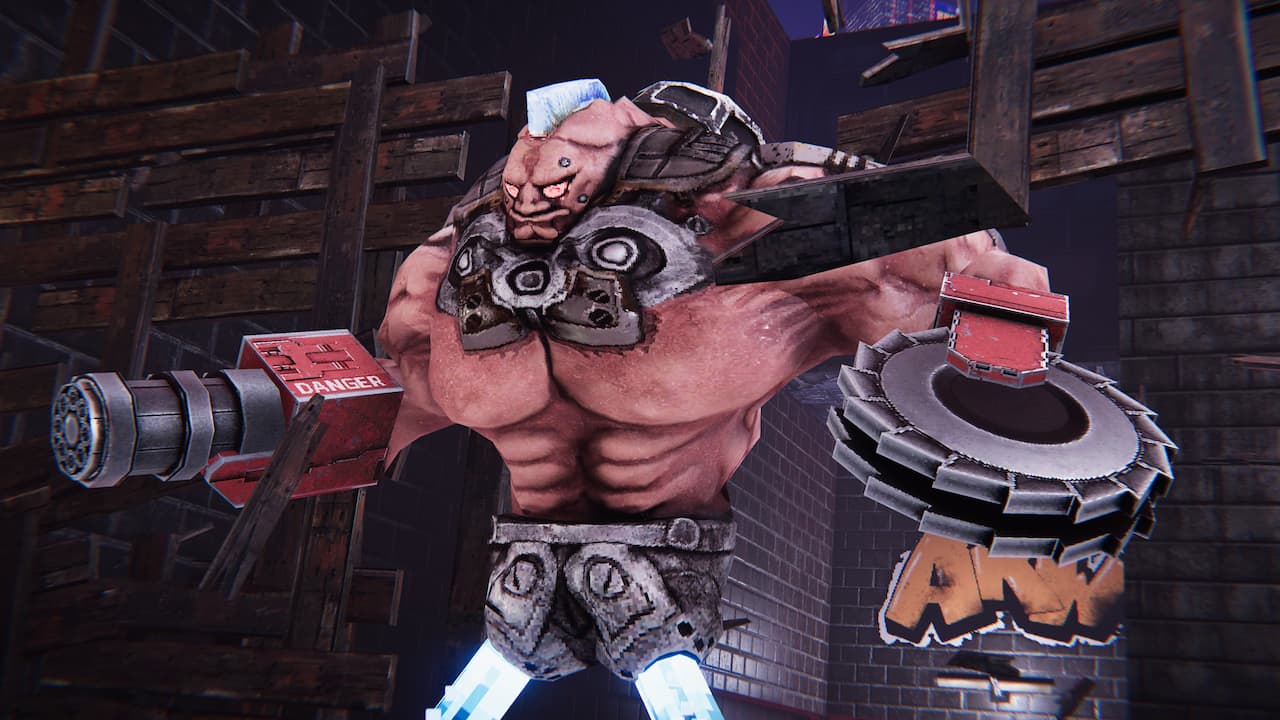
Mechanically, it can be overwhelming, and the gunplay only becomes more complex the further you delve into Johnny Turbo's grisly adventure. With this in mind, here are seven (lethally sharp) pointers to help you become the ultimate cybernetic murder machine.
Learn the ways of the chegg
Johnny Turbo's signature weapon is his chainsaw-leg, or "chegg" as it's known in more refined circles. By pressing crouch while moving forward, you can propel Johnny into a high-speed slide, dealing damage to enemies and instantly gibbing any "trash" level opponents that populate the game.
This is more than just a gimmick—it's Turbo Overkill's fundamental attack. Chegging regularly is the single most important tactic in the game. Not only does it let you mince up a lot of weak enemies quickly, it helps you avoid damage and lets you conserve ammo for larger enemies, which are more resistant to a high-speed chainsaw slamming into their ankles.

The earlier levels of Turbo are good at signaling when you should be chegging, with lots of long corridors and narrow walkways stuffed with trash enemies. Later on, combat arenas become more open, with many different enemies mixed together. At this point, it can be easy to waste ammo on weaker enemies as you try to fend off the motley hordes coming your way. Hence, it's important to remember that chegging is fast, fun, and above all, free.
Master your dash early on
Your chainsaw slide isn't the only way to move around maps quickly in Turbo Overkill. The game also furnishes you with a short-range dash. This can be activated twice in quick succession, after which it'll require a short amount of time to recharge.
Early on, you'll mainly use dashing for platforming purposes. But it's important to familiarize yourself with the dash's timing, as it becomes essential to survival later in the game. Not only will you need it to avoid the vast number of projectiles coming your way, certain enemies like the Sloth have powerful attacks that can only be reliably avoided with a well-timed dash.
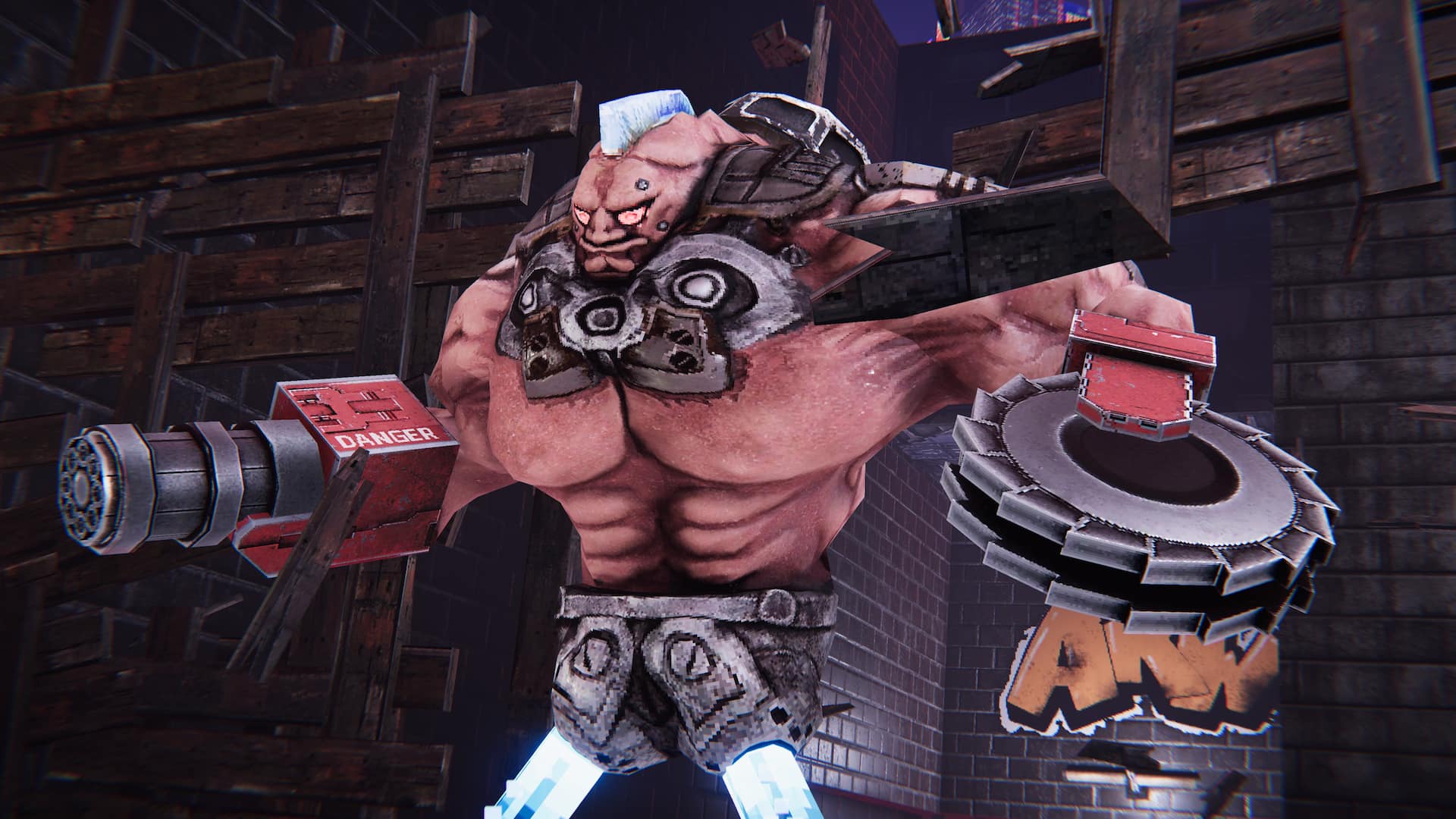
You should also note certain attacks are best avoided by dashing in a specific direction. Going back to the Sloth, this deceptively named creature barrels forward with its attacks at rapid speed, so you want to dash sideways to avoid them. By comparison, bosses like Maw are more easily evaded by dashing backward, as this enables you to time your dodges and keep the nippy mercenary in your sights.
Match the right weapon to the situation
Although there are no "right" ways to kill enemies in Turbo Overkill, its enemies do have vulnerabilities to specific weapons and weapon combinations. If you check the game's bestiary, you'll find a specified weakness listed at the bottom of each entry.
But Turbo Overkill has a lot of enemies, which makes remembering all the different weaknesses difficult. Moreover, during intense combat scenarios, some combinations can be tricky to pull off. Fortunately, there are some simple rules to follow that'll help you make mincemeat of your foes.
Enemies are split into three groups. I've already mentioned trash enemies, but alongside these are "heavies" and "super heavies." Certain weapons and fire-modes are especially effective against each group. For trash enemies, you want to use your chegg, the alt-fire for your twin magnums and waster shotgun, and your twin machineguns. Against heavy enemies like the Belcher, Daddy, and Leaper, you're best off using the twincendiary chaingun, the plasma rifle, and primary fire for the rocket launcher. When facing super heavy opponents like the Syntaur and the Sloth, you want to be using the rocket-launcher's alt-fire, the ion cannon, your micro-missiles, or chainsaw arms (more on these shortly).
That isn't everything; some weapons can be upgraded to unlock a third fire-mode. The plasma rifle, for example, has two alt-fires you can switch in and out of the weapon. Frankly, I've never found either of these to be enormously useful. That said, the unlockable fire-mode for the telefragging sniper-rifle is one of the best in the game. Once you've unlocked it, holding down primary fire will charge semi-automatic fire-mode. This temporarily transforms the rifle into a railgun, firing glowing slugs that penetrate through enemies and deal huge damage to even the toughest foe.
Don't waste your combat abilities
In addition to your chegg, you'll unlock a trio of combat abilities across Turbo Overkill's three episodes. Midway through episode one, you'll acquire a mini-rocket barrage that does huge damage to multiple enemies. Episode two empowers you with a slow-motion ability called "Turbo Time," while episode three gives you chainsaw arms to match your chainsaw legs—Johnny Turbo is deeply fashion conscious.
Unlike your guns and your chegg, these abilities must recharge after being used. Because of this, you don't want to waste them clearing out trash enemies. Instead, they're best deployed as fail-safes for when a fight turns against you. Mini-rockets are great at clearing the playing field or dispatching a single powerful adversary (the total damage is divided between the number of rockets you fire). Turbo Time, meanwhile, is ideal for planning your next move or escaping a particularly dangerous situation.

Both these abilities recharge over time, letting you deploy them once or twice per encounter. But Johnny's chainsaw arms work differently. These only charge by killing enemies with your chainsaw legs, which has a certain perverse logic. Consequently, your chainsaw arms are best saved for as a last resort, as they'll carve through pretty much any enemy with ease.
When combat takes off, so should you
One of the best ways to stay alive in Turbo Overkill is to get airborne, as it lets you avoid many enemy attacks entirely. Early on in the game, you can achieve brief bouts of airtime by combining jumps, dashes and wall-runs. Sustained aerial combat becomes more viable once you unlock the grappling hook in episode two. Not only do many ensuing arenas feature grapple points that you can pull yourself up toward, you can also grapple onto rockets that you fire. Doing this is a little tricky, but with practice, you can get a bird's eye view of the action almost anywhere in the game.
Cruising at altitude is also handy when dealing with certain enemies. Leapers, for example, cover the ground with electrical area-of-effect attacks, so you need to stay off it whenever they're close by. Security drones, meanwhile, can only be killed by shooting their brain from above, so you have to get airborne to deal with them.
It's also worth noting that when drones die, the resulting explosion will catapult you back into the air. If you use the boomer shotgun, you can time your attack to kill the drone just before you land, propelling you back into the air and keeping you above the mayhem for longer.
Augment yourself appropriately
In case the chainsaw in his leg didn't give it away, Johnny Turbo is a cyborg. As a cyborg, he can install shiny new chrome into his body to upgrade his combat abilities. There are a wide range of upgrades to unlock throughout the game, but you can only install so many at one time.
While there's no bad way to upgrade Johnny, there are several upgrades that are particularly relevant to the playstyle outlined here. Dashing Grace, for example, makes you immune to damage while dodging, which is especially useful later on when you're practically dashing all the time. A Good Ol Thumpin', meanwhile, makes you deal explosive damage when landing from a height, which makes bouncing around maps like a robot kangaroo extra fun.
There are also numerous ways to upgrade your chainsaw leg, either by increasing its damage or installing a second chainsaw into Johnny's other shin. But the most important chegg-specific upgrade is "Healthy Insertion," which provides bonus health for every enemy shredded by chainsaw leg. Much like Doom Eternal's glory kills, this upgrade rewards you for pushing forward, helping you maintain your attacks without needing to search the corners of the level for health.
There's more to secrets than bragging rights
Although you can purchase many upgrades directly from vending machines, getting the best upgrades requires a little extra work. Turbo Overkill's levels are scattered with secrets, from computer chips that unlock game-altering mutators to cassettes that provide access to bonus content. By far the most important, however, are Teratek chests.
These big metal boxes contain the most prized upgrades in the game. The chests themselves are easy to find, but you need a key to unlock them. The key is usually hidden nearby, but Trigger Happy is pretty devious in squirreling them away. Verticality is a major part of Turbo Overkill's levels, so ensure to look above and below you as well as checking any nearby corners. You may even have to backtrack a little to find them. Fortunately, the technological treasures contained within are easily worth retracing your steps.
You can pick up Turbo Overkill now on the Epic Games Store.