
The verbs and villains that shape Rocksteady’s Batman: Arkham Asylum

Batman as a character has been around for nearly a hundred years, with the Dark Knight enjoying a spotlight across all of pop culture. Though the character got his start in comic books, he's made appearances in films, TV series, toys, and dozens of video games.
However, though some of these games enjoyed a modicum of commercial and critical success, no game came close to translating Batman's iconic cape to video games until developer Rocksteady tried its hand at it in 2009. Games released prior to Batman: Arkham Asylum would often bring one element of the Batman character into the mix, but it was never more than a passing impression.

Batman: Arkham Asylum possesses all of the necessary elements needed to accurately portray the atmospheric tapestry of Bruce Wayne’s dilapidated, crumbling, and all but doomed world. It also captures the outlandish but very real enemies that surround Batman, who are the perfect ingredients for creating a convincing and exciting Batman experience.
The Caped Crusader's trip across Arkham Island—and his delve into the asylum's secrets—is more than just another game with Batman on the cover. Developer Rocksteady was able to succeed where others failed by carefully picking out the right Batman verbs from the character’s lush history to apply to gameplay, while also creating a convincing world. When you play Arkham Asylum, you sometimes feel as though you're inhabiting a world imagined by the Joker. These are the gadgets, actions, and little subtleties that brought Batman: Arkham Asylum to life for players back in 2009.
Sneaking, climbing, and gliding from gargoyles are just a few of the stealthy moves that feel fully articulated in Arkham Asylum. Stealth mechanics had been attempted in Batman titles, but Rocksteady found a way to make a more cohesive experience.
Batman’s brute force and power are still in the game—particularly in the hand-to-hand combat mechanics—but he can clearly take hits and die. His human vulnerabilities are present. His vision gets blurry and he goes down when thugs hit him with lead pipes again and again. Rocksteady gives players motivation to consider the tightly constructed stealth elements of the game, but this humanizes Batman. However, it also explores his dark, detective side. The stealth gameplay includes basic elements such as cover and surprise attacks, but it also boasts an influential third-person vision filter called Detective Mode, which highlights enemy weaknesses and secrets. It’s through these wonderful toys that Batman is painted in fine detail—with no broad strokes to be found.
Rather than the magic and superpowers of his caped comrades like Superman, Batman has a bag of gadgets that open up Arkham Asylum for players. The tools show how accurately Rocksteady has articulated the caped comic-book crusader—more than any game that came before.
Items like Explosive Spray allow players to use targeted detonation against enemies and the environment. However, Batman's capabilities extend far beyond just causing damage. The Cryptographic Sequencer is a high-tech gadget with radio frequencies and dials, allowing Batman to overload and blast past electronic devices that block his progress, such as force fields, bombs, and doors. By utilizing Batman’s arsenal of WayneTech gadgets, players can fully inhabit the character of Bruce Wayne, adding to both immersion and gameplay possibilities.
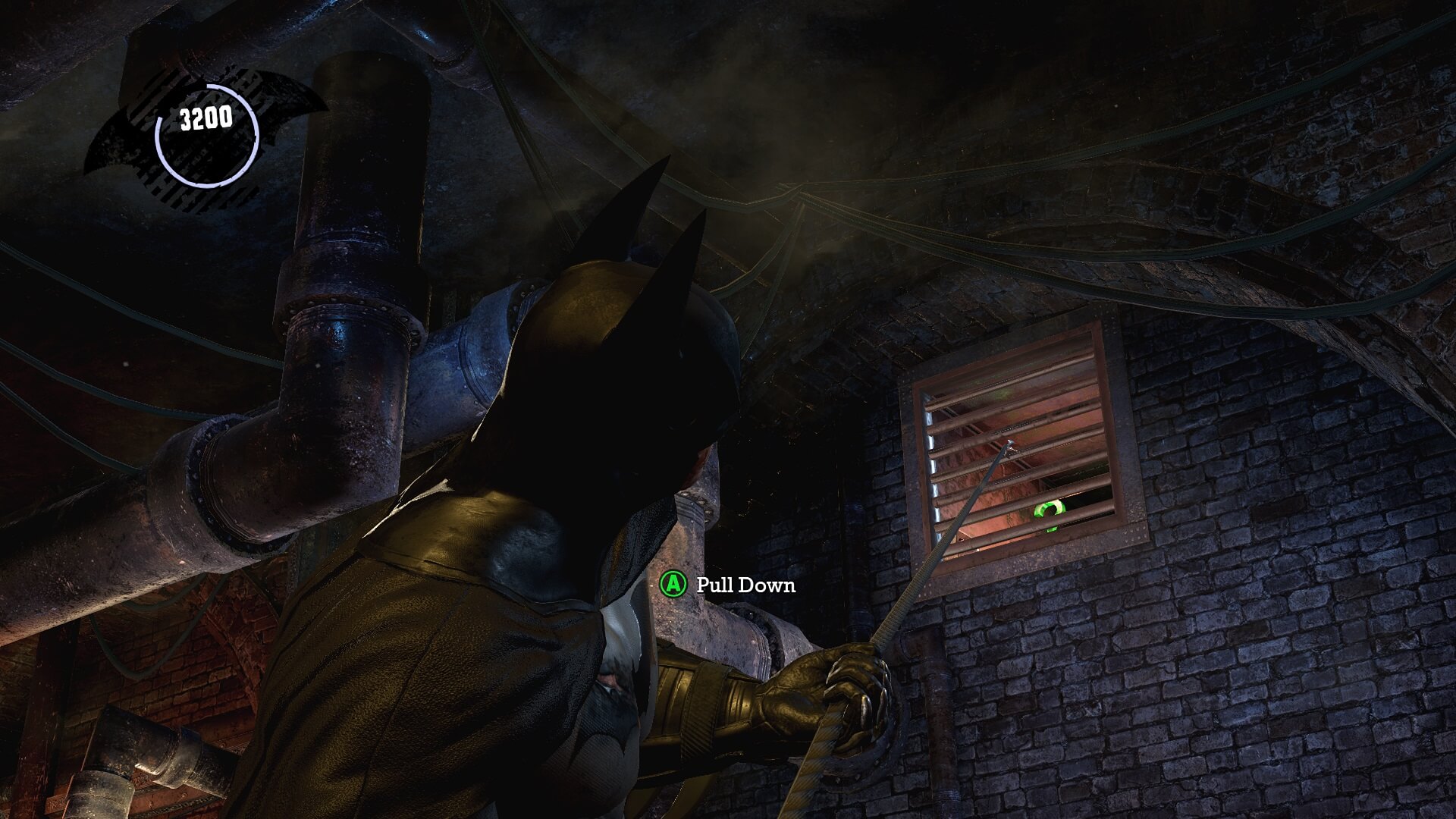
Exploration is a natural part of video games, but it’s an aspect that's particularly important to Batman’s character. After all, he's more than a superhero—he’s also a detective. Tracking scent and handprints while manuevering around various obstacles makes for good gameplay, but it also makes players feel that they're playing a scene straight out of a comic book or Batman: The Animated Series.
In addition to the Batclaw, players use the Line Launcher to traverse the island and asylum, with some locations and places being completely unreachable without its help. It’s exciting to use fancy, high-tech items for more than just violence, especially when you use it to access a barely-visible cave, chasm, or room. Items such as the Batarang and the Remote Control Batarang can be used to take out enemies or hit an out-of-reach switch, which might unlock a door or reveal another path.
Batman feels like more than just a crime fighter. He’s an explorer, a detective, and a superhero, and Arkham Aslyum properly reflects that with its array of abilities, vulnerabilities, and powers. The asylum's mostly-nonlinear structure also helps here, as it allows for the detective tone and structure to fit neatly into separate playthroughs, helping them feel personal and unique.
Batman is never too powerful; in fact, he's often quite vulnerable. Even standard thugs can present a threat in common combat encounters. Stun sticks and knives force players to consider different strategies, which encourages you to experiment to see what works. The game asks you to jump over enemies, roll, and use Batman's cape to stun enemies in order to make it to the Joker.
It wouldn’t feel like a Batman game if the World's Greatest Detective wasn’t also wrapped up in some sick and twisted game with the Joker, and that’s exactly what Rocksteady achieved with Batman: Arkham Asylum. It’s not the player’s game, Batman’s game, or even the developer’s game—it’s the Joker’s game.
The Joker isn’t just trapped inside the asylum with Batman. He’s managed to break free and orchestrate a plan with the other inmates, one that involves some rather iconic enemies, such as Harley Quinn, Victor Zsaz, Killer Croc, Bane, Poison Ivy, and Scarecrow. The cast of characters works as connective tissue for the Joker’s big plan across the game’s story, while also offering up a rich and detailed world for players to explore. Arkham Asylum is dense and detailed, with nothing left out of place. This sense of cohesion comes from the fact that the characters are squarely at the center of everything, and the Joker is there from the start to pull every little string.
The Joker works well as a sort of master of ceremonies for the game itself, seen on television sets and heard through intercom speakers. Then, of course, he serves as the game’s final boss. Joker’s crew following through on his plans while simultaneously functioning as boss battles makes everything feel more real and meaningful. It never feels like players are mashing buttons at enemies for no reason.

Each encounter with major, big-name boss enemies feels epic, but also important and necessary. Battles against the likes of Bane, Poison Ivy, and Scarecrow easily could have been button-mashing filler meant to distract players in between story beats. Instead, each villain’s battle feels suited to that moment in the game, and with each designed around what would work best for the enemy. Bane is superhumanly strong, with the use of his classic Titan chemical infusion—he charges at the player, forcing them to dodge, stun, and jump behind. It’s a perfect early boss fight that makes sense within the Batman universe.
However, when it comes to the Scarecrow, things go in a completely different direction, resulting in multiple altercations with the sinister doctor. In these sequences, players are transported to a hallucinatory realm thanks to the boss's toxic gas. These encounters essentially have zero combat, instead consisting of gauntlets where players must avoid being seen by a staggeringly huge Scarecrow, who is intent on catching the player in his deadly grip. Rather than physically attacking their enemy, players just need to reach the end of a linear sequence and shine a spotlight on his face to bring the level to a close.
These different battles are just two examples of how Rocksteady utilizes Batman’s fiction and characters to simultaneously support gameplay, story, and atmosphere.
There's an AI system at the center of Arkham Asylum's enemy design, and it runs from the lowest thug all the way up to The Joker. Hearing enemies react in fear to Batman is delightful and immersive, especially when they don't know where the Caped Crusader is hiding in a stealth sequence. Listening to these thugs try to figure out Batman’s current whereabouts while you engage in timed explosions, silent takedowns, and glide kicks from gargoyles solidifies the atmosphere and tension. The game's events never feel scripted, instead delivering unique player experiences. It’s beautiful how everything in Arkham Asylum works to serve both the gameplay and the plot—and it’s why Arkham Asylum feels like the first real Batman game.
Batman: Arkham Asylum may have been released in 2009, but it’s still an essential experience for fans of Batman, superheroes, or anyone that appreciates good adaptations of existing source material. To top it off, the game also features writers and artists from the Batman DC comic books. Its Rocksteady-developed sequels—Batman: Arkham City and Batman: Arkham Knight—continued the studio's rock-solid work by iterating further on the concepts and ideas introduced in Arkham Asylum. This makes Arkham one of the best superhero video game franchises available.