Cricket Club President
Műfajok
Jellemzők
It is the middle of winter
Nobody has picked up a bat since March.
The Annual General Meeting is upstairs at the bowling club, twenty-two people in a room set for sixty, and the Treasurer is a long way into the accounts before it becomes clear the president is not coming back. Nominations are called for. Nobody moves.
Then somebody says your name. Somebody else seconds it before you have worked out who.
Carried. You have a club at the bottom of Division 8, three sides to field by October, and a committee who will spend the next six months finding out what you are like.
Where the club is
Pick the country first: Australia, England, New Zealand, South Africa, the West Indies or the United States. Each has its own cities and districts, its own seventy-nine rival clubs and its own names on the teamsheet. In England, teas are a serious matter. In the West Indies the away trip is a flight. In the United States a league game can be three hours in the car, and the pitch might be matting.
Name the club and both grounds, and pick a district and the colours. The crest and the kit are drawn from the name. Then decide who you were before the vote: a former 1st XI captain with two hundred games the club remembers, a local businessman with three hardware stores and a view, a stalwart with thirty years of canteen rosters behind them, or an outsider who ran a Division 3 club. It ended badly, and people read about it.
If your own competition is not in there, the pack editor takes a pasted list of names.
Every week
Three sides take the field on your first weekend — 1st Grade, 2nd Grade and the U19s — and all three want the best eleven players. A fourth side arrives in Division 6.
You call the selection meeting, hear the captains out, take the Chairman of Selectors' recommendation or overrule it, and have the sides settled before the Friday. The league alternates one-dayers and two-dayers. The mid-week T20 is a knockout cup for all eighty clubs, and from the bottom of Division 8 winning it takes seven ties.
Field placings, declarations and coaching are not on you.
The room
A captain who counts the times you overruled him starts voicing his opinion. A Chairman of Selectors with a bias you did not choose: he might take the club man ahead of the better player, or blood a junior who is not ready. Because his dad asked.
Agreeing with one of them is refusing another. Both remember.
You get one call a week, to one committee member. Level with them, back them publicly or ask what they would do, and somebody else on the committee hears whose number you rang. Stay on good terms with someone who is good at the job and they start doing things for the club. One Facilities Officer keeps the upkeep down until she has not called a tradesman in three years.
Some of them are family. The Treasurer's son might be in your 2nd Grade side. Drop him and she notices, and she may ask for him back: "I will not pretend I am neutral about this." Let him go to another club and she does not forgive it. When one of a married couple on the committee turns against you at the AGM, the other usually goes too.
You cannot appoint anybody. You can put a word about for the woman who wants a seat, and if the members keep the man already in it, he finds out what you were doing.
The vote
At the end of the season the club votes on whether you stay: the players, the committee, the staff and the volunteers.
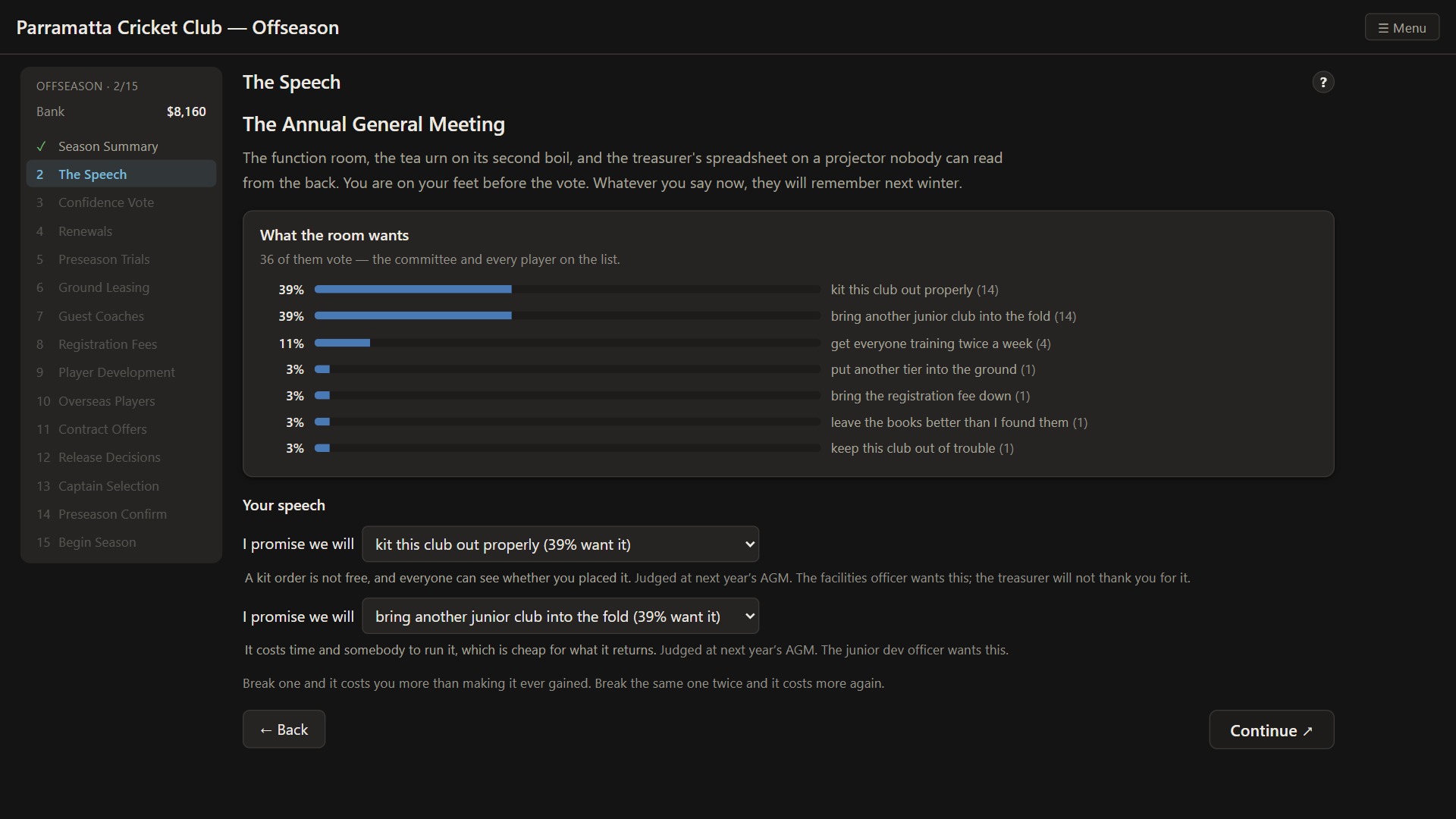
Before the vote you get to your feet and make up to two promises: "bring the registration fee down", "put another tier into the ground", "get everyone training twice a week". Next winter they hold you to every one. You can promise nothing at all. Nobody is owed anything next year, and nobody is grateful this year either.
Five people sit on the committee and each judges you on something different: the Treasurer on the bank balance, the Facilities Officer on what you built this season. Below fifty per cent and the run ends — no relegation needed, no final lost. Say no to one of them often enough and they may stand against you, and a broken promise gives them something to campaign on.
What the club actually costs
Kit suppliers arrive with their own designs and their own prices, and the design you like is rarely from the supplier with the best deal. Registration is what pays for it, and the players notice what you charge them.
Sponsors start with a logo on the training kit and go up to naming rights, where the ground takes the sponsor's name. The biggest only talks to a club with a following. A good Treasurer who gets on with you leans over before you go in and tells you what they can afford. "Not a dollar more." Now and then a local firm backs one man, and pays only while he is in 1st Grade.
Volunteers run the canteen, the scoring and the ground prep, and they have a vote at the AGM.
Juniors come through schools and junior club partnerships, and rival clubs poach from both. Do the Junior Development Officer a favour and the Senior Rep notices. Lose twice in a row in 1st Grade and the Senior Rep wants no more development picks.
The cricket, if you choose not to sleep in on the Saturday
Then Saturday morning happens. Somebody texts at 7:43: "can't make it today mate, bit of a situation." No further detail. Somebody tweaked his back getting out of the car. Somebody has food poisoning, and he was fine at the pub last night. Somebody else pulls a hamstring in the warm-ups, and the side still has to take the field. Run short enough and you field a ring-in. His file reads: "Watching from the car park. Seemed keen. We were desperate."
Any match can be watched ball by ball: both innings, real bowling figures, a field that mirrors for a left-hander, and every shot drawn from the middle of the ground. Or skip to the result and hear about it on Sunday. Every card comes with a wagon wheel, a Manhattan and a worm, and the side gives its three votes for the Players' Player.
The dressing room
Every player at the club has mates in it, and a few of them have somebody they cannot stand. Put two friends in the same side and both are happier for it. Brothers count, and when one leaves the club the other feels it. Put two men who do not get on in the same eleven and it sours them both. The club has a culture too, somewhere between a social club and a serious one, and it decides how many men come back each winter. At one end of it: "Men turn up because their mates play here."
Some players have an archetype:
The Grinder, who gets an extra chance to improve every winter, whatever his age
The Leader, who keeps his captain's spirits up
The Showboat, who loves a big day and goes missing in the quiet weeks
The Mercenary, who notices he has no contract
The Hothead, who is worth it right up until he is not
Somebody will dispute an umpire's decision for eleven minutes and forty-three seconds, timed by the scorer, and the association bans him for a week. Somebody will tell a fourteen-year-old to harden up after a blow on the helmet. That one is yours to deal with: a warning, a fine, a ban, or the sack.
And the men who leave do not disappear. A player you release, or one who walks out, can turn up at a rival club with his record under his arm. When you meet, tempers are shorter and the umpire has a word. A man you sign from a rival brings the same history the other way.
Who follows the club?
Nobody, at first. The club page has about fifty followers and most of them are somebody's parents.
Hire a media manager and their voice is on the card before you sign. One finds the positive in a nine-wicket defeat. One is factual, and occasionally critical of you in public. How good they are is the half you find out afterwards.
The players post regardless. Somebody who has been in the reserves since October posts something sour. A few weeks later he hands in his boots, and he may turn up at another club. You had the warning if you were reading.
Climb the divisions and the local paper starts returning calls.
Who you hire
Advertise a coaching job for $200 and the applicants turn up the next week, each with a qualification, a coaching style and a goal they want to be judged on, which is not always the one the job needs. At the end of the season they are held to that goal, and you keep them or advertise again.
Players come looking too. Put up a free-agent notice and wait for an answer. In the winter, men at rival clubs who want a higher grade ask to come across. Pay the ones worth keeping a wage, with bonuses for fifties, hundreds and five-fors, inside a budget the board sets. An overseas agent will sell you a man you have never seen bat: "Genuinely unplayable on his day. Allegedly most days."
Going up
Eight divisions of ten clubs, and you start at the bottom of the eighth. Finish in the top two and the association inspects your main ground. If it is not good enough for the division above, promotion is refused and it costs you five reputation.
Six facilities, each built up tier by tier, each charging upkeep from the day it opens. Nobody coaches bowling at a club without proper nets. A better ground loses fewer Saturdays to the weather. "It will not save you from a downpour."
The other seventy-nine clubs do not stand still. Their players age, retire and change clubs every winter.
And then the winter
Nine rounds, finals, and then an offseason of fifteen screens, with decisions that come back in October whether you remember making them or not:
which sponsors you keep
what to charge in registration, and who makes the kit
which of twenty-two trialists you sign, and which boys too old for the U19s you keep
whether to rent a ground to a winter football or rugby club, and start the season on it a tier worse
which guest coaches to bring in, one of them "Grade cricket legend in his suburb. Slightly too confident about it."
how many nights a week everyone trains
who is released, and who captains which side
And then you go around again.
Elérhető eredmények
Cricket Club President – Rendszerkövetelmények
Minimum
Ajánlott
OS version
Windows 10 64-bit (version 1809 or later)
OS version
Windows 11 64-bit
CPU
Intel Core i3-4130 / AMD FX-4300
CPU
Intel Core i5-8400 / AMD Ryzen 5 2600
Memory
4 GB RAM
Memory
8 GB RAM
GPU
Integrated graphics (Intel HD 4000 or equivalent)
GPU
Any dedicated GPU
Storage
1 GB available space
Storage
1 GB available space
Kötelező bejelentkezési fiókok
Epic ID
Támogatott nyelvek
Hang: N/A
Szöveg: English
© 2026 JSK Software Pty Ltd. All rights reserved.
Adatvédelmi szabályzat (Új lapon nyílik meg)