
Agatha Christie—Death on the Nile infuses the hard-boiled whodunit with ‘70s swagger

A bored man is sitting—waiting, perhaps—in the dining car of a train stuck in a snowdrift when the conductor comes to him for help. As it turns out, a passenger has been murdered in one of the carriages, and the crew needs his help to find the perpetrator. “The murderer is still on the train,” says a railway executive on board. To everyone’s relief, the man agrees to investigate, looking forward to the prospect of whiling away several hours on this intriguing murder mystery.
This is Murder on the Orient Express, and it has all the ingredients of a classic hard-boiled tale: a talented detective bored out of his wits, an enclosed location full of suspects, and tons of shocking twists and turns. Such thrills characterized the stories of Agatha Christie, the undisputed royalty of detective fiction (alongside Arther Conan Doyle of Sherlock Holmes fame, of course). It’s also a video game adaption—and a modern retelling—of the famous novel by French studio Microids Studio Lyon, with you playing as the fastidious and impressively moustachioed Belgian detective Hercule Poirot. The detective, however, will be traveling back in time a few decades in an upcoming adaptation of another Christie novel: Death on the Nile.
Unlike Murder on the Orient Express, a game set in the current decade—with Poirot using his smartphone and other technology to aid his investigation—Death on the Nile is, instead, taking place in the 1970s. This begs the question: Why is Death on the Nile taking place in a different era?

David Chomard, cofounder and head of Microids Studio Lyon, shares that the team wanted to sidestep the complications they faced with Murder on the Orient Express by setting that game's investigation in 2023. “[This is] mainly because of mobile phones, computers, the internet, forensic science, and so on. So we wanted a modern time period that still had technology, but not anything too advanced,” he says. ”The 1970s felt like the obvious choice, especially since that also gave the characters and environments a very distinctive look that made them even more memorable.”
Death on the Nile has adopted the stylings of the era, complete with thumping Disco music, big afros à la Diana Ross, and iconic fashion like platform shoes, sequins, and polyester suits. Poirot himself can even collect vinyl records and tinker with paraphernalia of the era, from jukeboxes to slide projectors. Chomard is insistent, however, that this is more than just a simple aesthetic choice; Death on the Nile also incorporates several details that add a layer of authenticity to its ‘70s setting.
“The puzzles feature iconic objects from the time: cassette players, Polaroids, Super 8 cameras, rotary phones, record players, and more,” he says. “The characters and their dialogue are firmly rooted in the period: Vietnam veteran, hippie, jet-setter, etc. The locations are also highly emblematic of the era: Disco clubs, the Bronx in New York, Mallorca—which was like the Ibiza of the time.” Then there is the Disco-inspired soundtrack, which Chomard points out was composed by musician Kurtz Mindfields. For the game’s music, he makes ample use of popular vintage synthesizers of that time, such as the ARP Odyssey 1 or Minimoog Model D.
Another departure from Murder on the Orient Express? Death on the Nile will feature two protagonists—and thus two diverging perspectives on the murder. Not only will you get to solve the game’s central mystery as Poirot, but you can also sleuth around as Jane Royce, an original character written by the developer.

Chomard explains that this is one way of engaging players who may already be familiar with the story: “One of our biggest challenges when adapting Agatha Christie's novels is that most players already know the story, at least to some extent. It’s not very exciting to investigate a case when you already know how it ends. By introducing a second protagonist, we’re able to bring in a parallel investigation that no one knows, adding freshness and surprises even for longtime fans.”
Some fans might expect this second character to be Poirot’s close friend and perennially clueless sidekick Arthur Hastings. But Chomard says that Hastings’ temperament is too similar to Poirot’s coolheadedness. “Hastings doesn’t appear in the Death on the Nile novel, so we had no reason to include him in the main story. And for the secondary storyline, we wanted a completely original character to free ourselves from the constraints of a character created by Agatha Christie. Jane is combative, hot-tempered, athletic, and a bit of a daredevil—all of which wouldn’t have suited Hastings very well,” adds Chomard.
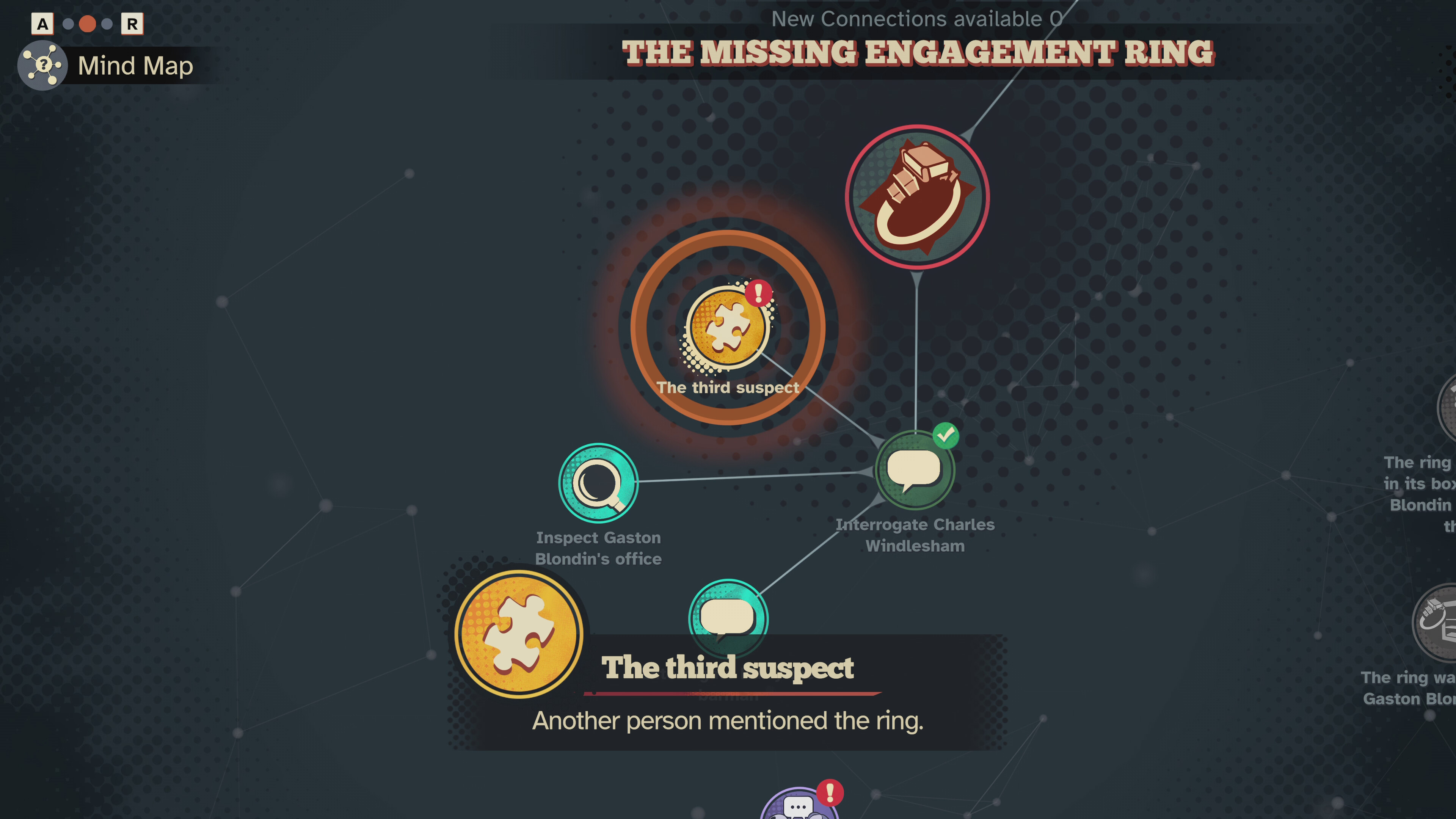
At the same time, Microids has tweaked the way players sleuth in Death on the Nile, though investigations are still centered around Poirot’s Mind Map. Think of this as a journal that Poirot has in his head, or the “little gray cells” that chart all the clues he has gathered. It informs him of his subsequent steps in the investigation, as well as serving as a place to analyze clues and make deductions, such as piecing together the chronological order of events.
“What’s new in Death on the Nile is the ability to connect clues together to make deductions, similar to what you see in other detective games,” Chomard says. “But what makes our system unique is that the player must also answer, ‘Why can I connect these clues?’ We want the player to feel smart by making the right deductions like a real detective.” Aside from examining items like photographs and pocket watches—all par for the course for a detective, really—Poirot and Royce can also eavesdrop on private conversations. Doing so requires them to keep a low profile, such as by blending in with the crowd or tailing their suspects.
 Chomard says one of the studio’s most daunting challenges was writing the game’s new narrative, which goes beyond what was originally in the book. Crafting a narrative befitting of expanding on Christie’s story took the team at least six months to write and design. He also shares that investigations in Death on the Nile are a lot less linear than in the previous game, and this is best exemplified in the Character Profiles—mental notes that Poirot will make about the colorful characters he meets. This differs slightly from the more elementary system used in Murder on the Orient Express. “The player can now fill them out gradually as they uncover new information about each character,” Chomard says. “For example, they might learn someone’s profession during a conversation, but only uncover their secret much later by eavesdropping. Every major character has a well-kept secret waiting to be discovered.”
The task of adapting much-beloved novels into video games is never an easy one, but it’s a challenge that Microids seems to tackle with relish. With an extended narrative, a second original protagonist, and even a different timeline from the novel, the team sought to offer an experience that can delight even the most well-read of Christie's readers. “We learned a lot from Murder on the Orient Express by reading player and press reviews,” Chomard adds. “The investigation is less linear, with more freedom in how it unfolds, more exploration, more interactions with the environment, better character controls. We also added new gameplay mechanics and puzzles, since players really appreciated the variety and the fact that the gameplay never felt repetitive in Murder on the Orient Express.” While not a brand new tale, these updates should revitalize the classic whodunit for players.
Agatha Christie—Death on the Nile will soon be sleuthing on the Epic Games Store.