Beholder: Conductor is a one-way ticket to unsettling moral ambiguity
The Beholder series excels at pitting players’ survival instincts against their moral convictions. As an everyday citizen with an unpleasant job in a dystopian police state, you gotta do what you gotta do to survive this oppressive, murderous regime.
In Beholder and Beholder 3, you were a snooping landlord ratting out your tenants. In Beholder 2, you were a lowly government intern operating the heartless machinery of the state. In Beholder: Conductor, an all-new train conductor spin adds a management sim to the series’s usual blend of stealth, immersive sim, and document-checker genres. Though this time around, it’s more “Tickets, please!” than Papers, Please.
“Up to now, the series mostly focused on a single building or a few houses,” explains Stepan Komarov, a producer at Alawar. “With Conductor, we wanted to go beyond that and show that the totalitarian laws of the state reach far beyond the capital, across a country full of broken lives and fading towns.”
You’ll spot these broken lives and fading towns as Winston Smith, a conductor pumped full of sleep-repressing drugs to oversee the Determination Bringer’s carriages. Trains have been a promising venue for real-time simulation since Jordan Mechner’s The Last Express back in 1997; following in those footsteps (or train tracks), the Determination Bringer similarly operates on the clock over a weekslong journey across a vast nation at war.
Previous games focused on a small group of people under intense scrutiny, but Conductor had to be different to reflect the hustle and bustle of long-distance commutes. Each stop introduces a new cast of characters stepping onto your carriage, their pixel art portraits animated with panache. Each brings with them new subplots and side quests as part of a cast that dwarfs that of previous titles, including estranged brothers in a bitter feud, antiestablishment spies, down-on-their-luck aristocrats in shabby sable coats, and many others.
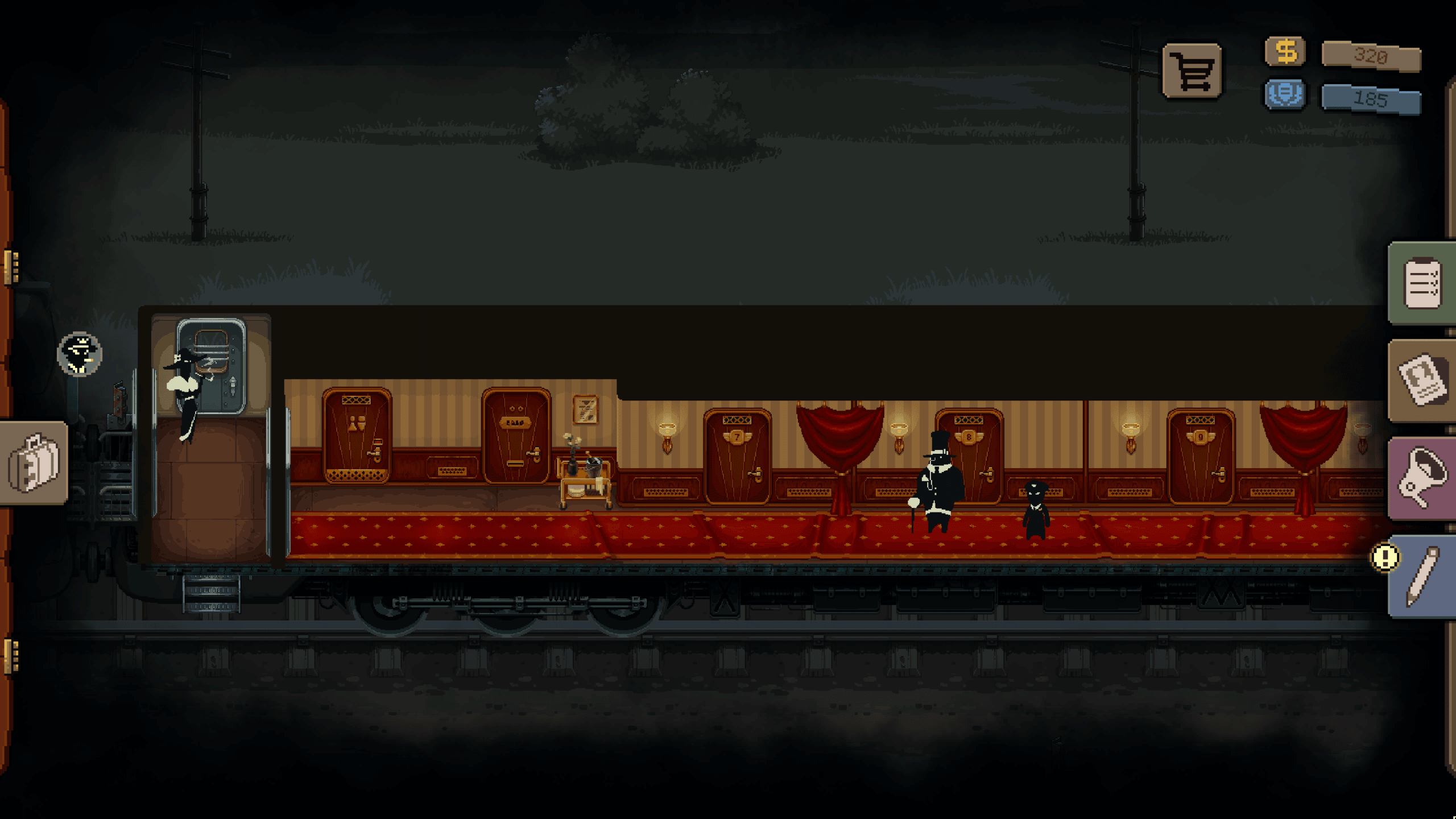
As for the train they temporarily occupy, Komarov says that, in addition to expanding the Beholder universe, the developers wanted to take the opportunity to “explore class division in a very direct, visual way.” The team looked to mirror the imagination on display in Snowpiercer, a French sci-fi graphic novel and 2013 film adaptation that feature impressively distinct societies coexisting in just one train.
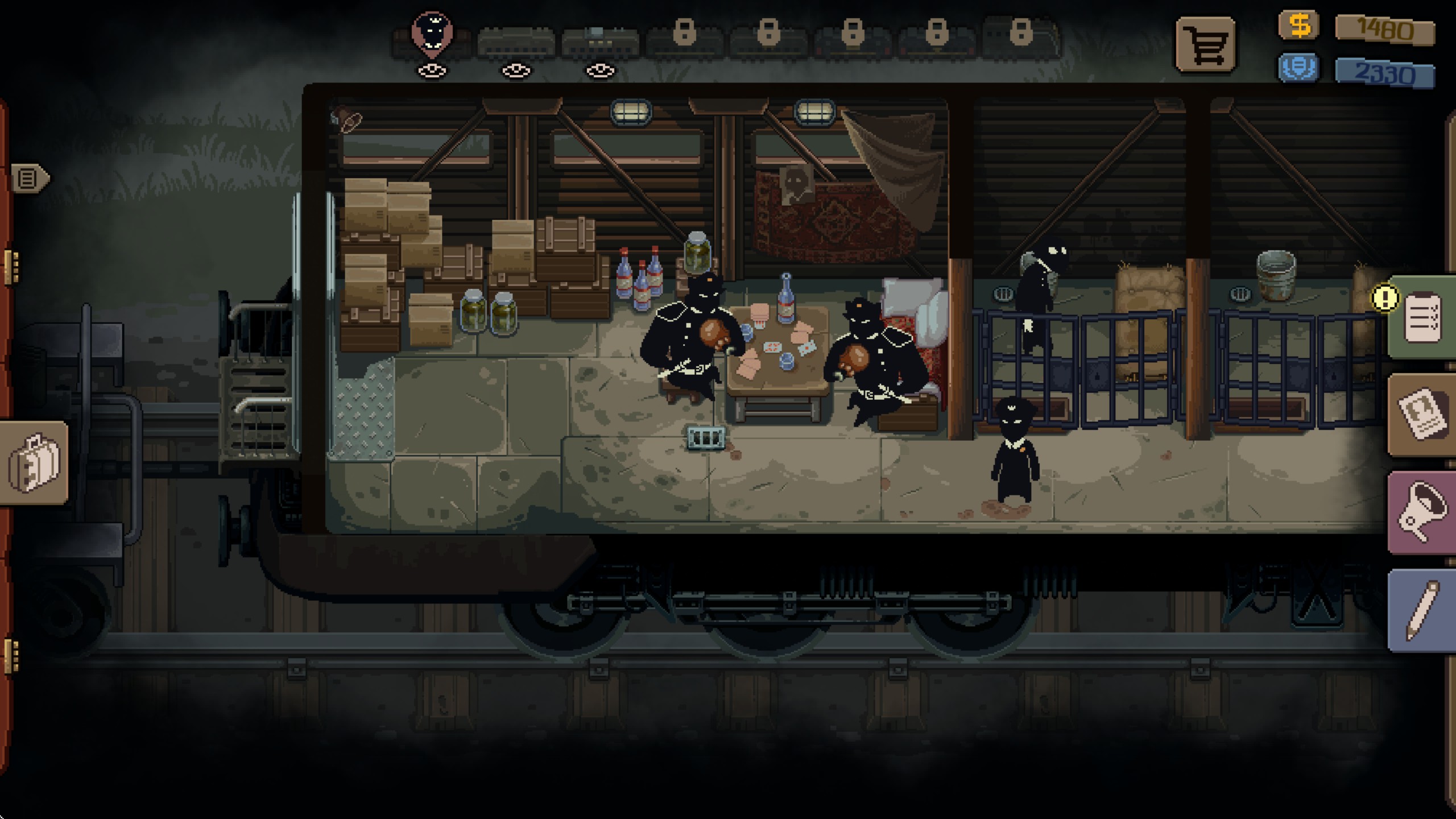
Hence the Determination Bringer’s cramped, uncomfortable third-class carriages whose passengers are fed meals fit for prisoners in a canteen where cutlery is chained to the table, contrasting with decadent first-class carriages where passengers enjoy no-expense-spared delights. And you'd best stay clear of the guard compartments, dreary places full of bullies, caged prisoners, and blood-smeared floorboards.
If only inspecting tickets, maintaining order, arranging dreary meals, and furnishing passenger compartments were Winston’s sole duties. He’s a cog in an inhuman machine, but that’s not all. “Beneath that, you’re also expected to spy,” says Komarov. “That means eavesdropping, searching passengers’ belongings when they're not around, and keeping an eye out for anything the state deems suspicious or prohibited.”
Beholder: Conductor’s snitches don’t get stitches. Instead, for intruding into their passengers’ private lives, they’re rewarded with authority points, an important means to guarantee promotion and keep your loyalty beyond suspicion—and yourself out of the firing line.
If you can’t know the contents of someone’s mind, the contents of their suitcase are the next best thing for a nosy conductor with an ever-rising quota of passenger dossiers and state dissidents to suss out. Wait for them to leave their room, and you can raid their belongings for prohibited items, laying them out across the cabin and racing to put them back in the same order before their owners return.
A lengthy list of contraband ranges from foreign records and dangerous books to even innocuous apples. All are fodder to report to your superiors or to blackmail passengers for your own sordid gain. And Komarov is quick to remind us: Nothing stops players from extorting payment, then reporting them to the guards anyway!
With these perverse incentives paired with what felt like total power over my passengers, I soon found myself making decisions that made me queasy. Under the state’s absurd, draconian rule, you can arrest practically any NPC. I reported one rude military general out of spite when I was already ahead on my dissident quota, then saw him being marched away after suffering a cudgel to the skull. Other characters inspired sympathy. I found illegal content in their luggage, but their backstories moved me to let them get to their destination. It’s unusually and often unsettlingly murky ground, and Komarov is content with this state of moral ambiguity.
“We never label choices as ‘right’ or ‘wrong.’ Players make choices based on their own conscience and interests, and how much they’re willing to immerse themselves in the world,” he explains, outlining the team’s method to inspire ethical torment. “If a player sees characters as mere resources, they won’t hesitate to rob an old woman or get rid of a hungry cat just to avoid having another mouth to feed. The game doesn’t judge.”
The game may not judge, but it will bend over backward to accommodate its players’ worst totalitarian impulses. Occasionally, a very significant passenger will enter the train, one with finely crafted motivations and a multi-stage subquest the developers labored tirelessly over. Some players who let power go to their heads just arrest them on sight—and practically everyone else with them.
“That surprised us at first, but it makes sense!” says Komarov, who believes players deserve the freedom they refuse to give their passengers. “It’s like in an open-ended RPG where you can kill quest givers. If you do that, well, you won’t be getting those quests.”
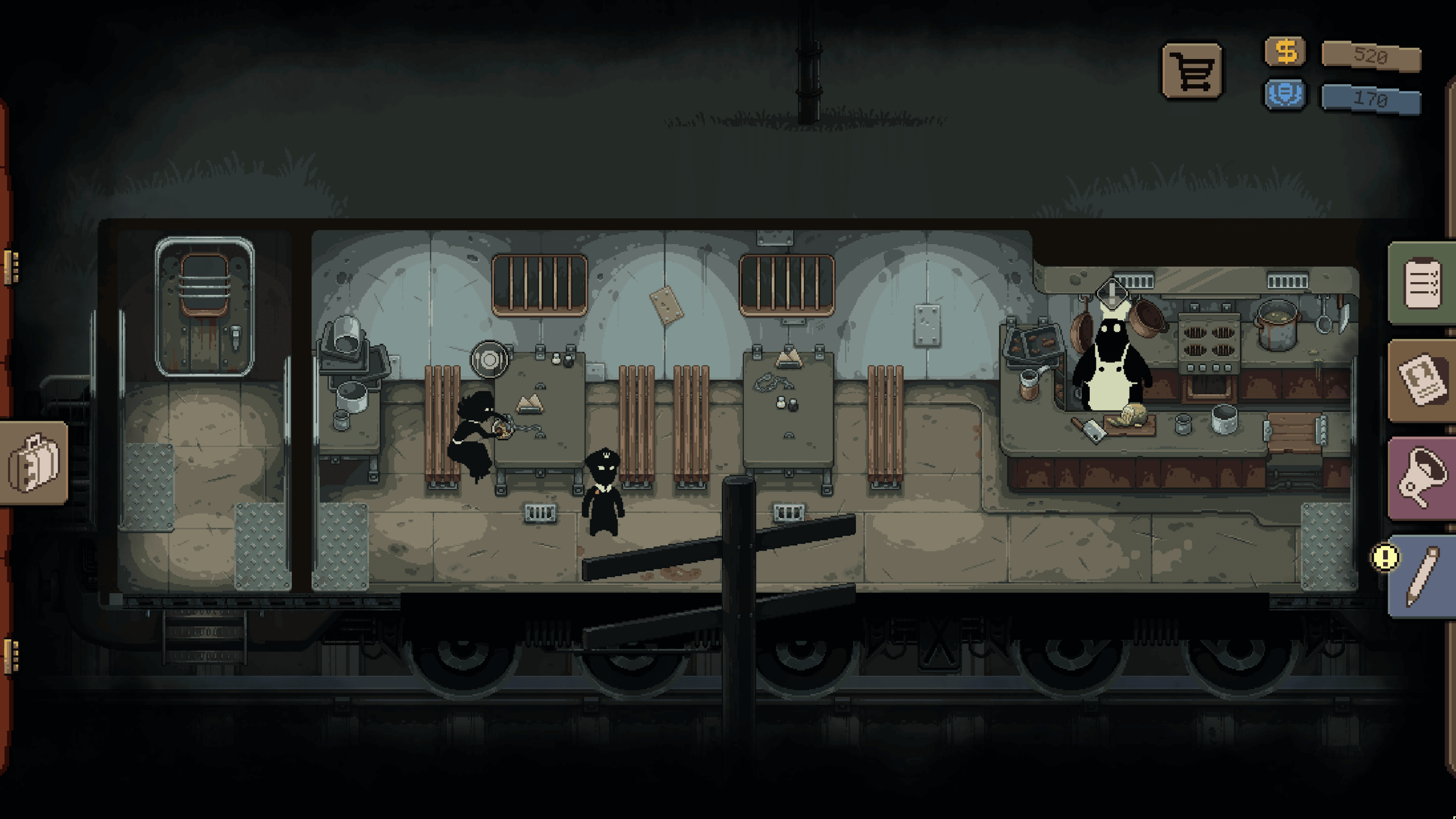
You may struggle to believe realism is the goal for a game with stylized pixel art characters who look like Casper the Friendly Ghost gone goth, yet, when it comes to the decisions Alawar forces players to make, Komarov insists that’s really the case.
“You’re often stuck choosing between two bad options,” he says. “There’s no obvious right answer, no clear hint about the consequences. And sometimes those consequences are sudden and tragic. A character might die because of a seemingly small decision you made. You might think, ‘How could I have known that would happen?’ But that’s the point. You couldn’t. Just like in real life.”
Events are set to escalate from there, as relentless tyranny usually does. Komarov hints that the early game’s repetitive aspects gradually become replaced by dramatically unpredictable elements outside of the player’s control once your destination—and the hidden mission that takes you there—draws near.
“That unpredictability was intentional,” Komarov says. “We wanted to show what characters, conversations, prohibitions, and events are created by military conflicts.”
Again, it's just as in real life. As much as we wish it wasn’t.
Beholder: Conductor is out now on the Epic Games Store.