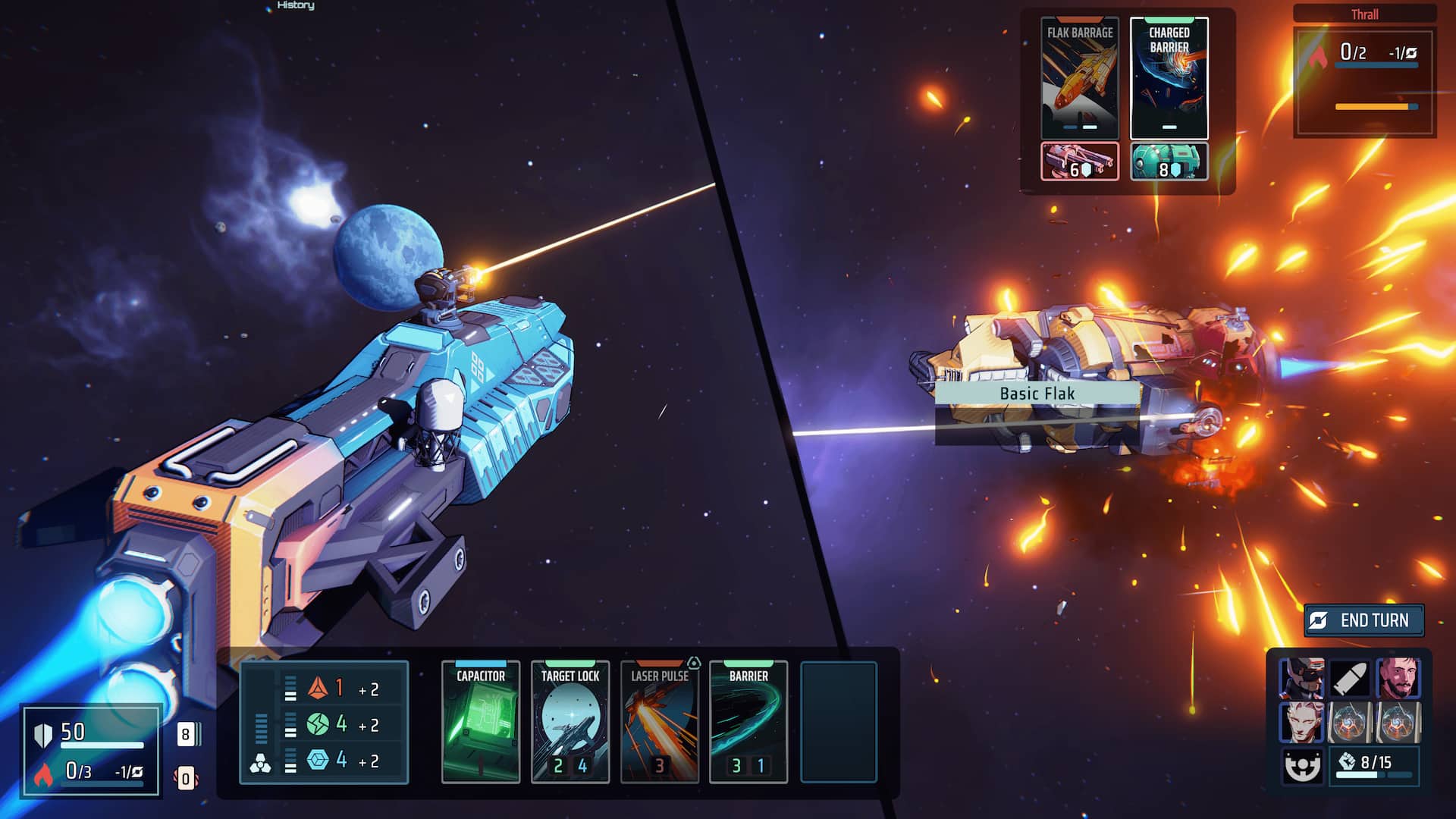
Breachway combines high-concept sci-fi with a strategic choice-driven card game
We’re in the far reaches of space when we come across a wayward ship. The ship is damaged and its crew is reaching out with an SOS signal—but the ship belongs to an enemy faction. It’s a tough call, but we choose to help our stranded enemies. Doing so begins repairing relations between our two fractured factions. They offer equipment which will undoubtedly help us in future conflicts, which may include a skirmish with a once-friendly faction that doesn’t like our fledgling alliance.
Breachway, developed by Edgeflow Studios and set for release on the Epic Games Store in early 2024, is a card-based strategy game with roguelike elements. Drawing on high-concept science fiction, the game takes place in the depths of space. You pilot your ship through the unknown and try to survive against both friend and foe.
While the core of the game may seem simple at first glance—and indeed the team at Edgeflow have publicly discussed their inspirations and love for titles such as Faster Than Light and Slay the Spire—Breachway hopes to stand out with its unique world and deckbuilding mechanics.

You don’t simply build a deck in Breachway—you build a crew and upgrade a ship. Beyond the abilities on the card, these crew members have their own quirks and allegiances. Coupled with a randomized, branching story that allows you to join any of the in-game factions based on your ship choice, the promise and potential for endlessly replayable card-based antics is apparent.
While Edgeflow has been open about its love for modern indie darlings, Breachway’s true inspirations are actually found more than two decades ago—and require averting our eyes from the vastness of space and into the world of fantasy. More specifically, Ubisoft’s Might and Magic franchise.
“When I was a kid, I played a game called Might and Magic VII, and in the taverns in that game was this very rudimentary card game you could play called Arcomage. That was our initial inspiration,” explained lead designer Victor Rubinstein.

Rubinstein wanted to create a game inspired by Arcomage the moment he played it, but found the idea too challenging for his then-14-year-old self to manage. After two decades and experience making 3D models for mods, he felt it was more realistic to return to the idea and it felt more approachable.
“[Arcomage] also had three resource types and three card types that we still have in our design, though the gameplay changed a lot. This was the initial idea back in 2019, and Hearthstone was big at the time so I thought I could try doing it as well, because card games are easy, right?”
Was it easy? Well…
Building a card game from scratch is one of those things that sounds simple until you actually try and do it for yourself. Doing so requires more than coming up with a few rules for combat, designing some cool-looking visual designs for the cards, and calling it a day. Making the rules balanced, fair, and enjoyable for all parties, while also being malleable enough to allow player agency, and avoiding any clear exploits that could ruin the game’s depth by allowing one strategy to overpower all others? That’s where the real challenge lies, lest you flatten the game into little more than a luck-based roulette that quickly overstays its welcome.

All this to say that it wasn’t as easy a task building Breachway as Rubinstein anticipated. Anything but, in fact. “It was very hard,” he said. “Card games are very design-heavy. You need a lot of synergies and systems that work together and have a lot of emergent properties in order to be more than the sum of their parts. It’s quite a challenge, but I enjoyed it! I learned a lot about game design and engines in general because this is the first project I did.”
Breachway’s sci-fi aesthetic developed as a way to stand out. While many card games—including his own inspirations—came from the realm of fantasy, Rubinstein wanted to lean into his love of sci-fi.
As things evolved over time—rather significantly in some areas, as early multiplayer prototypes pivoted to the single-player experience we have today—Breachway’s sci-fi setting became integrated into the very mechanics of battle, enhancing the strategy at the core of building your deck/ship.

Every ship needs a crew, for example, and these crew members naturally have their own specialties, from weaponry to defense, repairs, and so forth. As such, each crew member has their own pool of cards to draw from, making the construction of a balanced crew key to accessing all the various resources and building a balanced deck consisting of both offensive and defensive cards.
This served two gameplay benefits. On the one hand, it made deckbuilding more accessible by transforming the physical deck into the ship you pilot. Each part of the ship and each crew member you obtain increases your deck capacity and the cards at your disposal. In turn, it’s easier to construct a deck to your own style of play when the act of emphasizing defensive shields or offensive missiles and lasers is visually represented in the ship.
It also adds further depth to combat scenarios that must be taken into consideration. If a ship is made up of different parts, it’s only natural that you can target certain areas of enemy ships in combat to incapacitate their capabilities in a modular fashion, bringing greater consideration to placing every attack. You can work to weaken the enemy’s shields in order to deal more piercing damage, for instance, or disable their lasers to give yourself time to recover.

“You’ll see the cards your opponent plays and in how many turns they’ll apply, so you’ll have all the information needed to make a choice of whether you want to attack their defensive systems so you can kill them faster or if you want to cripple their offense, meaning you’ll invest less in shields and can focus more on attacking,” said Rubinstein. ”It creates a nice back-and-forth on what choices to make.”
Learning what works well in combat over the course of multiple runs opens up further opportunities to optimize your build to whatever scenario might potentially come up over the course of battle. Of course, with experience and knowledge of the systems also comes the possibility of finding the chink in the armor that breaks Breachway apart entirely, but this is something the developers have deeply considered and hope won’t be an issue upon the final launch.
“I don’t try to imagine how I would play the game [during testing],” explained Rubinstein. “Instead, I try to break it as much as I can, and I had other developers helping me on that. I don’t think you’ll ever fully be able to predict how players will approach your game, but we’ll see what happens and we may make adjustments if we need to. We’re limited in terms of what we can imagine, and I’m sure players will come up with all sorts of crazy combinations!”

Choices on who to recruit and how you build your deck won’t just have an impact in battle. Your team’s allegiances will have a similar impact on your out-of-combat relations with the other factions in this universe-spanning story, with your decisions complicating these relationships even further. This is where the game’s ever-expanding potential for storytelling comes into play, with the endless expanses of space and the decisions you make opening up more and unique scenarios to face on every playthrough.
“Each starting ship belongs to one of the four factions,” Rubinstein explained. “You’ll be allied with that faction, but based on that faction’s relationships to others some factions will be opposed to you. However, you might start as an enemy of that faction, but through the choices you make as you play, you can ally yourself with that faction and maybe move further away from your own. You can even betray all factions and become a pirate.”
The roguelike, randomized nature of the game prevents it from telling a linear story, but that doesn’t mean you won’t be able to have an adventure that feels driven and crafted around your choices, both right and wrong.

“What we chose to do is have around ten star systems, and in each run you play about three of them. Each star system has its own theming, its own factions that are present, a different dominant faction and one that challenges that,” Rubinstein said. “You also have your crew members, some of which are loyal to a specific faction. If you make choices that are against their faction they might disagree with you and your morale goes down. So far we’re trying to make that mesh together and turn it into a cohesive whole, and I think we're on the right path.”
This element has its origins in many of the sci-fi stories Rubinstein enjoyed growing up—like The Expanse, which itself recently became a story-driven video game from Telltale Games. These stories inspired the different factions, their differing strengths, life in space and a lot of the lore of the series in its early days, something which began to diverge greatly the further into development things got.
“With The Expanse, that’s more of a ‘realistic’ sci-fi in terms of being much closer to our timeline, using weapons that are more plausible with current technology, no energy shields or magic weapons or things like that,” said Rubinstein. “The fights in that are very long-distance and there’s a lot of characters presented in more diverse ways, too. It’s not like Star Trek where there’s some perfect way. [In The Expanse] you see some nations struggle, factions struggling to make a living on Mars. Others are living in the Belt under the boot of Earth and Mars, while others are independent.”

“That was our starting point, but as the story developed it started taking on a life of its own and started diverging greatly from things like The Expanse or other sci-fi,” Rubinstein continued. “Of course you have the sci-fi tropes that people expect, but hopefully they’re remixed in ways that people haven’t really seen before.”
“I’m really happy to be able to write a story for this because of course, for a card game, you don’t really need a story,” said Rubinstein. “But I’ve always loved games like Planescape: Torment that are very story-heavy, so I’m glad to be able to do some writing too.”
Put it all together, and there’s a lot of potential wrapped within Breachway’s wide expanses and tightly-controlled gameplay. Look beyond the vastness of space though and what we have is a story of a childhood dream, revisited with over two decades of experience as an art director and modeler. Breachway started life in 2019 as a project developed in small spurts during downtime at Rubinstein’s day job, honed slowly over the years into the game we see today.
“For the longest time, I didn’t think it would go anywhere,” said Rubinstein. “I just worked on it because I needed a way to be creative. I wanted to do something that I wouldn’t hate myself for not doing when I was older. At a certain point we launched a demo on Reddit, a very early showing of it. It was very basic, but it connected with people.”
“That was the first time I thought ‘Okay, maybe this game can be something.’”
Breachway launches in early 2024 on the Epic Games Store.