End of Abyss Hands-On: Body Horror on a Brutalist Canvas
The body slowly splits apart, ropy tendrils of ocher flesh stretching till they break as the gray mechanical doors tug and finally slide open.
A curled leg to the left, a foot at the end of an outstretched calf to the right, are the only signs that the now-split mass was once a body, perhaps two.
A single light above the darkened entrance to the door — motes floating in the flickering light — is all that suggests that this compound was once an operating facility.
Soldier E-19’s echoing voice fills the room. It had hoped the infection was contained to the compound itself, but now it’s clear it’s far worse.
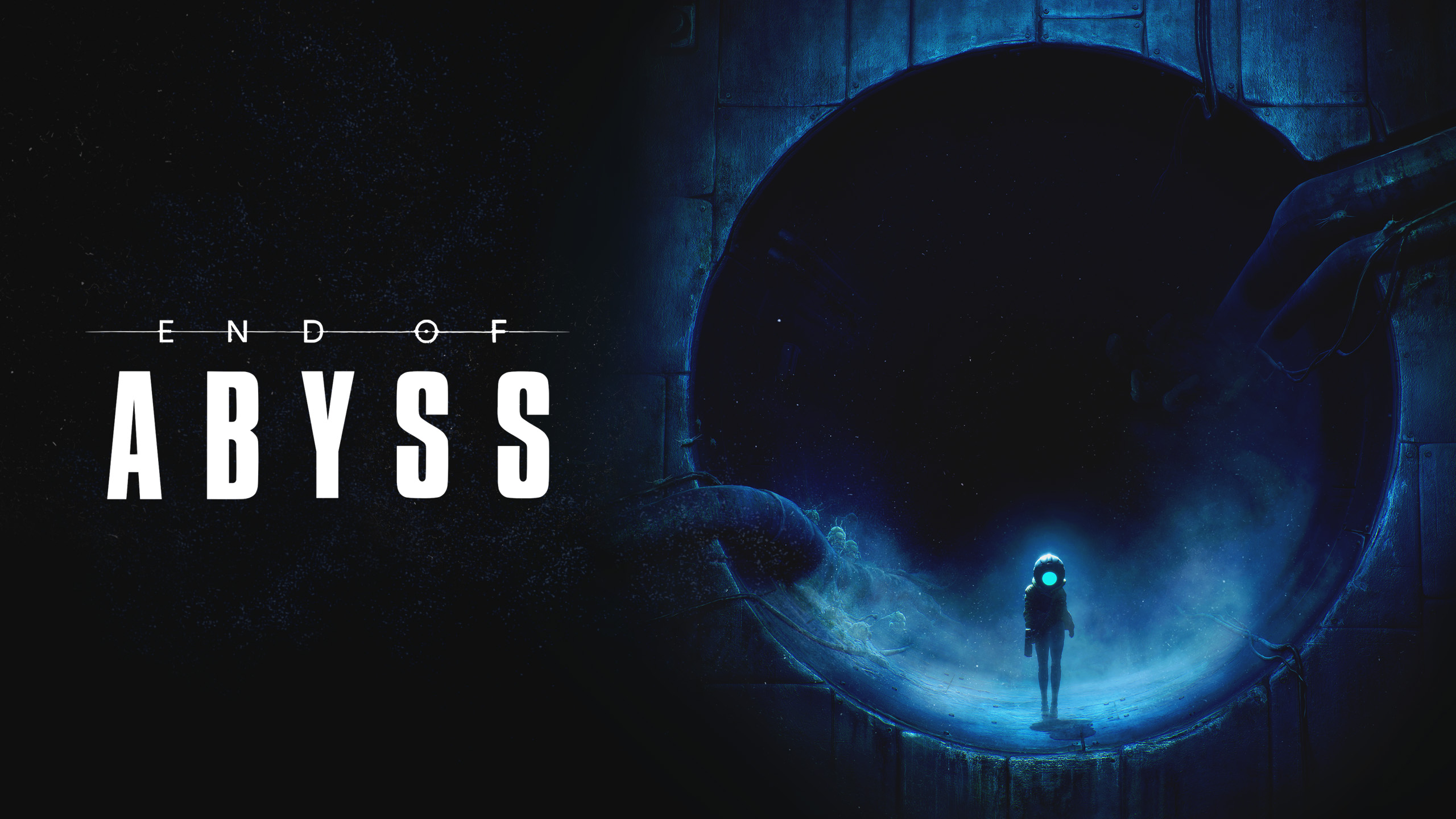
The kick-off to End of Abyss is every bit as dark, harrowing, and atmospheric as the rest of the game. It’s a title that sends Cel, a young combat technician, journeying through the often claustrophobic rooms, tunnels, and ventilator shafts of the massive compound at the orders of the enigmatic Captain and his cadre of seemingly useless but heavily armed soldiers.
Armed with a flashlight, scanner and — at least initially — just a pistol, Cel must take on the infected horrors of the compound as she fights to reach the bowels of the facility for her commander.
The roaming creatures,initially faceless, ambling husks, grow more ferocious and morbid in design as you make your way through the brutalist building. Soon they’re sprouting sinuous, elongated necks topped with repulsive heads, merging with one another, exploding, or simply combining body parts to inflict the most grievous harm.
The Chest Hugger, for instance, looks a bit like a massive hand, while some husks survive with just a head that scrambles around a room looking to latch onto a dead body to attack you.
By the time you reach the many-armed human centipede, it’s clear you’ve dropped into a horror steeped in Cronenberg and Carpenter-inspired influence.
While End of Abyss’ creature design is the first thing likely to sink its hooks into your imagination, I found the compound’s brutalist architecture to be the game’s most effective atmospheric tool.
The entire game is played from an up-and-back perspective —low and tight behind Cel in the corridors, high overhead in the open rooms — giving you a wide view of the compound as you traverse its labyrinthine space. The lighting frames most rooms in shadow, adding to the sense of a place closing in on you and a feeling that you’re never quite sure if you’re alone.
Occasionally, Cel walks into cavernous spaces — like the subbasement of the Outer Sector — that perfectly underscore the minimalist construction and bare bones decorative design: a slab of concrete for a wall that disappears off the top of the screen, a massive door, exposed power lines and ventilation pipes wrapping into a receding hallway.
This is brutalism in the literal sense — béton brut, raw concrete, the structure and its supporting elements completely exposed, nothing decorated or softened for comfort.
Other times, Cel will traverse an area where you can see two or three or four floors below you, all eventually accessible and the effect is the same: You feel the weight of the thing she’s inside, and how small Cel is against it.
The corruption you find as you push deeper is all the more unsettling because it spreads across so blank a concrete canvas. That blankness is also why the creatures hook you so fast: Spotlighted against bare concrete in a dimly lit room, anything made of flesh feels like an intrusion.
The game’s brutalism doesn’t stop with the architecture. Nothing in the design is softened for your comfort either. End of Abyss is defined as much by what it withholds from players as by what it delivers.
For instance, your perspective is at times blocked by the geometry of the space you’re in. In many titles of this design, this is handled by fading away the blocker. But in End of Abyss there are moments when something, like a pipe or bit of wall, will block a portion of your view.
Marcus Ottvall, co-founder of Section 9, noted that there are some areas where they fade the environment when moving between rooms, but that’s it.
“Having big parts of geometry fading in front of the camera was something we tried to avoid,” he said. “We had to be cautious with how we placed objects in the world and looked for dynamic and interesting ways to frame the environments without obscuring the player, enemies, or the path forward. It was a process of trying out compositions of scenes and camera angles to find the balance where we felt good about it.
“For cameras, we limited their movement depending on what we feel worked for combat and exploration. At most times we try to separate the two by not having much exploration in a room that is heavily combat-focused. We ended up using a collection of camera setups that we found worked well for different situations and we stuck with those throughout.”
End of Abyss also initially withholds the map from players, instead relying on Cel to walk through the environment to fill out the map. There are map stations, but they’re remote and not easy to locate. To find the many secrets, and even to progress at times, Cel has to use her scanner to minutely explore rooms.
The idea is that the scanner can help mark things on your map, like a door that requires a key, or a wall that can be blown apart with explosives. And then when you’re properly outfitted you can use the map to go back to those areas.
You’ll also need to find everything in the game, including all of the map secrets — like hidden rooms — in order to 100 percent it, Ottvall said.
“At its core, we wanted the game to feel mysterious and reveal more content to the player if they were to explore the environments thoroughly,” he said. “The intent was for the story and world to be understandable but somewhat curious when following the main path, and that you would find more pieces to the puzzle and access to more equipment and weapons if you explored beyond that.”
The need to use Cel’s scanner to detect secrets, and help her along her way, also adds to the End of Abyss’ sense of anxiety.
When Cel pulls out her scanner, blue beams of light shine out from the device, dancing around the room to scan. When it lands on something that can be more deeply explored, you hold in the right trigger to do a deep scan and reveal more information about the item.
For instance, when she scans a locked door, it will tell you what key it needs or if you have to trace its power supply through the walls to blast an energy node and force it open.
However, while Cel is using her scanner she can’t run, dodge, or hold her weapon. Once she does any of these the scanner is put away automatically. So it’s a deliberate trade off that also slightly imperils Cel as she slowly walks through the darkened rooms of the compound.
The game nicely blends combat, puzzle solving, and exploration together:
Cel spends a lot of time tentatively exploring one of the massive multi-floor areas like the Habitation Area, Factory East, Factory West and the Waterworks. This is when she examines rooms, solves light puzzles, and sorts out how to achieve the current goal assigned to her by the Captain.
Combat can occur at any time, but usually it starts as a surprise. A shambling husk slowly rises from the debris of a room, or drops from the ceiling and leaps at you. Over time, Cel can find new weapons (there are six in all) throughout the game. She can also use workbenches, which are located next to restoration pods (where you’ll be revived when you die) to upgrade those weapons and give them new abilities.
There’s a lot of backing away in Cel’s many encounters, the enemies are often slow, but damaging. Unfortunately, the ones that are fast are also damaging. So you’ll have to be good at dodging and picking away at your targets.
Finally, once Cel has explored an area and sorted out how to achieve the goal her Captain has set for her, she has to execute it, which usually involves a lot of backtracking, and using newly acquired items, like explosives, a grappling hook, or a key card.
These excursions always end in a boss battle, and they’re the unforgiving sort.
I’ve found it takes quite a few runs at a boss to finally figure out its attack patterns and weaknesses, but once you do, it’s just a matter of skillfully applying that knowledge while trying not to die.
I won’t give away too much about the bosses, but I will say they’re almost all delightful fusions of infected, bloated, and misshapen bodies.
The human centipede (officially called the Husk Centipede), for instance, is a collection of legs, arms, and flesh. It skitters through the locked room you’re in, biting, spewing bile and attempting to wrap itself around Cel and squeeze her to death.
The creature and character design of the game is perfectly augmented by some truly memorable sound design, and it is brutalist in the same sense as the architecture: raw, with no ornamentation.
The Captain, the soldiers, and everyone else in the game speak a made-up, chilling language. The soldiers sound almost as if you should be able to understand their deep, echoing words. The cadence and tone of real speech are all there, but the meaning is withheld. Other voices are eerier still.
Ottvall said that once the team settled on having spoken lines in End of Abyss, they decided that the voices needed to sound real, but slightly otherworldly.
“In real life, anytime that you hear someone speaking a language that you are not familiar with, you can usually tell that they are actually speaking a real language from how their tone sounds and how the sentences are organized,” he said. “For us, the aura of the voice and the base tone of the sentences was our focus, creating a kind of robotic and stoic way in which the characters speak, rather than an actual functioning language.”
They achieved this through a number of different approaches including combining a voice generator's lines with lines spoken by the designers and then combining them.
“For the end result, our audio designer created parts of a made-up language, recorded the lines and distorted them digitally to make them feel slightly robotic and somewhat otherworldly,” Ottvall said.
The end result is spoken lines that add to the mystery of End of Abyss and its creeping infection.
It’s this overriding mystery, soaked in a brutalistic atmosphere of horror and dread, that will ultimately push players to seek answers to the questions built into the game’s design.
Methodically walking through darkened corridors framed by shadows and filled with the echoes of distant shambling creatures and the drone of some creaking machine, you can’t help but want to see what’s through the next door; what creeping, trudging, spewing horror awaits you.
That every boss defeated, and each puzzle solved, pushes you one step closer to a revelation is simply a crowning flourish to End of Abyss’ atmospheric perfection.
ลิงก์ที่เกี่ยวข้อง

Control Resonant opens up as you get stronger — and as characters start trusting you