
Hírek
PengPong’s hockey-pinball chaos was the result of a game jam
A
Aron Garst
As lead game designer and game director Jongchang Lee tells it, PengPong wasn’t originally conceived as a major project. Instead, it emerged from Sandy Floor’s two-week game jam, a space where the team was encouraged to experiment with anything they personally found fun.
“PengPong actually started as a small internal game jam project earlier this year," he said. "We ran a two-week jam where everyone on the team had to make something fun in the genre they felt most confident in. I’ve always loved survivor-style games, so I began thinking: What if you kept the core of a survivor game, but the weapon never dropped and instead bounced around the arena like a pinball?”
That bouncing, ricochet-infused idea became the seed of PengPong. The prototype resonated with the rest of Sandy Floor almost immediately.
“The prototype, which we initially called Pinball Survivor, ended up ranking first in our internal game jam," he said. "From there, we kept iterating on the core mechanics and overall feel, polishing the bouncing weapon system and layering more depth on top of it. Through that process, the project gradually evolved into what is now PengPong.”
The studio didn’t set out to mash genres together, but once the core feel of “momentum, bounce, and chaos” took shape, real-world inspirations started to align.
Bounce-first design
From the beginning, the game’s foundational mechanic wasn’t a character or a story concept, but a sensation: the unpredictable, slightly slippery impact of a projectile bouncing around an arena. That tactile idea guided every aesthetic choice that followed.
“A lot of it started from the fact that ‘bouncing’ is the core mechanic of the game," Lee said. "Once we locked that in, it was natural to look at existing things in the real world that already feel like that—pinball, table tennis, pucks sliding on ice, and so on.”
Among those references, one stood out as the perfect thematic pairing.
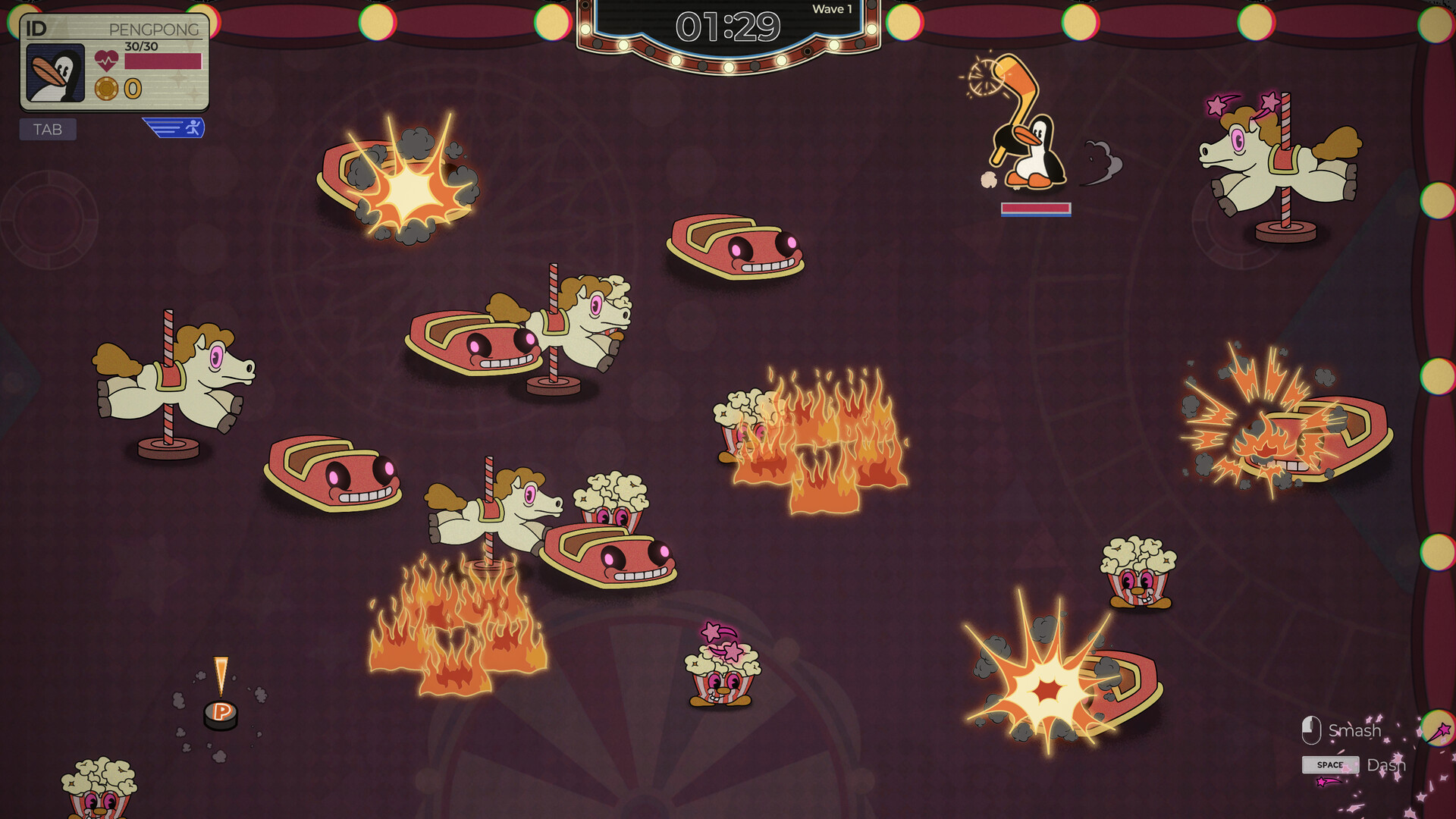
“An icy floor felt like the best fit for the game’s feel: It’s slippery, it exaggerates momentum, and it makes every bounce a little less predictable," Lee added. "From there, it was a short jump to ice hockey—a fast, physical sport where a puck is constantly ricocheting around the rink, just like our weapon.”
With ice came a natural setting, with that setting came a character. But Sandy Floor wanted something globally relatable, not tied to language or cultural context. They decided to go with the most popular flightless bird in the world.
“As for the penguin, we wanted a character that global players could instantly understand and connect with, without us having to over-explain the setting," Lee said. "Animals are very universal in that sense.”
After considering multiple arctic animals, the penguin emerged as the ideal mascot. It matched the environment, the tone, and the personality the team wanted to convey. It tied in naturally with their ice and hockey elements.
Sandy Floor is a small but nimble studio. While the whole company supports its projects, PengPong is primarily driven by a focused core group.
“Right now, Sandy Floor is a 10-person studio," Lee said. "For PengPong specifically, we have a core team of four people: one focusing on game design, one on engineering, and two handling art and visuals.”
That compact size, Lee says, is a major advantage rather than a limitation. It allows the team to experiment, iterate, and pivot rapidly based on feedback.
A perfect fit
Many game titles go through long lists or pitch meetings before landing on the final choice. PengPong wasn’t one of them. Instead, it came from a casual moment of inspiration from one of the team’s artists.
“It wasn’t something we sat down in a formal meeting to decide, because game titles rarely appear just because you force yourself to come up with one at a desk," Lee said. "Instead, we agreed to just keep throwing out ideas whenever something popped into our heads during development.”
One day, unexpectedly, lightning struck.
“One day, completely out of the blue, Juyoung said: ‘What about PengPong?’ It sounded like a mix of ‘ping-pong’ and ‘penguin,’ and we immediately felt it was a witty, memorable fit for the game," Lee recalled. "It captured both the bouncy, ricochet-driven feel of the gameplay and the personality of our penguin protagonist in a single, simple word.”
While PengPong’s presentation is playful and approachable, its systems are built with depth in mind. At its heart is a survivor-style roguelike loop where players assemble new builds each run, but with an extra twist that leans into the game’s theme of debt and gambling.
“PengPong is built very much as a survivor-style roguelike, where each run is about building a completely different weapon and item setup," Jongchang said. "Every time you play, you’re assembling a new build from scratch with different weapons and items, and between waves you can even take on extra risk through a casino-style roulette system.”
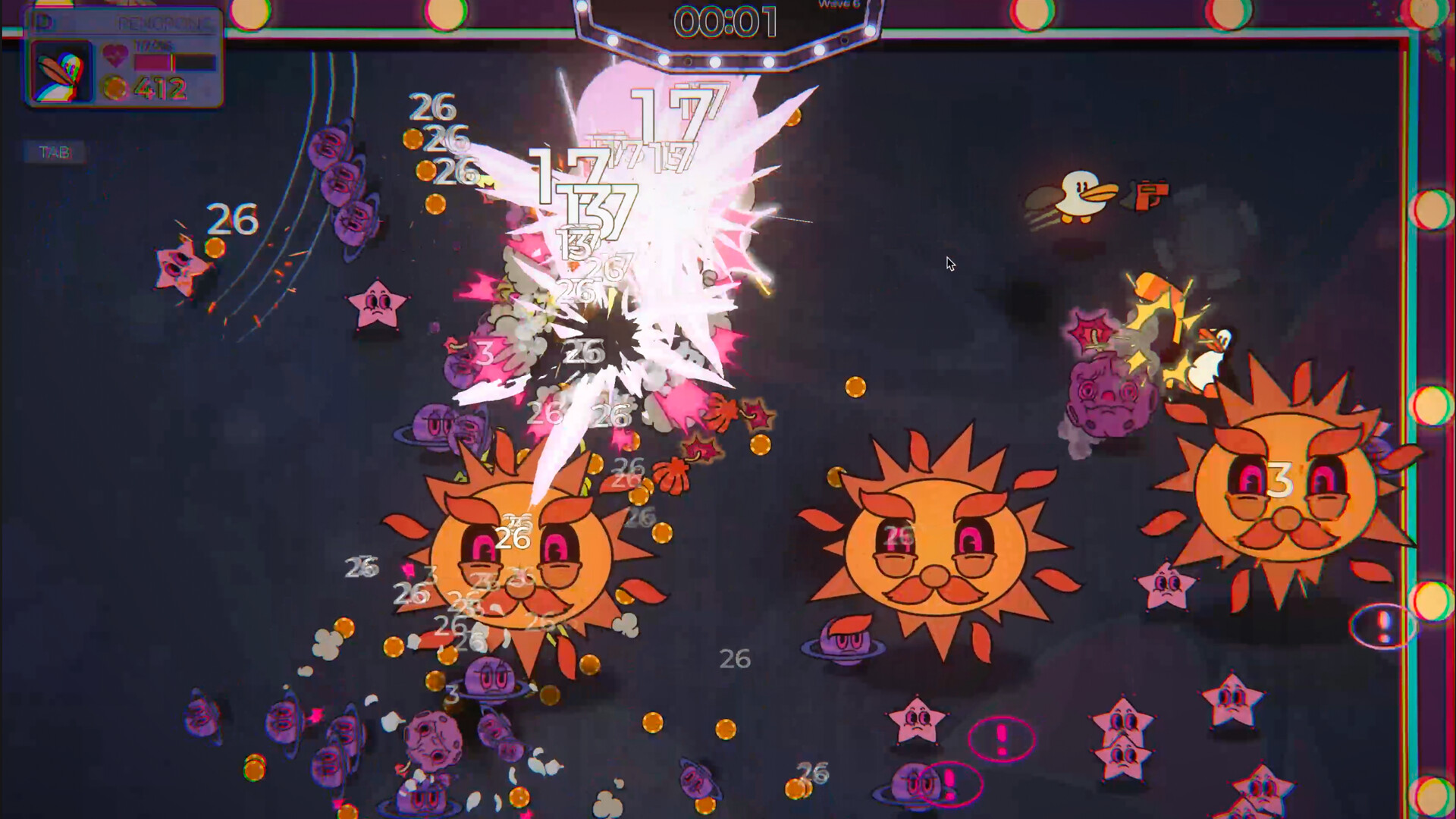
That roulette becomes a key decision point. Players can take big gambles to earn bigger payoffs, or play conservatively to preserve their run. As players level up, new layers of complexity open up through Hyper Capacities, which are essentially evolution tiers that let builds grow in wildly different directions.
“By choosing different combinations of items and Hyper Capacities, you can lean into very distinct playstyles," Lee said. "For example, status-effect-focused builds, explosive or wide-area damage builds, or highly evasive, mobility-oriented builds.”
The joy of PengPong is in discovering synergies that feel unintended or game-breaking, which is the hallmark of a great roguelike.
“The roguelike aspect isn’t just about random drops," Lee said. "It’s about how each run pushes you to experiment with different synergies, take risks in the casino between waves, and discover new combinations that can ‘break’ the game in interesting ways.”
Survivor philosophy
Lee’s background spans multiple genres on both PC and mobile, but he describes his philosophy today as centered on revisiting old-school arcade fundamentals and refreshing them for modern players.
"Over the years, I’ve worked across multiple genres on both PC and mobile," he said. "But my main focus has always been on game design and the business side of games, especially monetization and how players actually engage with a title over time.”
That interest has driven him back toward a certain purity of experience. He aims at bringing the fun you would find in old-school arcade games directly to players, with modern twists in terms of mechanics and presentation. PengPong, he says, is a direct expression of that philosophy.
"It’s one of the projects where our team is trying to distill that ‘arcade soul’ into something that feels fresh and contemporary for today’s players," he says.
Even if PengPong began with a simple idea, it has been influenced by a long list of roguelikes, survivor games, and others. Both modern hits and lesser-known projects as sources of inspiration.
“There are honestly so many great games out there that it’s hard to say we were influenced by just one or two specific titles,” Lee said.
Still, a handful stood out during development. Games like Brotato, 20 Minutes Till Dawn, Titan Souls, and The Binding of Isaac all inspired various mechanics in PengPong. More recent games like CloverPit, Ball X Pit, Megabonk, and Deep Rock Galactic: Survivor have also had an impact on how Sandy Floor built out pacing, build variety, and ‘feel’ in a roguelike.
Every new entry in the genre teaches the team something and they hope that, in time, PengPong earns its place among them.
“New, high-quality games keep coming out all the time, and we’re constantly learning from them," Lee said. "Our hope is that, one day, PengPong can be mentioned in the same breath as those titles as part of that lineup of games people look to for fresh, satisfying roguelike experiences.”
PengPong is coming soon to Epic Games Store.