Samurai, cowboys, and the tactical legacy of Mimimi Games
German developer Mimimi Games recently announced that its latest game, Shadow Gambit: The Cursed Crew, would unfortunately be the studio's last. Sad though the closure may be, Mimimi’s legacy is secure. Over the past eight years, the studio has become known as the torchbearers for a specific style of strategy game that had gone all-but-extinct: real-time tactics, or what Mimimi itself would come to call “stealth strategy.” With three games and one expansion, the studio has had a truly impressive run.
In 1998, Pyro Studios' Commandos: Behind Enemy Lines established the subgenre with its top-down perspective and stealth focus. Players must guide a small team of WWII operatives through maps where they are vastly outnumbered and outgunned. Proceeding requires pruning the enemy ranks, luring guards away from their posts, or waiting until their compatriots are focused elsewhere. The subgenre may resemble real-time strategy games at a glance, but the business of scrutinizing patrol patterns and dodging enemy vision cones is much more akin to a puzzle game.

Commandos inspired a wave of like-minded projects, most notably the Wild West-themed Desperados series—but its heyday was short-lived. As pure stealth-based games fell out of fashion, so did real-time tactics.
The recently remastered Commandos 3, originally released in 2003, would be the last top-down game in the series. Its 2006 sequel emulated first-person shooters instead. That same year, the second Desperados game added third-person elements—and after a 2007 spin-off, Helldorado, the series went silent for more than a decade.
Shadow Tactics: Blades of the Shogun
By 2016, there were no expectations whatsoever for future real-time tactics games—much less from Mimimi Games, which had previously developed the platformer The Last Tinker: City of Colors. That game little resembled Shadow Tactics: Blades of the Shogun and its backdrop of a bloody uprising in feudal Japan.
Playing Shadow Tactics today, it’s striking to see just how fully-formed the studio’s design sensibilities were from the start. Apart from future tweaks to character pathfinding and UI readability, Blades of the Shogun plays very much like Mimimi’s later titles. Its large levels feature different combinations of five distinct characters, each color-coded to be easily identified on the intricate maps. They come in all shapes and sizes, from powerful samurai Mugen to frail sniper Takuma to child thief Yuki.

Each character possesses special abilities and different means of interacting with the world, and Shadow Tactics is all about weighing these attributes against a given situation. Neither Takuma nor Mugen can climb vines, for example, but Mugen is the only one who can take out an enemy samurai alone. Other situations require coordination via the game’s Shadow Mode, where you set up combinations of actions that trigger at the press of a button.
Out of all the Mimimi titles, Blades of the Shogun is the most grounded, but certain touches give it a heightened tone that would be expanded in the studio’s subsequent work. One of Takuma’s abilities summons a little tanuki to make noise, while Mugen has the preposterous ability to pick up boulders and lob them at enemies—which technically counts as an “accident.” And guard types are distinguished by their clothing, with a straw hat marking guards who won’t leave their posts to investigate distractions.
Most of all, Shadow Tactics unabashedly embraces so-called "save scumming." Harboring no delusions that its levels should be completed in a single attempt, Mimimi plasters a timer at the top of the screen that ticks down from the last time you quicksaved. Out of all the game’s features, it’s perhaps this simple timer that shows a deep understanding of how the genre works and how people engage with it. While some games force you to adapt to the circumstances, stealth strategy is all about executing a plan and trying to get it exactly right.
Desperados III and Aiko's Choice
Four years after Shadow Tactics, Desperados III saw Mimimi resuscitate one of the very franchises that inspired the studio, seamlessly migrating its style to the Wild West. Outfits are swapped out accordingly, with immobile guards now equipped with ponchos instead of straw hats and bruisers in long coats standing in for beefy samurai.
The character lineup combines familiar faces and newcomers, shuffling the distribution of abilities a bit from Blades of the Shogun. Prototypical cowboy John Cooper handles like shuriken-equipped ninja Hayato, albeit with two pistols at his disposal. And the trapper Hector combines the moveset of little Yuki with the strength of Mugen, totally altering the process of setting traps—since he can simply hurl bodies into nearby hiding spots rather than slowly drag them out of sight. It’s emblematic of just how thoughtfully constructed Mimimi's games are that such small changes so drastically affect the game balance.

The new character of Isabelle embraces supernatural powers in lieu of the relatively grounded abilities in Shadow Tactics—hinting at the direction of Mimimi's next game, Shadow Gambit: The Cursed Crew. Her voodoo powers are some of the most fun and outright powerful in Desperados III, like linking enemies together so that whatever happens to one will affect the other. She can even briefly control the minds of certain guards to set up some truly devious chain reactions.
Above all else, Desperados III exhibits a “more is more” philosophy. Not only do the characters have more abilities, but the levels are much larger and boast extra modes that give further incentive to try them again. Bounty Mode lets you take characters into a level who weren’t present for the initial run, and the extra Baron challenges totally alter existing maps with new objectives.
Unlike the action elements that crept into earlier real-time tactics games, the additions to Desperados III expand the game without compromising the stealth focus. Apart from the Shadow Mode equivalent now helpfully pausing the action, the biggest additions are neutral zones where your characters can walk freely before executing a violent strategy.
Perhaps best of all, Desperados III shows a stylized replay video after each level. From a zoomed-out perspective, you watch your actions play out again in fast-forward, with colored lines charting each character's progress across the map and icons popping up to mark where you used certain abilities or killed certain guards. It's a truly invigorating victory lap, emphasizing all the careful planning and coordination you did while puzzling your way through each level.

And if there was any doubt as to how right Mimimi got the genre in its first outing, the standalone expansion to Shadow Tactics: Blades of the Shogun retains all the same mechanics despite coming out five years later (and a year after Desperados III). Beyond a few shorter, in-between missions, the handful of bigger levels in Shadow Tactics: Aiko’s Choice provide an opportunity the original featured all too briefly: using all five characters at once.
Shadow Gambit: The Cursed Crew
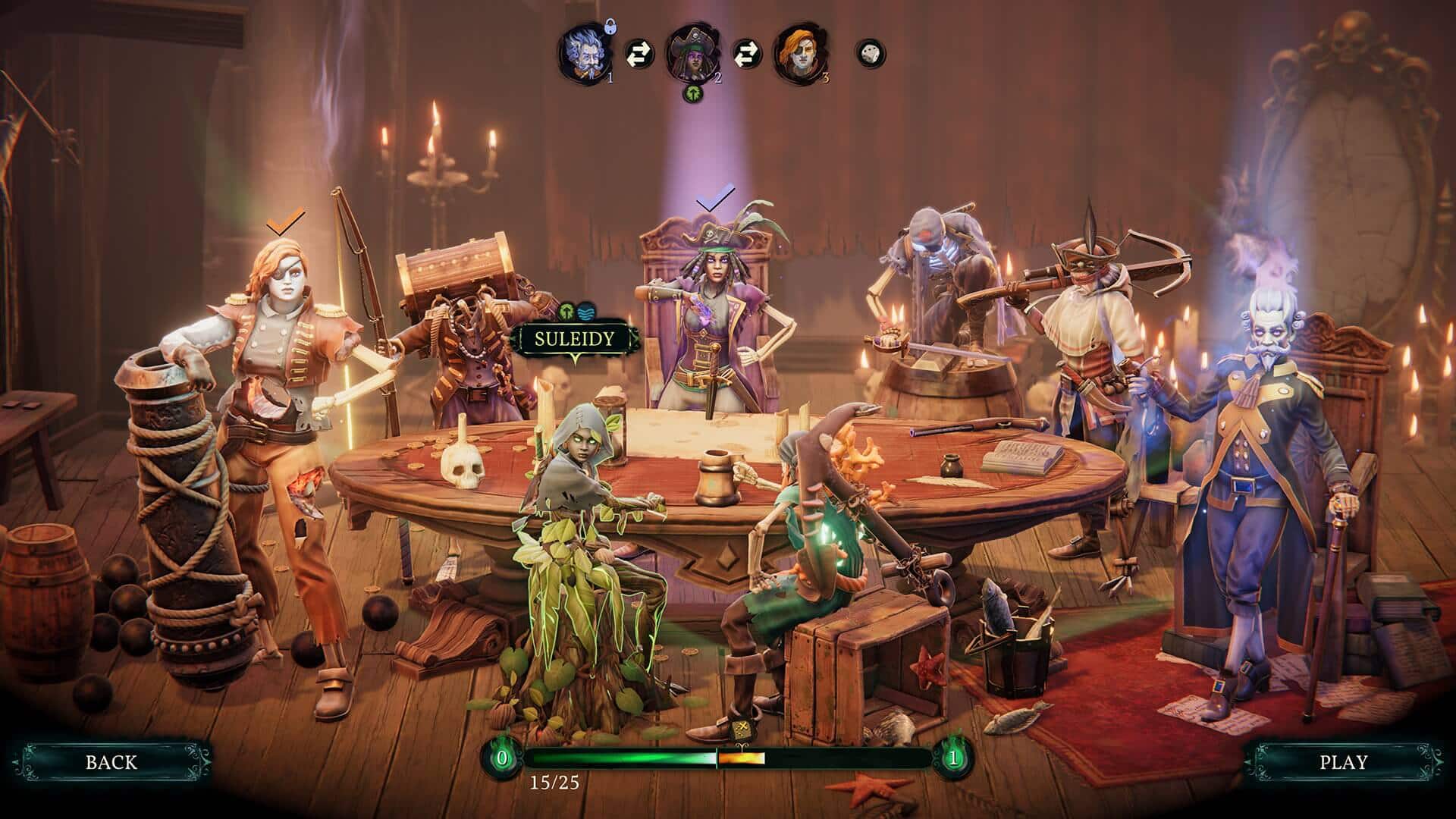
Shadow Gambit: The Cursed Crew totally embraces fantasy, taking place in a supernatural version of the Golden Age of Piracy where the dead have risen to set sail alongside the living. Protagonist Afia sheathes her sword through a wound in her chest and sets out to revive the sentient pirate ship Red Marley and its legendary crew.
In many ways, Shadow Gambit marks Mimimi’s most ambitious effort. Where the studio's other works built upon a specific lineage, The Cursed Crew enters uncharted territory by adding nonlinear elements to the established stealth strategy blueprint, allowing players to choose which island to visit next and which quest to take. The islands even ask you to pick from one of several spots to make landfall, because they’re all designed for return visits in future missions.

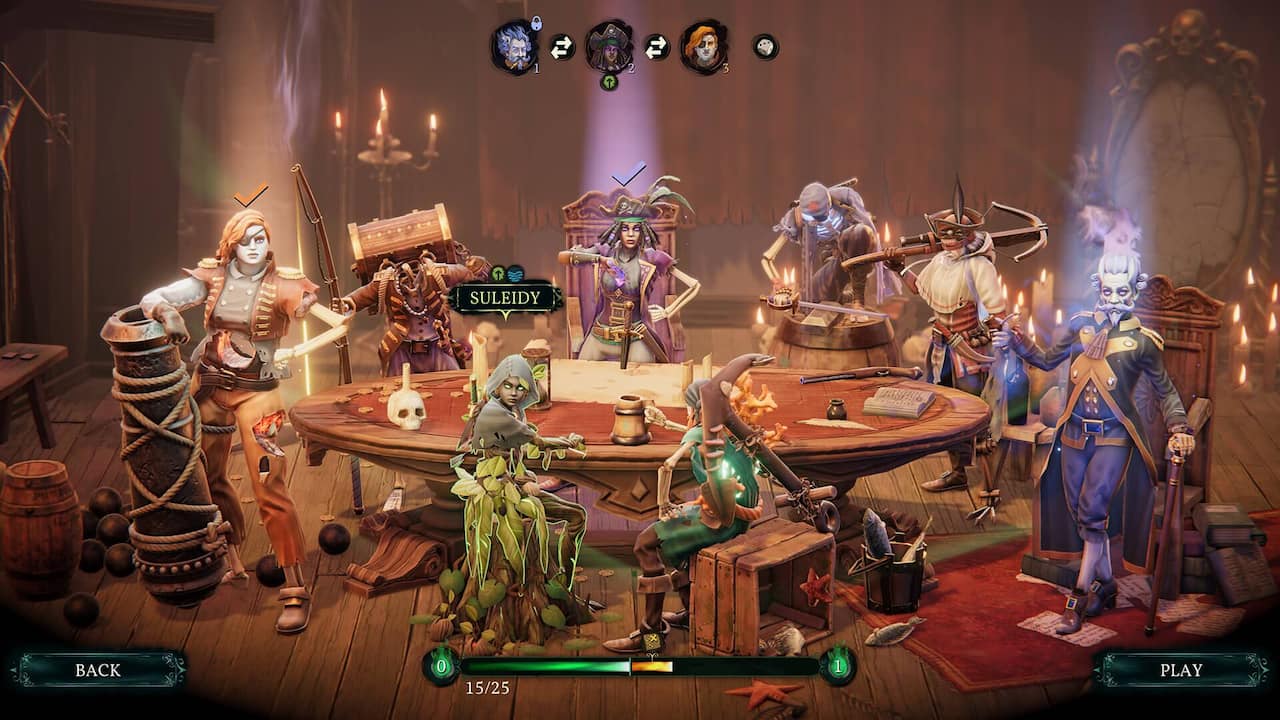
The non-linear approach also extends to playable crewmates, who Afia can revive in any order once she has the proper resources—for a whopping total of eight undead pirates. And the characters are the real joy of The Cursed Crew simply because of how wild the developers let their imaginations run with new abilities.
Some totally bypass conventional obstacles—the muscular gunner Gaelle, for example, can load crewmates into her cannon and blast them over walls or onto rooftops. Quentin, a gold skeleton, uses his fishing rod to interact with objects from afar, both to quickly dispose of bodies and to pull allies to his position. There’s even a hub area to get to know your crew, in the style of Mass Effect.
Perhaps the most drastic narrative change is how The Cursed Crew handles quicksaving, though. Rather than an unacknowledged timer at the top of the screen, the need to quicksave is outright woven into the game’s fiction. Quicksaves are now “memories,” preserved through the abilities of the Red Marley, who vocally encourages you to save after a set period of time, as a ghostly bell appears onscreen.

Mimimi’s refinements over the years show a developer that truly, intimately understands its chosen genre. That Shadow Gambit: The Cursed Crew suggests an invigorating new direction for the company is even more tragic now that the team won’t be able to iterate on the mechanics it introduced. What Mimimi leaves behind is far from a mere footnote, though. Mimimi made itself integral to the history of a genre that the studio essentially willed back into existence entirely on its own.