Six Metroidvanias that change up the classic formula
From the haunting bug-infested tunnels of Hollow Knight to the twisted Inquisition-inspired imagery of Blasphemous, the so-called "Metroidvania" has become one of the most enduring subgenres in video games. First innovated by the Metroid series—along with certain Castlevania classics, especially Symphony of the Night—the expansive maps and nonlinear exploration that define the term have become increasingly popular over the past few years. However, though most Metroidvanias tend to stick to the formula established by these classics, there are a few that try to change it up.
The six following Metroidvanias offer their own spin on the usual 2D grid-based maps of their forebears. Whether it's a different camera angle, a shining new mechanic, or the absence of something that players usually expect—combat, for example—these Metroidvanias stand out for all the right reasons. Even if you're a total newcomer to the genre, these are six games on the Epic Games Store that are worth a look, especially if Gothic castles and hordes of undead are growing a bit stale.
Rain World
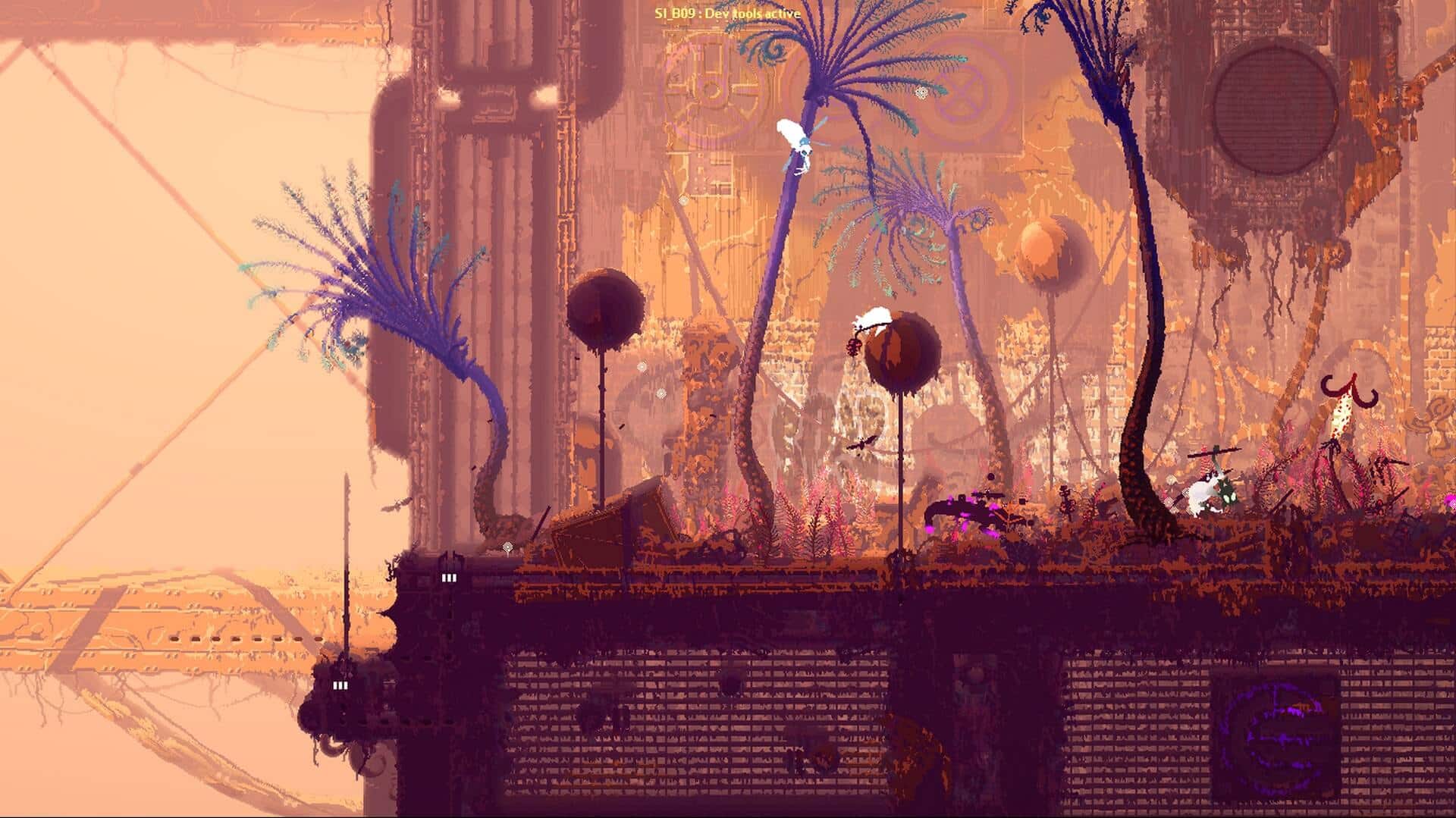
We often overuse the word "unique" when describing video games, but Rain World is one that deserves that label. You control a cute (yet somewhat nightmarish) "slugcat" that's just trying to survive in a wet swamp world filled with scaly lizards and undulating tentacle monsters that want to eat you for breakfast.

Its grimy aesthetic and complex ecosystem make it stand out in any crowd. Like Another World and the Knytt series before it, Rain World drops you into an alien environment and expects you to make the best of it. Your slugcat can throw spears you find for self-defense, but combat isn't the answer to most of your problems; in fact, you'll spend most of your time running away from the bad guys.
It's definitely fair to say that some hardcore fans might quibble with its status as a Metroidvania, given that it has no upgrades or ability-gating. However, like some other games on this list, the gating in Rain World comes in the form of player knowledge and skill. Over time, you will learn tricks to deal with the pesky lizards and challenging climbs that your slugcat will need to overcome to survive in the wastes. If you enjoy the exploration aspects of classic MV games, you'll feel right at home with this one.
Aeterna Noctis
On the surface, Aeterna Noctis appears as an archetypical Metroidvania: satisfying combat, a massive map, and a grim medieval-inspired aesthetic. However, once you get past its first few hours, you'll see that it pushes the mechanical backbone of the genre to its limit. It's also brutally difficult, but not necessarily in the ways you might expect.

While most Metroidvanias require platforming to some degree, the actual running and jumping sequences are not particularly challenging. Aeterna Noctis eschews this model, instead opting for a wide variety of traversal abilities and skill gauntlets that wouldn't be out of place in a pure "masocore" platformer like Super Meat Boy or Celeste. (This includes an arrow that lets you teleport to its location in midair, which becomes a huge part of the game later on).
Fundamentally, the game is about skillful jumping and dashing, with even the boss fights requiring pinpoint reflexes and complex movements to dodge their every attack. The game features less exploration than many Metroidvanias—especially in the second half—but the platform challenges will keep you coming back for more.
Death's Door
If you're a Metroidvania devotee, you've probably noticed that many in the subgenre have begun to take notes from FromSoftware's Souls series and its imitators. Death's Door draws fruitful inspiration from Souls while making its own mark thanks to its great swordplay, charming artstyle, and moving story.

This isn't the first Metroidvania to use an isometric over-the-shoulder perspective, but Death's Door takes it to new heights. As an ultra-cute crow charged with fighting monsters and tearing souls from the bloated dead, you battle massive behemoths in simple but satisfying combat. If there's a single word to describe the game, it's "charming." It manages to pull off several feats that are rare in video games: it's legitimately funny, it has an interesting world to explore, and it doesn't outstay its welcome. It's not as exploration-focused as a pure Metroidvania, but it makes up for it with secrets and great boss fights. And it does have ability gating, so please put away your dictionary.
It's difficult to say more about Death's Door without giving it all away. It's fair to say that if you like cute games and you don't mind a little bit of a challenge, give it a look.
Yoku's Island Express
Yoku's Island Express is another that truly deserves its reputation as a unique title: a Metroidvania that replaces the usual Mario-style platforming with pinball flippers and bumpers. There are other modern pinball-inspired games out there, but Yoku's Island Express is the only one that combines the ability-gating and exploration of a MV with the mechanics and physics of the silver ball.

Yoku is a dung beetle on vacation who is named the new postmaster of Mokumana Island, which means he must swing and bounce his way through the tropical paradise, delivering mail to its colorful denizens. Of course, the island hides its own dark and mysterious secrets that Yoku uncovers for himself, along with a slew of traversal upgrades and trick-shot challenges to boot.
Like Death's Door, Yoku's Island Express is a game that simply lathers on the charm until you simply have to surrender to it. In terms of pure fun and whimsy, it really can't be beat.
Prey
Working on a space station with your brother might sound like a heap of fun, but Morgan Yu discovers that it's not all it's cracked up to be in 2017's Prey. Turns out the station's been overrun by aliens, and you're the only worker around to fix it. Like a lot of so-called "immersive sims"—an ill-defined subgenre dating back to the days of System Shock—Arkane's Prey defies easy categorization.

Though it's a first-person shooter with plenty of weapons, it's more about scavenging and finding creative solutions to the problems you face than blasting the bad guys. Should you put resources into your hacking skill to open the door, or should you use your handheld GLOO cannon's limited ammo to craft squishy platforms to climb above the wall and into the room?
Regardless of what you want to call it, this sci-fi adventure has all of the makings of a Metroidvania. The space station Talos I is a single interconnected location with plenty of nested routes to find and secrets to discover. Backtracking is strongly encouraged, and enemies have a wide variety of strengths and weaknesses to overcome and exploit. You can eventually choose to invest in the alien technology to give yourself an edge, but watch out; the tech might have some unintended side effects. If you like freedom and making your own path out of GLOO and bullets, Prey is your game.
Outer Wilds
A universe-ending apocalypse is always a major bummer, but what if you had to experience it over and over for all of eternity? Thankfully, Outer Wilds puts a cheery spin on what could have been a downright dour premise. You play as an alien who experiences the last 22 minutes of its solar system's life again and again, doomed to watch its star go supernova in a time loop of unknown origins.

Your only option is to explore this miniature system and discover as much as you can about the extinct spacefaring race called the Nomai. In true "Metroidbrainia" fashion, there are no abilities to collect or items to nab in Outer Wilds; instead, your main tool is information, gathering lore to solve the various logic puzzles that prevent you from exploring every planet in the system. Theoretically, you have access to these planets from the start, but many of these areas are only available at certain times during the loop, and the worlds even react to some of your decisions accordingly.
Like Fez, Outer Wilds is not a true Metroidvania, but its exploration-focused gameplay and evocative worldbuilding will be familiar to fans of the genre. If you want to know what it's like to ride out a time loop again and again, it's certainly up your alley.