News
Star Overdrive: How a small development team created a big open-world sci-fi adventure
P
Paul Cecchini
Impressively, though, Star Overdrive isn’t a AAA title. Not by a long shot. Indie studio Caracal Games started as a small group of three developers. Ten years later, one might expect the company to have expanded significantly. However, that’s far from the case. The team has grown from three to a mere 12—and that’s just how founder/CEO and Star Overdrive Creative Director Tommaso Bonanni likes it.
“The idea of Caracal is to be a very small team,” says Bonanni. “This cuts down on a lot of our communication. Every structure of communication is managed by me. Every member of the team speaks directly to me for what is needed. Everything speeds up a lot. That's why we are able to do these big games. We know how to work with each other and love to work with each other. They are awesome, incredibly talented, super cool veterans that have a lot of experience. I work with people that are way more experienced than me.”
Ultimately, Bonanni estimates they were able to do the amount of work of a 50- to 60-person team with only 12. “It’s five times the efficiency at least.”
Star Overdrive began with a simple concept: a hoverboard. Bonanni, a huge fan of American culture from the 1980s, loved the concept of a hoverboard since he first saw the film Back to the Future Part II. The general vibes and aesthetic related to the board were inspired by the Japanese manga series Eureka Seven. For gameplay, the team looked to the The Legend of Zelda series, most notably Breath of the Wild, for inspiration. “We believe that the philosophy behind the exploration in those games is great,” he says. “It's full of the stuff that we love.”
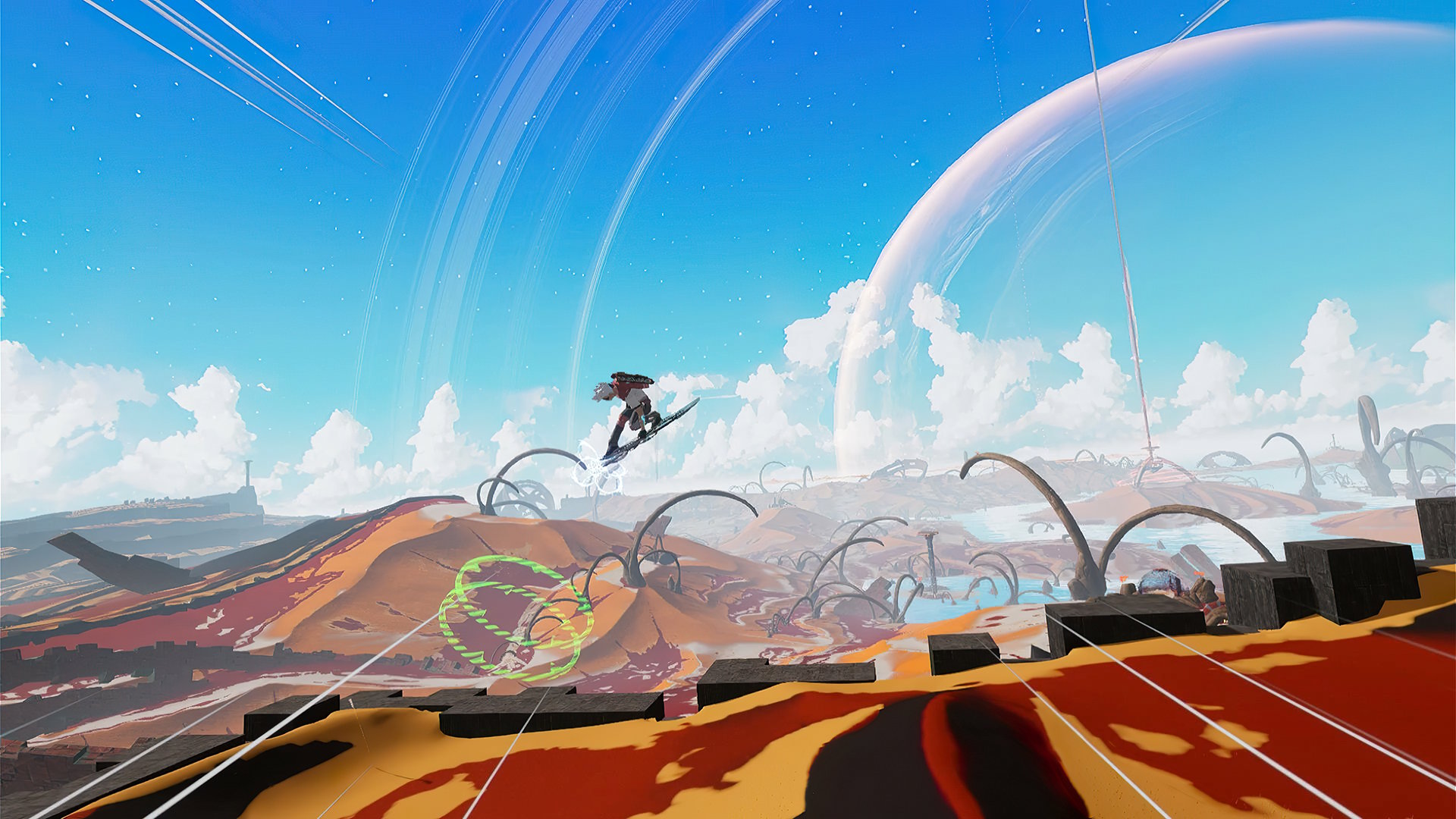
Naturally, to make a hoverboard cool, it needs to go fast. However, the faster the character moves, the faster they cover ground. The faster that ground is covered, the more of it the game needs. While making a tremendously large map was beyond the timeframe and budget of the indie studio, Star Overdrive's map nevertheless manages to cover a respectable 135 square miles (170 square kilometers).
Despite its relatively small size compared to massive titles like Breath of the Wild, it could still be densely packed with points of interest—in Star Overdrive’s case, over 300. “I did all of the map alone with basically no procedural tools except for foliage,” says Bonanni. “Everything else has been handmade.”
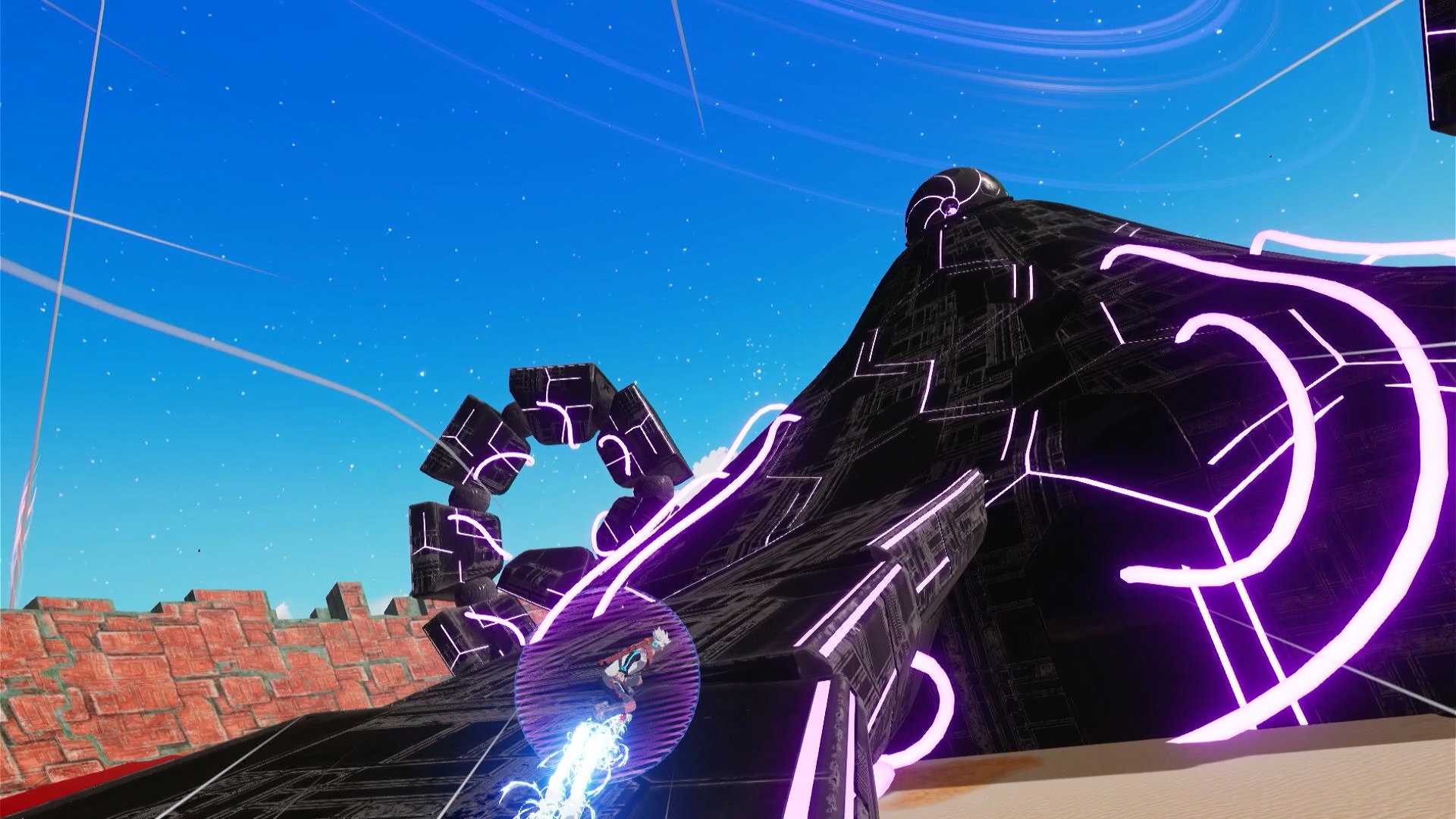
To keep players engaged when boarding from one point of interest to the next, the desert planet is full of sand dunes that are perfect for some sick hoverboard tricks. Pulling off moves in the air rewards you with a light boost upon landing, helping propel you toward the next dune. Dunes are strategically placed so that whenever the player lands after reaching one, the next one is close by and clearly visible so the player knows where to head next.
“The hoverboard is built for the map. The map is built for the hoverboard,” says Bonanni. “This loop of jumping, doing the trick, landing, boosting, and then searching for the next dune is the very core of the gameplay.”
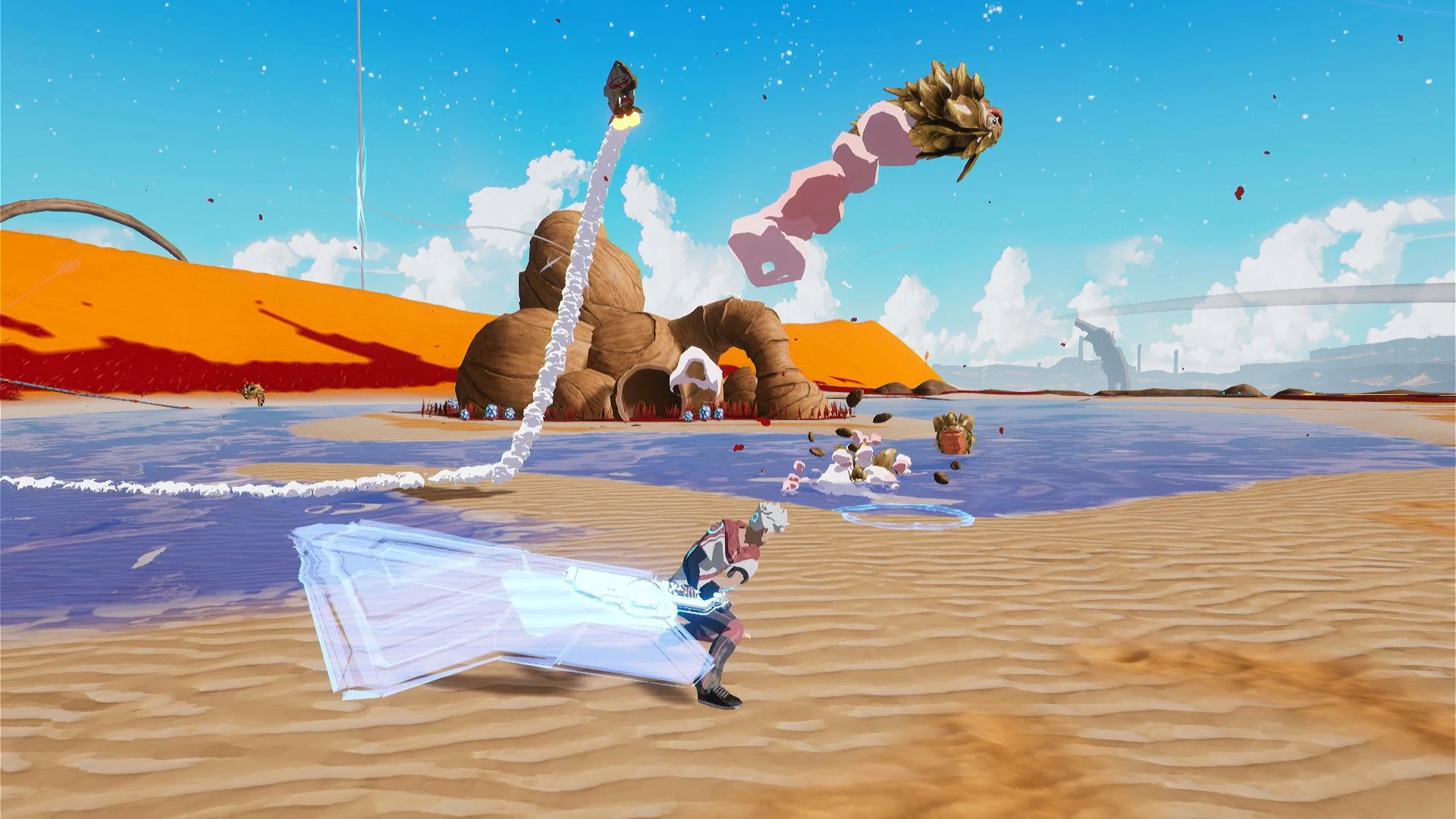
Despite the board not touching the ground, the moment-to-moment action is designed to keep players engaged in ways that typical aerial traversal cannot. “If we would have done something like Harry Potter’s broom, you are flying and have no interaction,” says Bonanni. “Since you are very far from the ground, you don't feel the speed. The fact that you feel the speed [in Star Overdrive] is because you are close to the ground and are constantly engaged by doing this loop of pressing inputs to jump, do tricks and boost. It gives all the magic of riding, keeping the player engaged. This has been among the most difficult things to do design-wise.”
Of course, the hoverboard is more than just a means of transportation. “Since the hoverboard is so unique, it needed to be at the center of everything that you do,” says Bonanni. “The story is based around the hoverboard. The crafting, you do to enhance the hoverboard. The combat. Everything you do in the game is tied to the hoverboard.”
Similar to The Legend of Zelda's Link, Star Overdrive’s protagonist Bios doesn’t speak. His personality is limited to grunts and facial animations during cutscenes. Typically, developers incorporate silent protagonists in order for the player to be able to imprint their own personality onto the character. In Bios’s case, the reasoning behind his silence runs deeper than one might expect.
Bonanni elaborates: “He needs to be silent for three reasons: narrative, technical, and inspiration. First, if we have a talking character, this would not be a Breath of the Wild-inspired game. Link is silent. Zelda does all the speaking for him. This was very important for us. The second reason is technical. We put 200 percent of our effort on the character of Nous. She drives all the emotion in the game. We believe that the person you need to save needs to be more interesting than the main character.”
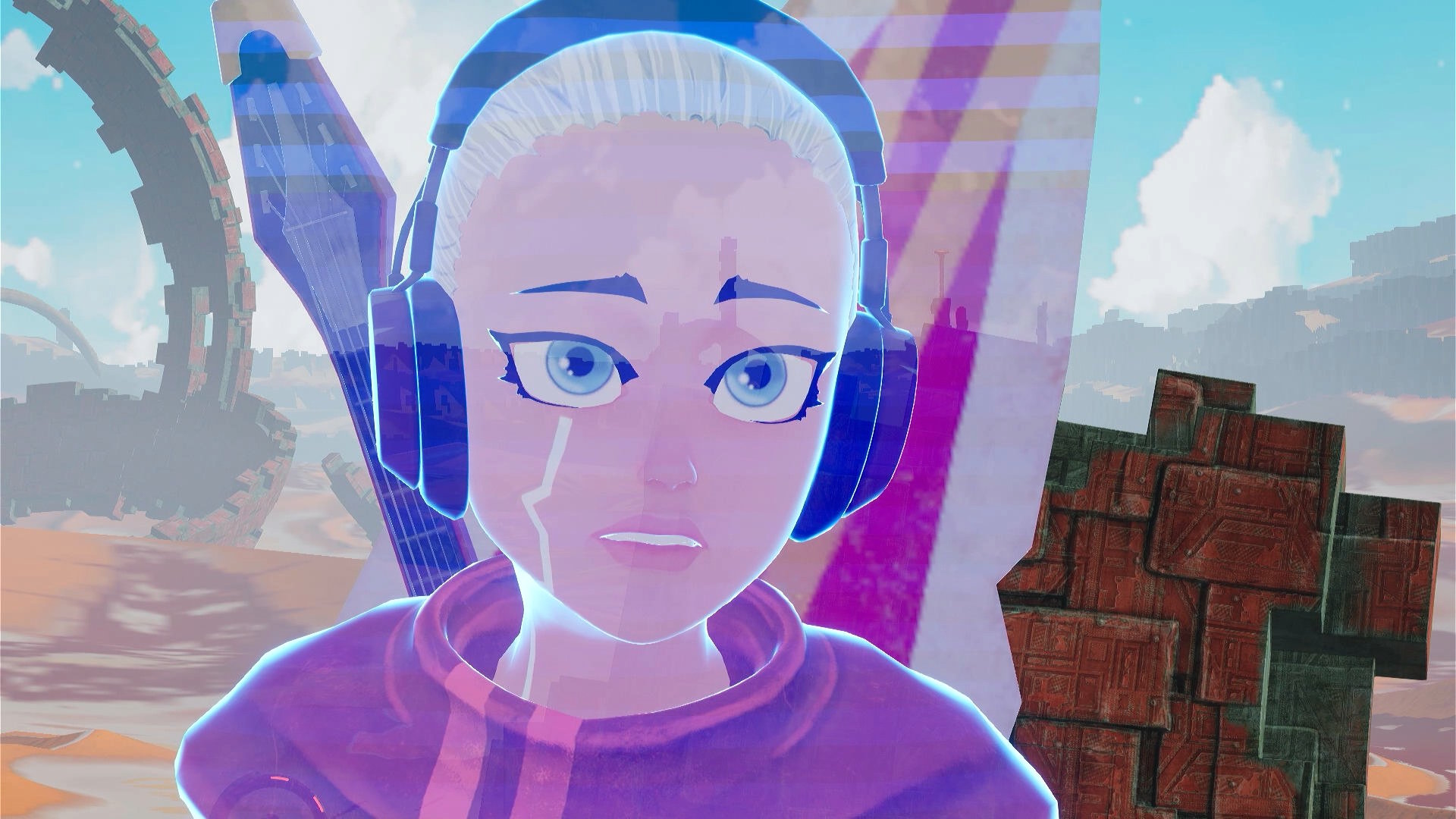
He explains this as the difference between a game being a "The Witcher” or a “Skyrim.” “In The Witcher, you are playing Geralt,” he says. “You have choices, of course. You have shades of how he will act, but that's Geralt. But in Skyrim or even a Pokémon game, the character is there to be filled with the emotion of the player.”
As far as the narrative reason goes, Bios used to play with Nous in a band—ironically enough, as the singer. After her disappearance, he became completely mute. Information regarding this is uncovered as players explore the world and discover cassette tapes that go into more detail about the relationship between the two.
“It’s been a big trauma for him,” says Bonanni. “We want people to discover this during the story. In Star Overdrive, there is a very deep lore that we build up, but the heart of the story is these two characters—what they did in the past, what they like and don't like, the story of the world, of this galaxy, why there are no weapons in this galaxy, all this kind of stuff. Of course, we didn't have the space to put everything inside the game, but we always had references when we needed to answer questions during development.”
As mentioned earlier, the small studio of 12 has managed to do much with very little. Despite the scope of Star Overdrive and the size of their team, Bonanni is proud that the team experienced virtually no crunch during the entirety of development. Bonanni wants to help inspire and teach other developers large and small how to do the same.
“I have a one hour talk that I'm doing about this, how to create positive culture and maintain it, and how that has a very strong impact on production,” he says. “It's a topic that I care a lot about. Everything in Caracal works because we have fun with what we're doing. I grew this team in 10 years with select persons who get along very well with each other.”
This camaraderie extends beyond the workplace, as well. A week after our interview, Bonanni and his crew took a nice vacation together to a lake in central Italy. “We love to work together and spend our vacation together because we are more of a brotherhood than a developer,” he says.
Keeping a team happy and motivated to work requires synchronization and knowing how each member works, which is much easier with a smaller team size. Bonanni wants everyone on his crew to feel like Star Overdrive is their game.
“I'm the creative director, but everyone is the author,” he says. “That's why I'm bringing around this talk, because I want to say to people that you are way more effective if you are not tired of crunching and you love what you are working on. We do eight hours a day of work, maybe nine, and no more than that. You are way more effective than working double the hours.”
Another tip he offers: Do research before production begins. This advance planning provided Caracal with a decent buffer that could account for lost development time—which was important, as they ended up needing to release Star Overdrive several months earlier than initially planned.
Perhaps Star Overdrive’s crowning achievement was receiving commendation from the company that inspired it. “When Nintendo invited us in Tokyo to pitch the game to them, it was the apex of happiness,” Bonanni relates. “We did a Breath of the Wild-inspired game, and then Nintendo liked the game and asked to have it as [a timed] exclusive. So, we basically have a blessing of Nintendo on a game inspired by one of their major IPs. That's, like, the most beautiful thing that can happen.”
Star Overdrive is designed to be more than just a standalone game. Star Overdrive: Deluxe Edition includes an original manga story featuring exclusive story content and a deeper dive into the backstories of the characters. And as a fun side project, the team also created a fictional Van Halen-esque band (also known as Star Overdrive) that Bios and Nous love in-game. Interested players can purchase a 12-song album by the fictional band on various music platforms, with vocals by Bonanni himself and guitars by the game’s sound designer.
Bonanni and crew have plenty more stories to tell in this exciting new sci-fi world they’ve created. They want to delve more into the story of Bios and Nous—how they met and how their relationship developed, how Nous first arrived on the deserted planet (which is hinted at throughout the game), and what’s to come after the surprising plot revelations that close out the game.
“This is only the tip of the iceberg,” says Bonanni. “The story of Nous on the planet is super interesting, but it was too complicated, too big, so we went straight to the Bios chapter. The next game we want to do is a prequel. You see parts of the past, but there is so much to say about how this super strong bond has been built over time. We want to do more manga. We want to do more songs. We wish to do animated stuff. But to do that, you need numbers, and we need this game to do nice numbers. I'm not sure it's going to be Star Overdrive 2, the prequel or whatever. We’d love to continue.”
Whatever project might be next for the 12 developers at Caracal Games, Star Overdrive is a game that they can all look back on with pride. “We’re a small team that did a very big thing with Nintendo’s blessing against all technical odds,” says Bonanni. “We are super happy with the results.”
Star Overdrive is available now on the Epic Games Store.