Seoul, The Night
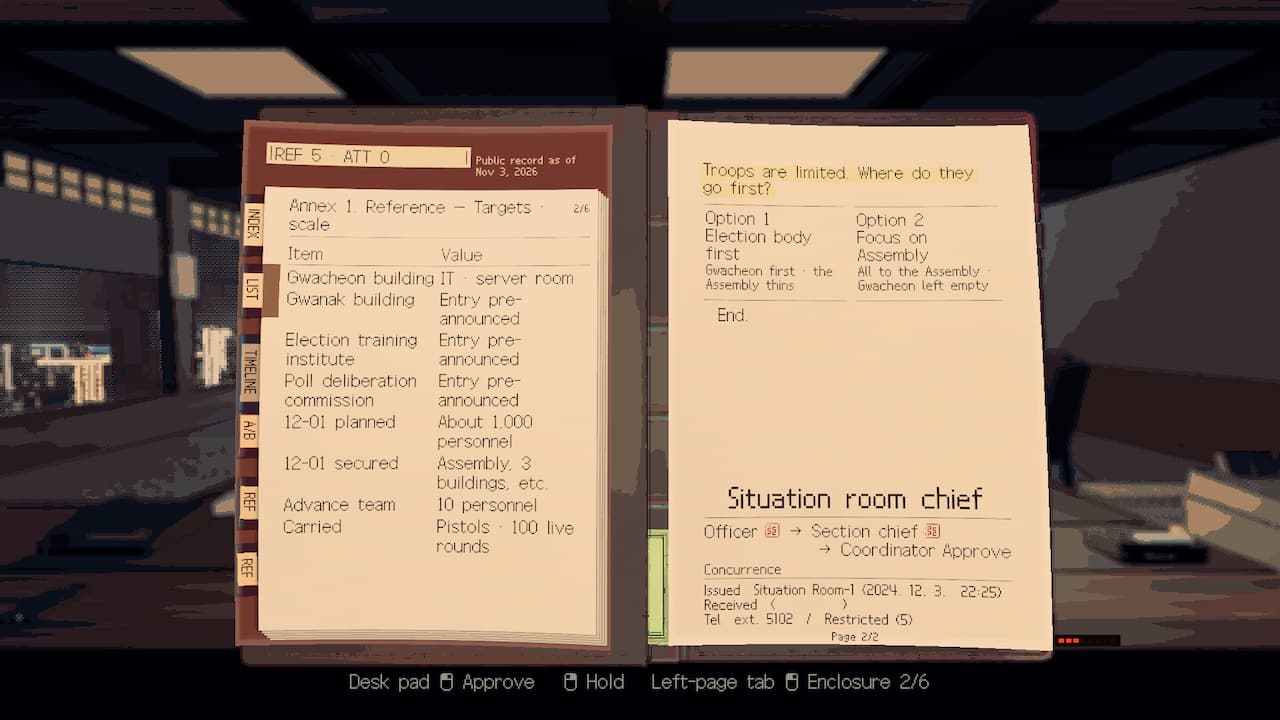


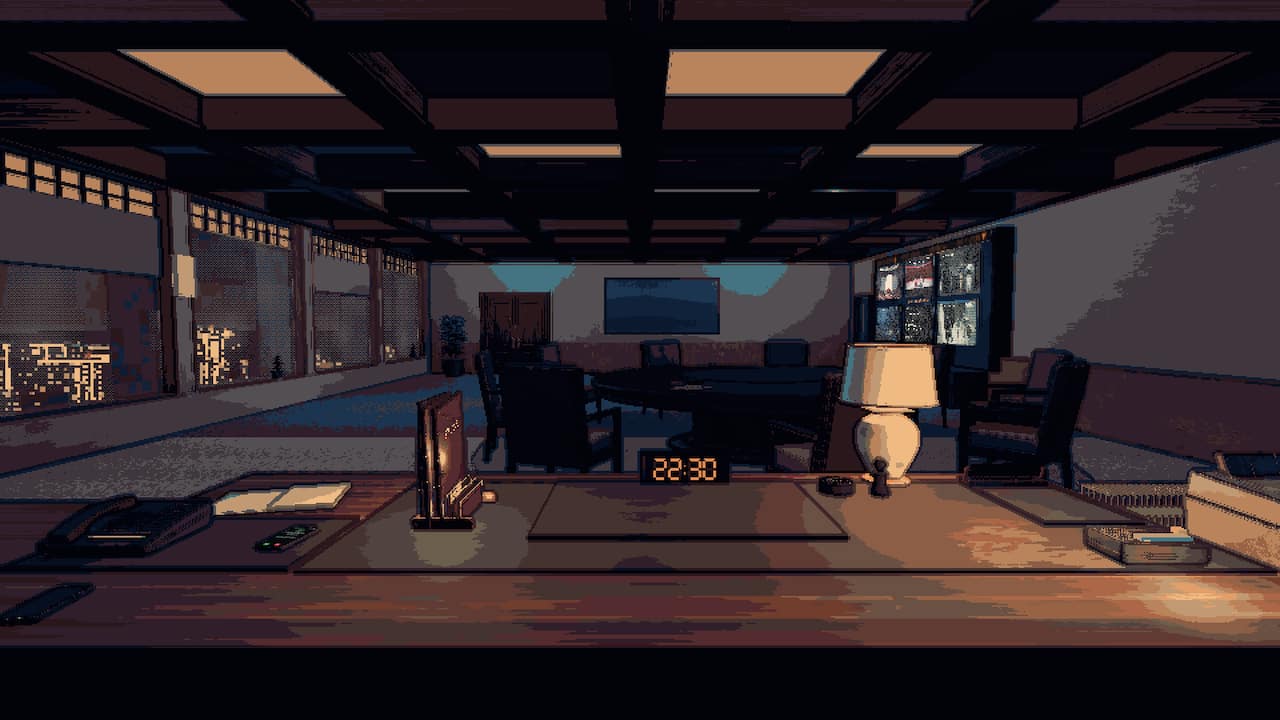
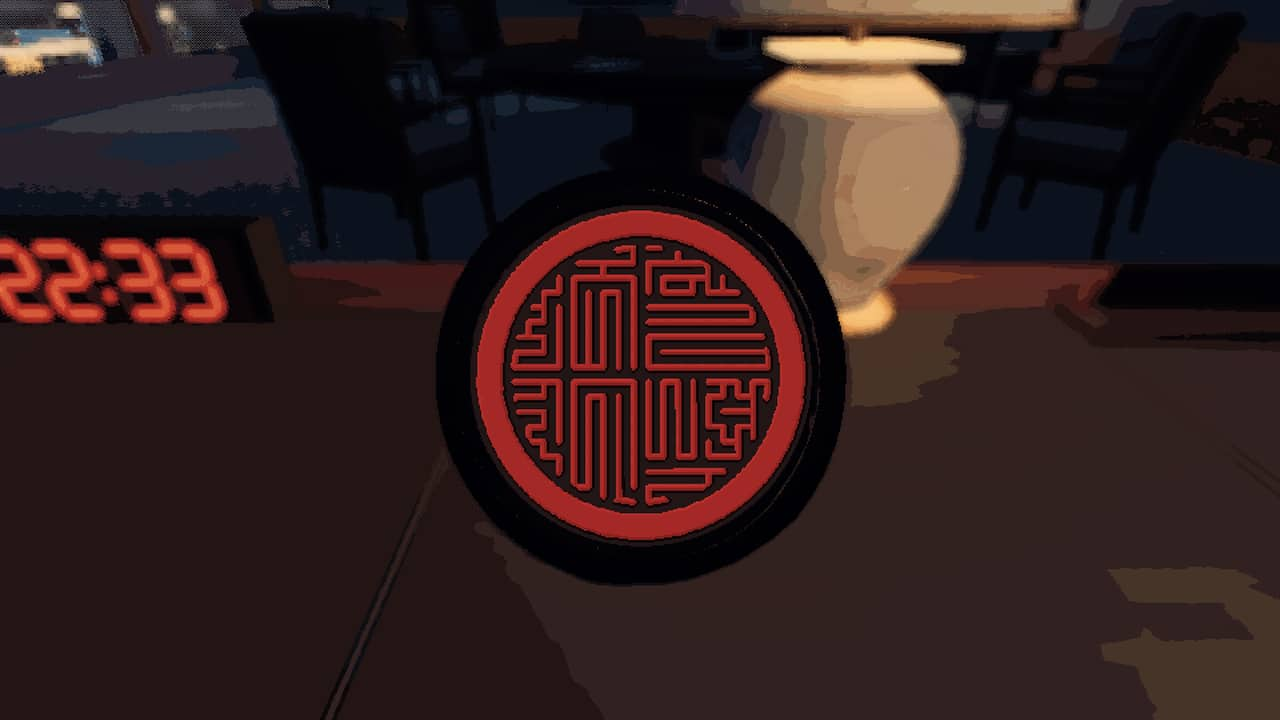

The night martial law is declared, you stamp papers as the situation-room coordinator. Your job is to leave no record, but the game is built from court rulings and the public record. The National Assembly stopped martial law. Play to find out how many times it nearly didn't.
This is an Early Access Game
Early Access games are still under development and may change significantly over time. As a result, you may experience unforeseen issues or completely new gameplay elements while playing this game.
You can play now to experience the game while it's being built or wait until it offers a more complete experience.
On the night of December 3, 2024, the President declares emergency martial law in an address. While the address is on the air, a room full of telephones goes to work. Until seven in the morning.
No minutes were taken. (Constitutional Court, Seoul, April 4, 2025)
You wear no stars. Your role is to receive the words of those who do and send them where they need to go. As coordinator, you take the calls and prepare the documents. What goes on paper and what stays off it is decided at this desk. The night has already been planned. Your job tonight is to keep that plan moving, even when it runs up against people.
EVERYONE KNOWS HOW IT ENDS
Martial law was lifted about six hours later, after the National Assembly passed a resolution demanding it. The institutions held, and the night settled into a reassuring story.
This game is about how close that was.
What stopped martial law that night was people: citizens who resisted, and soldiers and police who carried out their orders half-heartedly. A commander who told his men to take their time. Investigators who drove slowly on purpose. Military lawyers who said the order was unlawful. Take a few of them out of the room, and the night ends differently.
WHAT YOU DO
- Orders arrive by radio, by telephone, on paper, over the broadcast. What you can do with one depends on how it came in.
- Approve, delay, send it back. Some moments call for a single careful sentence that means nothing at all.
- Leave no record. The catch: bureaucracy does not move without making one.
- Close the night, and the next day an envelope is waiting on the same desk: what the record wrote after that night.
Each time the night's plan gets past the people who hesitated, the cost is billed to the record. The deeper into the small hours, the thicker the evidence. The last scene is a court ruling, and what you did at this desk that night is read back: how many papers you stamped, how many you held back, the calls you missed, how many times you looked out of the window.
A NOTE ON FORMS
Even the settings are paperwork. Pick a language, then pick a country's paper: the settings folder is reprinted, and printed out, in that state's official forms. The approval folders on the night's desk keep their Korean format. That is where it happened. The same folder holds text size, contrast, subtitles, volume and camera sway.
IT'S ALL IN THE RECORD
The events and times of what actually happened that night come from the public record: hearings, court rulings, constitutional decisions, reporting. Words in quotation marks are the record verbatim; the rest is rewritten by the game from the record. The coordinator, the other paths you can choose, and the scenes they open are the game's own.
Sooner or later you will hit a scene and think: they made this one up. There is usually a record behind it. Which line comes from the record and which is the game's is on our fact sheet. The names are gone; only the titles remain. The questions this game asks start from the ones raised in the hearings and in court about that night. Where the records disagree, both versions stand side by side.
The facts in this game follow the public record as of November 6, 2026 (court rulings, decisions, hearing transcripts, reporting). When new rulings or facts come out, a patch brings them in and this date moves with it.
The plan is to keep adding supported languages during Early Access.


Seoul, The Night System Requirements
Minimum
OS version
Windows 10 64-bit or later
CPU
64-bit dual-core, 2.0 GHz (Intel Core i3-6100 / AMD equivalent)
Memory
4 GB RAM
GPU
Vulkan 1.0 compatible GPU, 1 GB VRAM (Intel HD Graphics 620 / NVIDIA GeForce GTX 650 / AMD Radeon HD 7750)
Storage
500 MB available space
Additional Notes
Full controller support.
Recommended
OS version
Windows 10 64-bit or later
CPU
64-bit dual-core, 2.0 GHz (Intel Core i3-6100 / AMD equivalent)
Memory
4 GB RAM
GPU
Vulkan 1.0 compatible GPU, 1 GB VRAM (Intel HD Graphics 620 / NVIDIA GeForce GTX 650 / AMD Radeon HD 7750)
Storage
500 MB available space
Login Accounts Required
Epic ID
Languages Supported
- Chinese (Simplified)
- Chinese (Traditional)
- English
- Japanese
- Korean
- Polish
- Turkish
© 2026 humblebee. All rights reserved.
Privacy Policy (Opens in new tab)