Hírek
Empire of the Ants offers a new micro-sized perspective on the RTS genre
F
Francisco Dominguez
The game has you playing as the 103,683rd ant soldier from the Bel-o-kan Federation, the same ant from Bernard Werber’s French sci-fi book trilogy, The Ants. In Werber’s 1991 novel, humans find intelligent life where they least expect it: not in the infinite void of space but on the soil right below their feet (perhaps raiding unguarded picnics). And humans are helplessly outnumbered—there’s 2.5 million ants for every person alive on Earth today.
Creative director Renaud Charpentier was in his 20s when the book first stormed the French bestseller charts. It transformed the Parisian woods where he once played as a child into an unknowable, strange, and alien place. He told Epic Games Store that the studio he founded was delighted by the opportunity to apply the team’s narrative-driven strategy style to the novel’s surprising sci-fi setting, swarming insect battles, and geopolitical intrigues—following the original story, but not without a few twists of their own.
A stranger in a strange land
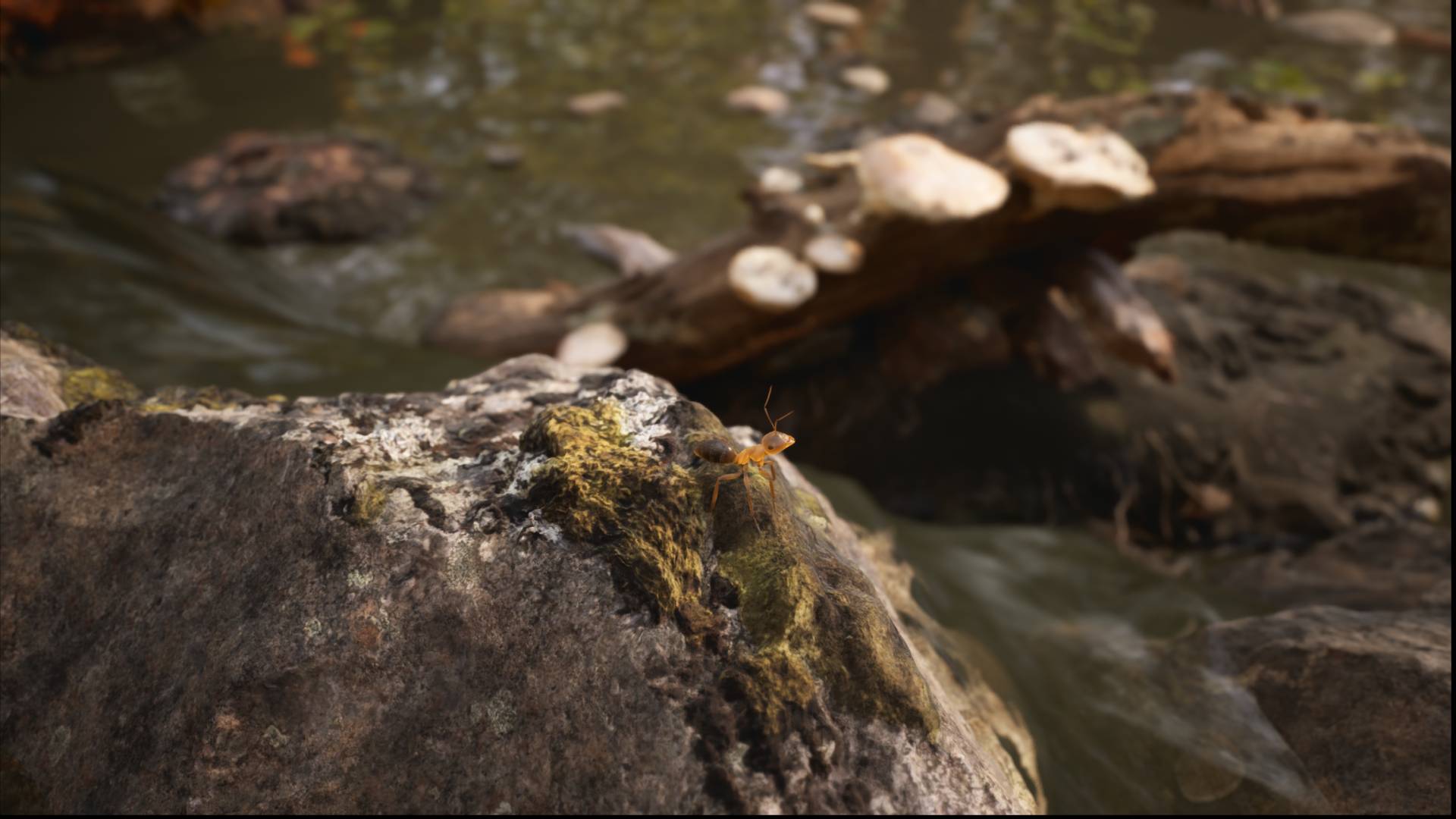
Decades after his childhood excursions in the forêt de Fontainebleau, Charpentier returned to the ancient woods with Tower Five. However, this time he came equipped with camera gear for the studio’s artists to accurately capture this ecosystem in all its seasonal variations, from the color of the mantises (which only display their recognizable green during the summer) to observing the precise natural behaviors of countless numbers of wildlife—beetles, slugs, ladybugs, and more. Their photographic equipment wasn’t just for reference material; the team used a technology that promises to supercharge their game’s visuals and make it almost indistinguishable from the BBC nature documentaries that inspired them: photogrammetry.
Similar to how your smartphone stitches multiple photos into a seamless panorama, photogrammetry turns overlapping photographs of a single subject into a photorealistic 3D model. With computing hardware increasingly able to handle these richly detailed assets, game engines like Unreal Engine 5 now include tools to harness them. It promises to be a game-changer for small (if not quite ant-sized) teams like Tower Five in bringing the woodlands and other locations to life.
“The trick is that our characters are all insects, so it is possible to model and animate photorealistic insects with a small team, which would have been impossible with humans or, even worse, huge animals," Charpentier explained. "No one has done a photorealistic real-time lion yet. It will come but, like with humans, it will be a huge challenge and a big project for a much bigger team than ours.”

Charpentier believes a human or lion would take his team months, or even years. “Human skin, eyes, veins, hairs are much more complex than the rigid chitin of our heroes. And a photorealistic, real-time lion, with all its glorious fur collar and muscles rolling below its skin? I don't even know if it is possible on the current consoles, but certainly it is impossible for us!”
Photogrammetry has a drawback when it comes to living subjects: your subject can’t move. “It was not possible for us to scan the insects.” But for good reason, Charpentier explained: “you would have to kill them for that, and no insect was harmed in the making of this game." At least, he thinks that’s the case: “Okay, we must have walked over a couple, unknowingly, while strolling through the forest. But we didn't catch any; photographic references were enough!”
Earlier this year in a GDC talk on the artistry behind his army of ants, Charpentier spoke about the profound influence Georges Méliès had on him. The famous early filmmaker and magician is known in particular for a famous early special effect: a man’s face convincingly merged with an image of the moon in Le Voyage dans la Lune. It’s a proud legacy of inventively blurring reality that is continued by Empire of the Ants with its use of photography, mixing real-life nature with the unreal.
Charpentier is also relieved that UE5’s Nanite geometry feature removed one magician’s sleight of hand that’s existed since the advent of 3D gaming: level of detail (LOD). Players can’t see detail from a distance, so it’s common practice to save computing power with a low-quality model, which is then swapped for a higher fidelity version as you draw closer. It’s the cause of texture pop-in, when a blurry wall is swapped for the high-definition version just a bit behind schedule. Now Nanite handles it, and it’s removed a tedious task for a game whose detailed art assets benefit from the tiny insect legs and their slower pace of movement.
“In Empire, you move relatively slowly forward, it's not a racing game,” Charpentier said. "So having this branch smoothly going from a speck on the horizon to this huge asset you are climbing on, without several strange transitions in the process, is a huge gain for immersion.”
A certain point of view
Fallout told us "war never changes," but Empire of the Ants says otherwise (even if an ant exoskeleton can’t beat power armor). Shifting from the human perspective to that of an ant—a tiny fraction of an inch above the ground—is already a radical shift. But that wasn’t enough for Tower Five, who chose to move from the trusty top-down view from their previous Total War games and Tower Five’s own Lornsword Winter Chronicle to a gamepad-friendly third-person. As in their own strategy games, this decision had consequences.
"Fog of war" is an RTS staple that’s perfect from top-down vantage point, where areas of a map your units can’t see are blurred. Changing to third-person meant redesigned visibility and detection rules that were inspired more by third-person tactical shooters. Powers, meanwhile, were changed from the hotkeys and rows of icons you’d see in RTS games or MMOs to pheromones you apply by your own proximity.

This introduces a new form of challenge. The actions-per-minute economy is completely different when your position matters. You’re the military general issuing orders, the inspirational source of unit buffs, the economic mastermind. But you have to be in the right spot to give orders. As Charpentier put it, in a world without traditional mouse control, you are the cursor. “Your ‘cursor positioning’ matters, it's a constant high level strategic decision you have to take: where should I position myself to see better, to command battles, or to manage my economy."
It even extends to how the game handles UI. When choosing between tech tree options, instead of pointing and clicking, you walk on the upgrade you want to build. Charpentier feels this is more intuitive and organic than 2D UI popups; instead, you should feel like you’re touching a realistic, living world at all times.
Chemical warfare
For all its lush recreation of woodland undergrowth, some aspects of ant-life are harder to replicate. Ants simply don’t create barricades outside of the last-ditch move of blocking the colony entrance—not an interesting tactic, but understandable when faced with a greedy hedgehog’s snout—but here they serve as nest defenses. These nests are a necessary mechanism to slow enemy advances, and they feel natural, since they're made from convincing photogrammetric twigs. And how do you recreate the complex ant communications that take place through the invisible secretion of chemical pheromones? By modeling these effects after the misty emissions that mushrooms or even some insects emit.
“The idea is to never break the immersion by having an asset screaming ‘I am a 3D object in a filmed documentary!'" Charpentier said. "Everything in the 3D scene tries to blend in, all the game-y, artificial, non-natural elements in the game live in the UI, like information that would have been added on top of the video capture to add notes and descriptions to the documentary.”
Charpentier sees his game design as drawing from three key influences that any genre fan will recognise. In terms of structure, economy design, unit relationships, and progression, they look to Blizzard’s RTS all-timer Warcraft 3. For territorial control, they turn to Company of Heroes’ warzones, which reward controlling large swathes of the map with little tolerance for turtling, defined as overly defensive play confined to a limited portion of the map. And for battles, naturally they looked to the sweeping Total War conflicts they worked on before. With an average colony in reality hosting between 100,000 and 500,000 insects, the Total War approach to swarms of marching ants covering the battlefield makes impeccable sense.
“As their general, you can't move them around with the reactivity of a few warriors; when they are engaged in a fight, they are really engaged,” Charpentier explained. "You can't easily order them back, so taking the decision to engage is more tactical and more [involved]. At the same time, they are huge battles, they take time to resolve before the last ant is killed. You have time to intervene [in] each individual fight, through pheromone usage, ranged attacks, special support units, or flanking to disengage a losing troop. Combat is much more on the tactical side than the action side, you have to act cleverly rather than react quickly.”
Strength in not just numbers
Perhaps the biggest shift from Total War to the battles seen in Empire of the Ants is the scope of unit movement. Manor Lords’ mobs of warring medieval humans, as desperate as they are to serve their feudal masters, lack the various claws, hooks, and even goo-secreting glands that let a caterpillar or spider crawl up walls with ease. They just mass ranks and charge. Here, units can climb and fight on anything (once the team solved a micro-pathfinding system to account for such varied terrain, that is). For all the extraterrestrial weirdness of the Zerg in StarCraft, or XCOM 2’s intimidating alien trickery, they can’t touch the moveset of Earth’s regular insects.
When asked if this technology opens up new frontiers for RTS combat, Charpentier said that the only limit is us. Insect brains may be tiny, but they’re capable of much we just can’t handle. There are limits in player cognition under the added mental strain of tactical gameplay. “For a human it's very challenging, even confusing to strategize in full 3D,” Charpentier explained. “So, level design-wise, especially for the huge beetles, we went for relatively classic maps where you can read which regions are connected to which, evaluate distances and relative units positions. All things you lose quite quickly if you play in a tree, for example.”
With ambitious multiplayer plans—including a ranked mode for conventional 1v1 battles and three-player high-stakes Mexican standoffs—map and gamestate readability is essential for comprehending the meandering trails of hundreds of ants diligently following their orders.
The game’s action-adventure segments are different, letting players embrace that scope of movement our minds and senses can’t grasp as intuitively without our own twitching antennae and sensory bristles. Without the taxing demands of tactical decisions and resource management, you can move with a bug’s freedom. But anyone who has seen The Fly or read Franz Kafka’s The Metamorphosis would agree with Charpentier's observation that true insectoid movement is generally best left to the creatures born (or perhaps hatched) into it—in this case, the non-playable insects you can observe in their own habitat.
“All of these insects actually use their full movement capacities, hanging below leaves, crawling in caves and branches or flying across the fields," Charpentier said. "That's okay because you don't control them, they are just living their lives by themselves. So they can move in very insect-like ways without confusing the vertical and earthbound humans we are.”
While the game’s visuals get all the attention, Charpentier is especially pleased with the team’s audio work, which creates a unique soundscape for a microscopic world utterly beyond our senses. “We didn't want to go for the standard epic soundtrack with some aggressive guitars, but rather an evocation of this world, something fitting with this no-human civilization," he said. “No human voices, no industrial-age instruments.”
For Charpentier, the team's audio design sums up the book’s heady sci-fi ethos they channel in their game: “The same attention to immersion went into the sound design, keeping it organic as much as possible, up to creating ‘voices’ which fit our heroes and evoke to us, humans, their special means of communication: antennas, vibrations and pheromone emissions. Whenever we had to choose between ‘human’ and ‘alien,' we chose alien. We steered how the game sounds in the same direction as we aimed to make it look and play: different. That was the opportunity for the entire game: trying to propose something original, fresh.”
Looking at each map with all its lavish detail, populated by painstakingly crafted insects of all species, you get the sense the team really succeeded. You can almost smell the fresh scent of the forêt de Fontainebleau’s sycamore trees. Just don’t leave your picnic unattended.
Empire of the Ants is coming soon to the Epic Games Store.