Room to breathe: Why we love to survive in space
Have you ever been to space? Chances are if you have, then you’re reading this article as part of an archive of the most important human writings ever created, stored on a databank onboard the remains of your ship. Because if there’s one thing we all know to be true, it’s that all space travel ends in calamity. (Fun fact: They didn’t fake the moon landing; they faked the return home to Earth. Neil and Buzz are both still stuck up there, fashioning oxygen pumps out of loose pipes and moon-worm organs in a lengthy bid for survival.)
This is why you don’t get video games about what it’s like to safely travel to Mars, drop off the required supplies, and then uneventfully head home again. It would be far too unrealistic. So today we’re going to recognize the games that best represent the realities of stellar travel, where we’re all just barely clinging onto life, our Matt Damon posters stuck onto the walls with duct tape.
We all want to be The Martian
Of course, the standard by which all space survival games are measured is Mark Watney in Andy Weir's popular novel The Martian. In the book, that modern hero is stranded on Mars for a year, and his ability to jury-rig a potato farm or build an all-terrain vehicle—out of a candy bar wrapper and half a spanner, no less—is what we all aim to emulate whenever we’re playing a game in the genre. And that’s not even a facetious comparison—it’s impossible not to think of Watney’s misadventures on the surface of Mars whenever you’re starting a game like Osiris: New Dawn or Nibiru: Uncharted Planet. If Watney could do it, then so can we, and our trusty roll of duct tape can get us there.
This is very much the spirit in which so many space survival games begin. Osiris: New Dawn is a great example, where a brief opening storyline explains that various human expeditions to settle a planet within the Gliese 581 Star System have resulted in all contact being lost. You’re on board a resupply vessel, the U.N.E. Dawn, sent to provide the Phoenix settlement trip with all they’ll need should they have survived—except something goes wrong on your approach, and that ends with the remains of your ship crash-landing onto the surface. Immediately you need to seal a hole in your space suit and bandage wounds without a moment to catch your breath. Soon after, you're forced to build a shelter to protect yourself from the brutal temperature changes.
The bare requirements are—of course—oxygen, food, and shelter, and they’re things that are often in short supply on an alien planet. Thankfully, your Watney-like skills mean you’re almost immediately creating oxygen as a by-product of the smelting you’ve got going on. This means you’ve enough time to focus on bopping enormous ant-like beasts on the head with your pickaxe and foraging about for ore to mend a nearby all-terrain vehicle.
 Remains—another example out in early access—begins in a similar way, but this time without a planet to stand on. First of all, you’re aboard your ship, learning the basics of moving in zero-G, collecting items, and crafting, and then—kerpow—your ship explodes and you’re stuck floating in space, surrounded by thousands of pieces of debris from what was once your home. Again, you're called immediately to action, floating about and picking up as much as you can to begin crafting some manner of shelter, and ultimately a new ship. But oxygen, bandages, and food are still a greater priority. Luckily, the space around you contains near-infinite amounts of rubber, scrap metal, components, and a handy number of O2 tanks that can be gathered to ensure you keep on breathing.
In Remains, there’s a much simpler focus on grinding your way through a crafting regimen, where you can invest large amounts of raw materials into researching new recipes that in turn unlock new items to craft, which also reveal new recipes, and so on. It’s a very satisfying process. The methodical gathering of materials ensures a constant sense of progress, with the tangible ultimate goal of building some sort of base forever dangling in front of you, pushing you forward.
 Or how about Nibiru: Uncharted Planet, where once again you crashland on an alien world with the usual worries of shelter, oxygen and food, but this time you’re immediately given guns! Given that the genre is so often played in first-person, it's surprisingly rare to have ready access to powerful weapons and lots of ammo in these games. But Nibiru is a dangerous game, and of the many chitinous, crunchy insectoid creatures that stomp around you, a fair few will attack on sight. You’re going to want to protect yourself, even if it does make for a poor first contact.
Nibiru is also pretty unique for featuring—um—a dancing, singing, and giggling robot buddy who accompanies you as you explore. It’s quite the thing, with its upsetting twerking and menacing laugh, but it guides you as you go, albeit with peculiarly translated dialogue voiced by an AI. It’s quite the most bonkers game, approaching the genre with a peculiar attitude, yet it delivers everything you need, from survival to crafting, and with more combat than is usually offered.
Take a deep breath
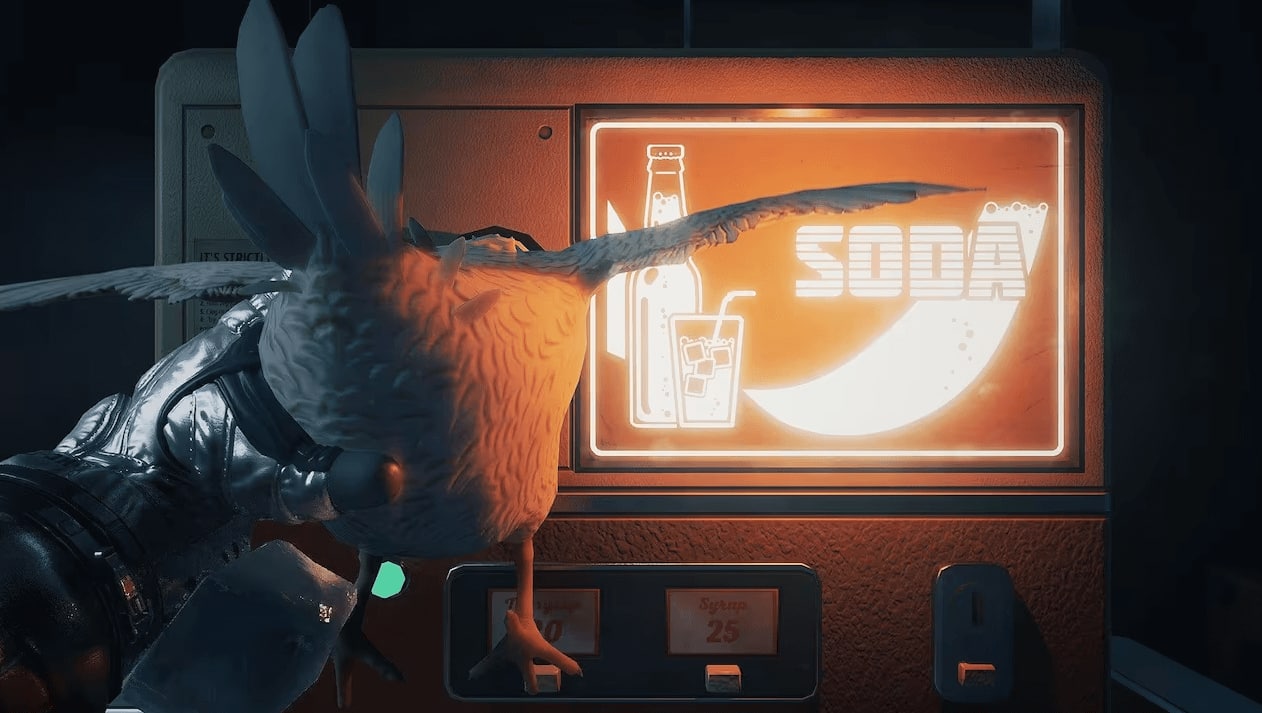
When it comes to being peculiar in space, it’s important not to forget Breathedge. Take the weirdness of Nibiru, set it in the floating looseness of Remains, but add the exploration of Osiris, and you’re on the way to Breathedge. Or, more briefly: Subnautica in space, but with chickens. “Try not to urinate on electrical items or bare wires, and also in the game,” reads one of its loading tips. Its humor is—well—broad, but the game is top-notch survival fun. In the year 2073, somewhere on the outskirts of the universe, our “hero” is out delivering coffins when his ship explodes (see, it’s almost guaranteed), and now he needs to try not to be dead for as long as possible.
Breathedge’s twist on the format, aside from a disturbing interest in chickens and carrots, is the way it limits oxygen supply. At first, you can barely make it for 75 seconds out of the surviving capsule which you’ll initially call home, hugely restricting how far you can travel. In this, the game takes on a sort of Metroidvania approach, with the distance you can travel increasing incrementally as you complete missions that reward you by improving your O2 supply. The better it gets, the greater the radius you can explore, and the more the game opens up around you. You’re never not worrying about breathing, since each improvement means you’re travelling farther from safety, but it increases your abilities and techniques at a fair pace. This ensures that you’re always pushing to explore further to reach the next mystery.
 For a more intense variation on the theme, there’s Occupy Mars, which sets up its stall with its first loading tip, telling you how it's easier to solder circuit boards from underneath than above. With this one line, you’re immediately aware that this is going to be a much more detail-oriented version of surviving life off-Earth. While early access Occupy Mars doesn’t begin in literal disaster, you’re in no less danger. From the moment you land on the planet, you’re informed about just how many variables in your HUD could lead to your rapid demise. Hunger, thirst, injury, radiation, sleep deprivation, weather events—it's a daunting list. Thankfully, you’re not alone on Mars, and while this is ultimately a sandbox survival and colonization game, there’s an extensive tutorial to introduce you to the game’s squillions of systems.
As an electrical engineer, you’re involved in all parts of the Mars base, from fiddling around in the greenhouse to grow better tomatoes to building a new solar array that produces more power for the base. Even in ideal conditions, death is lurking around every corner—as you'll soon learn.
 Occupy Mars may well remind you of Surviving Mars, not just because of the similar names, but because the latter is a colony development sim, albeit with a much more strategic approach. Published by strategy gurus Paradox, this is a whole other kind of survival: a city builder with all the aspects you’d expect from such a genre, but with the rather significant kicker that your entire colony could die at any moment should anything go spectacularly wrong.
The whole theme of Occupy Mars is that Mars is really not an appropriate planet for humans to try to live on. It’s just that it’s the only one near enough to us that we can realistically land on with feasible technology without immediately melting or exploding. There’s no air, there’s no water, there’s no food—these are all things humans are pretty fond of. Allowing people to survive on Mars is no mean feat, and this is a game that allows you to achieve that by building a flourishing city. But even when you have the city running like clockwork—drones dashing about cleaning and repairing, humans merrily arriving and settling down—it can fall apart with alarming rapidity, which can lead to some dreadful death tolls.
Occupy Mars came out five years ago, and since then the same developers have created another game that combines survival and strategy called Stranded: Alien Dawn. This is a far more intimate affair about keeping a much smaller group of survivors alive on a much more hospitable alien planet. This has the effect of feeling even more like a survival sim, even though you’re playing from the isometric view of a classic strategy game, issuing instructions to the trio of survivors as if they’re units. A superb tutorial walks you through the hands-on approach you'll take with each character, taking care to demonstrate how each has their own backstory, motivations, and set of skills.
From then on, it’s about managing calamities while simultaneously maintaining the physical and emotional well-being of your gang. The latter is an aspect all too often missing from off-world survival games, yet it's often prominently featured in their Earth-based counterparts. (Think about how many "earthly" games have sanity meters, or fear as a condition that needs to be balanced.) It’s great to see a slightly more human representation of our stranded survivors.
Space: the second dimension
As we skip merrily through the spacefields of off-world survival, you’ll note that the games are getting busier: more people, less isolation, with just as much likely to go wrong. This brings us to Oxygen Not Included. Developed by Klei, who previously had us survive more mundane situations—like Earth’s wilderness in Don’t Starve—this is yet another colony sim where everything can come crashing down around you any moment. (Or after a longer moment if you opt for the No Sweat mode.)
Despite being a side-on 2D cartoon game, it begins surprisingly similarly to Occupy Mars. You start with three characters who each have unique traits and skills, which you can reroll if you so choose. Once again, you have an strategy-like UI that allows you to issue orders to each of them while you attempt to ensure that everything is functioning and hopefully not about to kill everyone in the place.
Oxygen Not Included gets astoundingly intricate in terms of what you’re looking after: From plumbing the base’s pipe network to monitoring carbon dioxide levels, to ensuring everyone’s mental health is looked after through entertainment and rest. And that’s before you start adding in any of the huge number of DLCs—all of which inevitably end in suffocation. But you can always start again!
 Having reached the 2D portion of our tour, that takes us to one of the all-time classics of space survival, FTL. Once again, we have a small crew, a very precarious spaceship, and a lot of galaxy to explore. But this time failure is even more inevitable, and the game’s roguelite tendencies match failure with a desperate urge to start over and do better the next time.
In FTL, things are far simpler than in the strategic examples above, and yet no easier for it. It’s a game about risk management: Deciding whether you want to throw yourself into the next pirate encounter, or play it safe and try to make it to a space-store where you can resupply in a more legitimate fashion. Then suddenly you’re boarded and you need to defend yourself from within, and you find yourself putting out fires without accidentally putting out your crew and cursing your earlier decision not to improve your defenses in favor of better engines.
Released in 2012, FTL was a game that really pushed the roguelite genre to the forefront of the last decade of gaming. Over ten years later, it remains just as compelling, and most of all, it's moreish. We might not get to know our crew as well as in most other games mentioned in this piece, but in FTL you craft a deep relationship with your ship. Since it's upgradeable, you can invest huge amounts into perfecting the vessel that you use to explore, which makes it all the more of a gut-punch when you lose it all forever.
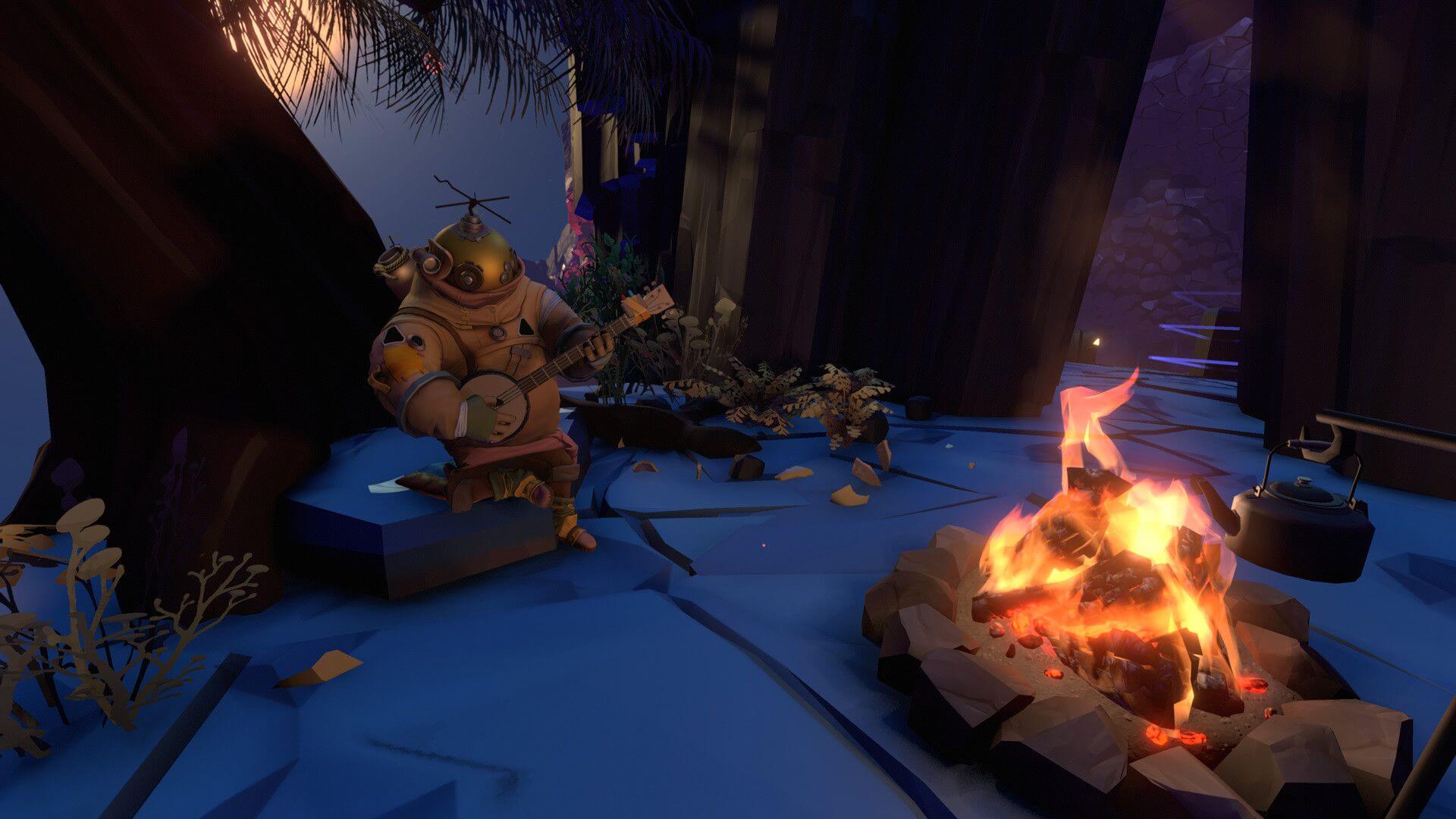 That brings us, naturally, to Outer Wilds. Not to be confused with Obsidian’s RPG The Outer Worlds—confusingly released in the same year—Outer Wilds takes the roguelite concept of survival to a whole other place by sticking you in a 22 minute time-loop. This Spacehog Day reset means you need to set out every loop with key actions in mind as you try to uncover the many mysteries of an extinct race called the Nomai.
Knowledge can be retained between loops, which is a very splendid way of acknowledging that you, the player, are not being routinely hit over the head with coconut between every turn. This gives the game a sense of continuous progress, unlike FTL’s agonizing (but brilliant) resets. However, in case you think we’ve drifted too far from the original remit of Mark Watney’s holy path, Outer Wilds still has you worrying about health, fuel and oxygen. Because, in the end, this is still space.
Gimme shelter
We’ve covered an enormous breadth of game types here, from first-person craft-me-dos to top-down real-time strategy to roguelite arcade, but they all have the same central premise: to survive the desert of space. It comes down to whether we can access oxygen and maintain our health in such extreme circumstances, no matter the genre or the twists. But what is it about this genre that’s so interesting to both developers and players?
It could be that games have always tended toward managing certain meters. Whether it’s a health bar or a high score, so much of gaming comes down to trying to keep those meters full, and surviving in space leans right into that. Limited provisions and a desire to last as long as we can—that's the nut of the spacefaring genre. Heck, based on this simplification, we could argue for Space Invaders as the first off-world survival sim!
But there’s also something deeper going on as well. Life can be scary, if for no other reason that one day it will end. We are all surviving, in all we do. We have our own hunger, thirst and health meters that we have to maintain, along with others for money, shelter, sanity, and so much more. And so often, it’s so hard to feel in control, with so many factors beyond our reach taking great chunks out of each of them almost at random. So when it comes to a survival game, though we may often fail, we have a much greater sense of control over our own fate.
Survival games simplify those meters and reduce the scale of what we need to manage. Even when they’re deliberately so hard that it seems like we’re destined to fail, we get another go. We can learn from failure, make incremental improvements, and—despite the ethos of the genre—never really die.
Further, within all this, survival games offer us the ability to create safety. As we float in space—the most blatant analogy for feeling unmoored or drifting in life—we’re provided with everything we need to create security. If we focus, stay safe, and gather enough resources, we can eventually build our sanctuary, a sheltered cave where the space-tigers can’t reach us. There’s something that's psychologically reassuring about this process that allows us to impose control on chaos, if only within the confines of a particular game.
In the end, we’d all love to be Mark Watney. Perhaps not stranded on the surface of Mars with no hope of rescue for hundreds of days, of course, but we'd love to have the skillset and imagination that allows him to so elegantly make do and mend. In space survival, we are allowed those moments—whether it’s helping an entire colony survive impending disaster, or simply building a temporary plastic roof over our lone character's head.