Hírek
To live and die in the shadows: an interview with the minds behind The Siege and the Sandfox
J
Jerry Bonner
The Siege and the Sandfox is one of the most impressive puzzle-platformers of the last few years, a virtually seamless amalgamation of what makes games of this ilk truly sing. Its controls are precise; its world is vast, unique, and evocatively Middle Eastern; its myriad puzzles and jumps are challenging but never too challenging; and, best of all, it makes you think so much that you have a hard time putting it down because there just has to be a better way to conquer a room, biome, or puzzle.
After spending a good chunk of time with this “stealthvania,” I needed to know more about this sublime game’s creation—and the mind behind it. Luckily, Cardboard Sword’s CEO Olly Bennett had the time to answer several of my burning questions.
This interview has been edited for length.
EGS: The Siege and the Sandfox evokes the spirit of classic titles like Prince of Persia. Beyond that, what were some of the other major influences?
Olly Bennett: Definitely the original Thief games and Mark of the Ninja were core inspirations. Shadow Complex had some stealth elements in a 2D space that were useful reference points. Visually, we took cues from Sunsoft’s Batman on the NES… specifically how it used black space and subtle edge lighting. Dead Cells inspired us to embrace normal mapping, which was a huge technical undertaking, but ultimately worth it. Metal Slug informed our detailed pixel art and bounce-style animations, and Monkey Island even influenced some of our NPC designs.
You combine stealth, parkour, and Metroidvania structure. How did that genre fusion come together?
Stealth and parkour naturally complement one another. Look at the Batman: Arkham series, Splinter Cell, or Assassin’s Creed: Sneaky traversal is at the heart of those games. We were already planning a 2D platformer, and Mark of the Ninja made us want to explore stealth in that space. Stealth in 2D is tricky; verticality becomes critical both for gameplay tension and spatial variety. The Metroidvania format allowed us to create interconnected spaces that reinforced stealth as a puzzle… encouraging exploration and problem-solving rather than direct confrontation.
You emphasized a non-lethal, puzzle-like approach to stealth. What was the philosophy behind that?
From the start, we didn’t want a protagonist who left a trail of bodies. The Sandfox has a mission, and maybe a few “means-to-an-end” moments, but their strength lies in evasion. You can’t fall back on combat like in Metal Gear or Mark of the Ninja. That disempowerment forces the player to engage with the level as a problem to solve: Where’s the entry point, the goal, and how do you move through the in-between? Success becomes much more satisfying when it's earned through planning and precision, not brute force.
The way Sandfox becomes a silhouette in the shadows is clever and subtle. How did that system come about?
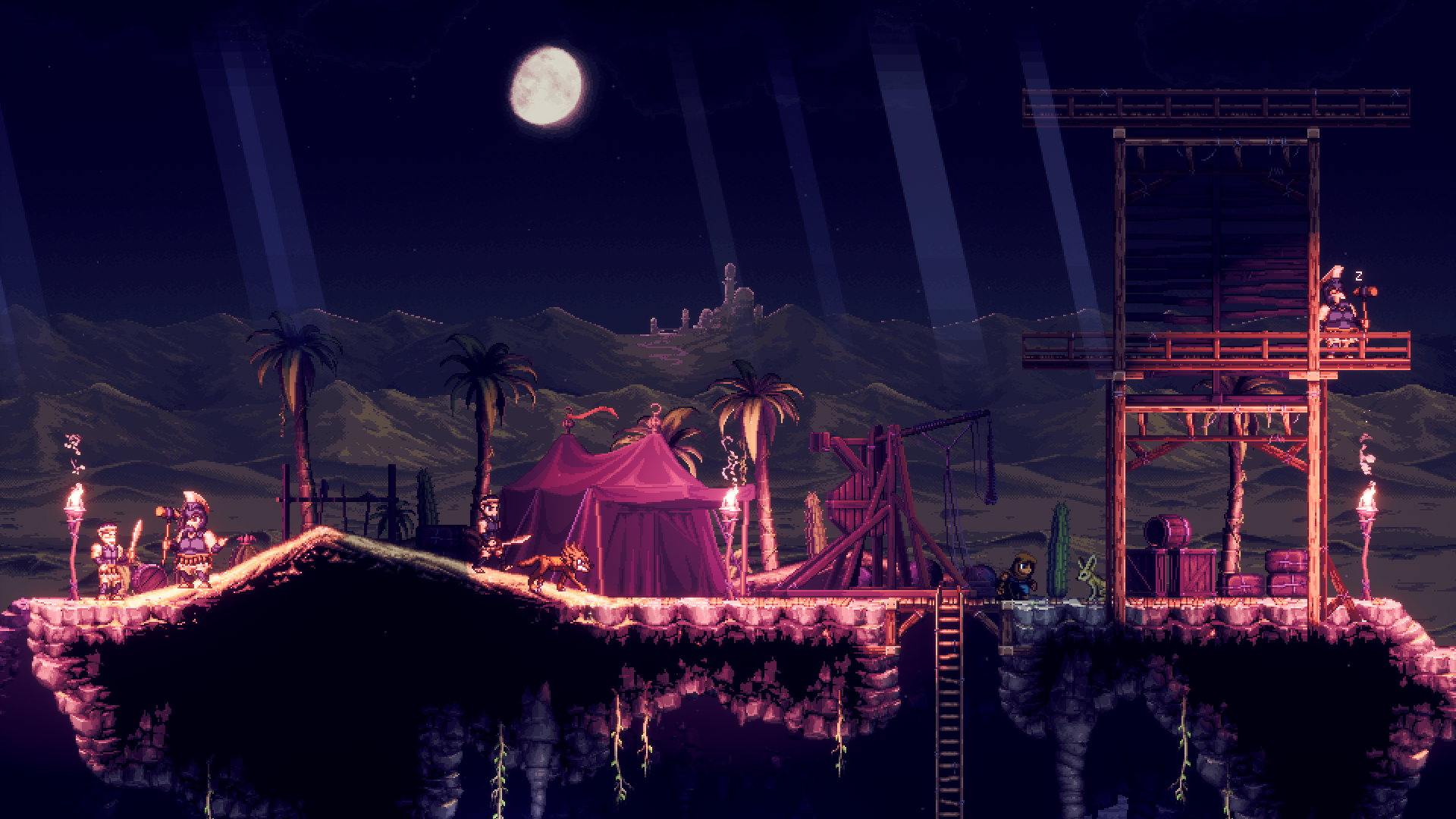
We really wanted to avoid cluttering the UI. A clean screen lets the art breathe and helps immersion. We used three main indicators: color shifts for lighting, sound rings to convey the reach of player-made noise, and an audio-assist ring that shows incoming sound. The shadow recoloring used to be subtler, but it needed to be more distinct for clarity. We took inspiration from games like Aragami… but our version is what we call the “Moon Knight effect,” making the Sandfox more silhouette-like when hidden. That change improved readability without breaking immersion.
Movement feels deliberately weighted, yet fluid. What influenced your approach to traversal?
We wanted to blend the animation richness of rotoscoped classics like Prince of Persia and Flashback with the responsiveness of Sands of Time. That meant a lot of hand-drawn blends, input queuing, and animation canceling to keep things tight without feeling stiff. Because combat isn’t a core element, we didn’t need fast, twitchy movement. Instead, we wanted parkour to feel grounded… like real muscles were moving the body. Once players master it, they can perform intricate sequences that feel like true accomplishments, turning stealth into a rhythmic dance.
Level design clearly reinforces mechanics like stealth and parkour. How did you make that feel organic?
We try to introduce new mechanics in clusters of three tutorials, then reinforce them through repetition and integration. That became tricky in an interconnected world where players can reach areas out of order. We tested features in isolated levels first, then translated that learning into the main world. Fortunately, our art team helped every area feel cohesive, even when repurposing existing assets. We also blurred biome boundaries, merging tilesets where regions met to create smoother transitions and maximize variety.
Each biome feels distinct, not just in looks but in tone and mechanics. How did you build that variety?
Each major area needed a unique challenge or AI behavior that made sense thematically. For example, the Iron Hold prisons have screaming inmates that affect stealth. Art and design worked closely to ensure theming matched gameplay both at the micro and macro levels. We wanted the world to feel authentic and historically layered. Our Metron music system helps reinforce this by adapting the score to what’s happening around you, while narration from Amelia Tyler (who also voiced the narrator in Baldur’s Gate III) adds a storybook tone and lets us emphasize key motifs directly.
Let’s talk audio and visuals. How did those teams collaborate to achieve such cohesion?
Our aesthetic actually predates the game. It started as a side project by our two artists. The assets were so compelling that we built the game around them. Art led theming, and audio followed, focusing on atmospheric, diegetic sounds. We put a lot of work into environmental reverb, wind FX, and scene dressing. Brendan O’Callaghan Ratliff, our Audio Director, also performed most of the score live using instruments like guitar, violin, bouzouki, low D whistle, mbira, and bodhrán. The Metron system allowed the music to respond dynamically to gameplay, meaning that tension, suspicion, enemy proximity are all linked in real time.
The Queen makes for a memorable antagonist. How did you approach her character?
The narrative was written by Talespinners, primarily Cash DeCuir (Disco Elysium), based on a story concept from Ian Thomas. We drew from [One Thousand and One Nights] to craft a regal, dramatic tone, and leaned into the “dark queen” archetype. She’s smug, calculating, and clearly the architect of your downfall. That alone gives players motivation, but her ties to the protagonist run deeper… though we’ll leave that for players to discover. The broader world, from the Kasha’i culture to the desert’s denizens, grew as we layered the story around her.
Players have noted some bugs and odd AI behavior. What were the biggest challenges in that department?
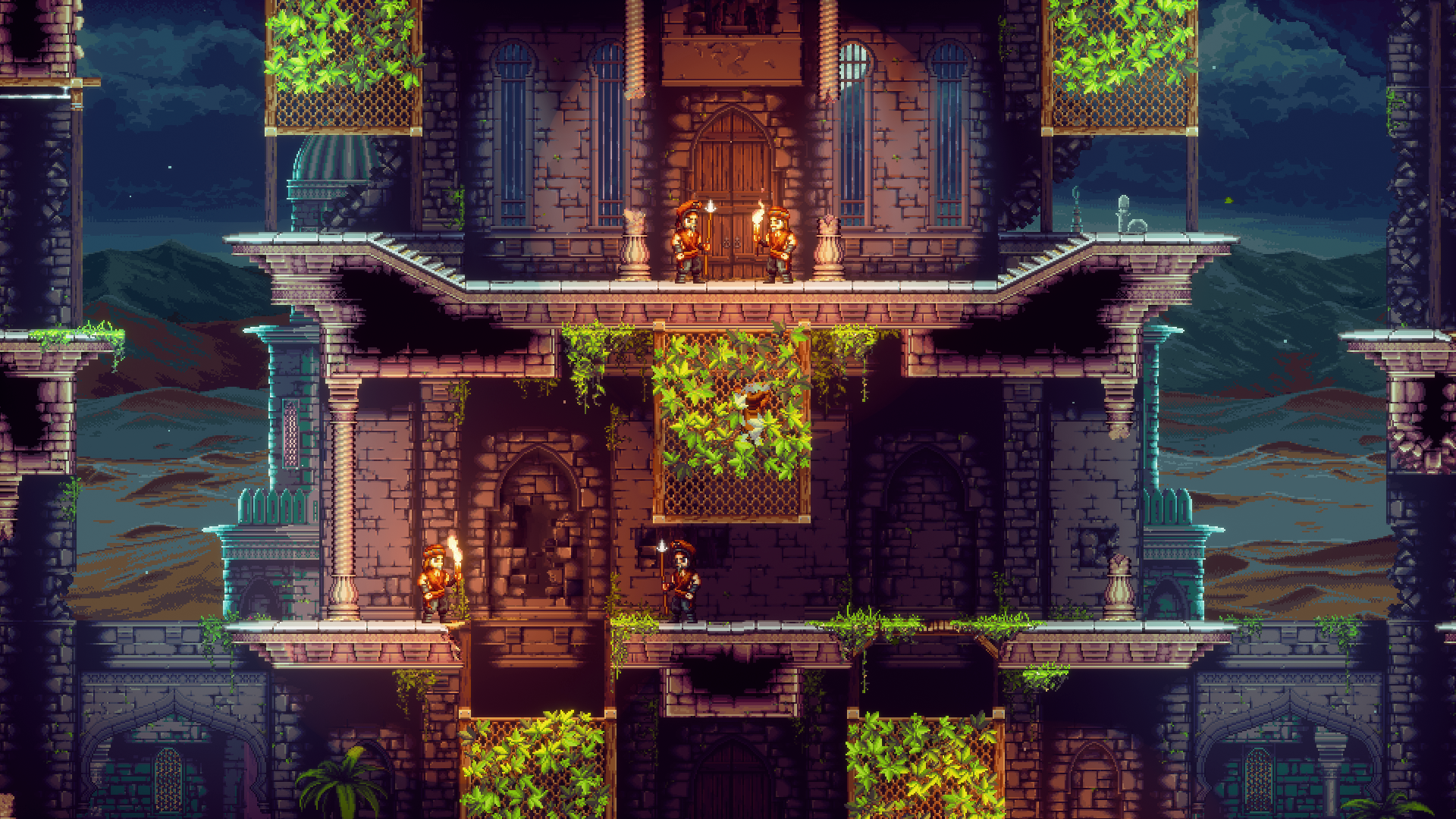
AI was probably the hardest system. We built our own A* navigation and avoided behavior trees due to performance issues. Instead, we used a priority list system similar to Half-Life, where each AI state has specific allowable behaviors. Early on, that system lacked nuance, so we overhauled it to let guards act more realistically: investigating lights going out, returning to patrols, reacting differently when in groups, etc. Of course, this led to some amusing bugs… like rats accidentally getting guard “brains” and investigating the player, or dogs assigned to NPC dialogue trees. We called them “Detective Rats” and they were hilarious… unintentionally.
What Unreal Engine features, or tools you developed, were essential to bringing the game to life?
We used Unreal’s Paper2D, but had to customize it heavily. The PaperZD plugin by Critical Failure was essential, and we collaborated with its creator, who even joined our team as a contract coder. We improved the tilemap editor, added features for better occlusion control, and developed a custom camera system to maintain cinematic framing. Our in-house Metron audio tool acts like a full DAW inside Unreal, handling dynamic score elements with beat-synced FM and Karplus-Strong synthesis. It was critical for real-time audio responsiveness and player feedback.
Your team has decades of combined AAA experience. How did that background shape the final product?
That experience really shows in the details. We knew the value of doing things the hard way when it mattered. For example, hand-painted normal mapping took months, but added a richness to the visuals we couldn’t get with automation. The same goes for the animation polish, audio fidelity, and interconnected level design. Even with the technical challenges we’re still refining, there’s a clear exhibition of craft across the game… and we hope to show even more of that in our future projects.
Thanks for answering our questions, Olly. Grab The Siege and the Sandfox right now on Epic Games Store.